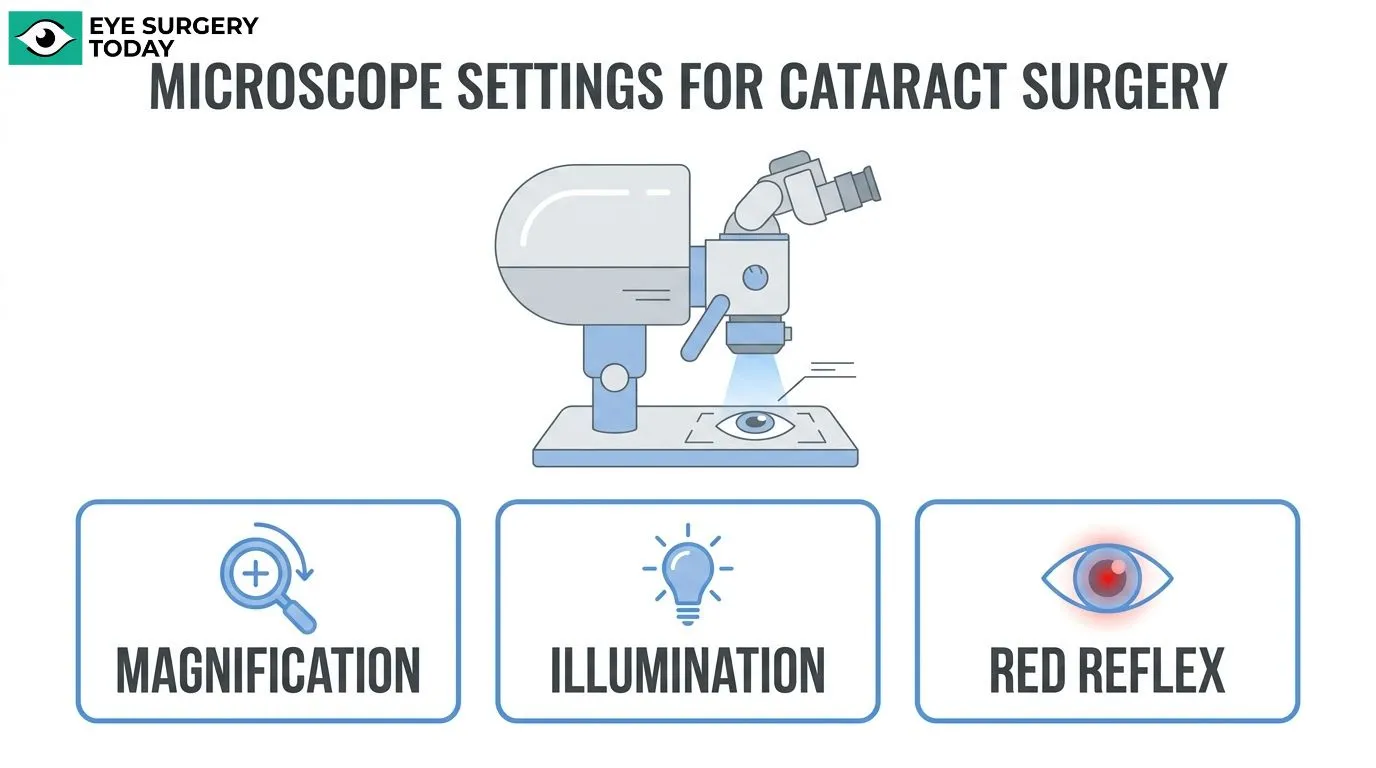
Microscope settings for cataract surgery are the adjustable parameters on an ophthalmic operating microscope, including magnification, illumination intensity, working distance, coaxial alignment, and zoom calibration, that surgeons configure to optimize visualization of delicate ocular structures during each phase of the procedure.
This guide covers the role of each core setting and how it may affect surgical precision, phase-by-phase adjustments from corneal incision through IOL implantation, coaxial illumination and red reflex optimization, technique-specific differences across phacoemulsification, femtosecond laser-assisted, and extracapsular methods, and the 2026 advances in digital and 3D visualization systems.
Each core setting serves a distinct function. Magnification typically ranges from 6x to 12x and shifts dynamically as the surgeon moves between orientation steps and fine maneuvers like capsulorhexis. Illumination intensity is kept at the minimum effective level because operating microscope light is a recognized risk factor associated with retinal phototoxicity, even during short procedures. Working distance, slit width, and pupil diameter configuration all contribute to contrast, depth perception, and red reflex stability.
Settings do not remain static throughout surgery. Surgeons recalibrate magnification, illumination, and focus at each phase; capsulorhexis demands the most attentive coaxial alignment for red reflex clarity, while phacoemulsification requires the most frequent adjustments as the anterior chamber changes rapidly during nuclear disassembly.
Technique choice also shapes microscope configuration. Phacoemulsification uses moderate-to-high magnification through small incisions, femtosecond laser-assisted surgery may reduce total microscope exposure time, and extracapsular extraction requires lower zoom with broader illumination across a larger wound.
Modern platforms like the ZEISS ARTEVO 800 and Alcon Ngenuity now offer hybrid digital-analog viewing and 3D heads-up displays that may help reduce phototoxicity risk while giving the entire surgical team shared real-time visibility of the operative field.
Why Do Microscope Settings Matter During Cataract Surgery?
Microscope settings matter during cataract surgery because they directly control visualization quality, surgical precision, and retinal safety. The subsections below cover how these settings enable high-precision work and why improper light exposure poses real risks.
Ophthalmic surgical microscopes provide the magnified, high-contrast view surgeons rely on to navigate structures measured in millimeters. Each adjustable parameter, from illumination intensity to magnification level, influences how clearly the surgeon can distinguish tissue boundaries, lens fragments, and the capsular bag throughout the procedure.
Precision visualization is not optional during cataract surgery. Surgical microscopes like the ZEISS OPMI LUMERA 700 are utilized for high-precision visualization during bilateral cataract surgery involving specialized laser techniques like CAPSULaser, according to a case report published in the American Journal of Ophthalmology Case Reports. When settings are poorly calibrated, even experienced surgeons lose the visual detail needed to perform capsulorhexis accurately or identify subtle complications as they develop.
Light exposure represents the most significant safety concern tied to microscope settings. Retinal phototoxicity can occur during cataract surgery even with short operation durations, with operating microscope light being a primary associated risk factor. This reality makes illumination management a patient safety issue, not merely a preference. Modern systems address this concern through engineered solutions; the LuxOR Revalia microscope, for example, features a red reflex zone designed to expand the illumination field while minimizing phototoxicity risk through safer retroillumination.
For these reasons, microscope settings function as both a precision tool and a protective measure. Properly configured optics help the surgeon work efficiently, while carefully managed light output may help reduce the cumulative photochemical stress on retinal tissue. Understanding how each setting contributes to surgical outcomes gives patients a clearer picture of the technology behind their procedure.
What Type of Microscope Is Used for Cataract Surgery?
The type of microscope used for cataract surgery is a specialized ophthalmic operating microscope. These instruments differ significantly from standard laboratory microscopes in design, illumination, and optical capability.
An ophthalmic operating microscope is a high-powered surgical visualization system engineered specifically for procedures on the human eye. Unlike benchtop research microscopes, which examine specimens on slides, the operating microscope is mounted on a counterbalanced stand or ceiling arm, positioned above the patient’s face, and designed to provide a magnified, stereoscopic view of living ocular tissue during active surgery.
Several features distinguish ophthalmic surgical microscopes from other microscope types:
- Coaxial illumination delivers light along the same optical path as the viewing axis, producing the red reflex critical for visualizing the lens capsule.
- Variable magnification allows surgeons to zoom between low and high power without interrupting the procedure.
- Extended working distance provides adequate clearance between the objective lens and the patient’s eye, typically ranging from 175 mm to 200 mm.
- Stereoscopic optics create a three-dimensional view, giving surgeons precise depth perception within the anterior chamber.
- Motorized or foot-pedal controls enable hands-free adjustments to focus, zoom, and XY positioning while the surgeon maintains instrument contact.
According to the textbook Cataract Surgery (Garg & Koch, 2022), standards for classifying and grading cataract types rely on six standard images to ensure consistent visualization under the operating microscope. This level of standardized imaging would be impossible with general-purpose microscopes lacking the refined coaxial light paths and calibrated optics that ophthalmic models provide.
Major manufacturers in this space include ZEISS, Alcon, and Leica, each offering platforms with distinct illumination architectures and digital integration capabilities. The choice of microscope often depends on the surgical technique being performed, the institution’s technology infrastructure, and the surgeon’s preference for optical versus digital viewing.
For patients wondering about the equipment involved, understanding that cataract surgery requires a purpose-built ophthalmic operating microscope can help contextualize the precision and safety built into every step of the procedure.
What Are the Key Microscope Settings Adjusted for Cataract Surgery?
The key microscope settings adjusted for cataract surgery include magnification, illumination intensity, slit width, working distance, zoom and focus calibration, and pupil diameter configuration for red reflex optimization.
What Magnification Level Is Used for Cataract Surgery?
The magnification level used for cataract surgery typically ranges from 6x to 12x, depending on the surgical phase. Lower magnification provides a wider field of view for orientation and incision steps, while higher magnification supports precise maneuvers like capsulorhexis and lens fragment removal. According to Garg and Koch in Cataract Surgery (2022), consistent visualization under the operating microscope relies on standardized imaging to ensure accurate assessment of surgical landmarks. Most surgeons adjust magnification dynamically throughout the procedure rather than locking in a single setting. Selecting the right magnification for each phase reduces the likelihood of tissue misjudgment, making it one of the most frequently adjusted parameters on the microscope console.
What Illumination Intensity Is Recommended for Cataract Surgery?
The illumination intensity recommended for cataract surgery should be the minimum level that maintains clear visualization of intraocular structures. Excessive light exposure from the operating microscope is a recognized risk factor for retinal phototoxicity, which can occur even during short procedures. Surgeons typically start at moderate intensity and increase only when deeper tissue layers require enhanced contrast, such as during cortex removal. Reducing illumination during pauses or instrument exchanges further limits cumulative light exposure. Balancing brightness against phototoxic risk is one of the most consequential decisions a surgeon makes when configuring the microscope, particularly for patients with prolonged surgical times or dense cataracts.
How Is the Slit Width Adjusted During Cataract Surgery?
The slit width is adjusted during cataract surgery to control the band of light projected onto ocular structures, enhancing depth perception and tissue contrast. A narrow slit beam helps surgeons evaluate the anterior chamber depth and detect subtle capsule tears or corneal irregularities. Wider slit settings illuminate a broader surgical field, which can be useful during lens fragment management. Most microscopes allow stepless adjustment so surgeons can fine-tune the slit width without interrupting the procedure. Choosing the appropriate width for each phase improves the surgeon’s ability to distinguish between tissue planes, a factor that becomes especially important during cortical cleanup.
What Working Distance Do Surgeons Set for Cataract Surgery?
The working distance surgeons set for cataract surgery generally falls between 175 mm and 200 mm, measured from the objective lens to the patient’s eye. This range provides enough clearance for instrument maneuverability while keeping the surgical field in sharp focus. According to the European Society of Cataract and Refractive Surgeons (ESCRS), evidence-based guidelines support standardized surgical setups that promote both optical precision and procedural safety. A working distance that is too short restricts hand movement, while one that is too long may reduce image resolution. Proper adjustment also supports better ergonomic posture, helping reduce musculoskeletal strain over long operating sessions.
How Are Zoom and Focus Calibrated for Cataract Surgery?
Zoom and focus are calibrated for cataract surgery through a combination of parfocal lens alignment and intraoperative fine-tuning, ensuring the image remains sharp across magnification changes. Parfocal systems maintain focus when the surgeon adjusts zoom, eliminating the need for manual refocusing at each step. Before surgery begins, calibration protocols verify that the optical axis is aligned with the patient’s pupil. During the procedure, foot pedal controls allow seamless zoom transitions without removing hands from the instruments. In practice, surgeons who establish precise calibration before the first incision spend less time making mid-surgery corrections, which can meaningfully reduce total operating time.
What Pupil Diameter Setting Optimizes the Red Reflex?
The pupil diameter setting that optimizes the red reflex aligns the microscope’s coaxial illumination aperture with the patient’s dilated pupil, typically 6 mm to 8 mm in diameter. A well-matched aperture ensures that light passes through the pupil, reflects off the retina, and returns through the microscope to produce a uniform orange-red glow behind the lens. If the illumination field is too narrow, the reflex appears dim or incomplete; if too wide, scattered light reduces contrast. Proper red reflex visualization is essential during capsulorhexis, where the contrast between the capsule edge and the underlying reflex guides tear direction. Adjusting this setting early in the procedure establishes the visual baseline for every subsequent step.
With these core settings defined, understanding how each parameter shifts across individual surgical phases reveals the full scope of microscope optimization.
How Do Microscope Settings Change During Each Phase of Surgery?
Microscope settings change during each phase of surgery to match the specific visualization demands of each step. Coaxial illumination, magnification, and focus shift as the surgeon moves from incision through lens implantation. Understanding these settings is also critical when considering IOL exchange, a procedure where an existing intraocular lens is replaced.
What Settings Are Used During the Corneal Incision Phase?
The settings used during the corneal incision phase prioritize moderate magnification and broad illumination to give the surgeon a wide, well-lit view of the corneal surface. Clear corneal incisions typically measure between 2.0 and 3.0 mm, placed temporally or superiorly depending on surgeon preference and astigmatism considerations, according to the Royal College of Ophthalmologists. At this stage, zoom remains relatively low so the surgeon can orient spatially across the anterior segment. Illumination intensity is kept moderate to avoid unnecessary light exposure while still providing sufficient contrast at the incision site. Digital systems like the Ngenuity platform offer specialized detection modes, including “Tissue Detail Mode,” which can enhance corneal tissue visualization during this anterior segment phase. Surgeons generally keep the working distance consistent and avoid frequent focal adjustments, since the corneal plane remains stable throughout the incision.
What Settings Are Used During Capsulorhexis?
The settings used during capsulorhexis shift toward higher magnification and optimized coaxial illumination to maintain a clear, stable red reflex. Coaxial illumination systems in modern microscopes, such as the Leica Proveo 8 with CoAx4 illumination, provide a stable red reflex specifically during this phase, as reported by The Ophthalmologist. A strong red reflex is essential because it creates contrast between the transparent anterior capsule and the underlying lens, allowing the surgeon to track the tear edge in real time. Magnification increases compared to the incision phase so the surgeon can monitor the curvilinear path of the capsulotomy with precision. Illumination is carefully centered and balanced; too much intensity risks phototoxicity, while too little compromises capsule visibility. This phase demands the most attentive illumination calibration of the entire procedure, making it the stage where coaxial alignment matters most.
What Settings Are Used During Phacoemulsification?
The settings used during phacoemulsification are adjusted to optimize visualization of the anterior chamber and lens fragments during nuclear disassembly. Magnification typically increases to its highest level so the surgeon can distinguish between nuclear fragments, cortical material, and the posterior capsule. Illumination may be slightly reduced from capsulorhexis levels because the red reflex is less critical during active emulsification; instead, contrast within the anterior chamber becomes the priority. Focus adjustments occur more frequently during this phase as the phaco tip moves through different depths of the lens. Surgeons often narrow the slit or adjust oblique illumination to better visualize residual cortex against the capsular bag. This is the most dynamic phase for microscope manipulation, requiring continuous recalibration as the surgical field changes rapidly with each fragment removal.
What Settings Are Used During IOL Implantation?
The settings used during IOL implantation return to moderate magnification with centered coaxial illumination to confirm proper lens positioning. The surgeon needs a broad enough field of view to assess IOL centration relative to the capsular bag and pupil margins. Illumination is rebalanced to restore a functional red reflex, which helps verify that the optic is centered and free of tilt. Zoom may briefly increase when the surgeon checks haptic placement within the capsular fornix. Focus is adjusted to the plane of the IOL, which sits slightly posterior to the corneal plane used during incision. For many surgeons, this phase represents the most critical moment for confirming optical alignment, making illumination stability and magnification accuracy essential for a successful refractive outcome.
What Settings Are Used During Wound Closure and Final Check?
The settings used during wound closure and final check shift back to lower magnification and broad illumination for a comprehensive overview of the surgical site. The surgeon reduces zoom to assess the entire corneal surface, confirm wound integrity, and check for Seidel leakage at the incision margins. Illumination intensity may increase slightly to enhance contrast across the corneal stroma and ensure no residual viscoelastic or cortical material remains in the anterior chamber. Focus returns to the anterior corneal surface. This final phase also involves verifying IOL position one last time under stable viewing conditions. A methodical final check under consistent, well-calibrated microscope settings can help reduce the risk of missed complications before the procedure concludes.
With phase-specific adjustments covered, the role of coaxial illumination in shaping the surgical view deserves closer attention.
How Does Coaxial Illumination Affect the Surgical View?
Coaxial illumination affects the surgical view by producing the red reflex, which gives surgeons a backlit contrast of anterior eye structures during cataract surgery.
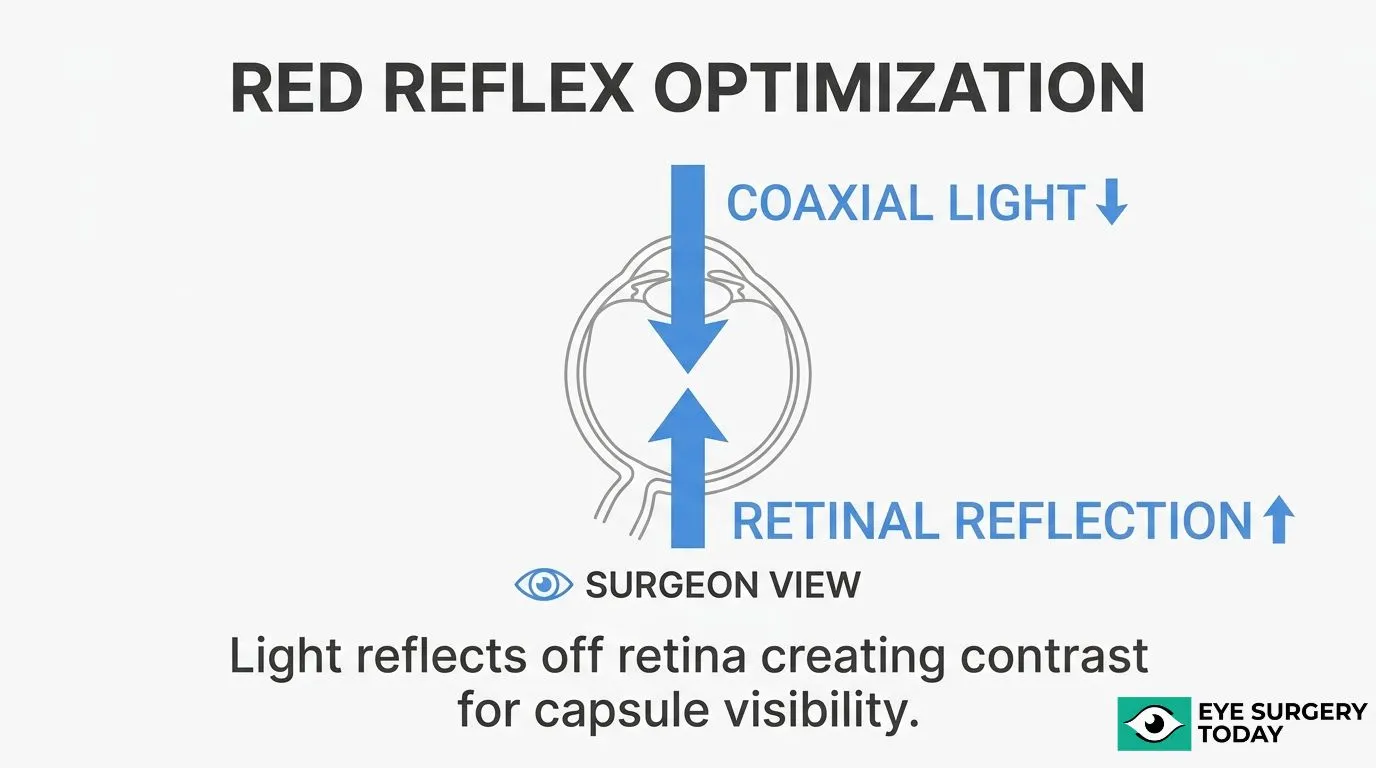
The red reflex is produced by reflection of coaxial light from the retina back to the observer through the surgical microscope. This retroillumination creates a bright, orange-red glow behind the lens, allowing the surgeon to see the capsule edge, cortical material, and lens fragments with high contrast. Without a stable coaxial light path, these translucent structures can become nearly invisible against the surrounding tissue.
Intensity and consistency of the red reflex vary based on the optical qualities of the microscope system, according to a report in Ophthalmology and Therapy. Pupil size, media clarity, and the alignment between the illumination source and the observation axis all influence reflex quality. Dense cataracts or small pupils may diminish the reflex, requiring the surgeon to increase illumination intensity or adjust the coaxial aperture to compensate.
Modern microscopes refine this principle further. Systems with dedicated coaxial illumination modules maintain a tighter alignment between the light path and viewing axis, producing a more uniform red reflex across the surgical field. This stability proves especially valuable during capsulorhexis, where the surgeon must track a nearly transparent capsular flap against the lens beneath it. For surgeons evaluating microscope platforms, the quality and adjustability of the coaxial illumination system deserves as much attention as magnification or resolution specs; it directly shapes intraoperative confidence during the most visualization-dependent steps.
Understanding how coaxial illumination generates the red reflex sets the stage for a closer look at optimizing that reflex through specific microscope settings.
What Is the Red Reflex and How Do Settings Enhance It?
The red reflex is the reddish-orange glow produced when coaxial light from the surgical microscope reflects off the patient’s retina and travels back through the pupil to the observer. Microscope settings enhance it by optimizing illumination alignment, intensity, and pupil diameter. According to a report in Ophthalmology and Therapy, the intensity and consistency of the red reflex vary based on the optical qualities of the microscope system.
Several settings work together to produce a strong, stable reflex during cataract surgery:
- Coaxial illumination alignment centers the light path so it enters and exits the pupil along the same axis, maximizing retinal reflection.
- Illumination intensity must be high enough to generate a visible reflex yet low enough to limit retinal phototoxicity risk.
- Pupil diameter setting on the microscope controls the aperture of the illumination beam, directly affecting how much of the reflex fills the surgical field.
- Magnification level influences perceived reflex brightness; lower magnification typically produces a brighter, more uniform glow.
- Zoom and focus calibration keep the reflex sharp and centered as the surgeon transitions between surgical phases.
A well-maintained red reflex is essential because it provides the contrast surgeons rely on to visualize the anterior capsule during capsulorhexis, identify lens fragments during phacoemulsification, and confirm IOL positioning. When the reflex dims or becomes uneven, it often signals a misaligned illumination path, an inappropriately narrow pupil aperture, or excessive magnification. Adjusting these parameters in real time restores visibility without requiring a pause in the procedure.
For surgeons working with modern platforms, dedicated reflex-enhancement features can simplify these adjustments considerably. Understanding how each setting contributes to reflex quality helps both surgical teams and informed patients appreciate the precision involved in cataract procedures.
How Do Microscope Settings Differ by Cataract Surgery Technique?
Microscope settings differ by cataract surgery technique based on incision size, magnification needs, and the level of automation involved. The subsections below cover phacoemulsification, femtosecond laser-assisted surgery, and extracapsular cataract extraction.
How Do Settings Differ for Phacoemulsification?
Settings for phacoemulsification differ primarily in magnification range and illumination adjustments made across its multiple micro-incision phases. Because clear corneal incisions typically measure between 2.0 and 3.0 mm, surgeons rely on moderate-to-high magnification with strong coaxial illumination to maintain a stable red reflex throughout nuclear disassembly.
Key setting considerations during phacoemulsification include:
- Magnification: Moderate zoom during incision and capsulorhexis, increased during nuclear fragmentation for finer detail.
- Illumination intensity: Kept at the minimum effective level to preserve the red reflex while limiting cumulative light exposure.
- Working distance: Maintained consistently to allow unobstructed instrument movement within the small incision.
- Focus recalibration: Required as the anterior chamber depth changes during lens fragment removal.
Phacoemulsification demands the most frequent intraoperative setting adjustments of any cataract technique, making familiarity with the microscope’s controls essential for efficiency.
How Do Settings Differ for Femtosecond Laser-Assisted Surgery?
Settings for femtosecond laser-assisted surgery differ because the laser performs key steps, such as capsulotomy and lens fragmentation, before the surgeon operates under the microscope. This two-stage workflow changes when and how microscope settings are applied.
During the laser phase, a separate imaging and docking system guides the femtosecond laser. The surgical microscope is not actively used at this point. Once the patient transfers to the microscope for the manual portion, the surgeon typically needs less aggressive magnification and shorter phacoemulsification time because the laser has already softened or pre-fragmented the nucleus. According to a 2023 study in the Journal of Cataract & Refractive Surgery, FLACS may require less cumulative dissipated energy than manual phacoemulsification in certain eye types, which can translate to reduced microscope exposure time during the ultrasound phase.
How Do Settings Differ for Extracapsular Cataract Extraction?
Settings for extracapsular cataract extraction (ECCE) differ because this technique uses a significantly larger incision, typically 10 to 12 mm, to remove the lens nucleus in one piece. The wider surgical field changes magnification, illumination, and working distance requirements compared to smaller-incision methods.
Key setting differences for ECCE include:
- Lower magnification: The larger incision and surgical field require a wider view, so surgeons generally operate at reduced zoom levels.
- Broader illumination field: A wider light cone helps visualize the entire wound and cortical material during manual extraction.
- Adjusted working distance: Surgeons may need slightly greater clearance to accommodate larger instruments.
- Extended light management: Because ECCE procedures often take longer than phacoemulsification, careful control of illumination intensity becomes important for reducing phototoxicity risk.
ECCE is less commonly performed today but remains relevant for very dense cataracts or in settings where phacoemulsification equipment is unavailable. Understanding these distinct microscope requirements helps surgeons adapt quickly when technique selection changes based on patient anatomy.
What Microscope Features Have Changed for 2026 Surgeries?
Microscope features that have changed for 2026 surgeries include hybrid digital-analog viewing, enhanced 3D displays, and integrated real-time imaging. The ZEISS ARTEVO 800 digital microscope features a hybrid mode allowing surgeons to switch between analog eyepiece viewing and a 55-inch 3D high-fidelity display, according to ZEISS Medical Technology. This flexibility lets the surgical team choose between traditional oculars for familiar tactile precision and a large-format screen that the entire operating room can view simultaneously.
Swept-source optical coherence tomography integration with surgical microscopes now provides 4D visualization capabilities, enabling real-time cross-sectional monitoring during each step of cataract surgery. These layered imaging tools give surgeons immediate feedback on tissue depth and lens positioning that was previously available only through separate diagnostic equipment.
For patients researching their upcoming procedure, these advances represent a shift toward greater surgical precision and safety. Understanding how your surgeon’s microscope technology compares to traditional systems can help frame a more informed conversation before surgery.
How Do Digital and 3D Visualization Systems Compare to Traditional Microscopes?
Digital and 3D visualization systems compare to traditional microscopes by delivering equivalent surgical outcomes through large-format screens, improved team visibility, and enhanced ergonomics. The key differences involve calibration demands, shared viewing, and workflow integration.
Traditional high-magnification surgical microscopes require intraoperative zoom lens calibration to maintain accuracy for surgical guidance systems, according to a 2023 study published in Computer Methods and Programs in Biomedicine. This calibration step adds a layer of technical overhead that digital platforms aim to simplify. Digital heads-up 3D visualization systems, such as the Alcon Ngenuity and ZEISS Artevo 800, project the surgical field onto large 3D displays rather than confining the view to binocular eyepieces. Research published in the Journal Français d’Ophtalmologie found these systems show comparable short-term anatomical and functional outcomes to conventional microscopes in both vitreoretinal and anterior segment surgery.
One of the most practical advantages of digital visualization is shared situational awareness. Digital visualization allows the entire OR team to see the same real-time image as the surgeon, empowering staff to anticipate surgical steps more effectively. With traditional eyepiece-based microscopes, only the primary surgeon and, at best, one assistant view the operative field directly. This limitation can slow communication during critical moments.
As Dr. Inder Paul Singh notes, “digital visualization will improve accuracy, efficiency, and workflow, as well as the overall experience of the patient, physician, and staff.” For surgeons performing high-volume cataract procedures, this workflow improvement is often underestimated; the cumulative time saved through better team coordination across a full surgical day can be substantial.
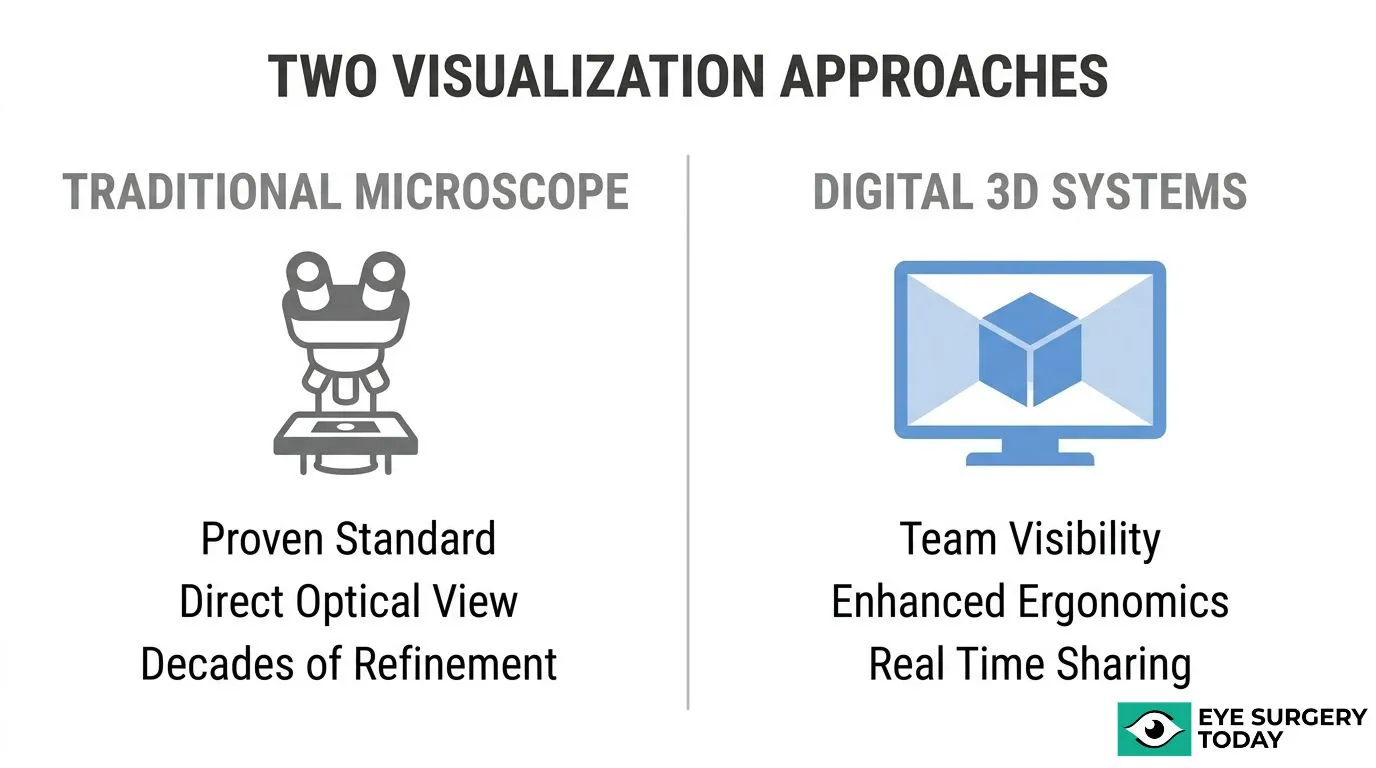
Neither platform is categorically superior. Traditional microscopes remain the proven standard with decades of refinement, while digital systems offer ergonomic and collaborative advantages that may reshape how surgical teams operate in the years ahead. Understanding both options helps patients have more informed conversations with their surgical team about the technology used during their procedure.
What Potential Risks Can Poor Microscope Settings Cause?
Poor microscope settings can cause risks ranging from retinal phototoxicity to compromised surgical precision during cataract surgery. These risks affect both patient safety and surgical outcomes.
Excessive illumination intensity is one of the most significant hazards. According to a study indexed in PubMed (National Library of Medicine), retinal phototoxicity can occur during cataract surgery even with short operation durations, with the operating microscope light identified as a primary associated risk factor. When brightness settings are not carefully managed, prolonged or intense light exposure may damage the retina before the surgeon completes the procedure.
Incorrect magnification or poor zoom calibration can also compromise accuracy. If the surgical view lacks sufficient detail, the surgeon may misjudge tissue boundaries during capsulorhexis or nuclear disassembly. Conversely, overly high magnification narrows the field of view, potentially causing the surgeon to lose spatial orientation within the anterior chamber.
Inadequate coaxial illumination alignment reduces red reflex quality, which can obscure the capsular edge and make delicate membrane work less predictable. Suboptimal working distance introduces additional strain, forcing awkward positioning that contributes to musculoskeletal problems over a surgeon’s career.
Key risks of poor microscope settings include:
- Retinal phototoxicity from excessive or prolonged light exposure.
- Inaccurate tissue assessment due to improper magnification levels.
- Loss of red reflex clarity from misaligned coaxial illumination.
- Reduced depth of field when focus or zoom calibration drifts during surgery.
- Surgeon fatigue and musculoskeletal strain from incorrect working distance.
Standardized protocols help mitigate these risks. Careful pre-surgical calibration, phase-specific setting adjustments, and adherence to evidence-based guidelines collectively reduce the likelihood of adverse events. For surgeons and patients alike, understanding that visualization quality directly influences outcomes reinforces why microscope configuration deserves the same attention as any other element of the surgical plan.
Who Decides the Microscope Settings During Cataract Surgery?
The microscope settings during cataract surgery are decided primarily by the operating surgeon, with support from trained ophthalmic staff. Responsibilities span preoperative setup, intraoperative adjustments, and adherence to standardized safety protocols.
The surgeon selects initial magnification, illumination intensity, and working distance based on the patient’s anatomy and the planned technique. Before the procedure begins, ophthalmic nurses or surgical technicians typically configure the microscope to the surgeon’s preferred baseline settings, ensuring the system is calibrated and positioned correctly.
Once surgery is underway, the surgeon makes real-time adjustments to zoom, focus, and light levels as each phase demands different visualization needs. During capsulorhexis, for example, coaxial illumination may be increased to enhance the red reflex, while phacoemulsification may call for changes in magnification to track lens fragments in the anterior chamber.
Standardized protocols also play a governing role. According to a study published in Anesthesia & Analgesia, adverse events in cataract surgery can be mitigated by following standardized protocols for patient identity, operative eye, and procedural steps under the operating microscope. These checklists ensure that microscope configuration aligns with institutional safety standards, not just individual preference.
In operating rooms equipped with digital visualization systems, the collaborative dynamic shifts further. The entire OR team can view the same real-time surgical image on a large display, allowing scrub nurses and assistants to anticipate instrument changes and verify settings without relying solely on the surgeon’s verbal direction. This shared visibility reduces communication errors and supports smoother procedural flow.
Ultimately, while the surgeon holds final authority over every microscope adjustment, modern cataract surgery distributes awareness across the surgical team through technology and protocol-driven workflows.
How Can Patients Ask Their Surgeon About Microscope Technology?
Patients can ask their surgeon about microscope technology by preparing specific questions before their preoperative consultation. The sections below cover how Eye Surgery Today supports patient education and the key takeaways about microscope settings for cataract surgery.
Can Eye Surgery Today Help You Understand Your Procedure?
Yes, Eye Surgery Today can help you understand your procedure. As a surgeon-reviewed education platform, Eye Surgery Today provides clear, unbiased guides that translate complex surgical concepts into accessible language. The platform covers cataract surgery fundamentals, advanced intraocular lens options, and the visualization technologies surgeons use during each phase of the operation.
Patients preparing for cataract surgery can explore educational articles that explain how microscope settings, illumination systems, and digital visualization tools contribute to surgical precision. This knowledge equips patients to have more informed conversations with their surgical team. Rather than relying on fragmented online searches, patients gain access to clinically accurate resources reviewed by nationally recognized ophthalmology experts.
Understanding what happens under the microscope during surgery may help reduce preoperative anxiety and build confidence in shared decision-making with your eye care provider. This includes discussing expectations for possible glasses use after surgery to ensure all post-operative needs are addressed.
What Are the Key Takeaways About Microscope Settings for Cataract Surgery?
The key takeaways about microscope settings for cataract surgery center on precision, safety, and evolving technology. Surgeons adjust magnification, illumination intensity, working distance, and coaxial light alignment at each surgical phase to maintain optimal visualization of delicate ocular structures.
According to a study indexed in PubMed Central, integration of swept-source optical coherence tomography (SS-OCT) with surgical microscopes now provides 4D visualization capabilities for real-time monitoring of cataract surgery steps.
Critical points to remember:
- Microscope settings change across phases, from corneal incision through IOL implantation and wound closure.
- Coaxial illumination produces the red reflex that guides capsulorhexis and phacoemulsification.
- Digital 3D visualization systems offer comparable outcomes to conventional microscopes while reducing phototoxicity risk.
- Standardized protocols for patient identity, operative eye verification, and procedural steps under the operating microscope may help mitigate adverse events.
- Surgeons, not automated systems, make final decisions on microscope configuration based on each patient’s anatomy.
Patients who understand these fundamentals are better positioned to ask meaningful questions and feel confident about their care.