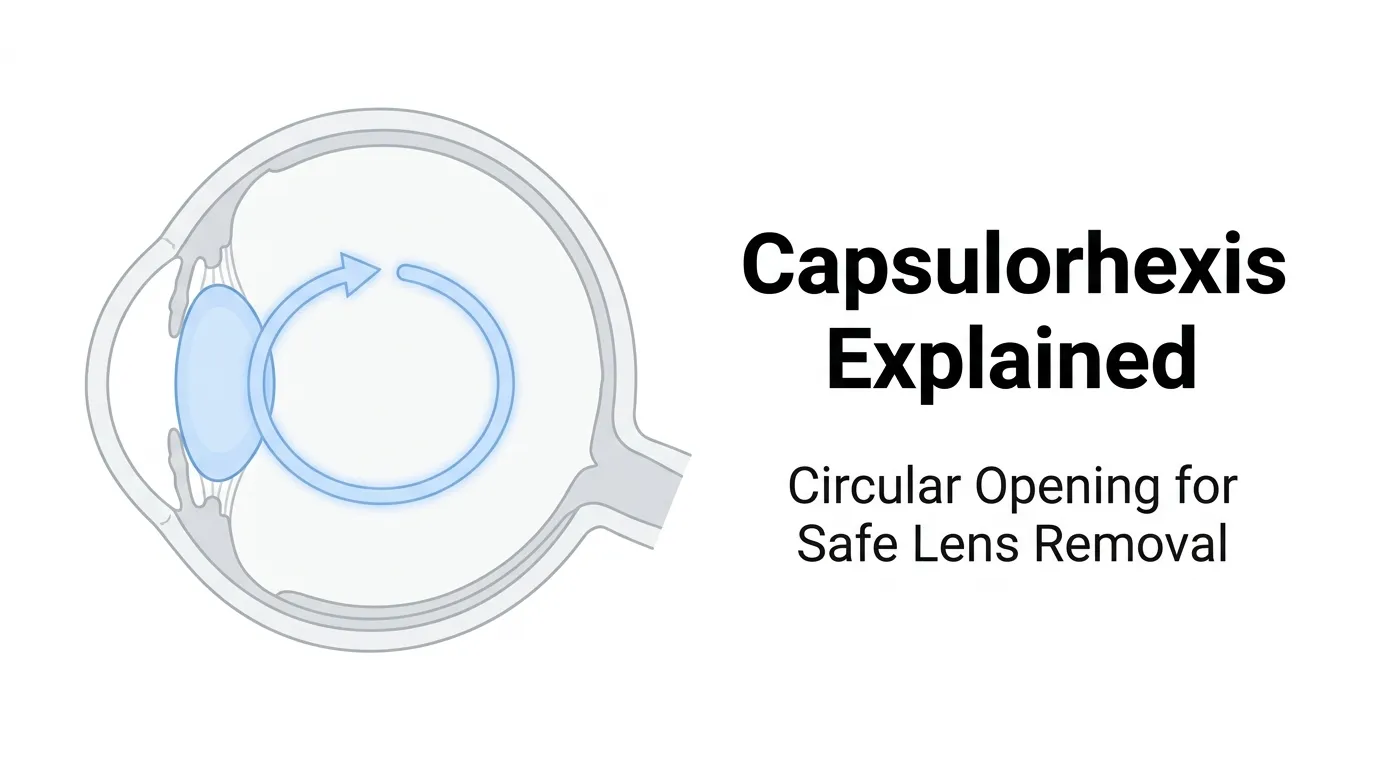
Capsulorhexis is a surgical technique used during cataract surgery to create a controlled circular opening in the anterior capsule of the lens, allowing safe removal of the cataract and precise placement of an artificial intraocular lens (IOL).
This guide covers how capsulorhexis is performed and why it is considered a foundational surgical step, the different technique types and how they compare, the role of the capsular opening in IOL positioning and long-term visual outcomes, potential complications and sizing considerations, candidacy factors and special populations that require modified approaches, and how the technique has evolved through AI-guided and robotic-assisted systems in 2026.
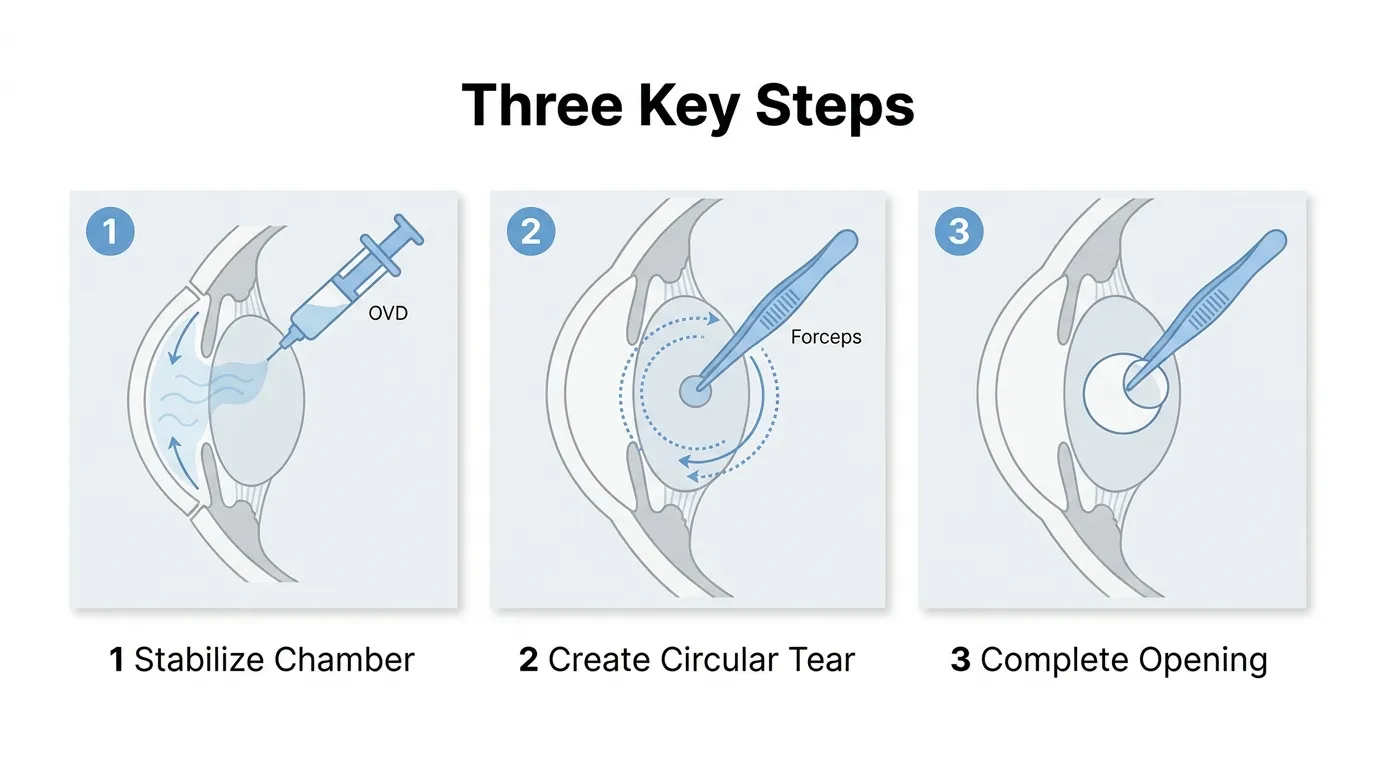
The procedure begins with stabilizing the anterior chamber using a viscoelastic device, followed by a controlled circular tear guided with specialized forceps or a cystotome. Surgeon skill, anterior chamber depth, and capsule characteristics all influence how predictably the tear progresses.
Several technique options are available, ranging from manual continuous curvilinear capsulorhexis (CCC) to femtosecond laser-assisted capsulotomy. Manual CCC remains the most widely practiced method because its continuous edge can stretch without propagating radial tears, while laser-assisted approaches offer geometric consistency that may benefit complex or premium lens cases.
A well-constructed capsulorhexis with 360-degree overlap on the IOL optic is associated with better lens centration and reduced risk of tilt, decentration, or refractive shift. Sizing errors in either direction, whether too small or too large, can compromise visual outcomes.
Patients with mature cataracts, weak zonules, or pediatric anatomy may require modified techniques, including posterior capsulorhexis to prevent secondary opacification. Recent AI-driven guidance systems trained on thousands of surgical videos have shown potential to improve the rate of ideal capsular openings significantly.
Why Is Capsulorhexis a Critical Step in Cataract Surgery?
Capsulorhexis is a critical step in cataract surgery because it establishes the structural foundation for every subsequent phase of the procedure, from lens removal to intraocular lens placement. A poorly executed opening can compromise the entire surgery, while a well-formed one enables safe phacoemulsification and long-term visual outcomes. The sections below explore how this step protects against complications, supports IOL stability, and influences refractive precision.
How Is Capsulorhexis Performed During Cataract Surgery?
Capsulorhexis is performed during cataract surgery by creating a controlled circular opening in the anterior capsule of the lens. The steps below cover the initial incision, the circular tearing technique, and the instruments involved.
What Happens During the Initial Incision of the Capsule?
The initial incision of the capsule begins after the surgeon stabilizes the anterior chamber of the eye. A cohesive ophthalmic viscosurgical device (OVD) is injected into the anterior chamber to maintain space and keep the capsule taut. According to a 2025 study published in Frontiers in Medicine, anterior chamber depth and the use of cohesive OVDs are critical factors in stabilizing the capsule during the rhexis procedure.
Once the chamber is pressurized, the surgeon uses a fine needle or cystotome to create a small central puncture in the anterior lens capsule. This initial nick serves as the starting point for the controlled tear. Proper OVD inflation at this stage can mean the difference between a smooth, predictable flap and an erratic tear, making it one of the most preparation-dependent moments in the entire procedure.
How Does the Surgeon Create a Circular Tear in the Capsule?
The surgeon creates a circular tear in the capsule by applying the “shear and tear” principle: one area of the capsule is held stationary while an adjacent section is pulled, guiding the tear along a controlled circular path. According to a review in Seminars in Ophthalmology, the manual continuous curvilinear capsulorhexis (CCC) technique involves using a cystotome to create an initial puncture and then using Utrata forceps to grasp the capsule flap and guide it in a smooth circular motion.
Throughout this process, the OVD keeps the anterior chamber stable, giving the surgeon consistent counter-pressure. The direction and speed of the pull determine the tear’s trajectory. Slight adjustments in vector force redirect the flap if the tear begins drifting peripherally.
This controlled technique can be particularly challenging in pediatric cases. The highly elastic nature of the young lens capsule tends to promote peripheral extension, often called a “runaway” rhexis, requiring modified approaches to maintain a circular opening.
What Instruments Are Used to Perform Capsulorhexis?
The instruments used to perform capsulorhexis include:
- Cystotome: A fine bent needle that creates the initial puncture in the anterior capsule.
- Utrata forceps: Specialized micro-forceps that grasp the capsule flap and guide the circular tear with precise directional control.
- Ophthalmic viscosurgical device (OVD) cannula: Delivers the cohesive viscoelastic material that maintains anterior chamber depth and capsule stability.
- Femtosecond laser systems: Used in laser-assisted capsulotomy to create a pre-programmed circular opening without manual tearing.
Emerging technology is expanding this instrument list. According to a 2025 study published in npj Digital Medicine, autonomous surgical robots can perform precise capsulorhexis in porcine eyes using diathermic tips and digital features extracted from AI systems. While still in early-stage development, robotic instrumentation may eventually complement the manual tools that remain the current standard.
With a clear understanding of how capsulorhexis is performed, the different technique types offer surgeons flexibility across clinical scenarios.
What Are the Types of Capsulorhexis Techniques?
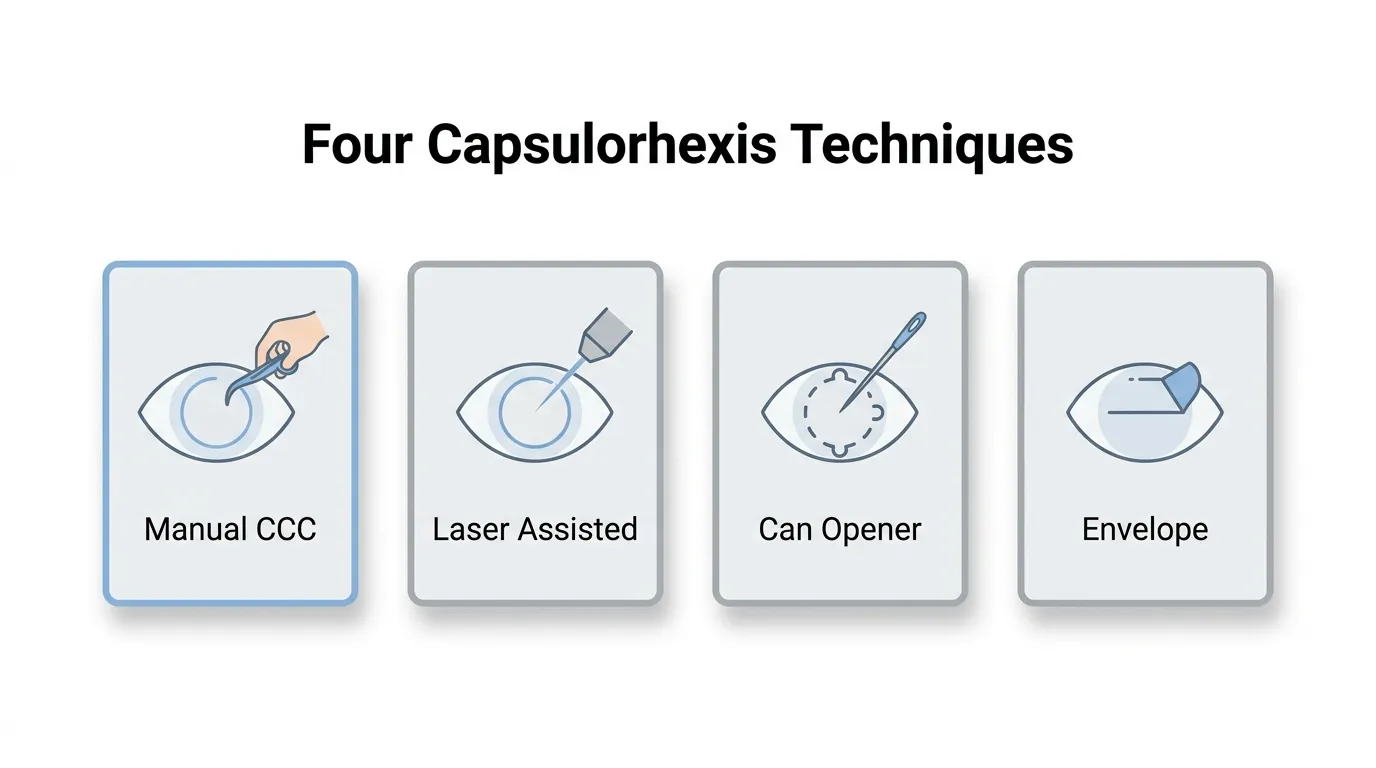
The types of capsulorhexis techniques are manual continuous curvilinear capsulorhexis, femtosecond laser-assisted capsulotomy, can-opener capsulotomy, and envelope capsulorhexis.
Manual Continuous Curvilinear Capsulorhexis
Manual continuous curvilinear capsulorhexis (CCC) is the gold standard technique in modern cataract surgery. The surgeon uses a cystotome or Utrata forceps to create a smooth, circular opening in the anterior lens capsule. Because the tear follows a continuous curved path, the resulting edge resists splitting under tension. As Dr. Howard Gimbel and Dr. Thomas Neuhann note in the Saudi Journal of Ophthalmology, “continuous curvilinear capsulorhexis prevents radial tears because its continuous edge can stretch rather than tear in response to surgical forces.” This resilience allows safe phacoemulsification, nucleus removal, and stable intraocular lens fixation. For most surgeons performing routine cataract procedures, mastering manual CCC remains the single most important technical skill, since every subsequent step depends on a well-constructed capsular opening.
Femtosecond Laser-Assisted Capsulotomy
Femtosecond laser-assisted capsulotomy uses precisely focused laser pulses to cut a circular opening in the anterior capsule. The laser creates a pre-programmed diameter and centration, reducing variability compared to freehand techniques. Circularity and reproducibility tend to be high because software controls the cut pattern. However, the technology requires docking the eye to a patient interface and adds cost to the procedure. Femtosecond capsulotomy may be particularly useful in cases where precise IOL centration is critical, such as premium multifocal or toric lens implantation. While it offers consistency, the technique does not eliminate the need for manual surgical skills, since the surgeon must still manage the capsule flap and complete the operation.
Can-Opener Capsulotomy
Can-opener capsulotomy is an older technique that creates a series of small punctures in the anterior capsule using a cystotome or bent needle. These individual perforations are then connected to remove the central capsular disc. Unlike continuous curvilinear capsulorhexis, can-opener capsulotomy leaves multiple ragged, discontinuous edges along the opening. These irregular margins significantly increase the risk of uncontrolled radial tears extending toward the posterior capsule during surgical manipulation. Because of this limitation, can-opener capsulotomy has largely been replaced by CCC in contemporary practice. It may still be encountered in resource-limited settings or referenced in training contexts to highlight why a continuous tear edge is essential for safe lens extraction.
Envelope Capsulorhexis
Envelope capsulorhexis is a technique that creates a linear incision across the anterior capsule rather than a circular opening. The surgeon makes a straight horizontal cut, producing a flap that can be lifted like an envelope. This approach was used in earlier extracapsular cataract extraction (ECCE) methods to allow manual nucleus delivery. Because the opening lacks a continuous curved edge, it provides less structural support for modern foldable IOLs and carries a higher risk of tear propagation. Envelope capsulorhexis is rarely performed today, though understanding it helps contextualize the evolution toward circular techniques that better accommodate phacoemulsification and precise lens positioning.
With each technique offering distinct trade-offs, comparing manual and laser-assisted approaches reveals further differences in precision and outcomes.
How Does Manual Capsulorhexis Compare to Laser-Assisted Capsulotomy?
Manual capsulorhexis compares to laser-assisted capsulotomy primarily in precision, complication rates, and surgeon dependence. Both techniques create an opening in the anterior lens capsule, but they differ in how that opening is achieved and how consistently it performs.
Manual continuous curvilinear capsulorhexis (CCC) relies on a surgeon’s skill to guide forceps in a controlled circular tear. The technique demands significant hands-on experience, and outcomes can vary based on the surgeon’s proficiency and patient-specific factors such as anterior chamber depth. However, manual CCC remains the most widely practiced method worldwide because it produces a strong, continuous edge that resists tearing during subsequent surgical steps.
Femtosecond laser-assisted capsulotomy uses programmed laser pulses to cut a precisely sized and centered circular opening. According to a study published in the International Journal of Ophthalmology, the overall intraoperative complication rate for femtosecond laser-assisted cataract surgery (FLACS) was 1.8%, compared to 5.8% for traditional manual phacoemulsification (P < 0.05). This difference suggests that laser assistance may reduce certain surgical risks.
Key differences between the two approaches include:
- Circularity and sizing: Laser capsulotomy produces a more geometrically uniform opening, while manual CCC circularity depends on surgeon technique.
- Edge strength: Manual CCC creates a smooth, continuous tear edge that can stretch without propagating radial tears. Laser-cut edges, though precise, have a different tissue interaction profile.
- Cost and accessibility: Femtosecond laser platforms require significant capital investment, making manual CCC more accessible in diverse clinical settings.
- Learning curve: Manual CCC has a steeper learning curve, whereas laser systems standardize the capsulotomy step regardless of surgeon experience level.
Despite these distinctions, neither technique has proven universally superior for all patients. Laser capsulotomy offers consistency that benefits less experienced surgeons and complex cases, yet many high-volume surgeons achieve equally reliable results with manual CCC at lower cost. The choice between these methods often comes down to clinical context, available technology, and the individual surgeon’s comfort level.
Understanding these procedural differences can help clarify how intraocular lens placement is affected by capsulotomy quality.
What Role Does Capsulorhexis Play in Intraocular Lens Placement?
Capsulorhexis plays a central role in intraocular lens placement by creating the capsular opening that holds, centers, and stabilizes the IOL after cataract removal.
A well-centered capsulorhexis with a 360° overlapping edge on the intraocular lens optic is critical to prevent IOL tilt, decentration, and myopic shift, according to The Ophthalmologist. When the capsular rim overlaps the optic evenly on all sides, it exerts symmetric forces that keep the lens seated in its intended position. Without this overlap, the IOL can shift or rotate over time, degrading visual outcomes and potentially requiring IOL exchange or surgical repositioning.
The size of the opening matters as much as its shape. A capsulorhexis that is too large may fail to cover the optic edge, allowing the IOL to decenter. One that is too small can lead to excessive capsular contraction, distorting the optic and altering the refractive result. Surgeons generally target an opening between 5.0 and 5.5 mm in diameter to balance adequate overlap with sufficient access for lens insertion.
For patients receiving premium IOLs, such as multifocal or toric lenses, precise capsulorhexis centration becomes even more consequential. These advanced lens designs depend on exact optical alignment to deliver their intended corrections. Even minor asymmetry in the capsular opening can compromise performance, making capsulorhexis quality one of the strongest predictors of long-term refractive satisfaction after cataract surgery. Achieving optimal vision often involves careful consideration of all factors contributing to acuity, including the role of refractive vision correction options beyond IOLs.
What Are the Potential Complications of Capsulorhexis?
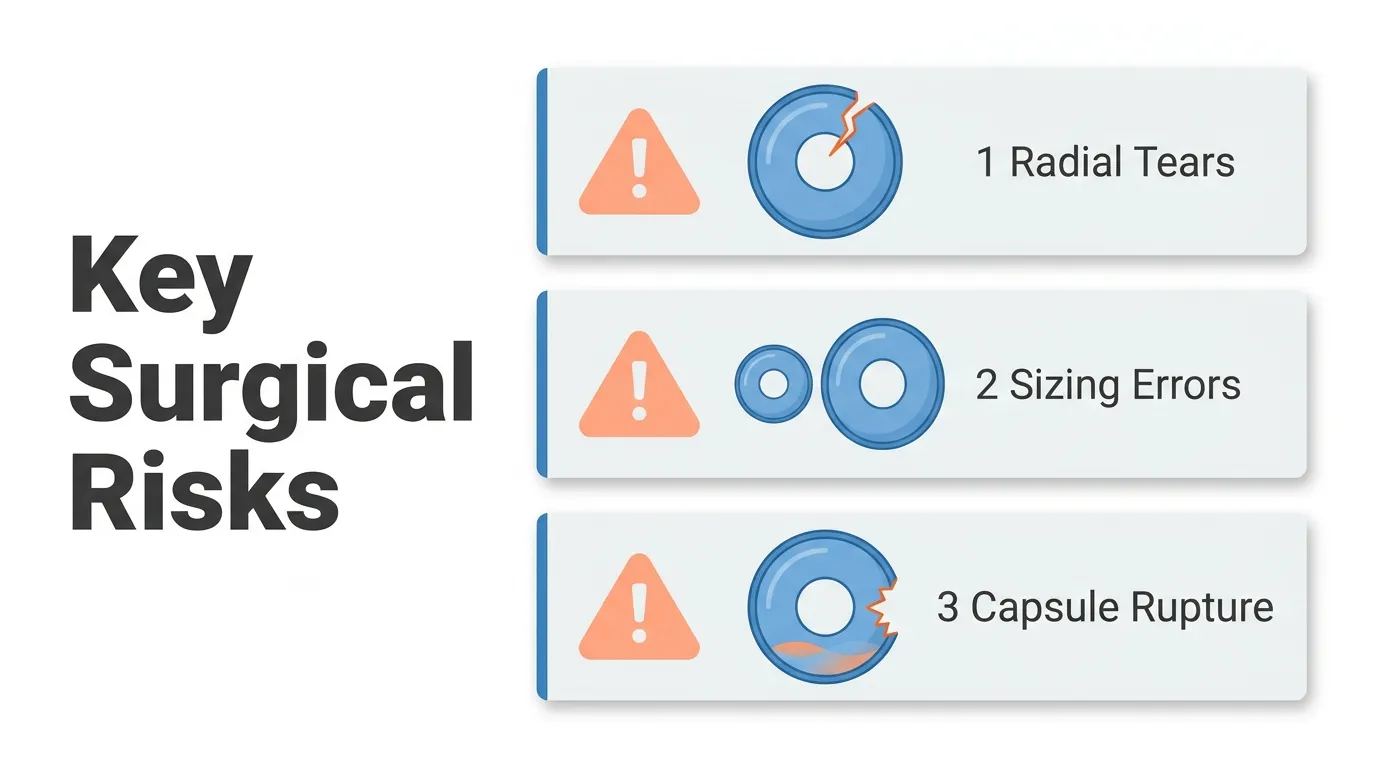
The potential complications of capsulorhexis include radial tears, sizing errors, and posterior capsule rupture. Surgeon experience significantly influences complication rates, particularly in training environments. Understanding these specific risks complements knowledge of other irrigation-aspiration risks and complications that can arise during cataract surgery. The following sections cover each major complication.
What Is a Radial Tear During Capsulorhexis?
A radial tear during capsulorhexis is an uncontrolled split that extends outward from the capsular opening toward the lens equator or posterior capsule. This complication can compromise the structural integrity of the capsular bag, making safe intraocular lens implantation difficult.
The continuous curvilinear capsulorhexis (CCC) technique was developed specifically to minimize this risk. Its smooth, unbroken edge can stretch under surgical forces without propagating a tear. Older techniques carry greater danger; according to the Saudi Journal of Ophthalmology, conventional can-opener capsulotomy leaves multiple ragged edges that can promote catastrophic radial tears extending to the posterior capsule during surgical manipulation.
When a radial tear does occur during CCC, the surgeon may attempt to redirect the flap or convert to a different management strategy. Recognizing the early signs of an extending tear remains one of the most important skills in cataract surgery, as even a small uncontrolled extension can change the surgical plan entirely.
What Happens if the Capsulorhexis Is Too Small?
A capsulorhexis that is too small can lead to accelerated capsular contraction, restricted IOL optic exposure, and increased risk of capsular phimosis. According to Tal Raviv, MD, an average 5.0 mm capsulorhexis opening was found to contract to 4.4 mm over time, illustrating how smaller openings shrink further postoperatively.
Excessive contraction may cause the capsular bag to tighten around the IOL, potentially inducing:
- IOL decentration or tilt
- Myopic refractive shift
- Visual axis obscuration from fibrotic capsular edges
For patients receiving premium multifocal or toric lenses, even minor capsular contraction can degrade visual outcomes. Surgeons generally aim for a capsulorhexis slightly smaller than the IOL optic diameter to balance overlap with adequate opening size. This sizing decision is one of the subtlest yet most consequential judgments in cataract surgery.
What Happens if the Capsulorhexis Is Too Large?
A capsulorhexis that is too large may fail to overlap the IOL optic edge by a full 360 degrees. Without complete overlap, the lens loses the capsular support needed to remain centered within the visual axis.
Consequences of an oversized opening include:
- IOL decentration or subluxation
- Reduced barrier to posterior capsule opacification (PCO)
- Increased likelihood of IOL edge glare or dysphotopsia
An oversized capsulorhexis also limits the surgeon’s ability to manage intraoperative complications, since less capsular rim remains to anchor the lens. Proper sizing, typically between 5.0 and 5.5 mm, gives the capsular edge enough structure to secure the IOL while still allowing efficient cataract removal.
What Is Posterior Capsule Rupture During Capsulorhexis?
Posterior capsule rupture during capsulorhexis is an intraoperative breach of the thin posterior wall of the lens capsule. The posterior capsule is especially vulnerable because it measures only about 3.5 µm at its thinnest point, compared to approximately 21 µm at the thicker anterior pre-equatorial region.
According to a review published in the Journal of Cataract and Refractive Surgery, the incidence of posterior capsular rupture during cataract surgery varies from 0.18% to 23.3%, with ocular risk factors such as miosis and zonular weakness.
Several mechanisms can contribute to this complication. Capsular block syndrome, where the capsulorhexis edge is completely sealed by the IOL optic, may cause fluid accumulation behind the lens and eventual posterior capsule rupture. In pediatric cases, primary posterior capsulorhexis (PCCC) is sometimes performed intentionally to prevent secondary visual axis opacification, though this approach carries its own risk profile.
Posterior capsule rupture often requires a change in surgical strategy, potentially affecting final lens placement and visual outcomes. With complications ranging from sizing errors to capsular rupture, understanding candidacy factors helps surgeons plan the safest approach.
Who May Not Be an Ideal Candidate for Standard Capsulorhexis?
Standard capsulorhexis may not be ideal for patients with mature cataracts, weak zonules, or pediatric anatomy. These conditions alter capsule behavior and require modified surgical techniques.
What Challenges Does a Mature or White Cataract Present?
A mature or white cataract presents several challenges that complicate standard capsulorhexis. The intumescent lens generates high intracapsular pressure, which can cause the capsule to tear unpredictably once punctured. Surgeons sometimes describe this as an “Argentinian flag” sign, where the tear races outward in an uncontrolled radial direction the moment the capsule is opened.
Visibility is another significant obstacle. The dense, opaque cortex obscures the red reflex that normally guides the surgeon’s tear path. Without that visual feedback, maintaining a smooth, continuous circular opening becomes far more difficult. Staining the capsule with a vital dye helps restore contrast, though even with dye, the sudden release of liquefied cortex can destabilize the anterior chamber. These cases demand careful decompression strategies before attempting the circular tear, making them among the most technically demanding scenarios in cataract surgery.
How Do Weak Zonules Affect Capsulorhexis?
Weak zonules affect capsulorhexis by reducing the structural support that holds the lens capsule taut during the circular tear. Zonular fibers anchor the lens equator to the ciliary body; when these fibers are compromised, the entire capsular bag shifts and deforms under surgical forces. According to a 2010 report in Cataract & Refractive Surgery Today, eyes with pseudoexfoliation syndrome face a surgical complication risk five to 10 times higher than normal eyes due to zonular weakness and poor pupil dilation.
Without adequate zonular tension, the capsule tends to fold or wrinkle unpredictably as the surgeon attempts the tear, increasing the likelihood of radial extensions. Capsular tension rings or iris retractors are often deployed to stabilize the bag before the rhexis begins. Even with these adjuncts, the margin for error narrows considerably. Zonular laxity remains one of the most common reasons surgeons modify or abandon the standard continuous curvilinear technique in favor of alternative stabilization methods.
How Does Pediatric Cataract Surgery Change the Approach?
Pediatric cataract surgery changes the approach because the young lens capsule is significantly more elastic than its adult counterpart. As noted in the Saudi Journal of Ophthalmology, pediatric capsulorhexis is challenging due to this high elasticity, which causes the capsule to tear peripherally in what surgeons call a “runaway” rhexis. The capsule stretches rather than following the controlled circular path typical of adult tissue, making directional control unpredictable.
Beyond the anterior capsule, the posterior capsule also requires attention. Children develop posterior capsule opacification at much higher rates than adults, so surgeons often perform a primary posterior capsulorhexis during the same procedure. A vitrectomy through the posterior opening may follow to reduce opacification risk further. These additional steps make pediatric cases longer and more complex than standard adult surgery.
Understanding which patients require modified capsulorhexis techniques helps clarify when posterior capsulorhexis becomes necessary.
What Is Posterior Capsulorhexis and When Is It Needed?
Posterior capsulorhexis is a deliberate circular opening created in the posterior capsule of the lens, typically performed during or immediately after cataract extraction. This technique is most commonly needed in pediatric cataract surgery, where leaving the posterior capsule intact carries a high risk of secondary visual axis opacification. According to the American Academy of Ophthalmology, primary posterior continuous curvilinear capsulorhexis (PCCC) is indicated in pediatric cases specifically to prevent this opacification, which develops at elevated rates in young patients when the posterior capsule remains closed.
Because the posterior capsule is considerably thinner than the anterior capsule, creating this opening demands precise surgical control. In adult surgery, posterior capsulorhexis may be considered when a surgeon encounters posterior capsule abnormalities during the procedure. A 2024 study published in the Journal of Cataract & Refractive Surgery found that primary PCCC was successfully performed in 44.7% of pediatric cases presenting with posterior capsule abnormalities, with an overall posterior capsule rupture incidence of 10.5%.
For most routine adult cataract procedures, the posterior capsule is left intact to support the intraocular lens. Pediatric eyes, however, present a unique challenge; the highly elastic young capsule and the near-certainty of postoperative opacification make primary posterior capsulorhexis a valuable preventive strategy rather than an optional step.
Understanding when posterior capsulorhexis applies helps clarify the broader factors that can influence capsulorhexis outcomes overall.
What Factors May Influence Capsulorhexis Outcomes?
The factors that may influence capsulorhexis outcomes include surgeon experience, anterior chamber stability, capsule characteristics, and the choice of viscoelastic device.
Surgeon experience significantly influences the rate of complications during capsulorhexis. In training environments, less experienced surgeons may encounter higher rates of “runaway” tears and irregular openings, which can compromise intraocular lens positioning and long-term visual results.
Anterior chamber depth and the use of cohesive ophthalmic viscosurgical devices are critical factors in maintaining the space and capsular stability needed for a controlled tear. According to a 2025 study published in Frontiers in Medicine, anterior chamber depth and cohesive OVD selection directly affect the surgeon’s ability to stabilize the capsule throughout the procedure. When the anterior chamber shallows unexpectedly, the flap becomes harder to redirect, increasing the risk of peripheral extension.
Capsule thickness also plays a role. The lens capsule varies from approximately 3.5 µm at the posterior pole to about 21 µm at the anterior pre-equatorial zone, and these structural differences affect how the tissue responds to tearing forces. Patient-specific conditions, such as pseudoexfoliation syndrome or a highly elastic pediatric capsule, further alter how predictably the rhexis progresses. For precise intraocular lens power calculation, pre-operative biometry for IOL assessment is another vital factor influencing long-term outcomes.
Additional factors that may influence capsulorhexis outcomes include:
- Pupil dilation: Poor mydriasis limits visualization and restricts instrument maneuverability during the tear.
- Capsule integrity: Pre-existing zonular weakness can allow the capsular bag to shift, destabilizing the rhexis path.
- Technique selection: The choice between manual continuous curvilinear capsulorhexis and femtosecond laser-assisted capsulotomy affects precision and reproducibility.
- Intraocular pressure management: Fluctuations during the procedure can cause the anterior chamber to collapse, leading to an unpredictable tear.
For most cataract cases, a combination of adequate surgeon skill, proper OVD use, and careful patient selection determines whether the capsulorhexis achieves the size, shape, and centration needed for optimal lens implant performance. Understanding how capsulorhexis technique has advanced helps contextualize these outcomes.
How Has Capsulorhexis Technique Evolved Through 2026?
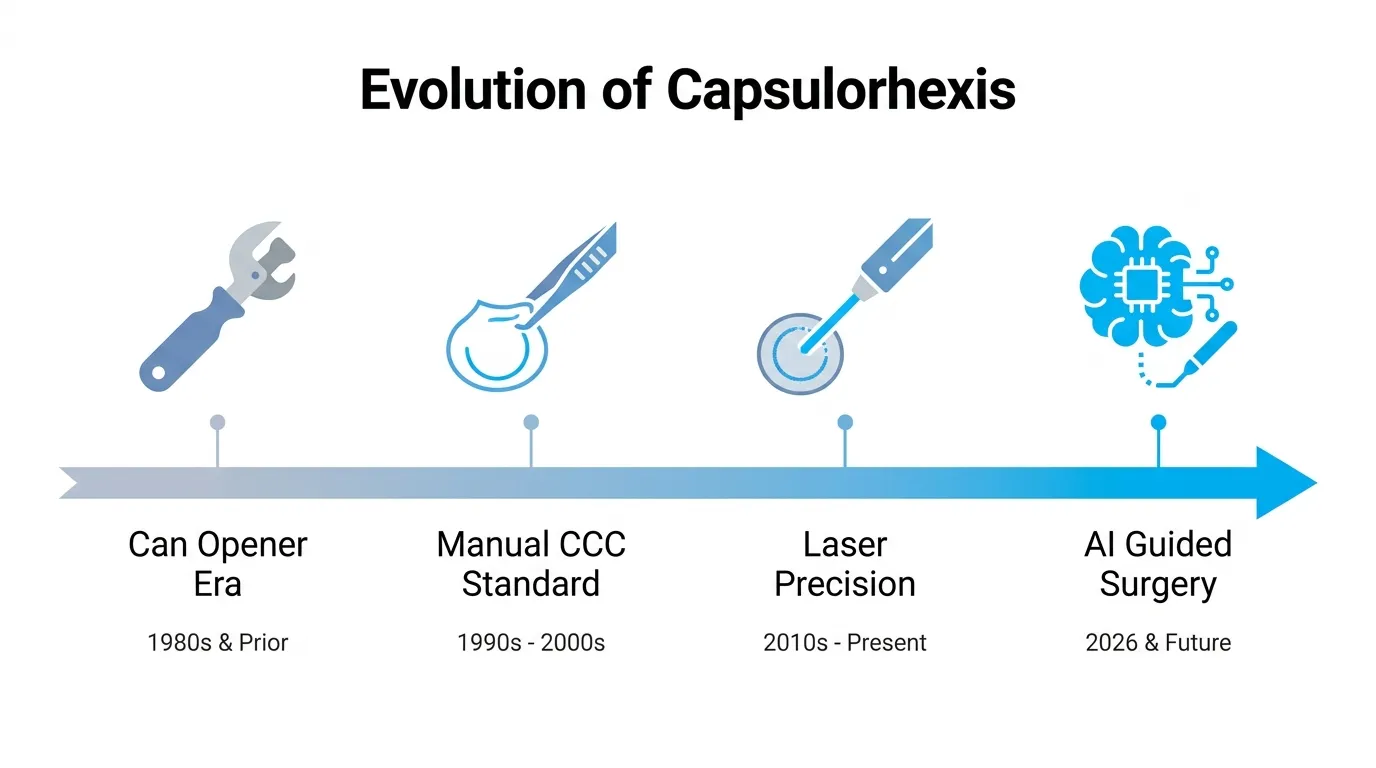
Capsulorhexis technique has evolved through 2026 from early manual methods to AI-guided and robotic-assisted systems that improve precision and reproducibility. Key milestones include the shift from can-opener capsulotomy to continuous curvilinear capsulorhexis, the introduction of femtosecond lasers, and the emergence of real-time AI trajectory guidance.
The earliest widely used approach, can-opener capsulotomy, created multiple small punctures in the anterior capsule. While functional, this method left ragged edges prone to unpredictable extension during lens removal. The technique served its purpose for decades but imposed a ceiling on surgical safety and IOL stability.
The development of continuous curvilinear capsulorhexis (CCC) in the late 1980s represented a transformative leap. By producing a smooth, continuous edge capable of stretching rather than tearing under surgical forces, CCC dramatically reduced radial tear risk. This single innovation made modern phacoemulsification and premium IOL implantation possible, establishing CCC as the standard technique that persists today.
Femtosecond laser-assisted capsulotomy added computer-guided precision to the opening’s size, shape, and centration. Laser systems use optical coherence tomography imaging to plan the capsulotomy before any physical contact with the eye, offering a level of geometric consistency that even experienced surgeons find difficult to replicate manually with every case.
The most significant recent advancement involves artificial intelligence. According to a 2025 study published in npj Digital Medicine (Nature), the Meta Surgery (MetaS) AI-driven system, trained on 17,538 capsulorhexis videos, increased the rate of ideal capsulorhexis from 44.2% to 85.0% by providing real-time trajectory guidance during surgery. Autonomous surgical robots have also demonstrated the ability to perform precise capsulorhexis in experimental models using diathermic tips guided by AI-extracted digital features.
What makes this trajectory remarkable is the consistent theme: each generation of innovation has targeted the same fundamental challenge of creating a predictable, well-centered, appropriately sized capsular opening. The tools have changed from needles to forceps to lasers to algorithms, but the surgical goal remains unchanged. AI-assisted capsulorhexis may prove especially valuable for training environments and complex cases where maintaining ideal geometry is most difficult. With these technological advances reshaping surgical precision, surgeon-reviewed educational resources can help patients understand what modern cataract surgery involves.
How Can Resources Help You Understand Cataract Surgery Techniques?
Surgeon-reviewed resources can help you understand cataract surgery techniques by translating complex procedural details into clear, evidence-based explanations. This includes comprehensive information on the various surgical solutions in ophthalmic procedures, such as balanced salt solution. The sections below cover how Eye Surgery Today’s guides support preparation and the key takeaways about capsulorhexis.
Can Eye Surgery Today’s Expert Guides Help You Prepare for Cataract Surgery?
Yes, Eye Surgery Today’s expert guides can help you prepare for cataract surgery by breaking down each procedural step, from capsulorhexis technique to intraocular lens placement, in language designed for patients rather than clinicians. Every guide on the platform is surgeon-reviewed, ensuring clinical accuracy while remaining accessible.
Understanding the technical landscape matters because cataract surgery continues to evolve rapidly. According to a 2025 study published in npj Digital Medicine, the Meta Surgery AI-driven system, trained on 17,538 capsulorhexis videos, increases the rate of ideal capsulorhexis from 44.2% to 85.0% by providing real-time trajectory guidance. Advances like these reshape what patients can expect, and Eye Surgery Today tracks these developments so readers stay informed.
Eye Surgery Today covers topics ranging from manual continuous curvilinear capsulorhexis to femtosecond laser-assisted capsulotomy, IOL options, complication risks, and recovery expectations. Patients who review these resources before consultations can ask more targeted questions and feel more confident in their surgical decisions. These comprehensive guides also cover related cosmetic eye procedures, such as eyelid surgery (blepharoplasty), for those exploring broader vision care options.
What Are the Key Takeaways About Capsulorhexis in Cataract Surgery?
The key takeaways about capsulorhexis in cataract surgery are:
- Capsulorhexis is the foundational step that creates a controlled opening in the lens capsule, enabling safe cataract removal and precise IOL placement.
- Continuous curvilinear capsulorhexis (CCC) remains the gold standard because its smooth, unbroken edge resists radial tears during surgical manipulation.
- Proper sizing and centration of the capsulorhexis directly affect long-term visual outcomes, influencing IOL stability, capsular contraction, and refractive accuracy.
- Multiple technique options exist, including manual CCC, femtosecond laser-assisted capsulotomy, and emerging AI-guided systems, each with distinct advantages depending on patient anatomy and surgeon expertise.
- Complications such as radial tears, posterior capsule rupture, and capsular block syndrome can occur, though skilled technique and appropriate instrumentation significantly reduce these risks.
- Special populations, including pediatric patients and those with weak zonules, may require modified approaches to capsulorhexis.
For patients considering cataract surgery, understanding capsulorhexis helps demystify the procedure and supports more productive conversations with your ophthalmologist. Eye Surgery Today provides surgeon-reviewed guides on each of these topics to help you navigate your options with confidence.