Topical anesthesia for cataract surgery is a numbing technique that uses eye drops applied directly to the ocular surface, and it remains the most widely preferred method among practitioners globally. When topical drops alone may not provide sufficient pain control or eye immobility, several proven alternatives exist.
This guide covers anesthesia fundamentals in cataract surgery, the core alternative techniques and how each compares to topical drops, patient candidacy based on health and procedure factors, and practical preparation for surgery day.
Cataract surgery demands precise instrument placement inside the eye, so the anesthesia plan must address both pain sensation and involuntary movement. Age-related cardiovascular changes and systemic conditions like hypertension or diabetes can further complicate anesthesia selection, making preoperative risk assessment essential.
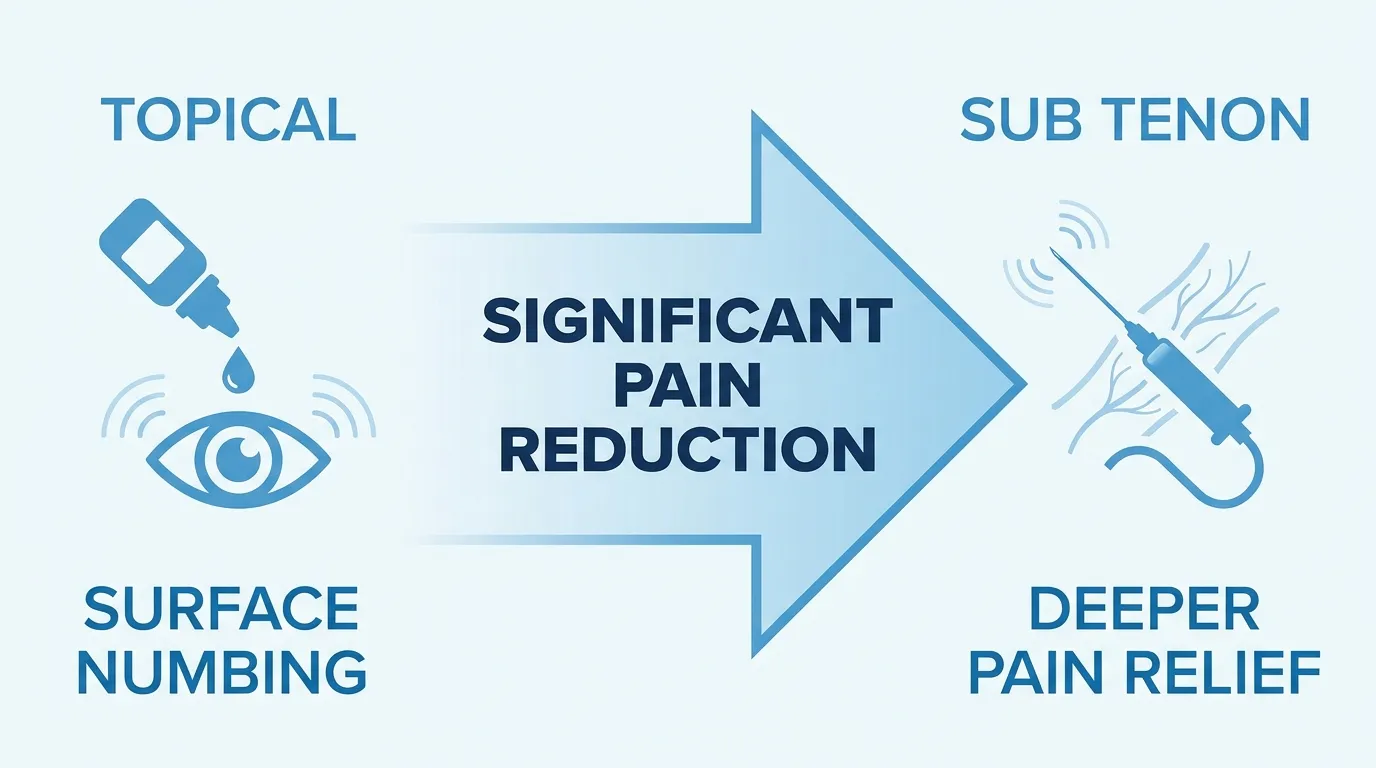
The primary alternatives include retrobulbar, peribulbar, and sub-Tenon blocks, along with intracameral lidocaine and general anesthesia. Regional blocks such as retrobulbar and peribulbar injections may deliver deep numbness and full eye immobility, though each carries distinct injection-related risks including rare hemorrhage or globe perforation. Sub-Tenon anesthesia is associated with statistically significant pain reduction compared to topical drops alone and avoids sharp-needle orbital risks, making it a practical step-up option.
Intracameral lidocaine, injected directly into the anterior chamber, is most often layered with topical drops to enhance interior pain control with minimal systemic exposure. General anesthesia is typically reserved for pediatric patients or adults unable to cooperate during the procedure, as it may carry higher postoperative risks in elderly populations.
Matching the technique to each patient’s anxiety level, surgical complexity, and overall health profile is the most reliable path to a safe, comfortable procedure.
Why Is Anesthesia Important During Cataract Surgery?
Anesthesia is important during cataract surgery because it controls pain, limits eye movement, and reduces the risk of complications that can threaten surgical outcomes.
Proper anesthesia selection protects both comfort and safety. Cataract surgery requires precise instrument placement inside the eye, so even slight involuntary movement or pain response can compromise the procedure. The wrong anesthesia approach may also introduce its own risks. A 2024 case report documented inadvertent globe perforation in an 81-year-old patient during retrobulbar anesthesia, illustrating how the delivery method itself can cause rare but severe injury.
Patient health profiles add another layer of complexity. According to Dr. Saul J. Prado Fonseca and colleagues, published in the Cureus Journal of Medical Science, age-related cardiovascular changes, such as reduced cardiac reserve and increased arterial stiffness, increase the susceptibility of geriatric patients to perioperative complications during cataract surgery anesthesia. This means the anesthesia plan must account for far more than just pain control; it must also safeguard cardiovascular stability throughout the procedure.
For these reasons, anesthesia choice is one of the most consequential preoperative decisions in cataract surgery. Understanding the available alternatives to topical anesthesia helps patients and their surgical teams identify the safest, most effective approach.
What Is Topical Anesthesia for Cataract Surgery?
Topical anesthesia for cataract surgery is a numbing technique that uses eye drops or gel applied directly to the surface of the eye to block pain sensation during the procedure. Rather than involving needles around or behind the eye, topical anesthesia works by desensitizing the corneal nerves, allowing the surgeon to perform phacoemulsification through small incisions while the patient remains awake and comfortable. The anesthetic agent, most commonly proparacaine or tetracaine drops, takes effect within seconds and provides sufficient numbness for the duration of a routine procedure.
Because topical anesthesia does not paralyze the eye muscles, patients retain the ability to move their eyes during surgery. This means cooperation and the ability to follow simple instructions, such as looking at a fixation light, are important for a smooth procedure. Surgeons may supplement topical drops with intracameral lidocaine, which is injected directly into the anterior chamber of the eye, for additional pain control during key surgical steps.
According to a 2022 survey published in PubMed Central on anesthetic preferences in cataract surgery, topical anesthesia techniques using 2% lidocaine are the most preferred method among practitioners, reflecting a global shift toward less invasive local anesthesia. This preference has grown steadily as phacoemulsification techniques have become faster and more refined, reducing the need for complete eye immobility that injectable blocks provide.
Topical anesthesia may be well suited for patients undergoing straightforward cataract removal with no anticipated complications. However, it is not ideal for every situation. Patients who experience significant anxiety, those with dense or mature cataracts requiring longer operative times, or individuals who have difficulty remaining still may benefit from alternative anesthesia methods. Understanding how topical anesthesia works provides a useful baseline for evaluating the other techniques covered in the sections that follow.
What Are the Main Alternatives to Topical Anesthesia?
The main alternatives to topical anesthesia for cataract surgery include retrobulbar blocks, peribulbar blocks, sub-Tenon blocks, intracameral anesthesia, and general anesthesia. Each method offers distinct advantages depending on the patient and the procedure.
Retrobulbar Block
A retrobulbar block is an injection of local anesthetic behind the eye, inside the muscle cone surrounding the optic nerve. This technique delivers deep anesthesia and complete akinesia, meaning the eye remains still during surgery. Surgeons may prefer it for procedures requiring minimal eye movement.
Although effective, the retrobulbar block carries rare but serious risks, such as retrobulbar hemorrhage and globe perforation. According to data published in StatPearls (2024), retrobulbar hemorrhage incidence ranges from 0.04% to 1.7%. Because of this risk profile, many cataract surgeons have shifted toward less invasive alternatives when patient anatomy and surgical complexity allow.
Peribulbar Block
A peribulbar block is an injection of local anesthetic outside the muscle cone, around the globe of the eye. It provides anesthesia and akinesia similar to a retrobulbar block but with a generally lower risk of serious complications like globe perforation. Onset can be slower, and supplemental injections may sometimes be needed.
According to a 2024 study published in BMC Ophthalmology, minor complications such as subconjunctival hemorrhage and chemosis are more common in incisionless sub-Tenon’s blocks compared to peribulbar blocks. This finding suggests peribulbar blocks may carry a favorable minor complication profile relative to certain other regional techniques. For straightforward cataract cases, this method remains a practical middle ground between deep orbital blocks and surface-level anesthesia.
Sub-Tenon Block
A sub-Tenon block involves injecting local anesthetic beneath the Tenon capsule, the thin membrane covering the sclera. A small incision in the conjunctiva allows a blunt cannula to deliver the anesthetic, providing effective pain control and partial akinesia without entering the orbital space. This approach avoids the sharp-needle risks associated with retrobulbar and peribulbar techniques, which makes it appealing for patients who may not tolerate deeper injections.
Minor complications, including chemosis and subconjunctival hemorrhage, can occur but are typically self-limiting. The sub-Tenon block is often considered one of the most versatile regional options because it balances strong analgesia with a comparatively favorable safety profile.
Intracameral Anesthesia
Intracameral anesthesia involves injecting a small volume of local anesthetic, typically preservative-free lidocaine, directly into the anterior chamber of the eye during surgery. Surgeons often use it as a supplement to topical drops rather than as a standalone technique. This combination can help reduce intraoperative discomfort, particularly during lens manipulation.
Because intracameral delivery targets the intraocular structures directly, it may improve pain control without the systemic or orbital risks associated with needle-based blocks. For routine phacoemulsification in cooperative patients, this supplemental approach represents a practical way to enhance comfort while keeping the anesthesia profile minimally invasive.
General Anesthesia
General anesthesia renders the patient completely unconscious during cataract surgery. It is typically reserved for specific patient populations, such as pediatric patients, individuals with significant cognitive impairment, or those unable to remain still and follow instructions during the procedure.
According to a 2024 review published in the Cureus Journal of Medical Science, general anesthesia in elderly patients undergoing cataract surgery is associated with higher risks of postoperative complications, including delirium, cognitive decline, and prolonged recovery due to age-related physiological changes. For this reason, most ophthalmologists prefer local or regional anesthesia whenever possible, reserving general anesthesia for cases where no other option can ensure patient safety and surgical success.
With these core alternatives outlined, the following sections compare each technique directly against topical anesthesia.
How Does Retrobulbar Anesthesia Compare to Topical Anesthesia?
Retrobulbar anesthesia compares to topical anesthesia by offering deeper pain control and complete eye immobility, though it carries additional injection-related risks. The following subsections cover the potential benefits and possible risks of a retrobulbar block.
What Are the Potential Benefits of a Retrobulbar Block?
The potential benefits of a retrobulbar block include profound anesthesia, complete akinesia, and a still surgical field. By delivering anesthetic directly behind the eye, this technique may eliminate both pain sensation and eye movement during the procedure. For surgeons managing complex or extended cases, that level of control can be difficult to replicate with topical drops alone.
A Cochrane Systematic Review found no significant difference in efficacy between peribulbar and retrobulbar blocks regarding akinesia and anesthesia, confirming the retrobulbar approach as a well-established regional technique. While topical anesthesia supplemented with intracameral lidocaine can reduce intraoperative pain, the effect size is considered small, particularly compared to the complete sensory and motor blockade a retrobulbar injection may provide.
For patients who struggle to remain still or who experience significant anxiety, the immobility a retrobulbar block produces is often the deciding clinical advantage.
What Are the Possible Risks of a Retrobulbar Block?
The possible risks of a retrobulbar block include retrobulbar hemorrhage, brainstem anesthesia, and inadvertent globe perforation. Because the injection targets the retrobulbar space behind the eye, proximity to delicate orbital structures introduces complications that topical anesthesia avoids entirely.
According to a 2025 systematic review and meta-analysis of 196,113 retrobulbar injections published in Ophthalmology, the literature-pooled incidence of retrobulbar hemorrhage was 0.10% and brainstem anesthesia was 0.23%. Although these rates are low, the severity of such events requires careful patient selection and experienced administration.
Additional rare complications may include:
- Optic nerve damage from direct needle trauma
- Elevated intraocular pressure from orbital hemorrhage
- Cardiovascular depression associated with brainstem spread
These risks explain why many practitioners now reserve retrobulbar blocks for cases where topical or sub-Tenon anesthesia may not provide adequate surgical conditions. Personalized anesthesia selection, guided by the surgeon and anesthesia team, helps balance the depth of pain control against these potential complications.
How Does Peribulbar Anesthesia Compare to Topical Anesthesia?
Peribulbar anesthesia compares to topical anesthesia by offering deeper pain control and eye immobilization, though it carries additional injection-related risks. The sections below cover its potential benefits and possible risks.
What Are the Potential Benefits of a Peribulbar Block?
The potential benefits of a peribulbar block include effective akinesia, profound anesthesia, and a favorable safety profile compared to deeper orbital injections. A peribulbar block deposits anesthetic outside the muscle cone, numbing the eye while significantly reducing eye movement during surgery. This combination of pain control and globe immobilization can be particularly valuable for complex or longer cataract procedures where a still surgical field is essential.
According to a Cochrane Systematic Review, there is no significant difference in efficacy between peribulbar and retrobulbar blocks regarding akinesia and anesthesia, meaning peribulbar blocks can achieve comparable results with a lower risk profile. Because the needle stays outside the muscle cone, the likelihood of inadvertent contact with the optic nerve or central retinal artery may be reduced. For patients who need more than what topical drops alone provide, the peribulbar approach offers a practical middle ground between minimal and deep orbital anesthesia.
What Are the Possible Risks of a Peribulbar Block?
The possible risks of a peribulbar block include conjunctival chemosis, local hemorrhage, incomplete akinesia requiring supplemental injections, and rare but serious complications. The Cochrane Systematic Review noted that conjunctival chemosis was more common with peribulbar blocks than with retrobulbar blocks, likely due to the larger volume of anesthetic solution deposited in the periorbital space.
Additional risks may include:
- Periorbital bruising or lid swelling at the injection site
- Globe perforation, though this is considered extremely rare
- Transient diplopia or ptosis following the procedure
- Elevated intraocular pressure from the volume of injected solution
Because the block sometimes requires more than one injection to achieve adequate akinesia, some patients may experience greater discomfort during administration compared to topical drops. Your ophthalmologist can help determine whether these risks are outweighed by the benefits based on your specific surgical needs.
Understanding peribulbar block trade-offs helps when evaluating another regional option: sub-Tenon anesthesia.
How Does Sub-Tenon Anesthesia Compare to Topical Anesthesia?
Sub-Tenon anesthesia compares to topical anesthesia by offering deeper pain control through local anesthetic delivered beneath Tenon’s capsule. The sub-sections below cover its potential benefits and possible risks.
What Are the Potential Benefits of a Sub-Tenon Block?
The potential benefits of a sub-Tenon block include stronger pain reduction, improved eye immobility, and suitability for patients who may not tolerate topical anesthesia alone. According to a 2025 systematic review published in Clinical Ophthalmology, sub-Tenon’s anesthesia provides a statistically significant reduction in patient-reported pain scores during cataract surgery compared to topical anesthesia alone.
Because the anesthetic solution spreads beneath Tenon’s capsule, it can produce partial akinesia, which may help reduce involuntary eye movement during the procedure. This added stability is particularly valuable in longer or more complex cases where sustained patient cooperation is essential. For patients who experience significant anxiety about remaining aware during surgery, the deeper numbing effect of a sub-Tenon block may offer greater comfort than surface-level drops. In clinical practice, this technique often represents a practical middle ground between the minimal intervention of topical drops and the deeper orbital blocks.
What Are the Possible Risks of a Sub-Tenon Block?
The possible risks of a sub-Tenon block include subconjunctival hemorrhage, chemosis, and, less commonly, damage to surrounding orbital structures. Minor bleeding under the conjunctiva is one of the most frequently reported side effects, though it typically resolves without treatment.
Chemosis, a swelling of the conjunctival tissue caused by fluid accumulation, can also occur and may temporarily affect the surgical field. While these complications are generally self-limiting, they occur more often with sub-Tenon blocks than with topical anesthesia, which involves no injection at all. Rare but more serious risks, such as globe perforation or retrobulbar spread of anesthetic, have been documented in the literature, though their incidence remains low compared to deeper orbital blocks. Your ophthalmologist can help determine whether the enhanced pain control of a sub-Tenon block outweighs these potential risks based on your individual health profile.
With sub-Tenon’s benefits and risks outlined, understanding intracameral anesthesia provides another perspective on topical alternatives.
How Does Intracameral Anesthesia Work With or Instead of Topical Drops?
Intracameral anesthesia works by injecting a small amount of anesthetic, typically lidocaine, directly into the anterior chamber of the eye during cataract surgery. This technique can serve as a supplement to topical drops or, in some cases, as a primary anesthetic approach.
A 2023 study by the Royal College of Ophthalmologists National Ophthalmology Database found that combined topical and intracameral anesthesia has become the most common choice of anesthetic technique for cataract surgery in the United Kingdom. Rather than replacing topical drops entirely, intracameral lidocaine is most often layered on top of them. The surgeon applies topical drops first to numb the ocular surface, then injects the intracameral dose once the eye is entered, numbing the deeper intraocular structures that drops alone may not fully reach.
This combination approach can be particularly valuable for patients who experience discomfort during specific intraoperative steps, such as iris manipulation or lens fragment removal, where surface-level numbness from drops alone may fall short. Because the anesthetic is delivered precisely where it is needed inside the eye, the overall systemic drug exposure remains minimal.
For most routine phacoemulsification cases, the topical-plus-intracameral combination offers a practical middle ground: broad surface anesthesia from the drops paired with targeted interior pain control from the injection. Understanding how sedation options complement local anesthesia can further help patients prepare for surgery day.
When Might General Anesthesia Be Needed for Cataract Surgery?
General anesthesia may be needed for cataract surgery when a patient cannot cooperate with the procedure under local or topical techniques. The sections below cover who may require it and the possible risks involved.
Who May Require General Anesthesia for Cataract Surgery?
Patients who may require general anesthesia for cataract surgery include pediatric patients, adults with severe cognitive impairment, and individuals unable to remain still or follow instructions during the procedure. According to a 2025 review published in JAMA, general anesthesia is typically reserved for these specific populations rather than used as a routine approach.
Patients with systemic comorbidities, such as hypertension, diabetes, or a history of stroke, require careful vascular risk stratification before any anesthesia decision is made. The American Academy of Ophthalmology emphasizes that the surgeon, in consultation with the anesthesia team, should determine the appropriate modality based on each patient’s needs and preferences.
For many patients who struggle with anxiety rather than an inability to cooperate, alternatives like oral sedation or monitored anesthesia care (MAC) may be considered before defaulting to general anesthesia. This distinction matters because general anesthesia carries additional risks that local techniques typically avoid.
What Are the Possible Risks of General Anesthesia for Eye Surgery?
The possible risks of general anesthesia for eye surgery include postoperative delirium, cognitive decline, and prolonged recovery, particularly in elderly patients. Age-related cardiovascular and respiratory changes can increase susceptibility to perioperative complications when general anesthesia is used instead of local alternatives.
Additional risks may include:
- Nausea and vomiting, which can increase intraocular pressure during recovery.
- Adverse reactions to anesthetic agents, especially in patients with multiple comorbidities.
- Longer facility stays compared to procedures performed under topical or regional anesthesia.
- Greater overall procedural cost due to the involvement of a full anesthesia team.
Because of these considerations, most ophthalmologists reserve general anesthesia for cases where local techniques are not feasible. When patient cooperation is the primary concern, discussing sedation options with your surgeon and anesthesia provider can help identify a safer, less invasive approach.
Who Is a Good Candidate for Each Anesthesia Method?
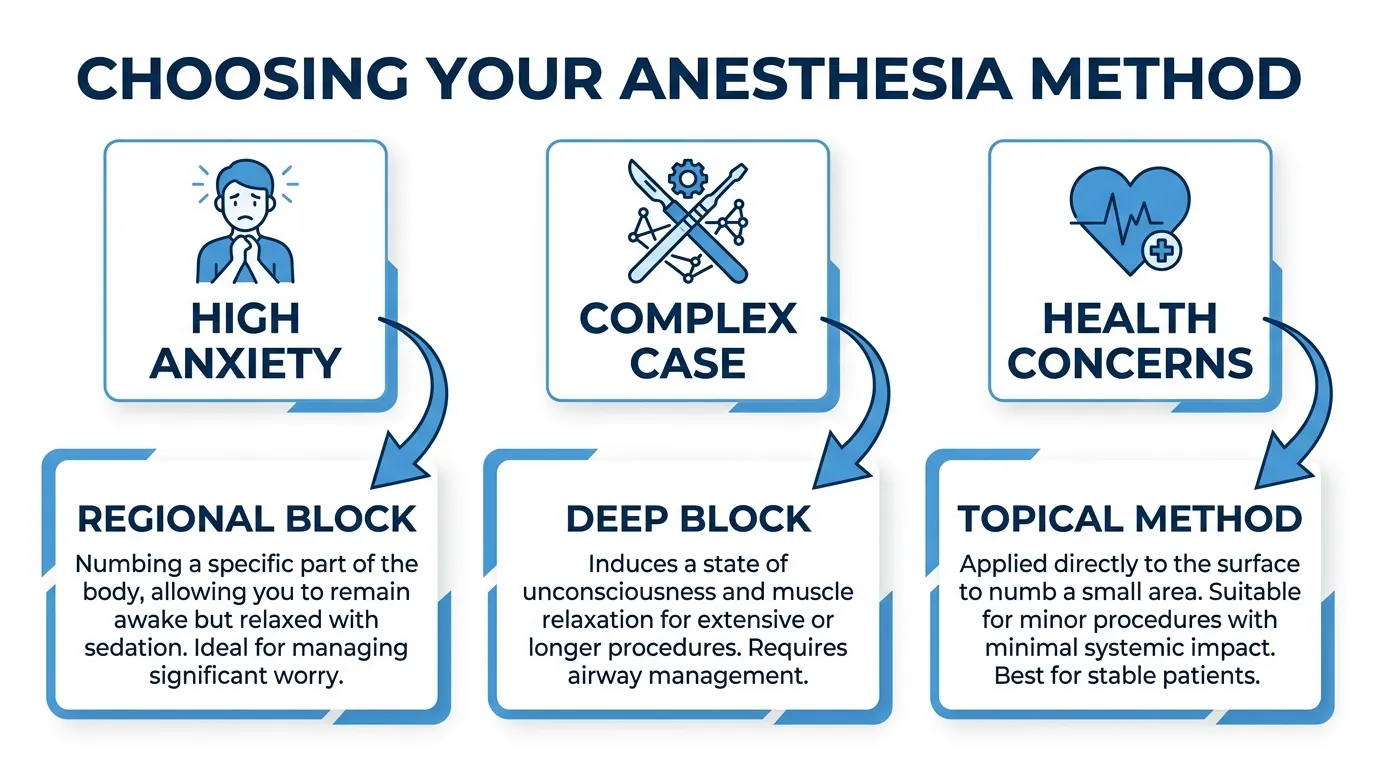
A good candidate for each anesthesia method depends on anxiety level, procedure complexity, and systemic health status. The following subsections cover candidacy for patients with high anxiety, complex surgeries, and systemic health concerns.
Which Option May Be Best for Patients With High Anxiety?
The option that may be best for patients with high anxiety is a regional block, such as a sub-Tenon or peribulbar block, often combined with monitored sedation. These methods can reduce awareness of surgical instruments near the eye, which is a common source of distress for anxious patients.
Oral or intravenous sedation may also help manage preoperative nervousness when paired with topical anesthesia. According to a 2025 study published in the Journal of Cataract & Refractive Surgery, intravenous sedation is associated with significantly less pain than no sedation, while oral sedation provides comparable pain control to IV methods.
For elderly patients, however, clinical recommendations suggest minimizing benzodiazepine premedication to avoid adverse cognitive effects. In practice, matching the sedation approach to a patient’s anxiety profile, rather than defaulting to one technique, tends to produce the most cooperative and comfortable surgical experience.
Which Option May Be Best for Complex or Longer Procedures?
The option that may be best for complex or longer procedures is a retrobulbar or peribulbar block, as both provide deep anesthesia and full eye immobility (akinesia). Procedures involving dense cataracts, combined surgeries, or anticipated complications benefit from the extended pain control and stable operative field these blocks deliver.
Sub-Tenon anesthesia offers a middle ground; it provides reliable pain reduction with a lower complication profile than needle-based blocks, though it may produce less complete akinesia. General anesthesia is typically reserved for cases where patients cannot remain still or follow instructions throughout a prolonged operation. According to a 2025 review in JAMA, general anesthesia for cataract surgery is typically reserved for pediatric patients and adults who are unable to cooperate.
Selecting the block depth based on expected surgical duration is one of the most reliable ways to prevent intraoperative pain and avoid mid-procedure technique changes.
Which Option May Be Best for Patients With Systemic Health Concerns?
The option that may be best for patients with systemic health concerns is typically topical anesthesia, with or without intracameral supplementation, because it avoids the cardiovascular and respiratory risks associated with deeper sedation or general anesthesia. Patients with conditions such as hypertension, diabetes, or a history of stroke require careful vascular risk stratification before any ophthalmic procedure.
According to a review published in the Journal of Clinical Ophthalmology and Research, the choice of anesthesia must be personalized, as patients with systemic comorbidities need individualized assessment before undergoing ophthalmic surgery. Age-related cardiovascular changes, including reduced cardiac reserve and increased arterial stiffness, can further elevate perioperative risk in geriatric patients.
When topical anesthesia alone is not suitable, sub-Tenon anesthesia may offer effective local pain control without the systemic burden of general anesthesia. Prioritizing the least invasive effective technique generally reduces overall medical risk for these patients.
With candidacy factors clarified, knowing what to ask your surgeon can help guide the final anesthesia decision.
What Should You Ask Your Surgeon About Anesthesia Options?
You should ask your surgeon about anesthesia options that address your specific health profile, comfort level, and the complexity of your procedure. The following questions can help guide a productive preoperative conversation.
- “Which anesthesia method do you recommend for my case, and why?” Your surgeon can explain whether topical drops, a regional block, or another approach best suits your eye anatomy and medical history.
- “What will I feel and hear during the procedure?” Understanding sensory expectations, such as pressure, light, or movement, can reduce anxiety before surgery day.
- “How do my current medications or health conditions affect the anesthesia plan?” Conditions such as hypertension, diabetes, or blood-thinning medications may influence which techniques are safest.
- “Is sedation available, and what type would you suggest?” Some patients benefit from oral or intravenous sedation alongside local anesthesia to manage nervousness during the procedure.
- “What are the possible risks of the recommended anesthesia?” Every method carries a distinct risk profile; asking directly helps you weigh comfort against potential complications.
- “Can the anesthesia plan be adjusted if I experience discomfort during surgery?” Knowing that supplemental options exist, such as intracameral lidocaine, can provide reassurance.
According to the American Academy of Ophthalmology, the mode of anesthesia for cataract surgery should be determined by the surgeon based on the patient’s needs, preferences, and the medical judgment of the anesthesia team. Preparing these questions in advance helps ensure the chosen approach aligns with both your comfort and your surgeon’s clinical expertise.
How Can You Prepare for Anesthesia on Cataract Surgery Day?
You can prepare for anesthesia on cataract surgery day by following your surgeon’s preoperative instructions, which typically cover fasting guidelines, medication adjustments, and arrival logistics. Taking a few practical steps in advance can help the process go smoothly.
- Follow fasting instructions. Your surgical team will specify when to stop eating and drinking before the procedure, especially if sedation or general anesthesia is planned.
- Review your medications with your doctor. Certain medications, such as blood thinners or drugs for hypertension and diabetes, may need to be adjusted or temporarily paused before surgery. Never change a medication without your healthcare provider’s guidance.
- Disclose your full medical history. Conditions like cardiovascular disease, respiratory issues, or prior reactions to anesthesia can influence which anesthesia method your surgeon recommends.
- Arrange transportation home. Sedation and anesthesia may impair alertness after the procedure, so a responsible driver is typically required.
- Wear comfortable, loose clothing. Avoid makeup, perfume, and jewelry on the day of surgery.
- Ask about anxiety management. If preoperative anxiety is a concern, your surgeon may discuss mild sedation options. According to a 2024 study published in Geriatric Nursing, clinical recommendations suggest minimizing benzodiazepine premedication in elderly patients to reduce the risk of adverse effects.
Arriving well prepared reduces stress and helps your anesthesia team tailor the experience to your specific needs. With preparation complete, understanding how anesthesia options fit into your broader surgical plan becomes the final step.
How Does Understanding Anesthesia Options Help You Plan for Cataract Surgery?
Understanding anesthesia options helps you plan for cataract surgery by enabling informed conversations with your surgeon and reducing preoperative uncertainty. The following sections cover how Eye Surgery Today supports that preparation and the key takeaways about topical anesthesia alternatives.
Can Eye Surgery Today Help You Learn About Cataract Surgery Procedures?
Yes, Eye Surgery Today can help you learn about cataract surgery procedures. As a surgeon-reviewed education platform, Eye Surgery Today provides clear, evidence-based resources that translate complex surgical topics into accessible language for patients considering vision correction.
Cataract surgery has evolved dramatically over centuries. According to EyeWiki (American Academy of Ophthalmology), the procedure progressed from ancient “couching,” which involved dislocating the lens into the vitreous cavity, to Jacques Daviel’s first extracapsular cataract extraction in 1748, and eventually to modern phacoemulsification introduced by Charles Kelman in 1967. Today’s techniques require equally refined anesthesia approaches, and understanding these options before surgery day can help reduce anxiety and support better outcomes.
Eye Surgery Today covers topics that matter most to patients preparing for cataract surgery, including:
- How different anesthesia methods, such as topical, sub-Tenon, and intracameral techniques, may affect comfort during the procedure
- Why sedation choices matter, since IV sedation may reduce pain more than no sedation, while oral sedation can provide comparable pain control
- What elderly patients should know about minimizing benzodiazepine premedication to avoid potential adverse effects
Exploring these resources before a consultation can help patients ask better questions and feel more confident about their surgical plan.
What Are the Key Takeaways About Topical Anesthesia Alternatives for Cataract Surgery?
The key takeaways about topical anesthesia alternatives for cataract surgery center on three points: topical anesthesia remains the global standard when suitable, several effective alternatives exist for patients who need more, and the choice should always be personalized.
According to a 2023 study published in the Journal of Cataract & Refractive Surgery using the Royal College of Ophthalmologists National Ophthalmology Database, combined topical and intracameral anesthesia has become the most common anesthetic technique for cataract surgery in the United Kingdom. This reflects the broader global trend toward less invasive local anesthesia.
Key points to remember:
- Topical anesthesia using agents like 2% lidocaine is the most preferred method among practitioners worldwide, and surgeons can supplement it with intracameral lidocaine for increased pain control.
- Sub-Tenon anesthesia is recommended by NICE when topical anesthesia alone is not suitable, offering a reliable step-up option.
- IV access is recommended when sedation or analgesic agents are administered but may be unnecessary for patients receiving purely topical anesthesia without IV analgesia.
- Every patient’s anesthesia plan should reflect individual health factors, surgical complexity, and personal comfort level.
For most patients undergoing routine cataract surgery, topical anesthesia with or without intracameral supplementation provides effective, well-tolerated pain control. When it falls short, proven alternatives like sub-Tenon blocks ensure that virtually every patient can undergo cataract surgery safely and comfortably. Discussing these options with your surgeon is one of the most valuable steps in preparing for a successful procedure.