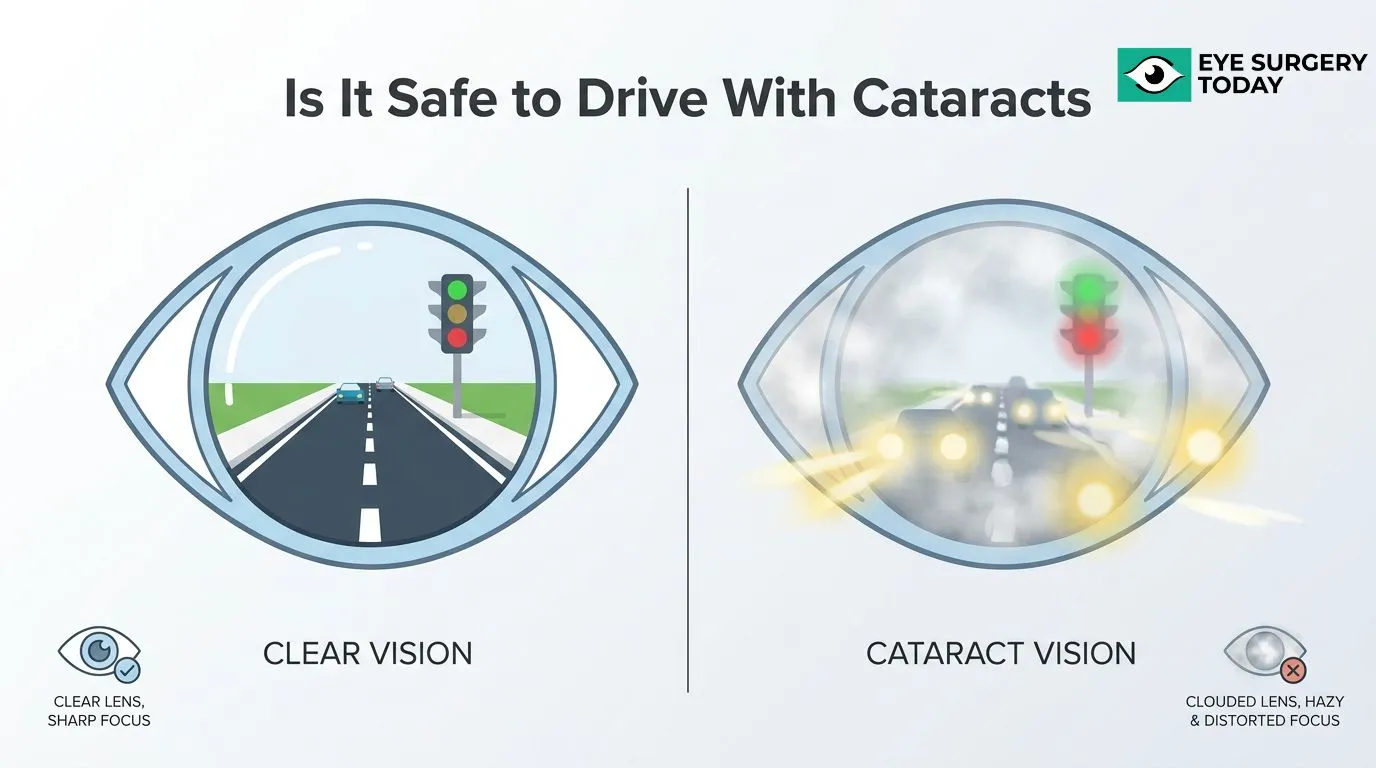
A cataract is a progressive clouding of the eye’s natural lens that can impair visual acuity, contrast sensitivity, glare tolerance, and color perception; each of these functions plays a direct role in safe vehicle operation.
This guide covers how cataracts affect driving vision, legal requirements and warning signs, nighttime safety concerns, practical strategies for early-stage cataracts, when to stop driving, how cataract surgery may restore driving ability, and the risks of leaving cataracts untreated.
Cataracts degrade driving vision through multiple pathways. Blurry distance vision can push acuity below the 20/40 threshold most states require, while light scattering through the clouded lens produces halos and starbursts that obscure lane markers and pedestrians. Contrast sensitivity loss, often undetected by standard eye charts, may be the most underestimated hazard because it impairs the ability to distinguish objects against similarly toned backgrounds.
Legally, you can drive with cataracts as long as your corrected vision meets state minimums, but a failed DMV screening or worsening symptoms like overwhelming headlight glare and frequent near-misses may signal it is time to stop. Most states do not require self-reporting of cataracts, though some allow physicians to notify the DMV when vision falls below safe thresholds.
Drivers with early cataracts can reduce risk by limiting night driving, increasing following distance, and scheduling regular eye exams, yet research suggests they still face a substantially higher crash rate even with these adjustments.
Cataract surgery may help many patients return to driving, often within 24 to 48 hours, by restoring contrast sensitivity and reducing glare. Earlier evaluation with a qualified eye care provider can help minimize the window of elevated risk on the road.
How Do Cataracts Affect Your Driving Vision?
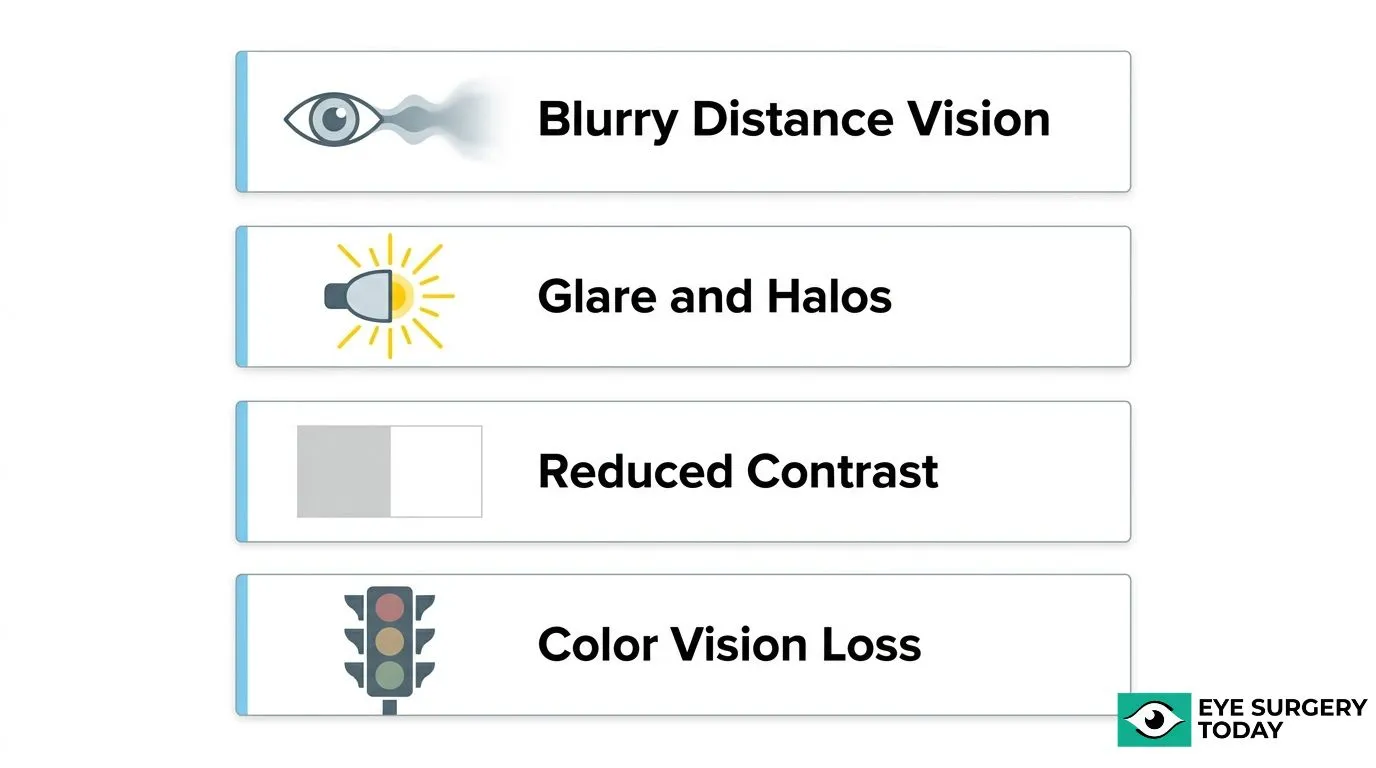
Cataracts affect your driving vision by reducing clarity, increasing glare sensitivity, lowering contrast perception, and altering color recognition. The following sections cover blurry vision, nighttime glare, contrast sensitivity loss, and color vision changes.
How Does Blurry Vision From Cataracts Impact Driving?
Blurry vision from cataracts impacts driving by reducing visual acuity below the thresholds required for safe vehicle operation. As the lens becomes increasingly clouded, fine details like road signs, lane markings, and distant objects lose definition.
Most jurisdictions set specific acuity minimums that cataract-related blur can push a driver below. According to the California Department of Motor Vehicles, the vision screening standard requires the ability to see 20/40 with both eyes together, with at least 20/40 in one eye and 20/70 in the other. Comparable standards exist internationally; the UK requires a minimum decimal acuity of 0.5 (6/12) using both eyes.
When cataracts degrade acuity past these benchmarks, even familiar routes become hazardous. Judging stopping distances, reading highway exit numbers, and spotting pedestrians all depend on sharp central vision that progressive lens opacity steadily erodes.
How Does Glare From Cataracts Affect Night Driving?
Glare from cataracts affects night driving by scattering incoming light across the clouded lens, producing halos and starbursts around headlights, streetlamps, and traffic signals. This scattered light reduces the ability to distinguish objects in darker areas of the visual field, making lane markers and pedestrians harder to detect.
Standard visual acuity tests performed in a well-lit clinic often fail to capture this deficit. According to a literature review published on ResearchGate, nighttime driving creates many glare situations that can be better identified by vision tests specifically designed for cataracts, such as contrast sensitivity testing and Useful Field of View (UFOV) assessments. Because glare worsens as ambient light drops, nighttime conditions disproportionately magnify cataract-related visual impairment. For many drivers, night glare is the earliest noticeable sign that cataracts are beginning to compromise driving safety.
How Do Cataracts Reduce Contrast Sensitivity on the Road?
Cataracts reduce contrast sensitivity on the road by scattering light within the eye, which diminishes the ability to distinguish objects from similarly toned backgrounds. This impairment affects real-world tasks like detecting a gray vehicle against overcast skies or spotting faded lane lines on wet pavement.
Typical symptoms of age-related cataract include reduced vision, disability glare, and impaired visual function in low-contrast conditions, according to a 2023 article published by PMC (National Institutes of Health). Even when standard acuity remains adequate, contrast sensitivity loss can silently elevate crash risk. Research published in JAMA Ophthalmology found that older drivers with cataracts have significantly worse contrast sensitivity and disability glare scores compared to those without cataracts, with severe impairment in even one eye elevating at-fault crash risk.
Contrast sensitivity loss is arguably the most underestimated cataract-related driving hazard, since it rarely triggers a failed letter chart test yet directly impairs real-world hazard detection.
How Does Cataract-Related Loss of Color Vision Affect Driving?
Cataract-related loss of color vision affects driving by making traffic signals, brake lights, and warning signs harder to distinguish. As the lens yellows and becomes more opaque, shorter wavelength colors like blue and green appear muted or washed out, while reds and oranges may lose their vibrancy.
This shift can delay a driver’s recognition of a changing traffic light or reduce the conspicuity of emergency vehicle signals. According to the American Academy of Ophthalmology, progressive vision loss from conditions like cataracts can compromise the visual functions essential for safe driving. Although color vision changes develop gradually, they compound the effects of reduced acuity, glare, and contrast loss already discussed.
Color perception deficits from cataracts rarely occur in isolation; they layer onto other visual impairments, making the combined effect on driving safety greater than any single symptom suggests. For a deeper dive into cataract symptoms and diagnosis, and how they generally affect vision, consider consulting a comprehensive guide. Understanding the full scope of these visual changes helps inform the decision about when cataracts have progressed too far for safe driving.
What Are the Signs Your Cataracts Are Too Advanced to Drive Safely?
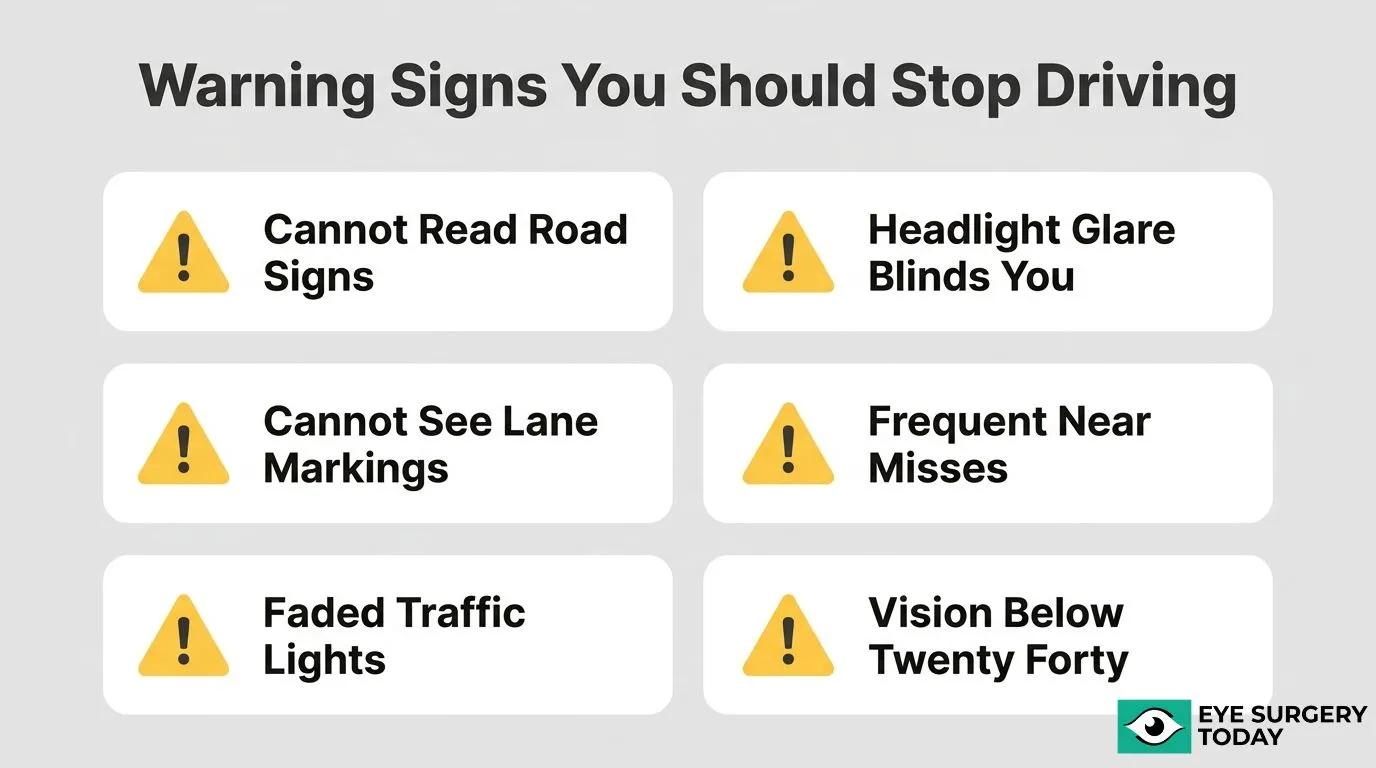
The signs your cataracts are too advanced to drive safely include persistent blurry vision, severe glare sensitivity, difficulty seeing in low-contrast conditions, and measurable visual field loss. These warning signs often overlap, and recognizing them early can help protect you and others on the road.
Several specific indicators suggest cataracts may have progressed beyond safe driving limits:
- Consistent difficulty reading road signs at normal distances, which may indicate visual acuity has dropped below the 20/40 threshold many states require.
- Overwhelming glare from oncoming headlights that temporarily blinds you or takes longer than a few seconds to recover from.
- Trouble distinguishing objects in low-contrast settings, such as spotting pedestrians at dusk or seeing lane markings on wet roads.
- Noticeable visual field narrowing, making it harder to detect vehicles or hazards in peripheral vision.
- Faded or yellowed color perception, which can delay recognition of traffic signals and brake lights.
- Frequent near-misses or difficulty judging distances when merging, turning, or stopping.
According to a study published in JAMA Ophthalmology, older drivers with cataracts have significantly worse visual acuity, contrast sensitivity, and disability glare scores compared to those without cataracts, and severe contrast sensitivity impairment in even one eye can elevate at-fault crash risk. This finding highlights that standard eye chart tests alone may not capture the full extent of driving-related visual impairment caused by cataracts.
A visual acuity reading worse than 20/40, combined with any of the symptoms listed above, is a strong signal that driving may no longer be safe without treatment. Many drivers underestimate how much their vision has changed because cataracts progress gradually. If you notice any combination of these signs, a comprehensive eye examination that includes contrast sensitivity testing can provide a clearer picture of whether your cataracts have reached a level that compromises driving safety.
Understanding these legal and clinical benchmarks becomes especially important when evaluating whether you meet your state’s minimum vision requirements for driving.
Can You Legally Drive With Cataracts?
You can legally drive with cataracts as long as your vision meets your state’s minimum acuity standards. The sections below cover driving vision requirements, DMV vision test outcomes, and cataract reporting obligations.
What Are the Minimum Vision Requirements for Driving?
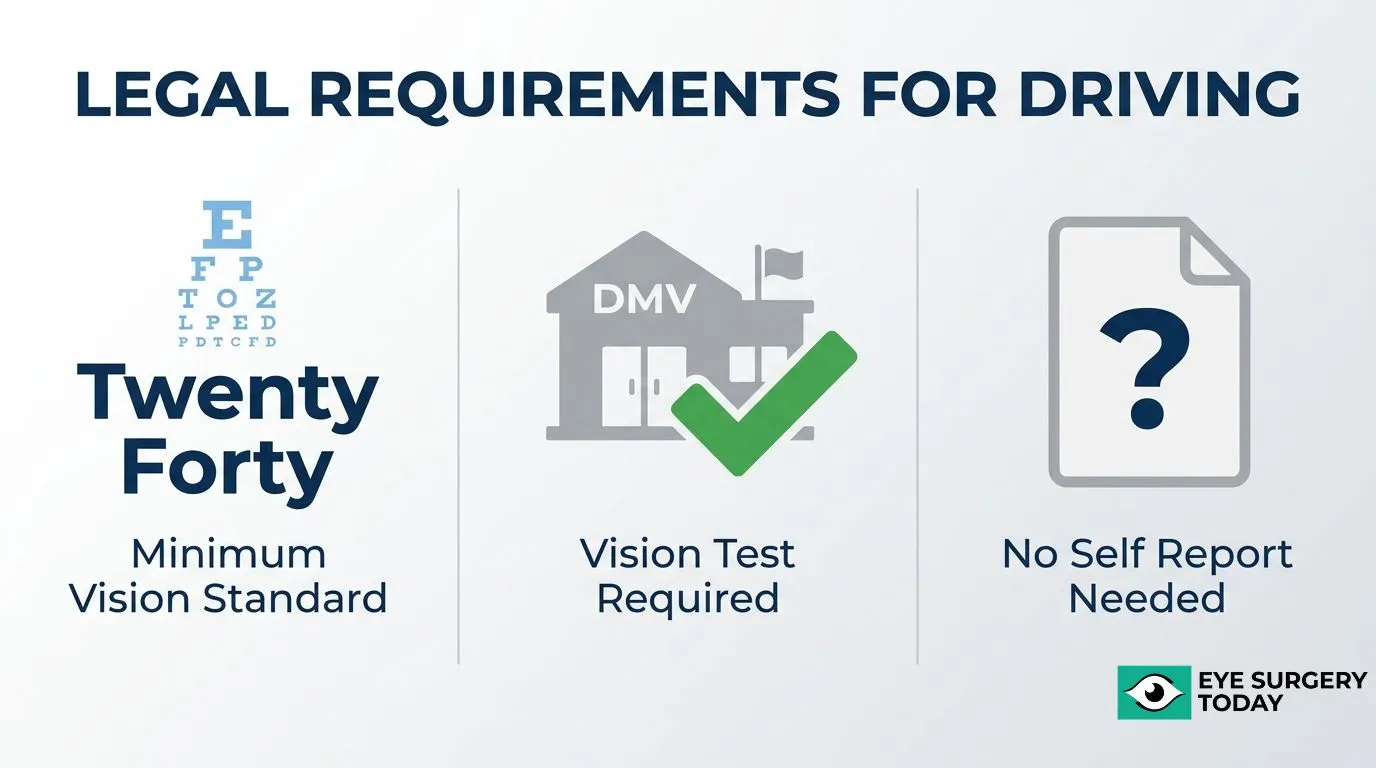
The minimum vision requirements for driving vary by jurisdiction but generally center on visual acuity thresholds measured on the Snellen chart. Most U.S. states require corrected acuity of 20/40 or better in at least one eye for an unrestricted license. According to the California Department of Motor Vehicles, the vision screening standard is the ability to see 20/40 with both eyes together, with at least 20/40 in one eye and 20/70 in the other.
Other countries set similar baselines:
- The United Kingdom requires a visual acuity of at least 6/12 (decimal 0.5) using both eyes together.
- Australia requires uncorrected acuity no worse than 6/12 in the better eye for an unconditional private license.
Because cataracts progressively reduce acuity, drivers whose vision has declined below these thresholds may need corrective lenses or surgical intervention before they can legally operate a vehicle. Regular eye exams remain the most reliable way to confirm whether your vision still qualifies.
Can You Fail a DMV Vision Test Because of Cataracts?
Yes, you can fail a DMV vision test because of cataracts if the lens clouding has reduced your acuity below the state’s legal threshold. Standard DMV screenings measure distance acuity using a letter or symbol chart, and cataracts that have progressed enough to blur vision past the 20/40 cutoff will produce a failing result.
What makes cataract-related failures particularly common is that standard screenings do not test contrast sensitivity or glare recovery. A driver may pass the acuity chart in a well-lit DMV office yet struggle severely under real-world conditions. For most drivers with early to moderate cataracts, an updated glasses prescription can temporarily restore acuity enough to pass. When corrective lenses no longer compensate, cataract surgery is typically the clearest path back to meeting legal standards.
Do You Have to Report Cataracts to the DMV?
No, you do not have to report cataracts to the DMV in most U.S. states. The majority of states rely on periodic vision screenings at license renewal rather than requiring drivers to self-report specific eye conditions. However, a few states allow or require physicians to notify the DMV when a patient’s vision falls below safe driving thresholds, regardless of the underlying cause.
Key considerations include:
- Some states issue restricted licenses (daytime-only driving, for example) if vision meets minimum acuity but falls short of full standards.
- An eye care provider may recommend voluntary reporting if cataracts have significantly impaired your functional vision.
- Failing to disclose a known vision impairment could carry legal liability in the event of an accident.
Even where reporting is not mandatory, scheduling a comprehensive eye exam before renewal helps avoid surprises at the DMV. Understanding your surgical options early can keep you driving safely and legally.
Is It Safe to Drive at Night With Cataracts?
Driving at night with cataracts is generally not safe for most people with progressing lens clouding. Glare sensitivity, reduced contrast, and visual distortion intensify in low-light conditions, creating significant hazards.
Cataracts impair the eye’s ability to manage incoming light, and oncoming headlights can scatter through the clouded lens, producing halos and intense glare. These effects make it difficult to see lane markers, pedestrians, and road signs clearly. According to the National Highway Traffic Safety Administration, drivers with cataracts experience major risks at night due to glare, halos around lights, and decreased night vision, which can make it difficult to see lane markers and pedestrians.
Many older drivers recognize these limitations and adjust their habits accordingly. Self-regulation is the primary compensatory strategy aging drivers with cataracts use, often choosing to avoid nighttime driving or other challenging conditions, as reported in a 2022 study published in Nature (Scientific Reports). Limiting night driving is one of the most practical steps a person with cataracts can take to reduce risk.
However, relying solely on self-regulation has limits. If cataracts have progressed to the point where night driving feels unsafe, that is often a signal to discuss surgical options with an eye care provider. An ophthalmologist can evaluate whether cataract severity warrants intervention before nighttime vision loss leads to a dangerous situation on the road.
How Can You Drive More Safely if You Have Early Cataracts?
You can drive more safely with early cataracts by adopting specific compensatory habits that reduce visual strain. Even with these adjustments, the underlying risk remains significant.
According to a study published in the British Journal of Ophthalmology, drivers with cataracts have 2.5 times more crashes than controls, even when they limit their driving exposure. This finding underscores why behavioral changes alone are not a permanent solution, though they can meaningfully reduce risk during the early stages.
Practical strategies for safer driving with early cataracts include:
- Drive only during daylight hours to avoid glare, halos, and reduced contrast that worsen after dark.
- Keep headlights and windshields clean to minimize additional light scatter.
- Increase following distance to allow more reaction time when visual clarity is reduced.
- Avoid unfamiliar routes where unexpected road conditions may demand sharper vision.
- Use anti-glare lenses or coated prescription glasses to help manage disability glare.
- Schedule regular eye exams so your ophthalmologist can monitor whether your cataracts have progressed beyond safe driving thresholds.
These measures can help in the short term, but they do not address the progressive nature of cataracts. For most drivers, planning ahead for cataract surgery before vision deteriorates further is the most reliable path to maintaining long-term driving independence.
When Should You Stop Driving Because of Cataracts?
You should stop driving because of cataracts when your vision no longer meets legal standards or when everyday driving tasks feel unsafe. Several specific situations signal it is time to hand over the keys:
- You fail a DMV vision screening. If your visual acuity drops below your state’s minimum threshold (often 20/40 with both eyes), you may no longer qualify for a valid license.
- Night driving becomes unmanageable. Persistent glare, halos around headlights, and difficulty seeing lane markers or pedestrians at night indicate your cataracts have progressed beyond safe limits.
- Contrast sensitivity is severely reduced. When you struggle to distinguish road signs, curbs, or other vehicles in overcast or low-light conditions, your ability to react safely is compromised.
- You notice near-misses or close calls. Frequent lane drifting, delayed reactions to traffic signals, or difficulty judging distances suggest your visual function can no longer support safe driving.
- Your eye doctor recommends stopping. An ophthalmologist can measure visual acuity, contrast sensitivity, and visual field loss with precision that self-assessment cannot match.
Waiting too long carries real consequences. Rather than viewing the decision to stop driving as a loss, consider it a temporary step. Cataract surgery may restore enough visual function to get you back behind the wheel, often within days. Speaking with your eye care provider early gives you the best chance of resuming safe, independent driving sooner rather than later.
Can Cataract Surgery Help You Drive Again?
Cataract surgery can help many patients drive again by restoring visual clarity, contrast sensitivity, and glare tolerance. The sections below cover recovery timelines, measurable vision improvements, and what to expect if corrective lenses are still needed.
How Soon After Cataract Surgery Can You Drive?
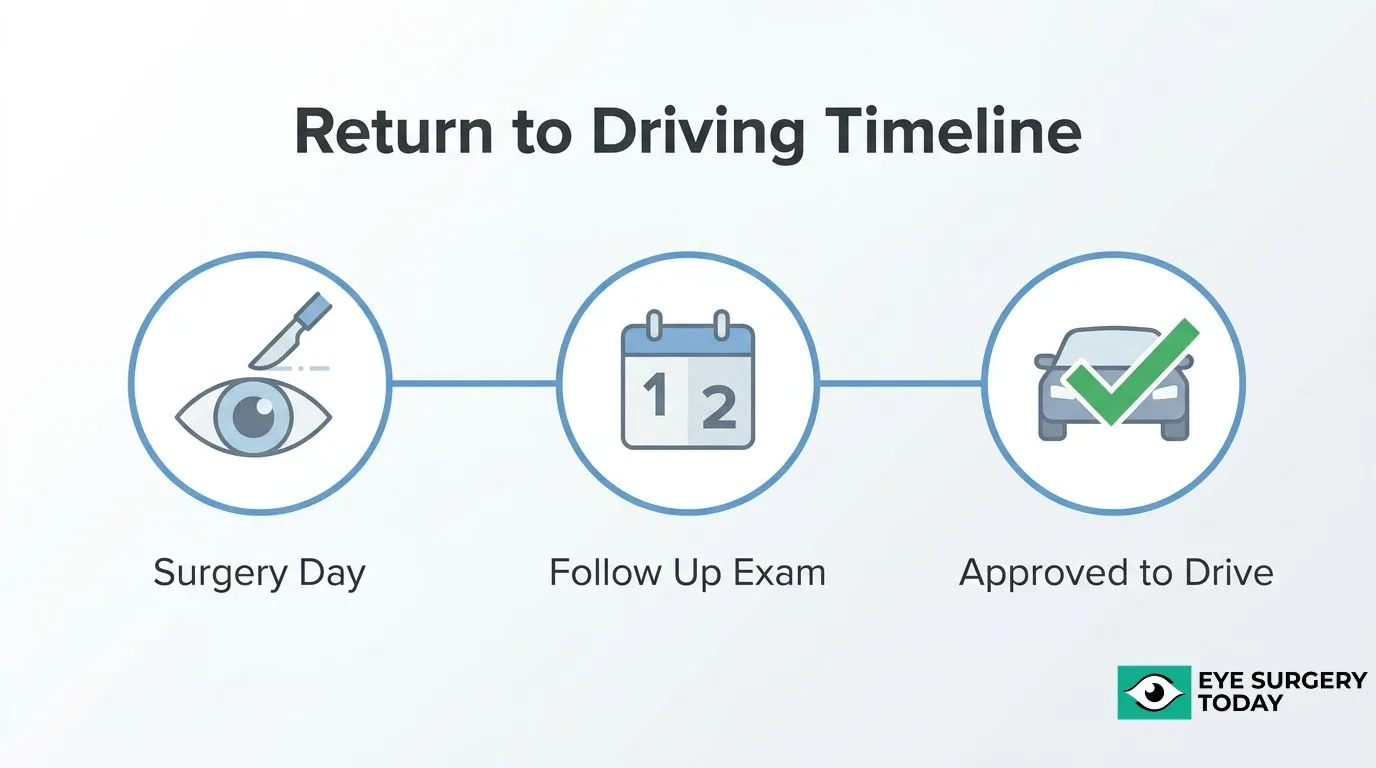
Most patients can return to driving within 24 to 48 hours after cataract surgery, provided they have their surgeon’s approval and meet applicable vision standards. However, individual recovery varies. Some people experience residual blurriness or light sensitivity during the first day, which makes operating a vehicle unsafe until symptoms resolve.
Your eye surgeon will typically schedule a follow-up exam within the first day or two after the procedure. During that visit, visual acuity is checked to confirm it meets the minimum driving threshold in your state. Until that clearance is given, arranging alternative transportation is essential.
According to a National Institutes of Health review, a proactive policy encouraging cataract surgery earlier, even for a lesser level of visual complaint, could significantly reduce motor vehicle collisions among older drivers. This finding suggests that waiting until cataracts become severely debilitating before pursuing surgery may unnecessarily extend the period when driving poses a risk. For patients whose independence depends on the ability to drive, earlier evaluation is worth discussing with a qualified eye care provider.
How Much Can Cataract Surgery Improve Driving Vision?
Cataract surgery can improve driving vision substantially, particularly in areas most affected by lens clouding. According to a study published in PubMed, cataract surgery results in marked improvements in driving performance, which are directly related to concurrent improvements in contrast sensitivity. Because reduced contrast sensitivity is one of the primary ways cataracts compromise road safety, restoring it addresses the root visual deficit rather than just sharpening letter acuity on an eye chart.
Improvements typically include:
- Sharper distance vision for reading road signs and recognizing hazards.
- Reduced glare sensitivity, making night driving more manageable.
- Better contrast detection for distinguishing lane markings, pedestrians, and obstacles in low-light conditions.
These gains often allow patients to meet or exceed state-mandated visual acuity thresholds for licensure. For many older drivers, this procedure represents the single most effective intervention for reclaiming safe, independent driving.
What if You Still Need Glasses to Drive After Surgery?
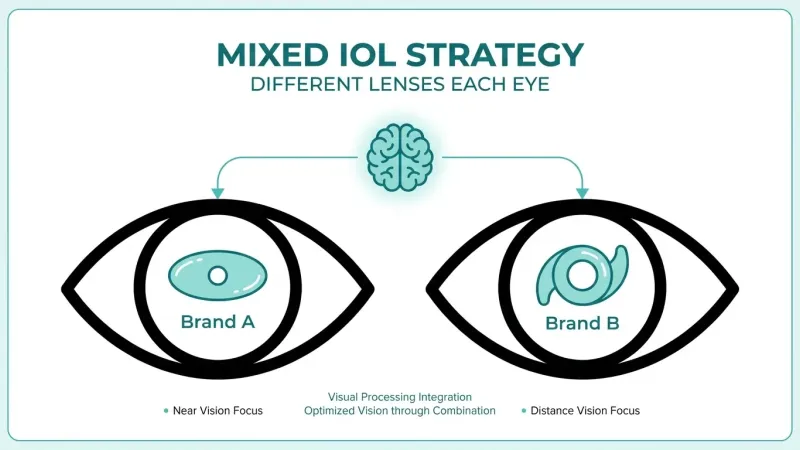
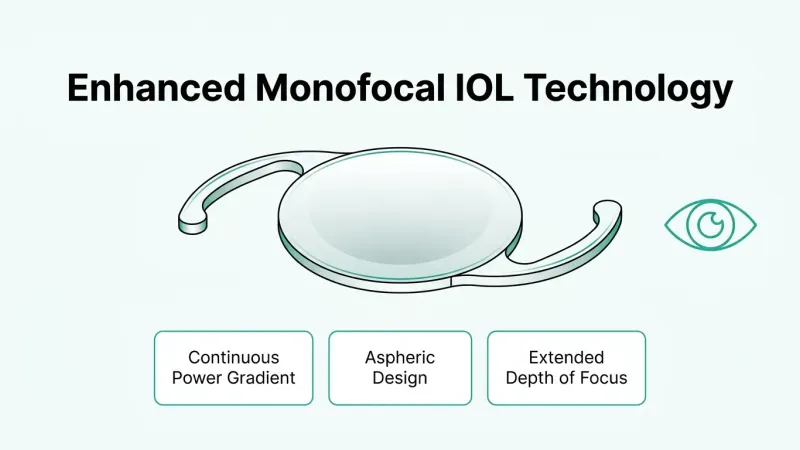
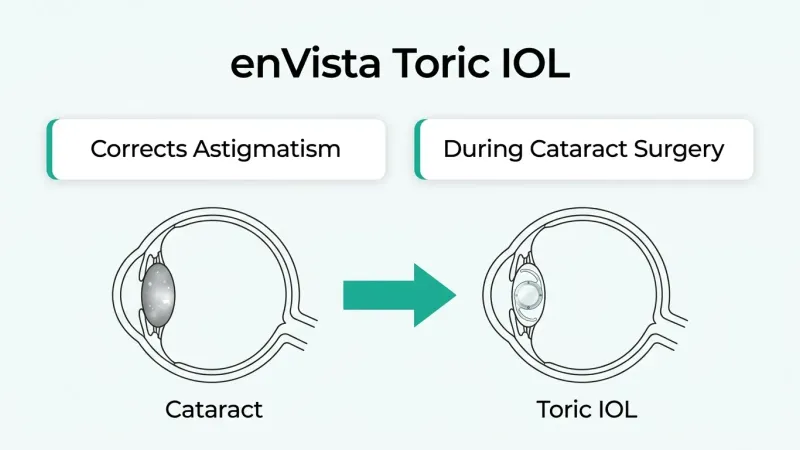
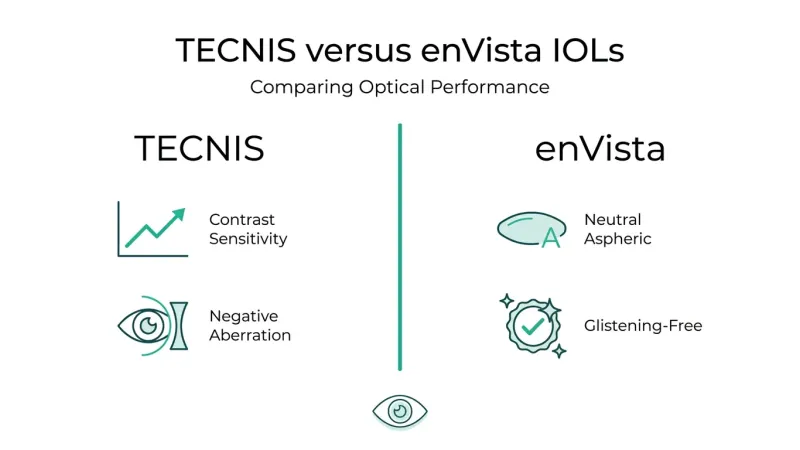
Some patients still need glasses to drive after cataract surgery, and this is completely normal. The artificial intraocular lens (IOL) implanted during the procedure corrects vision at a predetermined focal point. Depending on the IOL type selected, residual refractive error may require corrective lenses for certain distances. Even with excellent surgical outcomes, patients often benefit from understanding the range of before and after vision improvements and potential residual needs.
Common post-surgical scenarios include:
- Monofocal IOL patients may need glasses for near tasks or, less commonly, for distance driving.
- Multifocal or extended-depth-of-focus IOLs reduce glasses dependence but can occasionally produce mild halos at night.
- A small residual prescription can be corrected with lightweight glasses or a brief enhancement procedure.
Needing glasses after surgery does not diminish the safety benefits. As long as corrected visual acuity meets state driving standards, patients can drive legally and confidently. The key is ensuring your post-operative prescription is current and that you wear corrective lenses whenever required behind the wheel.
With driving vision restored, understanding the broader risks of leaving cataracts untreated helps frame why timely surgery matters.
What Are the Risks of Continuing to Drive With Untreated Cataracts?
The risks of continuing to drive with untreated cataracts include a significantly higher crash rate, worsening night vision, reduced contrast sensitivity, and potential legal consequences if vision falls below state minimums. These risks compound over time as the cataract progresses.
According to a study published in the British Journal of Ophthalmology, drivers with cataracts have 2.5 times more crashes than controls, even when they limit their driving exposure. That elevated crash rate reflects the combined effect of multiple vision impairments: blurred acuity, increased glare sensitivity, and difficulty distinguishing objects in low-contrast conditions.
What makes untreated cataracts particularly dangerous is their gradual progression. Many drivers adapt to slow vision loss without recognizing how much their ability has declined. Self-regulation strategies, such as avoiding night driving or unfamiliar routes, can reduce exposure but do not eliminate the underlying risk. A clouded lens still distorts depth perception, delays reaction to sudden hazards, and narrows the functional visual field.
From a safety standpoint, delaying treatment trades manageable early-stage limitations for compounding danger. Every month of progression means dimmer vision, slower hazard recognition, and a shrinking margin for safe response. Consulting an eye care provider early remains the most reliable way to protect both the driver and everyone sharing the road.
How Can Surgeon-Reviewed Cataract Resources Help You Decide?
Surgeon-reviewed cataract resources can help you decide by providing clinically accurate, accessible information about vision changes, driving safety, and treatment options. The sections below cover how Eye Surgery Today supports informed decision-making and the key takeaways from this guide.
Can Eye Surgery Today Help You Understand Your Cataract Surgery Options?
Yes, Eye Surgery Today can help you understand your cataract surgery options. The platform provides surgeon-reviewed educational guides covering cataract surgery fundamentals, advanced intraocular lens options, recovery expectations, and safety considerations. According to a study published in PubMed, cataract surgery results in marked improvements in driving performance that are directly related to concurrent improvements in contrast sensitivity. Eye Surgery Today translates findings like these into clear, jargon-free resources so patients can evaluate their choices with confidence. From understanding when cataracts may affect driving fitness to learning what recovery looks like, Eye Surgery Today gives readers the knowledge needed to have productive conversations with their eye care providers. It also offers insights into a broader range of vision improvement procedures, including refractive vision correction like LASIK, for those exploring other surgical options.
What Are the Key Takeaways About Cataracts and Driving Safety?
The key takeaways about cataracts and driving safety are:
- Cataracts can reduce visual acuity, contrast sensitivity, and glare tolerance, all of which are critical for safe driving.
- Night driving poses heightened risks due to halos, glare, and difficulty seeing lane markers and pedestrians.
- Most states and countries require a minimum visual acuity, often around 20/40, to legally operate a vehicle.
- Self-regulation strategies, such as avoiding night driving and unfamiliar routes, may help in early stages but do not eliminate elevated crash risk.
- Cataract surgery can restore driving-level vision, with many patients returning to driving within 24 to 48 hours after receiving their surgeon’s approval.
- Delaying treatment may increase collision risk unnecessarily, so discussing surgical timing with an ophthalmologist is important.
Reviewing surgeon-verified resources on Eye Surgery Today can help you move from uncertainty to a well-informed decision about your vision and driving safety.