Premium cataract lenses are intraocular lenses (IOLs) engineered to correct refractive errors such as astigmatism and presbyopia during cataract surgery, offering a broader range of clear vision than standard monofocal implants.
This guide covers the available premium lens types, candidacy and disqualifying factors, the diagnostic tests surgeons use to assess eligibility, potential benefits and risks, and the financial considerations involved.
Premium IOL options include multifocal, extended depth of focus (EDOF), toric, accommodating, and light adjustable lenses, each designed for a different visual profile. Multifocal and trifocal designs may provide spectacle independence across near, intermediate, and distance vision, while toric lenses specifically target corneal astigmatism.
Candidacy depends heavily on existing eye health. Patients with regular astigmatism, presbyopia, or prior LASIK may qualify after thorough evaluation, whereas conditions such as macular degeneration, glaucoma, corneal irregularities, and capsular instability can limit or exclude premium lens options due to concerns about compounded contrast sensitivity loss.
Surgeons rely on corneal topography, ocular biometry, macular OCT imaging, wavefront aberrometry, and structured lifestyle questionnaires to match each patient to an appropriate lens. These measurements identify irregularities that could impair premium IOL performance before implantation occurs.
While premium lenses may reduce glasses dependence for many patients, trade-offs include halos, glare, and reduced contrast sensitivity, particularly with diffractive designs. Most symptoms improve through neuroadaptation over time.
Medicare and most private insurers cover only the standard monofocal lens portion of cataract surgery. Premium IOL upgrades typically cost $3,000 to $5,000 per eye as an out-of-pocket expense, making financial planning an important part of the decision process.
What Are Premium Cataract Lenses?
Premium cataract lenses are intraocular lenses (IOLs) designed to restore vision after cataract surgery while also correcting refractive errors such as astigmatism or presbyopia. The following sub-sections explain how they differ from standard lenses and why surgeons and patients commonly refer to them as lifestyle lenses.
How Do Premium Lenses Differ From Standard Monofocal Lenses?
Premium lenses differ from standard monofocal lenses in their optical design and the range of vision they provide. According to the ISO 11979-7:2024 classification, IOLs fall into four categories based on optical design and clinical performance: monofocal, toric, simultaneous vision (SVIOL), and accommodating. Standard monofocal lenses correct vision at a single fixed distance, typically for distance, leaving patients dependent on reading glasses for near or intermediate tasks. Premium IOLs, by contrast, address multiple focal distances or correct astigmatism simultaneously.
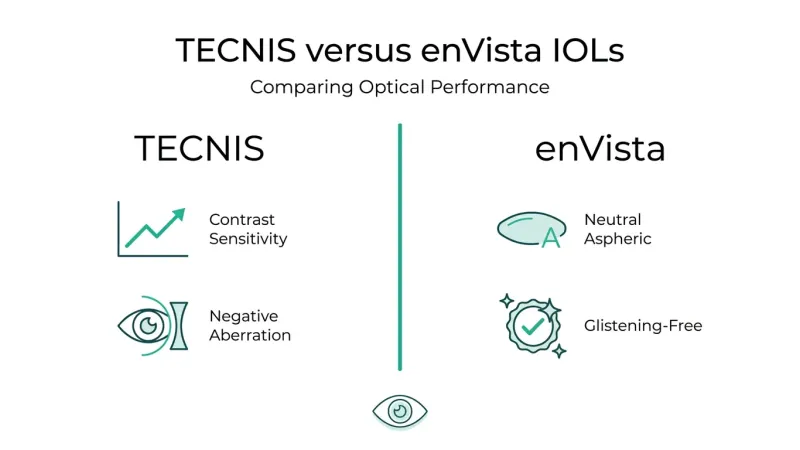
That added capability comes with trade-offs. Diffractive or refractive multifocal IOLs may reduce contrast sensitivity by 20 to 30 percent compared to monofocal lenses, according to the American Academy of Ophthalmology. The National Institute for Health and Care Excellence (NICE) notes that the NHS does not routinely offer multifocal IOLs, as they are not considered cost-effective relative to standard monofocal lenses. For most patients, weighing these optical trade-offs against lifestyle benefits is the central decision in lens selection.
Why Are Premium Lenses Called Lifestyle Lenses?
Premium lenses are called lifestyle lenses because they are designed around a patient’s daily visual demands rather than simply replacing a clouded lens. These IOLs are frequently referred to by several synonyms, including “lifestyle lenses,” “advanced technology lenses,” “presbyopia-correcting IOLs (PC-IOLs),” and “astigmatism-correcting IOLs (AC-IOLs).” The terminology reflects the goal of reducing or eliminating dependence on corrective eyewear across a patient’s typical activities, such as reading, computer work, and driving. The name is well-chosen: unlike a standard lens, a premium IOL is selected based on what a patient wants to do without glasses, making lifestyle alignment central to the candidacy process.
What Are the Types of Premium Cataract Lenses?
The types of premium cataract lenses include multifocal, extended depth of focus, toric, accommodating, and light adjustable intraocular lenses. Each is designed for a different visual need and patient profile, covered in the sections below.
Multifocal Intraocular Lenses
Multifocal intraocular lenses are IOLs that use multiple focal zones to provide clear vision at more than one distance, such as near, intermediate, and far. Using diffractive or refractive optics, they split incoming light across these zones simultaneously. According to a study published in the Journal of Current Ophthalmology, multifocal IOLs provide spectacle independence in 81% to 85% of patients. Trifocal designs, a subtype, generally offer the strongest performance across all three distance ranges, making them a preferred choice when maximum glasses freedom is the primary goal.
Extended Depth of Focus Lenses
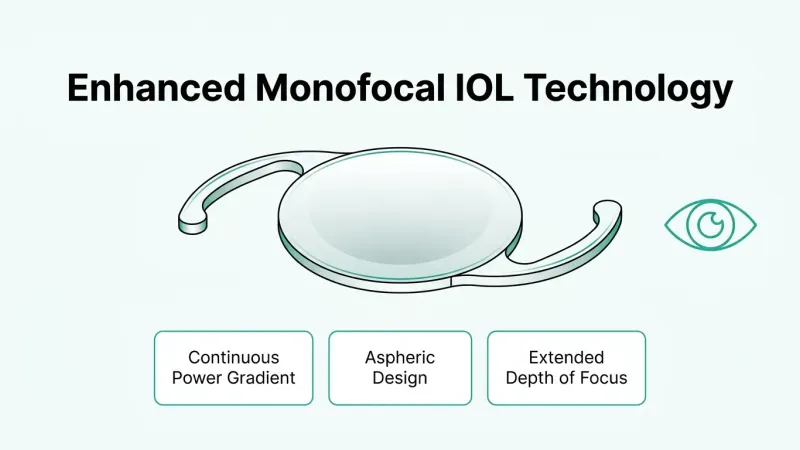
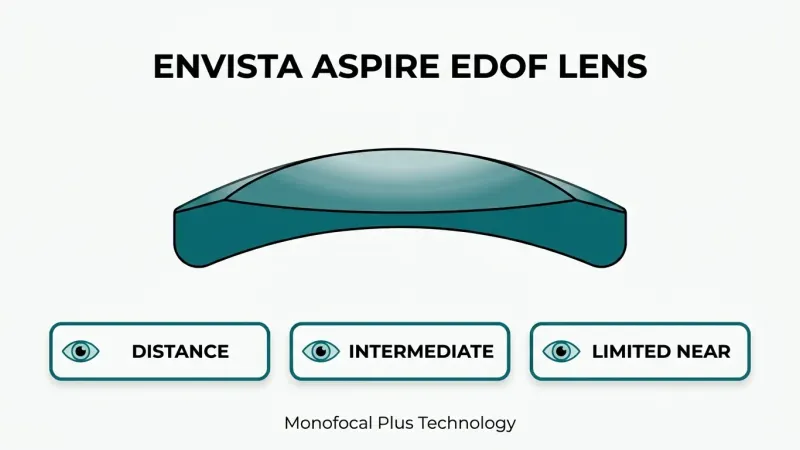
Extended depth of focus lenses are IOLs that elongate a patient’s focal range rather than dividing it into distinct near and far zones. This produces a continuous range of clear vision, particularly strong at distance and intermediate. Per the ANSI/AAO Standard Z80.35-2018, EDOF IOLs must provide a monocular depth of focus at least 0.5 diopters greater than a monofocal control lens. The tradeoff is that near vision, such as reading fine print, may still require glasses more often than with trifocal designs.
Toric Intraocular Lenses
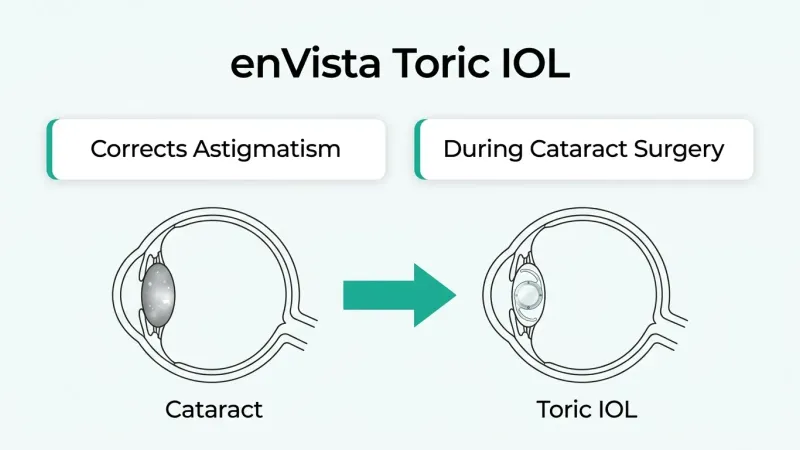
Toric intraocular lenses are IOLs specifically engineered to correct corneal astigmatism at the time of cataract surgery. Built with two meridional powers oriented along a precise axis, they neutralize the uneven corneal curvature that causes blurred or distorted vision. Proper axis alignment during implantation is critical; even minor rotational misalignment can reduce their effectiveness. For patients with significant astigmatism, toric lenses are often the most reliable path to clear distance vision without relying on glasses or contact lenses after surgery.
Accommodating Intraocular Lenses
Accommodating intraocular lenses are IOLs designed to shift position or change shape within the eye in response to natural ciliary muscle movement, mimicking the eye’s native focusing mechanism. In practice, the degree of true accommodation achieved varies between patients, and near vision performance tends to be less predictable than with multifocal or trifocal designs. They carry a lower risk of halos and glare compared to diffractive lenses, which makes them a reasonable option for patients who prioritize quality of vision in low-light conditions over maximum spectacle independence.
Light Adjustable Lenses
Light adjustable lenses are IOLs whose refractive power can be fine-tuned after implantation using ultraviolet light treatments. On November 22, 2017, the FDA approved the RxSight Light Adjustable Lens, making it the first implanted lens adjustable post-surgery to improve vision without glasses. This technology allows surgeons to customize the final prescription once the eye has healed, reducing dependence on pre-surgical measurements alone. For patients seeking a highly personalized refractive outcome, light adjustable lenses represent one of the most precise options currently available.
Who May Be a Good Candidate for Premium Cataract Lenses?
Good candidates for premium cataract lenses generally include patients with astigmatism, presbyopia, prior refractive surgery, or active lifestyles who want reduced dependence on glasses. The H3s below cover the most common eligibility scenarios in detail.
Can You Get Premium Lenses if You Have Astigmatism?
Yes, you can get premium lenses if you have astigmatism, provided the astigmatism is regular rather than irregular. Toric IOLs are specifically designed to correct corneal astigmatism at the time of cataract surgery. However, irregular astigmatism complicates candidacy considerably. According to a 2024 review in Current Opinion in Ophthalmology, inconsistent keratometry readings and a lack of continuous concentric rings on corneal topography may indicate irregular astigmatism or dry eye, both of which can impair premium IOL outcomes. Surgeons typically require thorough topographic mapping before approving a toric or multifocal lens for astigmatic patients. For billing purposes, HCPCS code V2787 identifies the noncovered portion of an astigmatism-correcting IOL, meaning patients with astigmatism who choose a toric premium lens will usually pay an out-of-pocket upgrade cost.
Can You Get Premium Lenses if You Have Presbyopia?
Yes, you can get premium lenses if you have presbyopia, and presbyopia is actually one of the primary indications for multifocal, trifocal, and EDOF IOLs. These lenses distribute light across multiple focal points, reducing or eliminating the need for reading glasses after surgery. Presbyopia-correcting IOLs are among the most commonly selected premium options for patients who want functional near and intermediate vision following cataract removal.
Can You Get Premium Lenses if You Have Prior LASIK?
Yes, you can get premium lenses if you have prior LASIK, though candidacy requires careful evaluation. Prior corneal refractive surgery alters the shape of the cornea and affects the accuracy of standard IOL power calculations. Surgeons typically use modified biometry formulas and additional diagnostic imaging to improve refractive predictability in these patients. A thorough preoperative workup helps determine whether a premium lens can still achieve the target refraction reliably.
Can You Get Premium Lenses if You Have Dry Eye Disease?
Yes, you can get premium lenses if you have dry eye disease, but the condition should be treated and stabilized before surgery. The Journal of Current Ophthalmology notes that patients with dry eye syndrome and meibomian gland dysfunction are at high risk of dissatisfaction after cataract surgery due to tear-film abnormalities and should be managed aggressively beforehand. Unstable tear film degrades the quality of topographic measurements used for premium IOL selection, potentially resulting in suboptimal outcomes. Patients who achieve adequate tear-film stability before surgery are generally considered reasonable candidates.
Can You Get Premium Lenses if You Drive Frequently at Night?
Yes, you can get premium lenses if you drive frequently at night, but the lens type selected matters significantly. Multifocal and diffractive IOLs are associated with increased halos and glare in low-light conditions, which can affect nighttime driving comfort, particularly in the early postoperative period. EDOF lenses are often considered a better fit for active nighttime drivers because they tend to produce fewer dysphotopsia symptoms than full multifocal designs. Discussing driving habits with your surgeon during the consultation helps guide lens selection toward the option that best balances spectacle independence with nighttime visual quality.
Who May Not Be Eligible for Premium Cataract Lenses?
Not every patient qualifies for premium intraocular lenses. Certain eye conditions can make multifocal, EDOF, or toric IOLs inappropriate or ineffective, covering disqualifying retinal diseases, glaucoma, and corneal irregularities.
What Eye Conditions May Disqualify You From Premium Lenses?
The eye conditions that may disqualify you from premium lenses include retinal disorders, glaucoma, corneal irregularities, and capsular instability. According to a review published in the Journal of Current Ophthalmology, ocular disorders with capsular instability, such as pseudoexfoliative syndrome or trauma-induced zonulolysis, are absolute contraindications for multifocal IOLs. Dry eye syndrome and meibomian gland dysfunction can also make patients poor candidates. In practice, even seemingly manageable conditions can significantly undermine premium lens performance, which is why thorough preoperative screening matters more than most patients realize.
How Does Macular Degeneration Affect Premium Lens Eligibility?
Macular degeneration affects premium lens eligibility by making multifocal IOLs generally unsuitable for affected eyes. According to a review published in PMC (National Institutes of Health), implantation of multifocal IOLs is often discouraged in patients with retinal disorders such as diabetic retinopathy or age-related macular degeneration (AMD), because the reduced contrast sensitivity of the lens can compound visual impairment from the disease. In these cases, a monofocal IOL typically provides safer, more predictable outcomes.
How Does Glaucoma Affect Premium Lens Eligibility?
Glaucoma affects premium lens eligibility primarily through its impact on contrast sensitivity. Multifocal IOLs are not considered ideal for patients with glaucoma because the relative loss of vision and contrast sensitivity may increase the perception of glaucomatous visual impairment, according to the European Society of Cataract and Refractive Surgeons (ESCRS). For most glaucoma patients, a monofocal lens is the safer, clinically preferred option.
How Do Corneal Irregularities Affect Premium Lens Eligibility?
Corneal irregularities affect premium lens eligibility by distorting the optical precision these lenses require. A preoperative corneal topography showing a lack of continuous concentric rings or inconsistent keratometry readings may indicate irregular astigmatism or dry eye, which can impair premium IOL selection, as noted in Current Opinion in Ophthalmology. Conditions such as Fuchs endothelial dystrophy require particularly careful evaluation due to their progressive nature. Patients with these findings are generally steered toward monofocal lenses to avoid unpredictable visual outcomes after surgery.
What Tests Does Your Surgeon Use to Determine Eligibility?
Surgeons use a combination of clinical measurements, imaging tests, and patient lifestyle assessments to determine whether you are a suitable candidate for a premium cataract lens. The evaluations covered below address both the technical and personal factors that guide lens selection.
Corneal Topography and Keratometry
Corneal topography maps the shape and curvature of your cornea’s surface. According to a review published in Current Opinion in Ophthalmology, a lack of continuous concentric rings and inconsistent keratometry readings may indicate irregular astigmatism or dry eye, both of which can significantly affect premium IOL selection.
Ocular Biometry
Ocular biometry measures the physical dimensions of the eye to calculate the correct IOL power. Swept-source optical coherence tomography (SS-OCT) based biometry provides improved measurement accuracy across all biometric parameters, supporting more precise lens power calculations before surgery.
Macular OCT Imaging
Macular OCT imaging allows your surgeon to detect hidden retinal pathology before surgery. The American Academy of Ophthalmology recommends routine macular OCT before cataract surgery, particularly for patients considering presbyopia-correcting IOLs, to avoid unexpectedly poor visual outcomes.
Wavefront Aberrometry
Wavefront aberrometry measures how light travels through the eye and identifies optical imperfections. Technologies such as the OPD-Scan III combine corneal topography, autorefraction, and wavefront analysis to assist in determining the correct axis placement for toric IOLs.
Lifestyle and Visual Goals Assessment
The lifestyle and visual goals assessment is a structured conversation your surgeon uses to understand how you use your vision in daily life. The Dell Questionnaire is a clinically validated lifestyle assessment tool used by surgeons to establish a common vocabulary with patients and determine their postoperative visual needs. This step is often underestimated, but it directly shapes which lens category aligns with your real-world priorities.
What Are the Potential Benefits of Premium Cataract Lenses?
The potential benefits of premium cataract lenses center on two outcomes: reduced dependence on corrective eyewear and improved vision across multiple distances. The sections below cover how premium lenses may address glasses dependence and near-to-intermediate visual tasks.
How May Premium Lenses Reduce Dependence on Glasses?
Premium lenses may reduce dependence on glasses by correcting vision across more than one focal distance within a single implant. Multifocal IOLs, for example, have demonstrated spectacle independence in 81% to 85% of patients, according to a study published in the Journal of Current Ophthalmology. Trifocal IOLs have shown even higher rates in clinical trials, with the AT LISAtri 839MP achieving 97.5% spectacle independence at distance.
That said, results vary by lens type, lifestyle, and preoperative eye health. For patients with strong motivations to minimize glasses use, aligning lens choice with daily visual demands is the most reliable path to satisfaction.
How May Premium Lenses Improve Intermediate and Near Vision?
Premium lenses may improve intermediate and near vision by distributing focal power across multiple zones, allowing the eye to see clearly at arm’s length and up close without reading glasses. A 2024 comparative study published on PubMed Central found that trifocal IOLs, such as the Alcon AcrySof IQ PanOptix, demonstrated better near visual acuity and higher spectacle independence at near distances compared to EDOF IOLs. For patients who read frequently, use screens, or perform detail-oriented tasks, this functional range can meaningfully improve daily quality of life.
What Are the Possible Risks and Side Effects of Premium Lenses?
The possible risks and side effects of premium lenses include visual disturbances such as halos and glare, reduced contrast sensitivity, and dissatisfaction linked to untreated ocular conditions. The following sections cover specific disturbances and what options exist if outcomes fall short of expectations.
What Visual Disturbances Can Premium Lenses Cause?
The visual disturbances premium lenses can cause include halos, glare, reduced contrast sensitivity, and misalignment-related optical symptoms. According to the European Society of Cataract and Refractive Surgeons (ESCRS), multifocal IOLs are not considered ideal for patients with glaucoma because the relative loss of contrast sensitivity may increase the perception of glaucomatous visual impairment. Patients with a large angle alpha greater than 0.5 mm, where the optical axis of the IOL may not align with the patient’s visual axis, should be excluded from premium IOL candidacy to avoid severe visual disturbances. Proper preoperative screening is the most effective tool surgeons have to prevent these outcomes before they occur.
What Happens if You Are Unsatisfied With a Premium Lens?
Unsatisfied premium lens outcomes are often traced back to undertreated preoperative conditions rather than the lens itself. According to the Journal of Current Ophthalmology, patients with dry-eye syndrome and meibomian gland dysfunction may be extremely unsatisfied after cataract surgery due to tear-film abnormalities, and these conditions should be treated aggressively before surgery. When dissatisfaction persists despite conservative management, lens exchange remains a surgical option, though it carries additional procedural risk. Addressing modifiable risk factors before implantation significantly reduces the likelihood of postoperative disappointment.
How Much Do Premium Cataract Lenses Cost?
Premium cataract lens costs depend on two factors: what insurance covers and what patients pay out of pocket. The sections below address Medicare’s coverage rules and the realistic out-of-pocket expenses patients should plan for.
Does Insurance or Medicare Cover Premium Cataract Lenses?
Insurance and Medicare do not cover premium cataract lenses. Under CMS Ruling 05-01, Medicare pays only for the conventional monofocal lens portion of cataract surgery. If a patient requests a presbyopia-correcting or astigmatism-correcting IOL instead, the additional upgrade cost becomes the patient’s responsibility entirely.
For billing, HCPCS codes V2787 (astigmatism-correcting) and V2788 (presbyopia-correcting) identify the noncovered “deluxe” portion of a premium IOL. Most private insurance plans follow a similar structure, covering the standard procedure while excluding the premium lens upgrade.
What Out-of-Pocket Costs Should You Expect?
The out-of-pocket costs patients should expect for premium cataract lenses range from $3,000 to $5,000 per eye, according to NVISION Eye Centers. This figure typically covers the lens upgrade, laser-assisted surgical planning, and any additional testing required for lens selection.
Standard cataract surgery itself may be covered by Medicare or insurance, so the premium lens fee is layered on top as an elective upgrade. For both eyes, total out-of-pocket expenses can therefore reach $6,000 to $10,000. Many practices offer financing options to help manage this cost, making it worth asking about payment plans during your consultation.
How Do You Choose the Right Premium Lens for Your Lifestyle?
Choosing the right premium lens depends on your visual priorities, daily activities, and tolerance for trade-offs such as halos or glare. The H3 below covers the key questions to raise with your surgeon before committing to a lens type.
What Questions Should You Ask Your Surgeon About Lens Selection?
The questions you should ask your surgeon about lens selection focus on three areas: your visual goals, your eye health profile, and realistic expectations for side effects. Start by clarifying which distances matter most to you — near, intermediate, or distance — and whether you are willing to occasionally wear glasses for specific tasks.
Ask your surgeon directly about the side-effect profile of each lens under consideration. According to a clinical study published in Current Surgery Reports, the Alcon PanOptix trifocal IOL showed a 76% incidence of halos and 52% incidence of glare, yet 98% of patients reported they would choose the same lens again — a finding that underscores how important it is to set expectations before surgery rather than after.
Additional questions worth raising include:
- Does my corneal topography or pupil size rule out any lens type?
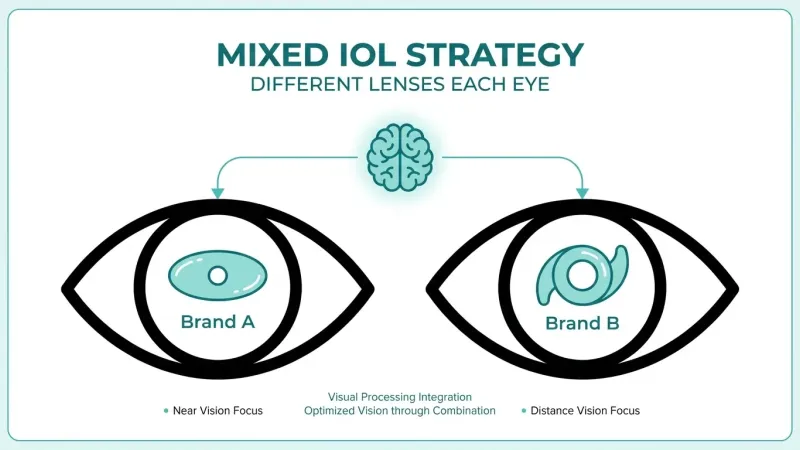
- How does my dominant eye affect which lens is recommended for each eye?
- What is your practice’s exchange rate if I am unsatisfied with the result?
- Are there lifestyle factors, such as frequent night driving, that should steer me toward one lens over another?
Thorough preoperative conversation with your surgeon is, in practice, the single most influential factor in premium lens satisfaction.
How Can Surgeon-Reviewed Guidance Help You Decide on Premium Lenses?
Surgeon-reviewed guidance helps patients cut through conflicting information and make confident, informed decisions about premium lens options. The sections below explain how Eye Surgery Today supports that process and what key eligibility lessons to take away.
Can Eye Surgery Today Help You Understand Your Lens Options?
Yes, Eye Surgery Today can help you understand your lens options through surgeon-reviewed educational content designed to make complex IOL decisions accessible. The platform covers the full range of premium lenses, including multifocal, toric, EDOF, accommodating, and light adjustable options, alongside the eligibility criteria and trade-offs each involves. Rather than replacing a personalized surgical consultation, Eye Surgery Today equips patients with the foundational knowledge needed to have more productive conversations with their own surgeons. For patients navigating premium IOL choices, that preparation can be the difference between uncertainty and confidence.
What Are the Key Takeaways About Premium Cataract Lens Eligibility?
The key takeaways about premium cataract lens eligibility are that candidacy depends on a combination of ocular health, lifestyle priorities, and realistic expectations. No single lens suits every patient. The most important conclusions from this article are:
- Eye health matters most. Conditions such as macular degeneration, glaucoma, and corneal irregularities may limit or exclude premium IOL options.
- Lifestyle drives the decision. Your daily visual needs, whether for near reading, intermediate screens, or distance, should guide lens selection.
- Testing confirms fit. Biometry, corneal topography, and macular OCT provide the objective data surgeons need to match a lens to your eye.
- Side effects are manageable for most. Halos and glare are common early after surgery but often improve with neuroadaptation.
- Cost requires planning. Premium lenses carry out-of-pocket costs that Medicare and most insurers do not cover.
Reviewing surgeon-vetted resources before your consultation puts you in the strongest position to participate in that decision.