A monofocal intraocular lens is an artificial implant placed in the eye during cataract surgery to replace the clouded natural lens, providing clear focus at a single fixed distance. As the most widely used IOL type worldwide, monofocal lenses remain a reliable standard-of-care option for a broad range of patients.
This guide covers how monofocal lenses work, who may benefit most from them, their potential advantages and limitations, how they compare to other IOL types, what to expect from surgery and recovery, and how monovision strategies can expand their utility.
Monofocal IOLs use a single-focus optical design that directs all light to one refractive target, typically set for distance. Because the lens does not split light across multiple focal zones, contrast sensitivity is generally preserved, and the risk of visual side effects like glare or halos may be lower than with multifocal alternatives.
Candidacy for a monofocal lens depends on lifestyle priorities and eye health. Patients with conditions such as glaucoma or macular degeneration may be better suited for monofocal optics, since multifocal and EDOF lenses can allow less light to reach the retina. Satisfaction rates across both enhanced and conventional monofocal IOL groups are consistently strong, with more than 90% of patients reporting positive outcomes in peer-reviewed research.
The primary trade-off is dependence on glasses for uncorrected distances; most patients set for distance vision will need reading glasses. Out-of-pocket costs tend to be lower because monofocal lenses are typically covered by Medicare and most private insurers as the standard implant.
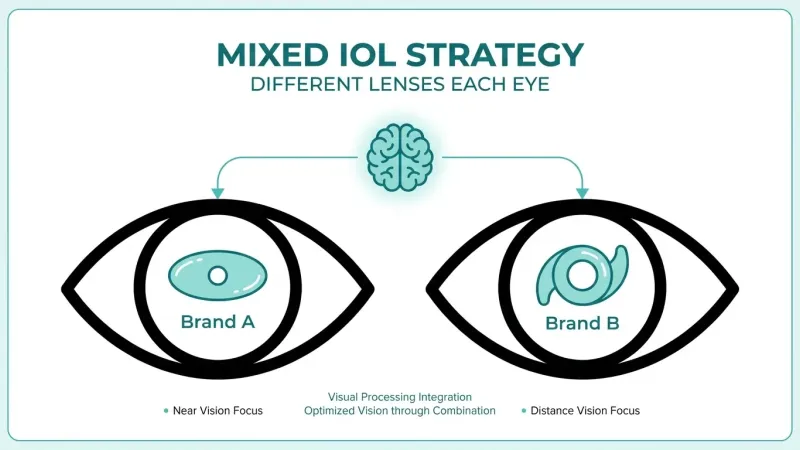
Compared to multifocal, EDOF, and toric options, monofocal lenses offer a straightforward risk-to-benefit profile. A monovision strategy, using two monofocal IOLs set to different focal targets, can partially expand the functional range for selected patients willing to accept minor depth perception trade-offs.
What Is a Monofocal Intraocular Lens?
A monofocal intraocular lens is an artificial lens implanted in the eye during cataract surgery to replace the clouded natural lens, designed to provide clear focus at a single fixed distance. According to Mordor Intelligence, monofocal lenses accounted for 62.68% of the global intraocular lens market share in 2025, making them the most widely used IOL type worldwide.
Most patients choose distance-focused monofocal lenses, which may deliver sharp vision for driving and outdoor activities while requiring reading glasses for near tasks. Some patients opt for near-focused targets instead, depending on their lifestyle priorities. The sections below explore how monofocal lenses work, who may benefit most, and how they compare to other IOL options.
How Does a Monofocal Lens Work After Cataract Surgery?
A monofocal lens works by replacing the eye’s clouded natural lens with a single-focus artificial implant, correcting vision at one set distance. During cataract surgery, the surgeon removes the opacified lens and implants the IOL inside the existing lens capsule, where it functions permanently. Because the lens has no accommodating ability, most patients will still need reading glasses or distance glasses depending on their refractive target.
One complication to be aware of after implantation is posterior capsule opacification (PCO), a clouding of the membrane behind the lens. According to a report in Experimental Eye Research covering 500,872 eyes, the incidence of PCO six months after cataract surgery is 2.3%, though rates can rise significantly over longer follow-up periods. PCO is treatable with a quick, outpatient laser procedure called YAG capsulotomy, so its occurrence does not represent a failure of the lens itself.
For most patients, the mechanics of a monofocal IOL are straightforward and predictable, which is precisely what makes it a reliable foundation for surgical planning.
Who May Be a Good Candidate for a Monofocal Lens?
Good candidates for a monofocal lens include patients prioritizing clear distance vision, those who prefer near-focus correction, and individuals with certain eye conditions such as glaucoma or macular degeneration. The following H3s address each scenario.
Who May Benefit From Choosing a Monofocal Lens for Distance Vision?
Patients who may benefit from choosing a monofocal lens for distance vision are those who primarily want sharp clarity for activities like driving or watching television and are comfortable wearing reading glasses for near tasks. Monofocal IOLs are indicated for the visual correction of aphakia after extracapsular cataract extraction, with the single focus point typically set for distance correction, according to StatPearls via NCBI Bookshelf. A Cochrane Review also found no significant difference in distance visual acuity between multifocal and monofocal IOL groups, suggesting monofocal lenses hold their own for far-range clarity. For patients whose daily life centers on distance activities, this lens type is often the most straightforward and predictable option.
Who May Benefit From Choosing a Monofocal Lens for Near Vision?
Patients who may benefit from choosing a monofocal lens for near vision are those whose primary activities involve reading, crafting, or close-up tasks, and who are comfortable relying on glasses for distance. In this approach, the ophthalmologist sets the lens target for near focus rather than distance. This strategy suits patients with occupational or lifestyle needs that center on close-range tasks, where wearing distance glasses afterward is an acceptable trade-off.
Who With Certain Eye Conditions May Be Better Suited for a Monofocal Lens?
Patients with certain eye conditions, such as glaucoma, macular degeneration, or severe dry eye, may be better suited for a monofocal lens because these conditions can compromise the visual performance of multifocal or EDOF optics. The American Academy of Ophthalmology notes that multifocal and EDOF lenses are generally not recommended for patients with vision loss from glaucoma or macular degeneration, as those lens types allow less light into the eye. A monofocal lens prioritizes contrast and clarity, which is especially valuable when the visual system is already under stress from underlying disease. According to a systematic review of 31 studies published in Eye (Nature), more than 90% of patients in both enhanced and conventional monofocal IOL groups reported being satisfied or very satisfied with their outcomes, reflecting consistently strong results across a broad patient population.
With the right candidate profile identified, understanding the specific benefits a monofocal lens may offer helps complete the decision.
What Are the Potential Benefits of a Monofocal Lens?
The potential benefits of a monofocal lens include sharper vision at a targeted distance, reduced visual side effects such as glare, and lower out-of-pocket surgery costs. The following sections cover each of these advantages in detail.
How May a Monofocal Lens Provide Sharper Vision at One Distance?
A monofocal lens may provide sharper vision at one distance by focusing all optical power on a single refractive target, typically set for distance. Because the lens does not split light across multiple focal points, contrast sensitivity is generally preserved. Research published by the National Institutes of Health on the RayOne EMV IOL found that monovision with a monofocal lens provided high patient satisfaction, preserved contrast sensitivity, good distance vision, and functional intermediate vision. For patients who prioritize crisp, reliable distance clarity, this focused optical approach tends to deliver consistent and predictable outcomes.
How May a Monofocal Lens Reduce Visual Side Effects Like Glare?
A monofocal lens may reduce visual side effects like glare because its single-focus optic does not split incoming light the way multifocal designs do. Multifocal and extended depth-of-focus lenses distribute light across multiple focal zones, which can introduce halos and glare, particularly in low-light conditions. According to Rex Hamilton, MD, for patients with compromised eyes due to glaucoma or significant macular degeneration, a monofocal toric intraocular lens is recommended to maximize potential vision without the light-loss side effects of multifocal optics. For patients with existing visual pathway sensitivities, this makes monofocal lenses a clinically safer choice.
How May a Monofocal Lens Lower Out-of-Pocket Surgery Costs?
A monofocal lens may lower out-of-pocket surgery costs because it is typically covered by Medicare and most private insurance plans as the standard-of-care implant after cataract surgery. Premium lenses, such as trifocal or extended depth-of-focus IOLs, are considered elective upgrades and generally require significant additional patient payment. Monofocal lenses carry no such premium surcharge, making them the most cost-accessible IOL option for patients working within insurance coverage limits.
What Are the Possible Drawbacks of a Monofocal Lens?
The possible drawbacks of a monofocal lens center on its single focal point, which limits vision at distances the lens was not set to correct. The sections below cover why glasses may still be needed and how range of vision may be affected.
Why May You Still Need Glasses After a Monofocal Lens?
You may still need glasses after a monofocal lens because the lens corrects vision at only one fixed distance, leaving other distances uncorrected. According to StatPearls via the NCBI Bookshelf, monofocal IOLs feature a single focus usually planned for distance vision, which means glasses are typically needed for near tasks such as reading or using a phone. Patients who choose a near-focused target will face a similar trade-off in reverse, requiring correction for distance. This is one of the most commonly underestimated aspects of the monofocal lens decision, and patients benefit most when their refractive target is chosen deliberately based on their daily visual priorities.
How May a Monofocal Lens Limit Your Range of Vision?
A monofocal lens may limit your range of vision by providing clear focus at one distance while leaving intermediate and either near or far distances blurred without optical correction. Unlike multifocal or extended depth-of-focus lenses, a standard monofocal IOL does not distribute light across multiple focal points, so tasks at uncorrected distances, such as reading a computer screen at intermediate range, may require glasses. Some surgeons use a monovision strategy, setting each eye to a different focal target, to partially offset this limitation while staying within the monofocal lens category.
What Are the Possible Risks or Complications of a Monofocal Lens?
The possible risks and complications of a monofocal lens include posterior capsular opacification, refractive surprises, and residual astigmatism, all of which are manageable with appropriate follow-up care. Cataract surgery itself is among the safest elective procedures performed, but no surgical intervention is entirely without risk.
Posterior capsular opacification (PCO) is the most common complication following cataract surgery, with a reported 9-year incidence rate of 47%, according to a study published in the Journal of Cataract and Refractive Surgery. PCO occurs when residual lens epithelial cells migrate across the posterior lens capsule, causing progressive clouding of vision. Fortunately, it is treatable with a quick, in-office laser procedure called YAG capsulotomy, which restores clarity without requiring additional surgery.
Beyond PCO, patients may experience refractive surprises, where the eye heals to a slightly different prescription than planned, requiring updated spectacle correction. Residual astigmatism is another possibility if a standard monofocal lens (rather than a toric variant) is implanted in an eye with pre-existing corneal astigmatism. Other less common risks include infection, inflammation, and intraocular pressure changes, all of which surgeons monitor closely during recovery.
From a practical standpoint, the risks specific to monofocal lenses are largely comparable to those of any IOL implant. The key distinction is that monofocal lenses do not introduce the light-splitting optical effects that can heighten visual disturbances in some premium lens designs, making their risk-to-benefit profile notably straightforward for appropriately selected patients.
How Does a Monofocal Lens Compare to a Multifocal Lens?
A monofocal lens compares to a multifocal lens primarily in its optical design: monofocal lenses provide sharp vision at one fixed distance, while multifocal lenses use multiple focal zones to address both near and distance vision. The right choice depends on your lifestyle priorities, eye health, and budget.
According to Mordor Intelligence, monofocal lenses accounted for 62.68% of the global intraocular lens market share in 2025, reflecting their continued dominance despite the availability of multifocal alternatives. The key differences between these two lens types are:
- Focal range: Monofocal lenses correct vision at one distance (typically far); multifocal lenses offer layered focal points for near, intermediate, and distance vision.
- Optical side effects: Multifocal lenses are associated with a higher risk of glare, halos, and reduced contrast sensitivity, particularly in low-light conditions.
- Candidacy restrictions: Multifocal and EDOF lenses are generally not recommended for patients with glaucoma or macular degeneration, as they allow less light into the eye. Monofocal lenses carry no such restriction.
- Cost: Multifocal lenses are premium implants that carry higher out-of-pocket costs, as most insurance plans cover only the standard monofocal option.
- Glasses dependence: Multifocal lenses may reduce the need for reading glasses; monofocal lenses typically require glasses for near tasks.
For patients who prioritize crisp distance vision, visual reliability in low light, or have pre-existing eye conditions, monofocal lenses remain a clinically sound and widely used option.
How Does a Monofocal Lens Compare to an Extended Depth of Focus Lens?
A monofocal lens and an extended depth of focus (EDOF) lens differ primarily in their focal range and how they manage light. The sections below cover optical design differences and candidacy considerations for each lens type.
How Do Their Optical Designs Differ?
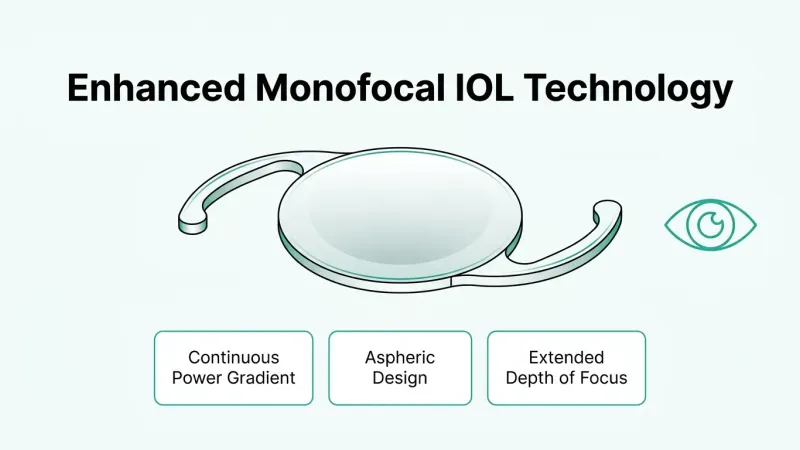
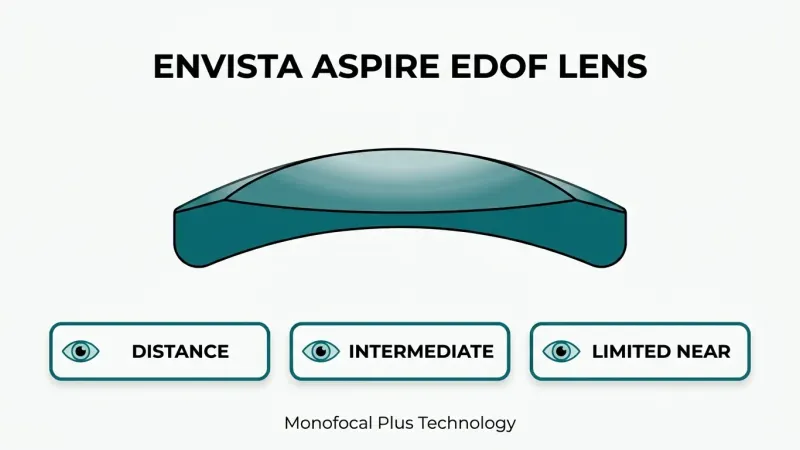
A monofocal lens delivers a single focal point, while an EDOF lens extends the range of clear vision by elongating the focal zone rather than creating distinct focal points. Some modified monofocal IOLs have emerged with optical designs that aim to extend depth of focus slightly to improve functional intermediate vision, blurring the boundary between these two categories. Custom monofocal designs can be measured using equivalent defocus, which quantifies in diopters the amount of defocus that produces the same on-axis visual performance, according to Optics Express. In practice, standard monofocals offer the most predictable, high-contrast single-distance outcome, while EDOF designs trade some of that precision for a broader functional range.
Which Lens May Be Better for Patients With Eye Disease?
The better lens for patients with eye disease is often the monofocal. According to the American Academy of Ophthalmology, multifocal and EDOF intraocular lenses are generally not recommended for patients with vision loss from glaucoma, macular degeneration, or other eye diseases because these lenses allow less light to reach the retina. Monofocal lenses preserve contrast sensitivity and deliver the maximum available light, making them the more reliable choice when the visual system is already compromised.
How Does a Monofocal Lens Compare to a Toric Lens?
A monofocal lens and a toric lens serve different optical purposes, though both can be monofocal in design. The key distinction lies in how each lens handles astigmatism correction.
How Does a Monofocal Lens Differ From a Toric Lens in Correcting Astigmatism?
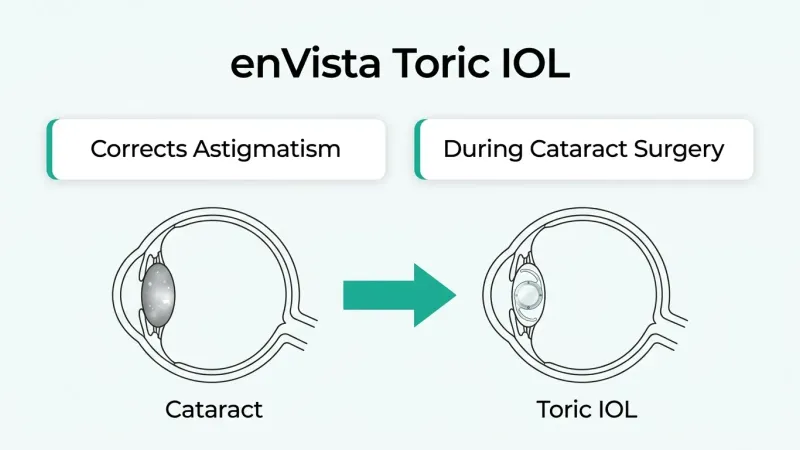
A monofocal lens differs from a toric lens in that it corrects vision at a single focal distance but does not address corneal astigmatism. A toric lens, by contrast, incorporates an additional cylindrical correction built into the implant to compensate for irregular corneal curvature. Patients with significant pre-existing astigmatism who receive a standard monofocal lens may still require glasses or contact lenses to correct residual blur, even at their targeted distance. For patients with both cataracts and significant astigmatism, a monofocal toric IOL may be recommended to maximize achievable clarity without the light-loss drawbacks associated with multifocal optics. In practice, the choice between these two lens types comes down to one clinical question: does the patient have measurable corneal astigmatism that would compromise their distance vision result after surgery?
Can a Toric Lens Still Be Considered a Monofocal Lens?
Yes, a toric lens can still be considered a monofocal lens when it corrects vision at only one focal point, with the added feature of astigmatism correction. The “toric” designation refers to the lens geometry, not the number of focal zones. A monofocal toric IOL provides sharp vision at a single distance, typically distance, while simultaneously neutralizing corneal astigmatism that a standard spherical monofocal cannot address. This makes toric lenses a refinement within the monofocal category rather than a separate lens class. Both lens types still leave patients dependent on reading glasses for near tasks.
What Should You Expect Before and After Monofocal Lens Surgery?
Monofocal lens surgery follows a structured path: a preoperative evaluation, a brief outpatient procedure, and a recovery period. The sections below cover each stage in detail.
What Happens During the Preoperative Evaluation?
The preoperative evaluation is a comprehensive eye assessment conducted before cataract surgery to determine your lens prescription and surgical suitability. Your surgeon will measure the size and shape of your eye using A-scan ultrasound or optical coherence biometry, which are medically necessary diagnostic tests for calculating the appropriate IOL power, according to Aetna’s Medical Clinical Policy Bulletins. Additional assessments typically include corneal topography, pupil dilation, and a full review of your ocular and medical history. Patients with existing conditions such as glaucoma or dry eye syndrome are assessed more carefully, as these can influence lens selection and expected outcomes.
What Can You Expect During the Monofocal Lens Procedure?
The monofocal lens procedure is a short outpatient surgery that typically takes 15 to 30 minutes per eye. Under local anesthesia, the surgeon uses phacoemulsification to break up and remove the cloudy natural lens through a small incision, then inserts the monofocal IOL, which unfolds into place within the capsular bag. Most patients remain awake but feel no pain. General anesthesia is rarely required. Because the incision is self-sealing, stitches are usually unnecessary, and patients are typically discharged within a few hours of the procedure.
What Does Recovery Look Like After Monofocal Lens Implantation?
Recovery after monofocal lens implantation is generally straightforward, with most patients noticing improved vision within 24 to 48 hours. Your surgeon will prescribe antibiotic and anti-inflammatory eye drops to prevent infection and reduce swelling. Activities such as swimming, heavy lifting, and rubbing the eye are typically restricted for several weeks. Mild side effects such as light sensitivity, blurry vision, and hazing may occur during the first few days. Posterior capsule opacification (PCO) is the most common long-term complication: according to a report in the Journal of Cataract and Refractive Surgery, PCO has a reported 9-year incidence rate of 47%, though it is treatable with a quick laser procedure.
Understanding the full surgical journey helps patients set realistic expectations and feel prepared for each stage of care.
What Is Monovision With Monofocal Lenses?
Monovision with monofocal lenses is a surgical strategy that uses two separate monofocal IOLs, each set to a different refractive target, to address both near and distance vision needs. The sections below explain how this approach works and which patients may be suitable candidates.
How Does a Monovision Strategy Work With Monofocal Lenses?
A monovision strategy works by implanting one monofocal IOL optimized for distance vision in the dominant eye and a second monofocal IOL optimized for near vision in the non-dominant eye. The brain adapts over time by blending input from both eyes to produce a functional range of sight. According to a study published in the MDPI Journal of Clinical Medicine, monovision using two monofocal IOLs with different refractive targets is a conventional strategy to optimize both near and distance vision, though it carries certain well-established drawbacks, including reduced depth perception and potential difficulty with intermediate tasks.
Who May Be a Good Candidate for Monovision?
Good candidates for monovision are patients who have previously tolerated monovision correction through contact lenses or laser refractive surgery, as prior adaptation strongly predicts post-surgical satisfaction. Patients with realistic expectations about needing occasional glasses for specific tasks, such as prolonged driving at night or fine close-up work, tend to adjust most successfully. Those with significant pre-existing conditions affecting retinal or optic nerve health may not be well suited, since monovision depends on strong bilateral visual input for effective cortical blending.
How Can Surgeon-Reviewed Resources Help You Choose the Right Lens?
Surgeon-reviewed resources can help you choose the right lens by translating complex clinical evidence into clear, patient-centered guidance. The H3s below cover how Eye Surgery Today supports lens decisions and the key takeaways for patients considering monofocal IOLs.
Can Eye Surgery Today Help You Understand Your Lens Options?
Yes, Eye Surgery Today can help you understand your lens options through surgeon-reviewed educational content designed to bridge the gap between clinical research and patient decision-making. Eye Surgery Today covers IOL types, candidacy criteria, surgical expectations, and recovery in plain language, free from medical jargon. For patients weighing monofocal lenses against premium alternatives, the platform offers unbiased comparisons grounded in peer-reviewed evidence. This kind of accessible, expert-reviewed education helps patients enter consultations with informed, confident questions rather than uncertainty.
What Are the Key Takeaways About Monofocal Lenses for Cataract Surgery?
The key takeaways about monofocal lenses for cataract surgery are that they deliver reliable single-distance vision, carry strong satisfaction rates, and remain the most widely implanted IOL category globally. According to a study published in Ophthalmology (American Academy of Ophthalmology), 84% of cataract surgery patients reported satisfaction with their vision and 88% said they would choose the same IOL again. Posterior capsular opacification remains the most common long-term complication, with a 9-year incidence of approximately 47% per the Journal of Cataract and Refractive Surgery, though it is treatable. Cost-effectiveness data from PLOS ONE shows trifocal IOLs carry only a $2,783 incremental lifetime cost over monofocals, a trade-off worth discussing with your surgeon. For patients with compromised eyes or budget constraints, monofocal lenses often provide the most dependable outcome.