Eye floaters are visual phenomena caused by collagen clumps, cells, or debris suspended in the vitreous gel that fills the back of the eye. Cataract surgery can both trigger new floaters and make pre-existing ones more noticeable.
This guide covers the anatomy behind floaters, how cataract surgery affects their development and visibility, when post-surgical floaters may signal a complication, available treatment options for persistent cases, and the risk factors that make certain patients more susceptible.
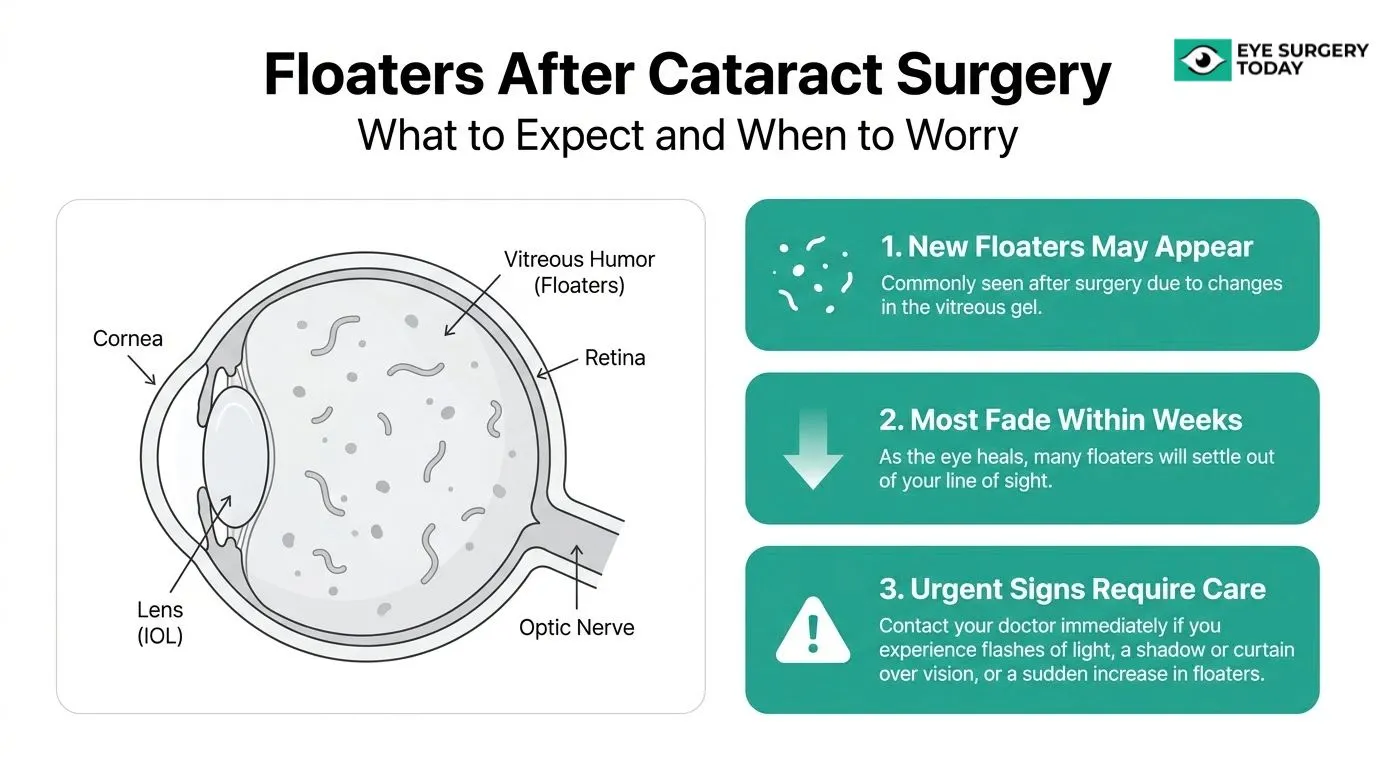
Floaters form when structural changes in the vitreous gel cast shadows on the retina, and they drift with eye movement because of the inertia of the vitreous body. Most are benign, though sudden onset alongside flashes of light can indicate a retinal problem requiring urgent evaluation.
Cataract surgery may accelerate posterior vitreous detachment, which is the primary mechanism behind new floater formation after the procedure. The clear intraocular lens implanted during surgery also transmits light more efficiently than the clouded natural lens it replaced, which can unmask floaters that were already present but previously obscured.
Many post-surgical floaters diminish over weeks to months as vitreous debris settles or the brain adapts. However, a rapid increase in floaters, flashing lights, or a shadow spreading across vision warrants same-day contact with your surgeon to rule out retinal tear or detachment.
For floaters that persist and impair daily function, options may include YAG laser vitreolysis or pars plana vitrectomy, though non-surgical observation remains the standard first approach. Patients with high myopia, advanced age, or prior vitreous detachment tend to carry elevated risk for floater development after cataract surgery.
What Are Eye Floaters in the First Place?
Eye floaters are visual phenomena caused by particles suspended inside the vitreous gel that fills the back of the eye. The following sections explain what these particles are, why floaters seem to dart away when you focus on them, and when they may signal a more serious problem.
What Causes the Tiny Specks and Strings You See Floating in Your Vision?
The tiny specks and strings you see floating in your vision are cells, clumps of collagen proteins, or debris present within the vitreous gel that fills the back of the eye. According to Johns Hopkins Medicine, these particles appear as specks of various shapes and sizes that move across your field of vision.
The vitreous gel is more than 98% water, but it also contains a fine network of collagen fibrils that maintain its structure. As those fibrils clump or degrade, they cast shadows on the retina, which is what you actually perceive as a floater.

Why Do Floaters Move When You Try to Look Directly at Them?
Floaters move when you try to look directly at them because of the inertia of the vitreous body and the fluid currents within it. When your eye shifts direction, the vitreous gel continues moving briefly on its own momentum, carrying the floating particles along with it. Because the particles trail behind your eye movement, they always appear to drift just beyond your direct line of sight, making them difficult to fix on.
Are Eye Floaters a Sign of a Serious Underlying Eye Problem?
Eye floaters are not always a sign of a serious underlying eye problem, but they can be in certain circumstances. Most floaters are benign and result from normal age-related changes to the vitreous. However, a sudden increase in floaters, the appearance of flashes of light, or a shadow spreading across your vision may indicate a retinal tear or detachment, which requires urgent evaluation. Rahul N. Khurana, MD, a vitreoretinal surgeon identified by the American Academy of Ophthalmology, stated: “It’s very important that people who experience new floaters or flashes get a dilated retinal exam.”
Chronic, stable floaters that have been present for years are rarely dangerous, but any new or dramatically worsening floaters warrant prompt attention from an eye care provider.
What Is the Connection Between Floaters and Cataract Surgery?
The connection between floaters and cataract surgery is well-established: the procedure can both trigger new floaters and make pre-existing ones more visible. The H3s below explain why new floaters appear, why they seem worse immediately after surgery, and how improved optics after lens replacement can unmask floaters that were always there.
Can Cataract Surgery Cause New Floaters to Appear After the Procedure?
Yes, cataract surgery can cause new floaters to appear after the procedure, primarily by accelerating posterior vitreous detachment (PVD). A study on progression of posterior vitreous detachment after cataract surgery found that complete PVD developed in 27.3% of eyes in the cataract-surgery group versus 5.2% in the non-surgery group within 12 months. After adjusting for age, sex, axial length, and baseline PVD stage, the relative risk for progression to complete PVD was 7.1-fold higher in the surgery group (P < 0.0001, 95% CI: 2.9–17.3). As the vitreous separates from the retina, displaced collagen and cellular debris cast shadows, which patients perceive as new floaters. The surgical type of viscoelastic device used may also influence how many patients report floaters in the first week post-operatively.

Why Do Some Patients Notice More Floaters Immediately After Cataract Surgery?
Some patients notice more floaters immediately after cataract surgery because the procedure disrupts the eye’s internal environment, and the newly implanted intraocular lens (IOL) transmits light more clearly than the clouded natural lens it replaced. According to SUNY Downstate Health Sciences University, floaters are more common in people who are very nearsighted, have diabetes, or have had a cataract operation. A prospective, observational study published in PubMed (National Library of Medicine) assessed 14 visual symptoms, including floaters, in 554 patients before and after cataract surgery with monofocal and premium IOLs at 4 to 6 months post-operatively. Patients with pre-existing vitreous opacities may simply become more aware of them once their overall visual clarity improves after surgery.
Can Cataract Surgery Make Pre-Existing Floaters Look More Noticeable?
Yes, cataract surgery can make pre-existing floaters look more noticeable, even when no new floaters have formed. Before surgery, a dense or cloudy lens scatters incoming light, which partially masks vitreous opacities. Once a clear IOL replaces the cataract, sharper, more focused light reaches the retina, making shadows cast by existing collagen clumps or debris easier to perceive. This is not a worsening of the underlying vitreous condition but rather an optical unmasking effect. Patients should be counseled before surgery that improved clarity can heighten awareness of floaters that were already present in the vitreous.
Do Floaters Go Away on Their Own After Cataract Surgery?
Many post-cataract floaters do resolve on their own, but the timeline and outcome depend on whether floaters are newly triggered by surgery or were present beforehand. The sections below cover how each type behaves after the procedure.
Do Floaters That Appear Right After Surgery Eventually Fade?
Floaters that appear right after surgery can eventually fade for many patients, though resolution is not guaranteed for everyone. When surgery accelerates posterior vitreous detachment, the vitreous collagen debris that creates floaters may settle out of the central visual field over weeks to months. However, new-onset floaters should never be dismissed without evaluation. According to Rahul N. Khurana, MD, a vitreoretinal surgeon identified by the American Academy of Ophthalmology: “It’s very important that people who experience new floaters or flashes get a dilated retinal exam.” Spontaneous fading is possible, but ruling out a retinal complication first is the clinically responsible step.
Do Floaters That Were Present Before Surgery Change After the Procedure?
Floaters that were present before surgery may not reliably change after the procedure, and some patients may notice new ones in the early postoperative period. A study comparing viscoelastic devices used during cataract surgery (“Comparison of Floaters after Cataract Surgery with Different Viscoelastics”) found that new-onset floaters were reported by 12.5% of eyes in one surgical subgroup at the day-after and one-week visits. Pre-existing floaters tied to long-standing vitreous changes are unlikely to disappear simply because cataract surgery was performed; the surgery addresses lens opacity, not vitreous debris.
When Are Floaters After Cataract Surgery a Warning Sign?
Floaters after cataract surgery become a warning sign when they appear suddenly, increase dramatically, or occur alongside flashes of light or vision loss. The H3s below distinguish normal from dangerous floaters, explain what a sudden surge may indicate, assess retinal tear and detachment risk, and outline when to contact your surgeon.
What Is the Difference Between Normal Post-Surgery Floaters and Dangerous Ones?
The difference between normal and dangerous post-surgery floaters lies in their onset pattern, quantity, and accompanying symptoms.
Normal floaters tend to appear gradually, remain stable in number, and cause no pain or vision changes. They typically result from vitreous gel shifting during healing and may fade over weeks.
Dangerous floaters, by contrast, appear suddenly and in large numbers. The warning profile includes:
- A dramatic, rapid increase in floaters over hours or days
- Flashes of light (photopsia) accompanying the new floaters
- A shadow, curtain, or dark veil spreading across part of your visual field
- Blurred or reduced central vision alongside new floaters
Any combination of these features warrants urgent evaluation, not a scheduled follow-up.
What Does a Sudden Increase in Floaters After Cataract Surgery Indicate?
A sudden increase in floaters after cataract surgery may indicate accelerated posterior vitreous detachment, retinal traction, or early retinal tear formation. Cataract surgery mechanically disrupts the eye’s internal environment, which can accelerate vitreous separation from the retina. When that separation pulls unevenly on retinal tissue, patients may experience an abrupt shower of new floaters.
This rapid surge is clinically distinct from the gradual, low-level floaters many patients notice during routine recovery. It signals that the vitreoretinal interface is under stress, and prompt dilated fundus examination is needed to rule out structural damage before it progresses.
Could New Floaters After Cataract Surgery Signal a Retinal Tear or Detachment?
New floaters after cataract surgery can signal a retinal tear or detachment, and this possibility should be taken seriously. According to data from the IRIS Registry analyzing 3,177,195 cataract procedures, 6,690 eyes (0.21%) developed rhegmatogenous retinal detachment within one year after surgery. Brian Zaugg, MD, an ophthalmologist at University of Utah Health, stated: “A new floater can be a sign of, what we most commonly fear is a retinal detachment.”
While 0.21% may appear small as a percentage, it represents thousands of patients annually, and the consequences of a missed retinal detachment include permanent vision loss.
When Should You Call Your Eye Surgeon About Floaters After Cataract Surgery?
You should call your eye surgeon immediately if floaters after cataract surgery are accompanied by any of the following:
- Sudden onset of many new floaters within a short period
- Flashing lights or streaks at the edges of vision
- A shadow, curtain, or dark area spreading across your visual field
- Any noticeable loss of vision, even partial
According to SUNY Downstate Health Sciences University, floaters are more common in people who have had cataract surgery, which means post-operative patients already carry elevated baseline risk. Do not wait for your next scheduled appointment if these symptoms develop. Contact your surgeon the same day or seek urgent eye care.

What Treatment Options Exist for Persistent Floaters After Cataract Surgery?
The treatment options for persistent floaters after cataract surgery include laser vitreolysis, surgical vitrectomy, and non-surgical observation strategies. The right approach depends on floater severity, location, and how significantly they affect daily vision.

What Is Laser Vitreolysis and Does It Work for Post-Cataract Floaters?
Laser vitreolysis is a procedure that uses a YAG laser to vaporize vitreous opacities, reducing or eliminating symptomatic floaters. According to a 2021 randomized controlled trial published in the European Journal of Ophthalmology (Ludwig et al.), the YAG laser group reported subjective symptomatic improvement in 77% of cases, compared to 25% in controls.
Candidates typically require a documented Weiss ring floater secondary to posterior vitreous detachment, with symptoms lasting at least 6 months, as outlined by NICE’s evidence review on YAG laser vitreolysis. However, risks exist: an observational case series in Ophthalmic Surgery, Lasers and Imaging Retina reported two patients who developed direct retinal damage following YAG laser treatment, including vitreous hemorrhage and a full-thickness retinal break. Patient selection is critical, and this procedure may not suit all post-cataract floater presentations.
What Is Vitrectomy and When Is It Considered for Floater Removal?
Vitrectomy is a surgical procedure that removes the vitreous gel, and with it, the floater-causing opacities. It is generally considered when floaters are severe, persistent, and significantly impair quality of life after less invasive options have been exhausted.
According to a prospective safety study published in Vitrectomy for floaters: prospective efficacy analyses and retrospective safety profile, none of the 60 patients treated with vitrectomy developed retinal breaks, infection, or glaucoma over a mean follow-up of 17.5 months. While those safety outcomes are encouraging, vitrectomy carries inherent surgical risks and is typically reserved for cases where floaters cause meaningful functional impairment, not minor visual nuisance.
Are There Non-Surgical Ways to Manage Floaters After Cataract Surgery?
The non-surgical ways to manage floaters after cataract surgery include watchful waiting, visual adaptation, and gaze-shifting techniques to move floaters out of the central visual field. According to EyeWiki, the most common advice ophthalmologists give patients is to “try to ignore them” and “learn to live with them.”
For many patients, this is a reasonable first step, particularly when floaters are mild and not centrally located. Given that most post-cataract floaters are benign and may diminish in perceived intensity over time as the brain adapts, non-surgical management remains the standard starting point before any procedural intervention is considered.
Who Is Most Likely to Experience Floaters After Cataract Surgery?
Patients most likely to experience floaters after cataract surgery include those with high myopia, older age, and a prior history of vitreous detachment. Each of these risk factors influences the vitreous in distinct ways that increase floater likelihood.
Are Patients With High Myopia at Greater Risk for Post-Surgery Floaters?
Patients with high myopia are at greater risk for post-surgery floaters because elongated axial length places added mechanical stress on the vitreous, accelerating its structural breakdown. According to SUNY Downstate Health Sciences University, floaters are more common in people who are very nearsighted, have diabetes, or have had a cataract operation. When myopia is combined with the surgical disruption of cataract removal, the vitreous may degrade faster, making floater onset more likely.
The American Society of Retina Specialists notes that about 85% of patients who experience posterior vitreous detachment never develop complications, and flashes and floaters subside within 3 months in most cases. That is reassuring, though highly myopic patients should still receive prompt monitoring given their elevated baseline risk.
Does Age Increase the Likelihood of Developing Floaters After Cataract Surgery?
Age does increase the likelihood of developing floaters after cataract surgery. As the vitreous naturally ages, it loses structural integrity, making older patients more susceptible to floater formation following the added stress of surgery. This age-related vulnerability compounds the surgical risk, making older cataract patients a group warranting closer post-operative observation.
Are Patients With a History of Vitreous Detachment More Vulnerable to Floaters Post-Surgery?
Patients with a history of vitreous detachment are more vulnerable to floaters after cataract surgery because their vitreous has already undergone significant structural change. According to the University of Iowa EyeRounds, the vitreous undergoes syneresis with age, becoming more fluid-like, with pockets of fluid creating the sensation of floaters or cobwebs. Published in the Survey of Ophthalmology, floaters, historically termed myodesopsia or muscae volitantes, are caused by vitreous opacities producing linear gray shadows with focal dark spots, moving in response to eye and head movements due to intravitreal currents.
The vitreous body is a gel composed of more than 98% water alongside collagen fibrils of types II, V/XI, and IX that maintain its structure, according to The Open Ophthalmology Journal. When this structure is already compromised by a prior detachment, cataract surgery can accelerate further vitreous collapse and floater development. For these patients, pre-surgical counseling about floater risk is particularly important.
How Can Eye Surgery Today Help You Understand Your Cataract Surgery Options?
Eye Surgery Today is a surgeon-reviewed education platform designed to give patients clear, unbiased answers about cataract surgery and related vision concerns. The sections below cover what the platform offers and the key lessons from this article.
Does Eye Surgery Today Offer Surgeon-Reviewed Guides on Cataract Surgery and Vision Complications?
Yes, Eye Surgery Today offers surgeon-reviewed guides on cataract surgery and vision complications, including topics such as floaters, posterior vitreous detachment, and post-operative warning signs. Every resource is reviewed for clinical accuracy and written to translate complex ophthalmology into language patients can act on. For readers who want to understand the full risk landscape, Eye Surgery Today references peer-reviewed sources, including journals such as Ophthalmic Surgery, Lasers and Imaging Retina, to ensure the information reflects current evidence. This makes it one of the more trustworthy starting points for patients preparing for cataract surgery or interpreting post-operative symptoms.
What Are the Key Takeaways About Floaters and Cataract Surgery We Covered?
The key takeaways about floaters and cataract surgery are:
- Floaters originate in the vitreous gel and become more common after cataract surgery due to accelerated posterior vitreous detachment.
- Most post-surgical floaters fade within weeks to months and do not require treatment.
- A sudden increase in floaters, flashes of light, or a shadow in vision warrants immediate contact with your eye surgeon.
- Treatment options for persistent floaters include YAG laser vitreolysis and pars plana vitrectomy, each with distinct benefit and risk profiles.
- High myopia, older age, and prior vitreous changes increase the likelihood of floaters after surgery.
Understanding these points helps patients approach cataract surgery with realistic expectations and confidence.