An intraocular lens (IOL) is the artificial lens implanted inside the eye during cataract surgery to replace the clouded natural crystalline lens. The type of IOL selected determines the range and quality of vision a patient can expect after the procedure.
This guide covers how IOLs work and why lens choice matters, the four primary lens types and their visual capabilities, cost differences and insurance coverage, and how to evaluate candidacy with your surgeon.
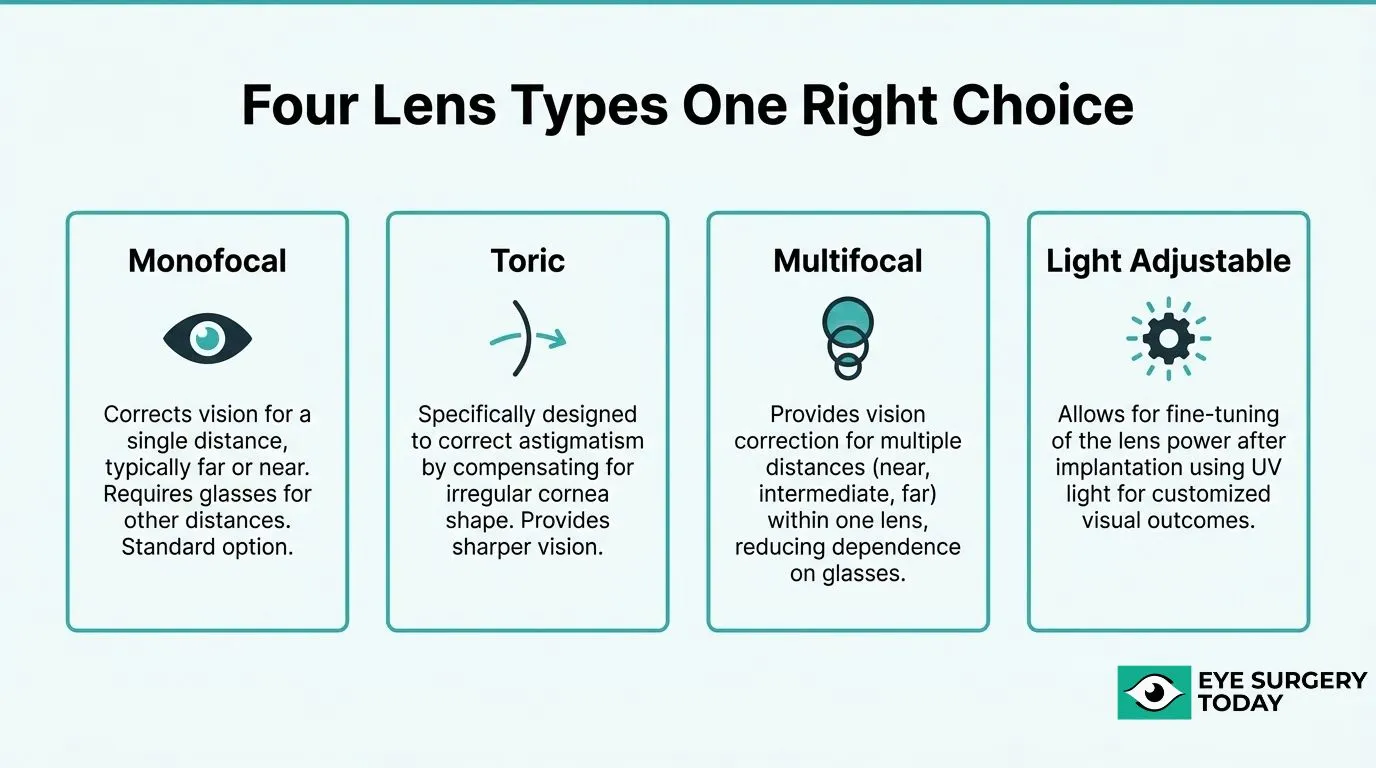
Monofocal IOLs focus light at a single distance and are typically set for far vision, making them the most widely covered option; however, most patients may still need reading glasses for near tasks. Toric IOLs add a cylindrical correction that compensates for corneal astigmatism, potentially reducing reliance on distance glasses for patients whose corneal curvature is uneven.
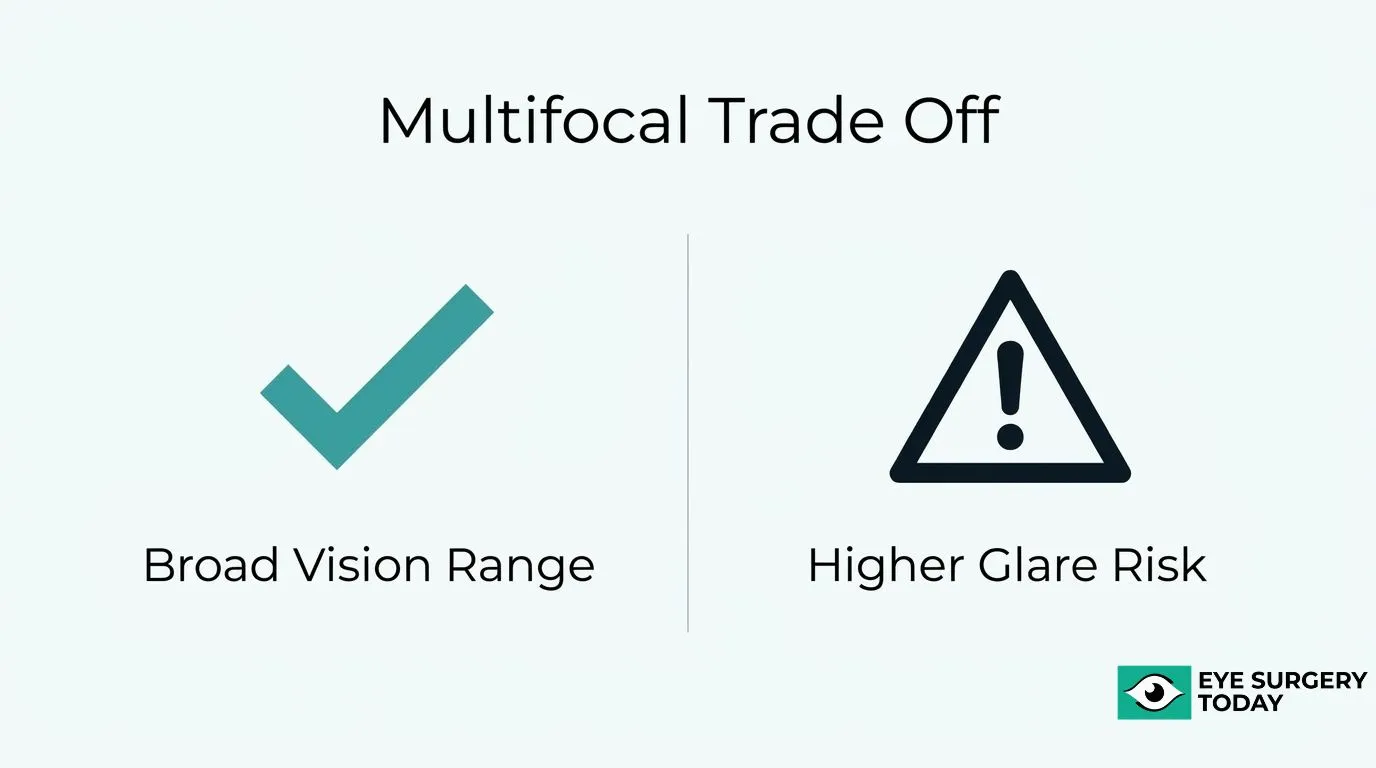
Multifocal IOLs distribute light across near, intermediate, and far focal zones, which may help many patients achieve broad spectacle independence. That benefit comes with trade-offs, as these lenses are associated with higher rates of glare and halos compared to single-focus options.
The Light Adjustable Lens (LAL) is a photoreactive silicone IOL whose power can be refined after implantation through targeted UV light treatments, then permanently locked in. This post-surgical adjustment window makes it the most customizable option available, though it requires strict UV-blocking eyewear compliance during the treatment period and carries the highest out-of-pocket cost.
Pricing ranges from fully insured monofocal lenses to premium options reaching several thousand dollars per eye, and existing eye conditions can significantly narrow which lenses are appropriate. We explore each of these factors in detail throughout the sections that follow.
What Is a Cataract Lens (IOL) and Why Does It Matter?
An intraocular lens (IOL) is the artificial lens implanted inside the eye during cataract surgery to replace the clouded natural lens. The type of IOL chosen directly determines the quality and range of vision a patient can expect after surgery. The following sections cover what an IOL replaces anatomically and how lens selection shapes post-surgical outcomes.
What Does an IOL Actually Replace Inside the Eye?
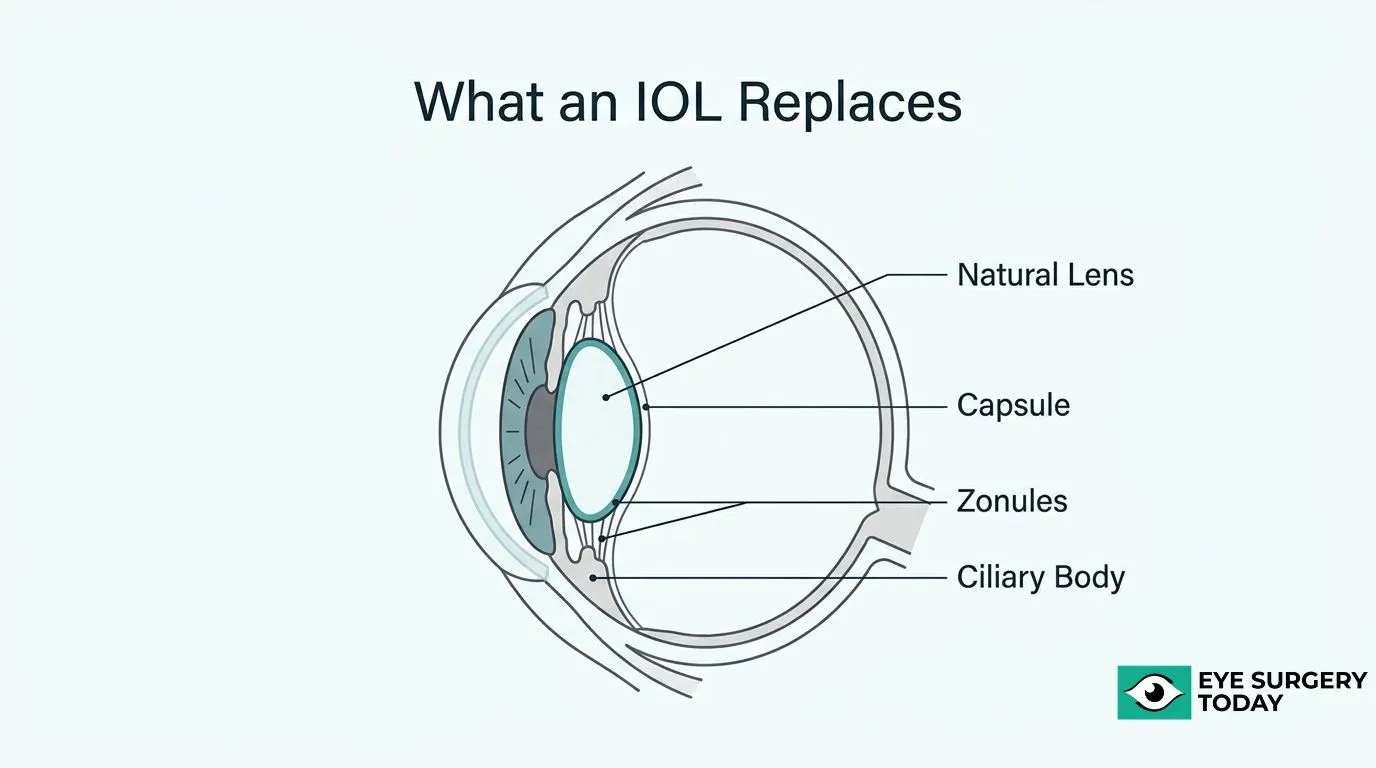
An IOL replaces the eye’s natural crystalline lens, a biconcave structure located just behind the iris. According to the University of Iowa Department of Ophthalmology and Visual Sciences, the natural lens sits suspended inside the eye by cord-like fibers called zonules, which connect it to the ciliary body. During cataract surgery, the anterior capsule is opened so the clouded nucleus and cortex can be removed. The remaining capsular bag is preserved to hold the newly inserted IOL in position.
The natural lens has four structural layers: the capsule, epithelium, cortex, and nucleus. It normally flexes to shift focus between near and distant objects, a process called accommodation. Because an IOL cannot flex the same way, the choice of lens type determines which distances a patient can see clearly without glasses after surgery.
How Does Choosing the Right IOL Affect Vision After Surgery?
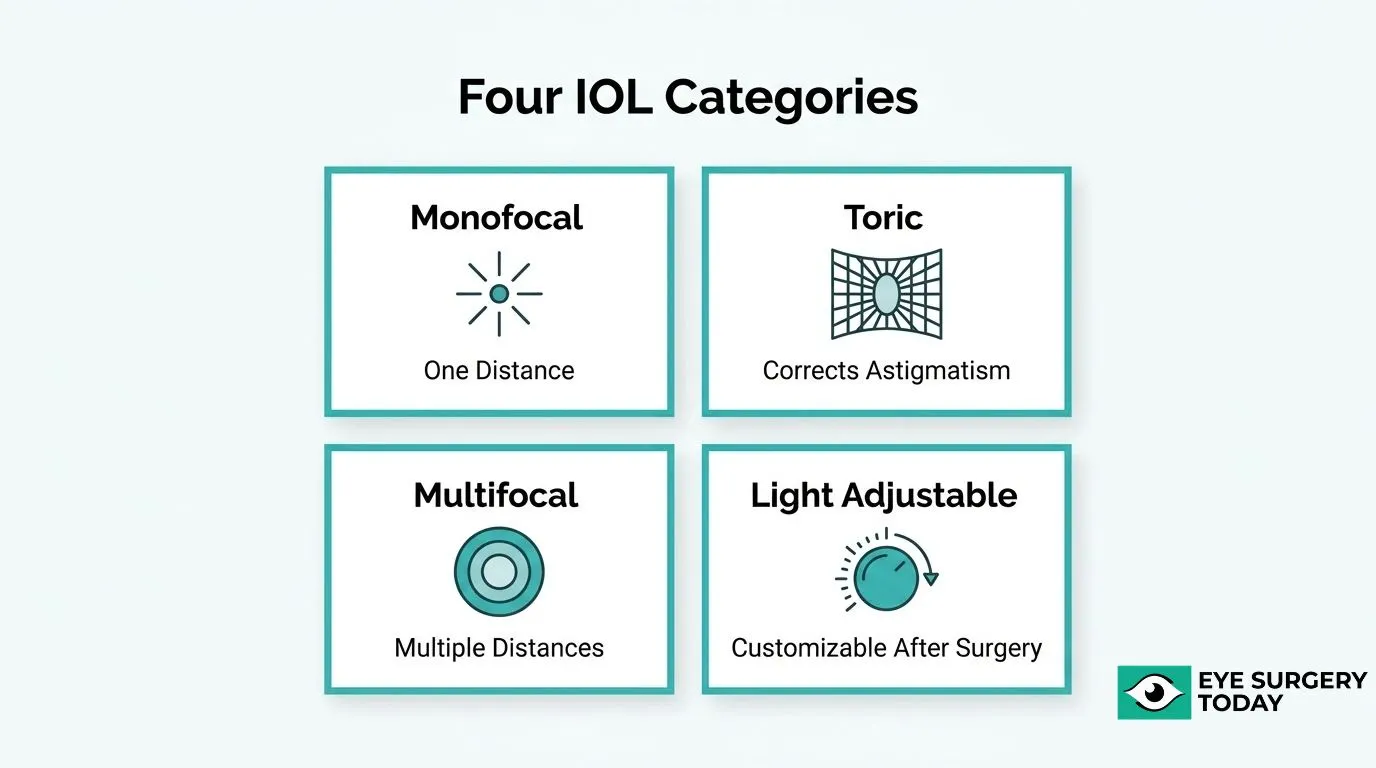
Choosing the right IOL affects whether a patient can see clearly at one distance or multiple distances, with or without glasses, after surgery. The available IOL categories include monofocal, toric, multifocal, and light adjustable lenses, each designed for a different visual outcome and lifestyle profile.
For patients who receive a Light Adjustable Lens (LAL), IOL selection also carries specific post-surgical responsibilities. According to the University of Utah John A. Moran Eye Center, patients must wear UV-blocking glasses during all waking hours until 24 hours after the final lock-in treatment. Failure to do so can distort the LAL and cause blurred vision that cannot be corrected with glasses afterward.
This makes the IOL decision one of the most consequential choices in the entire cataract surgery process, as it cannot easily be reversed once the lens is locked in.
What Are the Types of Cataract Lenses (IOLs) Available?
The types of cataract lenses (IOLs) available include monofocal, toric, multifocal, and Light Adjustable Lenses. Each addresses different vision needs and lifestyle priorities, covered in the sub-sections below.
Monofocal IOL
A monofocal IOL is an intraocular lens designed to provide clear vision at one fixed distance. According to the American Academy of Ophthalmology, most patients have their monofocal IOL set for distance vision and use reading glasses for close-up tasks. This makes monofocals the most common and widely covered IOL option, but patients with active near-vision demands should weigh that trade-off carefully before committing.
Toric IOL
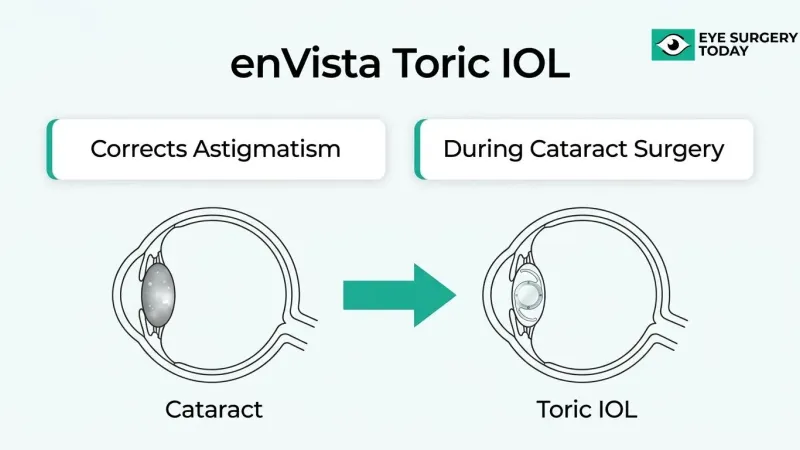
A toric IOL is an intraocular lens that corrects pre-existing corneal astigmatism in addition to replacing the clouded natural lens. The FDA notes that toric models are indicated for eyes with an abnormal corneal curve of 1 diopter or greater. Unlike a standard monofocal, a toric IOL compensates for the uneven corneal shape, which can reduce dependence on corrective lenses for distance vision in patients with astigmatism.
Multifocal IOL
A multifocal IOL is an intraocular lens with multiple focal zones, allowing the eye to focus on objects at far, intermediate, and near distances. In a 2020 prospective study published in Medical Hypothesis, Discovery and Innovation in Ophthalmology (Bianchi, hosted by NCBI/PMC), 92% of patients reported achieving spectacle independence after receiving a multifocal IOL. That level of glasses freedom is genuinely compelling, though it comes with a higher likelihood of glare and halos compared to monofocal options.
Light Adjustable Lens (LAL)
The Light Adjustable Lens (LAL) is a photoreactive silicone IOL whose power can be fine-tuned after implantation using targeted UV light delivered by the RxSight Light Delivery Device (LDD). According to the U.S. FDA Summary of Safety and Effectiveness Data (PMA P160055), the LAL is indicated for adults with pre-existing corneal astigmatism of 0.75 diopters or greater and no pre-existing macular disease. UV exposure reshapes the lens curvature to achieve a spherical or spherocylindrical correction, and a final lock-in treatment stabilizes the power permanently. The LAL is contraindicated in patients taking UV-sensitizing medications such as tetracycline, doxycycline, or amiodarone, and in those with a history of ocular herpes simplex virus. Harvard Health Publishing reports the LAL costs $5,000 to $6,000 per eye, making it the most expensive IOL option currently available.
What Is a Monofocal IOL and Who Is It Best For?
A monofocal IOL is a single-focus intraocular lens that replaces the eye’s clouded natural lens during cataract surgery. The following sections explain how it works, what you can see with one, whether glasses are still needed, and who benefits most.
How Does a Monofocal IOL Work?
A monofocal IOL works by focusing light at a single, fixed focal point, typically set for distance vision. Unlike the natural lens, it cannot change shape to shift focus between near and far objects. According to the American Academy of Ophthalmology, monofocal lenses are designed to provide the best possible vision at one distance, with most patients choosing distance correction and using reading glasses for close tasks.
What Can You See Clearly With a Monofocal IOL?
With a monofocal IOL, you can see clearly at whichever single distance the lens was set for at the time of surgery. Most patients choose distance focus, giving them clear vision for driving, watching television, or recognizing faces. Intermediate tasks (such as computer use) and near tasks (such as reading) typically still require corrective lenses.
Will You Still Need Glasses After a Monofocal IOL?
Most patients will still need glasses after a monofocal IOL, particularly for near-vision tasks such as reading. The National Eye Institute notes that once the eye is completely healed, patients may need a new prescription for glasses or contact lenses to see clearly. A 2022 study published in Scientific Reports found that 80% of patients set for distance emmetropia reported needing near vision correction in everyday life. Common questions patients ask their surgeons include whether glasses will be needed for distance or reading, and how prior LASIK or conditions like glaucoma may affect outcomes.
Who Is the Ideal Candidate for a Monofocal IOL?
The ideal candidate for a monofocal IOL is someone who is comfortable relying on glasses for near or intermediate tasks and who prioritizes the sharpest possible vision at one distance. Patients with ocular comorbidities such as macular disease, irregular astigmatism, or higher-order aberrations are often steered toward monofocal lenses because these conditions can reduce the effectiveness of premium lens options. According to Harvard Medical School’s Department of Ophthalmology, ideal candidates for premium lenses are those without such comorbidities, making the standard monofocal a practical default for patients who do not qualify. Monofocal lenses are also fully covered by Medicare and most insurance plans, making them the most accessible choice for budget-conscious patients.
What Is a Toric IOL and How Does It Correct Astigmatism?
A toric IOL is an intraocular lens designed to correct corneal astigmatism at the time of cataract surgery. The sections below explain how it differs from a standard lens, what correction levels it addresses, whether it eliminates glasses, and who qualifies as a candidate.
How Does a Toric IOL Differ From a Standard Monofocal IOL?
A toric IOL differs from a standard monofocal IOL by incorporating an additional cylindrical correction that compensates for the uneven curvature of an astigmatic cornea. A conventional monofocal IOL focuses light from objects only at one distance, typically far away. According to the U.S. Food and Drug Administration’s 2021 approval documentation for the TECNIS Synergy toric lens, toric models are indicated for people with pre-existing corneal astigmatism of 1 diopter or greater. The standard monofocal lens makes no such correction, meaning patients with astigmatism would still experience blurred or distorted vision at all distances without additional corrective eyewear.
What Level of Astigmatism Can a Toric IOL Correct?
A toric IOL can correct pre-existing corneal astigmatism, placing it within the broader category of astigmatism-correcting lenses. As noted in a review indexed in PubMed (Dtsch Arztebl Int), the spectrum of artificial intraocular lenses includes conventional single-focus lenses, multifocal lenses, extended-depth-of-focus (EDOF) lenses, and astigmatism-correcting lenses as distinct categories. Toric IOLs are available in multiple cylinder powers to address a range of astigmatic errors, and your surgeon will measure your corneal curvature precisely to select the appropriate power and axis alignment for your eye.
Does a Toric IOL Eliminate the Need for Glasses Entirely?
A toric IOL may significantly reduce or eliminate the need for glasses, depending on the specific lens model chosen. A 2015 study published in The Open Ophthalmology Journal (Crispim et al.) found that 100% of eyes receiving a multifocal toric IOL did not require eyeglasses at one month postoperatively. However, standard toric lenses without a multifocal component are primarily designed to correct astigmatism and optimize distance vision; many patients with a monofocal toric IOL may still require reading glasses for near tasks. Lens selection plays a meaningful role in the final glasses-independence outcome.
Who Is the Best Candidate for a Toric IOL?
The best candidate for a toric IOL is a patient with clinically significant corneal astigmatism who wants to reduce dependence on distance correction after cataract surgery. Ideal candidates have regular, predictable corneal astigmatism rather than irregular astigmatism conditions such as keratoconus, which can compromise the accuracy of toric lens alignment. Patients with coexisting ocular conditions including macular disease or high-order corneal aberrations may achieve less predictable outcomes and should discuss these factors thoroughly with their surgeon before proceeding.
Understanding who benefits most from a toric IOL helps clarify when a multifocal or light adjustable lens may be a stronger alternative.
What Is a Multifocal IOL and How Does It Restore Near and Distance Vision?
A multifocal IOL is a premium intraocular lens that uses multiple focal zones to simultaneously focus light from near, intermediate, and far distances onto the retina. Unlike a monofocal IOL, which targets only one distance, it restores a broader visual range after cataract surgery. The sections below cover how multifocal IOLs create multiple focal points, what tasks they support, their side effects, and who is and is not a suitable candidate.
How Does a Multifocal IOL Provide Multiple Focal Points?
A multifocal IOL provides multiple focal points by dividing incoming light across concentric rings or diffractive zones etched into the lens optic. Each zone bends light at a slightly different angle, directing it to focal points at near, intermediate, and distance ranges simultaneously. The brain learns to select the sharpest image for the task at hand, a process called neuroadaptation. According to a 2020 prospective study published in Medical Hypothesis, Discovery and Innovation in Ophthalmology (Bianchi, NCBI/PMC), 92% of patients with a multifocal IOL reported achieving spectacle independence, reflecting how effectively this technology serves multiple focal demands.
What Visual Tasks Can You Do Without Glasses After a Multifocal IOL?
The visual tasks you can typically do without glasses after a multifocal IOL include reading, using a computer, driving, and recognizing faces at a distance. Most patients manage daily activities across near and far ranges without reaching for glasses. However, ideal outcomes depend strongly on patient selection. According to Harvard Medical School’s Department of Ophthalmology, candidates most likely to succeed are those without ocular comorbidities such as irregular astigmatism, higher-order aberrations, or corneal and macular pathology, all of which can compromise multifocal performance.
What Are the Common Side Effects of Multifocal IOLs?
The common side effects of multifocal IOLs include glare, halos, and reduced contrast sensitivity, particularly in low-light conditions. A Cochrane systematic review found that adverse visual phenomena were significantly more prevalent with multifocal IOLs than with monofocal lenses, with a relative risk for halos of 3.58 (95% CI 1.99 to 6.46; eyes = 662; 7 studies; moderate-certainty evidence). These effects typically diminish as neuroadaptation occurs, but for patients who frequently drive at night or work in dim environments, they may remain disruptive. Discussing nighttime visual demands upfront with a surgeon is one of the most important steps in this decision.
Who Is a Good Candidate for a Multifocal IOL?
A good candidate for a multifocal IOL is a patient who wants broad spectacle independence for daily tasks and has no significant ocular comorbidities. Suitable candidates typically have healthy corneas and maculas, minimal higher-order aberrations, and a lifestyle that prioritizes visual freedom over optical perfection in all conditions. Patients who spend significant time reading, using screens, or doing detail work at multiple distances tend to benefit most from the near-to-distance range a multifocal IOL can provide.
Who Should Avoid a Multifocal IOL?
Patients who should avoid a multifocal IOL include those with irregular astigmatism (such as keratoconus), macular pathology, significant higher-order aberrations, or active ocular surface disease. Patients who do frequent nighttime driving may also find the halo and glare side effects problematic enough to outweigh the benefits. Additionally, ocular surface disease should be treated and optimized before diagnostic testing, as it can skew biometry results and lead to poor IOL selection outcomes.
What Is a Light Adjustable Lens and How Is It Different?
The Light Adjustable Lens (LAL) is unique among IOL options because its refractive power can be fine-tuned after implantation using UV light. The following H3s explain how the adjustment process works, what vision outcomes it may achieve, what lifestyle restrictions apply, and who is the ideal candidate.
How Is the Light Adjustable Lens Adjusted After Surgery?
The Light Adjustable Lens is adjusted after surgery through targeted UV light exposures delivered by an external device called the Light Delivery Device (LDD). According to the FDA Summary of Safety and Effectiveness Data (PMA P160055), spatially profiled UV light modifies the photoreactive silicone lens curvature, producing a spherical or spherocylindrical power change post-operatively. A subsequent lock-in exposure then stabilizes the final lens power. This two-stage process, adjustment followed by lock-in, is what distinguishes the LAL from all other IOL types, where power is fixed at implantation.
What Vision Outcomes Can the Light Adjustable Lens Achieve?
The Light Adjustable Lens may help improve uncorrected visual acuity by allowing post-surgical refinement of lens power, including correction of residual astigmatism. According to the Mayo Clinic MedProfVideos webinar on the LAL, patients who cannot dilate to at least 6 to 6.5 mm are typically excluded, as the entire optic must be visible for adjustment to be performed accurately. This customization potential makes the LAL one of the more precise options for patients whose final refraction is difficult to predict before surgery.
What Are the Lifestyle Restrictions After Getting a Light Adjustable Lens?
The lifestyle restrictions after getting a Light Adjustable Lens center on UV light protection. Patients must wear special UV-blocking glasses during all waking hours until 24 hours after the final lock-in treatment. According to the University of Utah John A. Moran Eye Center, failing to wear these glasses can distort the LAL and cause blurred vision that cannot be corrected with spectacles. Patients should also avoid prolonged sun exposure and tanning beds throughout the adjustment period, which typically spans several weeks.
Who Is the Ideal Candidate for a Light Adjustable Lens?
The ideal candidate for a Light Adjustable Lens is an adult patient with pre-existing corneal astigmatism of 0.75 diopters or greater and no pre-existing macular disease. According to Harvard Medical School’s Department of Ophthalmology, ideal candidates for premium IOL technology are those without ocular comorbidities, as irregular astigmatism, higher-order aberrations, or corneal and macular pathology can preclude good outcomes. Patients taking systemic medications that increase UV sensitivity, such as tetracycline or amiodarone, are contraindicated. Pupil dilation capacity is equally critical, as the adjustment process requires full optic visibility.
How Do Monofocal vs Toric vs Multifocal vs Light Adjustable Lenses Compare?
Monofocal, toric, multifocal, and light adjustable lenses each offer distinct trade-offs across distance vision quality, reading glass dependence, astigmatism correction, and customizability. The sections below compare each lens type across the four criteria patients ask about most.
Which IOL Gives the Best Distance Vision?
The IOL that gives the best distance vision is the monofocal lens. According to the American Academy of Ophthalmology, monofocal lenses are designed to provide the best possible vision at one distance, and most patients choose distance as their target focal point. Because all of the lens’s optical power serves a single focal zone, nothing is split or redistributed. Multifocal lenses, by contrast, divide light across near and distance foci, which reduces peak intensity at each focal point compared to a monofocal. For patients whose top priority is sharp, high-contrast distance vision, monofocal remains the strongest performer in this category.
Which IOL Is Best for Eliminating Reading Glasses?
The IOL best suited for eliminating reading glasses is the multifocal IOL. By distributing light across multiple focal points, multifocal lenses allow patients to see at near, intermediate, and distance ranges without reaching for readers. According to a 2020 prospective study published in Medical Hypothesis, Discovery and Innovation in Ophthalmology (Bianchi), 92% of patients reported spectacle independence after multifocal IOL implantation. The trade-off is meaningful: a Cochrane systematic review found that multifocal IOL recipients experienced significantly higher rates of glare (RR 1.41) and halos (RR 3.58) compared to monofocal recipients. For patients who strongly prioritize freedom from reading glasses and can tolerate those optical side effects, multifocal lenses are the leading option in this category.
Which IOL Works Best if You Have Astigmatism?
The IOL that works best if you have astigmatism is the toric IOL. Toric lenses contain a built-in cylindrical correction that counteracts the corneal irregularity responsible for astigmatism, something a standard monofocal lens cannot do. Both monofocal-toric and multifocal-toric configurations are available, meaning patients with astigmatism can also choose a multifocal toric if they want near-vision coverage alongside astigmatism correction. The light adjustable lens also addresses residual astigmatism post-operatively through UV-based power modification. For patients with clinically significant corneal astigmatism, a toric platform of some kind is the appropriate foundation for any IOL choice.
Which IOL Offers the Most Customizable Outcome After Surgery?
The IOL that offers the most customizable outcome after surgery is the light adjustable lens (LAL). Unlike all other IOL types, the LAL allows a surgeon to modify lens power non-invasively after implantation using targeted UV light delivered by the Light Delivery Device, then lock in the final prescription. This post-operative adjustment window accommodates fine-tuning that standard fixed IOLs cannot provide. It is worth noting that research in this area has limits: according to a review published in MDPI on functional optical balance in cataract surgery, few trials rigorously analyze which patient profiles are most likely to succeed with asymmetric strategies. The LAL represents the current frontier of outcome customization, though patient selection and surgical experience remain important variables.
How Much Do the Different Cataract Lens Options Cost?
Cataract lens costs vary significantly by IOL type, ranging from fully covered monofocal lenses to premium options with substantial out-of-pocket fees. The sections below break down typical costs for monofocal, toric, multifocal, and Light Adjustable lenses.
How Much Does a Monofocal IOL Typically Cost?
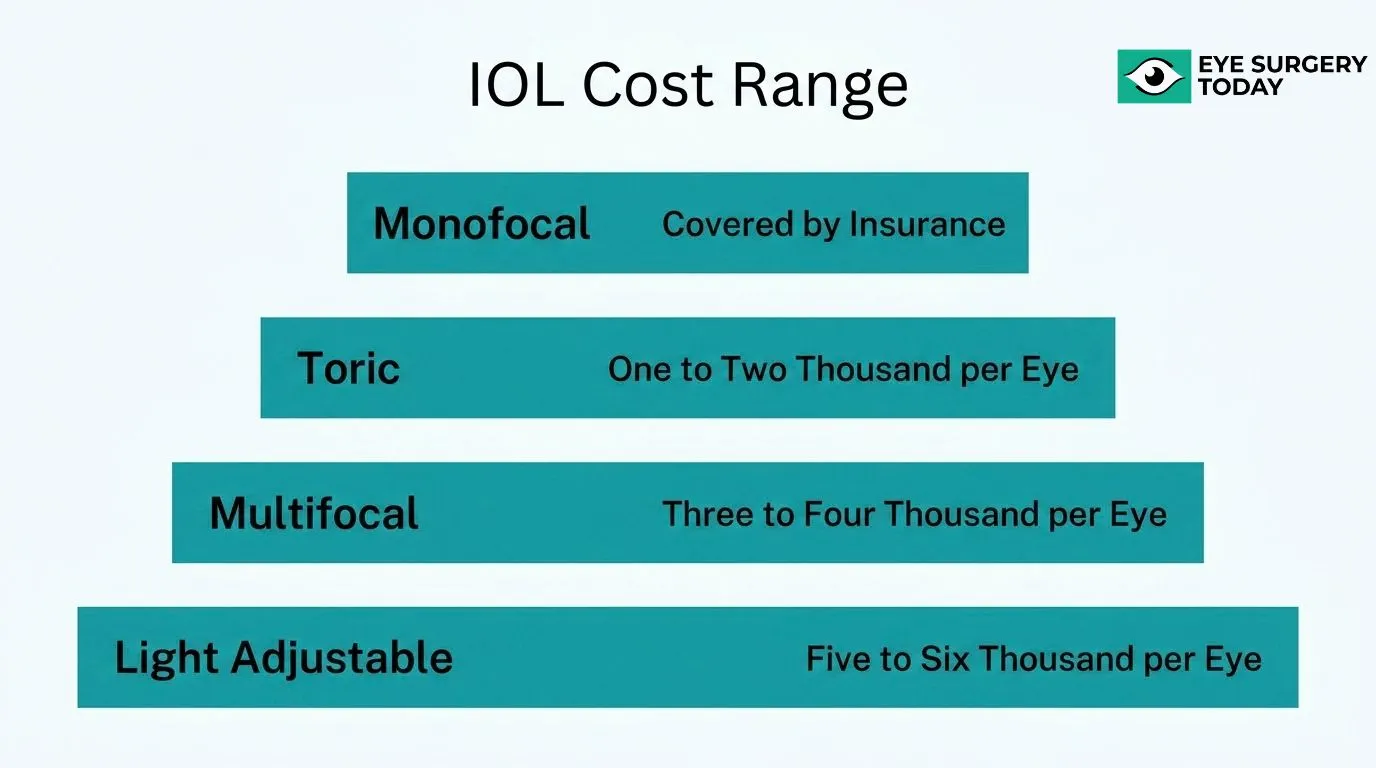
A monofocal IOL typically costs nothing out of pocket for eligible Medicare beneficiaries. According to Medicare.gov, after meeting the Part B deductible, patients pay 20% of the Medicare-approved amount for both the lens and implantation surgery. Private insurers generally follow a similar coverage model. Because monofocal lenses are the standard of care, they are the only IOL type fully covered by insurance, making them the most accessible option financially.
How Much Does a Toric IOL Typically Cost?
A toric IOL typically costs $1,500 to $2,500 per eye above what insurance covers. According to Harvard Health Publishing, patients can expect to pay this premium out of pocket because toric lenses are classified as elective upgrades. Duke Eye Center similarly notes an additional out-of-pocket expense of around $1,000 per eye for toric lenses. For patients with significant astigmatism, this premium is often worth considering given the potential reduction in dependence on corrective eyewear.
How Much Does a Multifocal IOL Typically Cost?
A multifocal IOL typically costs $3,000 to $4,000 per eye as an out-of-pocket upgrade. Harvard Health Publishing places wider-range lenses in this price bracket. Duke Eye Center estimates the additional patient cost for presbyopia-correcting lenses at $2,000 to $2,600 per eye. Insurance covers the base cataract surgery, but the premium portion of a multifocal lens remains the patient’s responsibility in most cases.
How Much Does a Light Adjustable Lens Typically Cost?
The Light Adjustable Lens typically costs $5,000 to $6,000 per eye, making it the most expensive IOL option currently available. Harvard Health Publishing confirms this range, reflecting the added cost of the post-surgical UV light adjustment treatments and the proprietary RxSight technology required. Given that this lens allows post-operative fine-tuning of prescription, many patients find the premium reasonable if achieving a precise refractive outcome is their primary goal.
What Factors Should You Discuss With Your Surgeon Before Choosing an IOL?
The factors to discuss with your surgeon before choosing an IOL include your daily visual demands, any existing eye conditions, and your budget. The following sections cover how each of these shapes your IOL decision.
How Does Your Lifestyle Affect Which IOL Is Right for You?
Your lifestyle affects which IOL is right for you by determining which distances matter most in your daily routine. A surgeon will typically ask about your occupation, hobbies, driving frequency, and whether you work extensively on screens or in low-light environments.
According to Harvard Medical School’s Department of Ophthalmology, key candidacy questions include: What are the patient’s visual demands? Do they do a lot of nighttime driving or spend significant time on the computer? Do they want to accomplish daily tasks with or without glasses after surgery?
- Distance-focused activities (driving, sports): a monofocal IOL set for distance may suit you well.
- Screen-heavy or reading-intensive work: a multifocal or extended-depth-of-focus IOL may reduce dependence on near-vision glasses.
- Mixed visual demands: a premium lens with intermediate range, such as a multifocal, is often worth exploring.
Being honest about your visual priorities before surgery leads to more predictable outcomes.
Does an Existing Eye Condition Limit Your IOL Options?
Yes, an existing eye condition can limit your IOL options significantly. Conditions such as macular degeneration, irregular astigmatism, keratoconus, or higher-order corneal aberrations may disqualify you from premium lens technology entirely.
According to Harvard Medical School’s Department of Ophthalmology, ideal candidates for premium IOLs are those without ocular comorbidities. Irregular astigmatism, higher-order aberrations, or corneal and macular pathology can preclude patients from being good candidates. Dry eye disease can also confound pre-surgical testing, meaning biometry may need to be repeated after the ocular surface is treated.
Additionally, the FDA notes that the Light Adjustable Lens is contraindicated in patients with a history of ocular herpes simplex virus or those taking medications that increase UV sensitivity, such as tetracycline or amiodarone.
Your surgeon will evaluate these factors with diagnostic testing before recommending any specific lens.
How Does Your Budget Influence the IOL Decision?
Your budget influences the IOL decision because premium lens options carry significant out-of-pocket costs that Medicare and most insurance plans do not cover. According to Harvard Health Publishing, patients can expect to pay $1,500 to $2,500 per eye for a toric lens, $3,000 to $4,000 per eye for a wider-range multifocal lens, and $5,000 to $6,000 per eye for the Light Adjustable Lens.
Standard monofocal lenses are covered under Medicare after the Part B deductible and 20% copay are applied, making them the most accessible option financially. Premium lenses require an additional out-of-pocket contribution regardless of insurance status.
Discussing cost early in the consultation allows your surgeon to present options that balance your visual goals with what is financially realistic for you.
How Can Surgeon-Reviewed Guidance Help You Choose the Right Cataract Lens?
Surgeon-reviewed guidance helps you choose the right cataract lens by aligning clinical evidence with your personal vision goals, lifestyle, and eye health. The sections below cover how Eye Surgery Today supports that decision and what key takeaways to carry forward.
Does Eye Surgery Today Provide Expert-Reviewed IOL Information to Guide Patients?
Eye Surgery Today provides surgeon-reviewed IOL information designed to help patients understand their cataract lens options before consulting their surgeon. The platform translates clinical evidence into clear, accessible language, covering lens types, candidacy criteria, costs, and recovery expectations. According to the National Eye Institute, patients may still need a new prescription for glasses or contact lenses after surgery, which makes pre-surgical education especially valuable for setting realistic expectations. Understanding the tradeoffs between monofocal, toric, multifocal, and light adjustable lenses before your appointment allows for a far more productive conversation with your surgeon.
What Are the Key Takeaways About Cataract Lens Options We Covered?
The key takeaways about cataract lens options covered in this article are:
- Monofocal IOLs provide clear vision at one distance and are fully covered by insurance, but most patients will still need reading glasses.
- Toric IOLs correct pre-existing astigmatism and improve distance vision, with out-of-pocket costs typically around $1,000 per eye beyond insurance.
- Multifocal IOLs reduce dependence on glasses across multiple distances, though they carry a higher risk of glare and halos compared to monofocals.
- Light Adjustable Lenses offer post-surgical fine-tuning using UV light treatments, making them the most customizable option for patients who want precision.
- Ideal IOL candidates have no significant ocular comorbidities, such as macular disease or irregular astigmatism, which can limit suitability for premium lenses.
- Questions to bring to your surgeon include whether you will need glasses for reading or distance, how prior LASIK affects your options, and how conditions like glaucoma may influence the decision, as outlined by MedlinePlus (National Library of Medicine).
Choosing the right lens depends on your vision priorities, daily activities, and ocular health. Surgeon-reviewed resources like Eye Surgery Today exist to make that decision clearer and more confident.