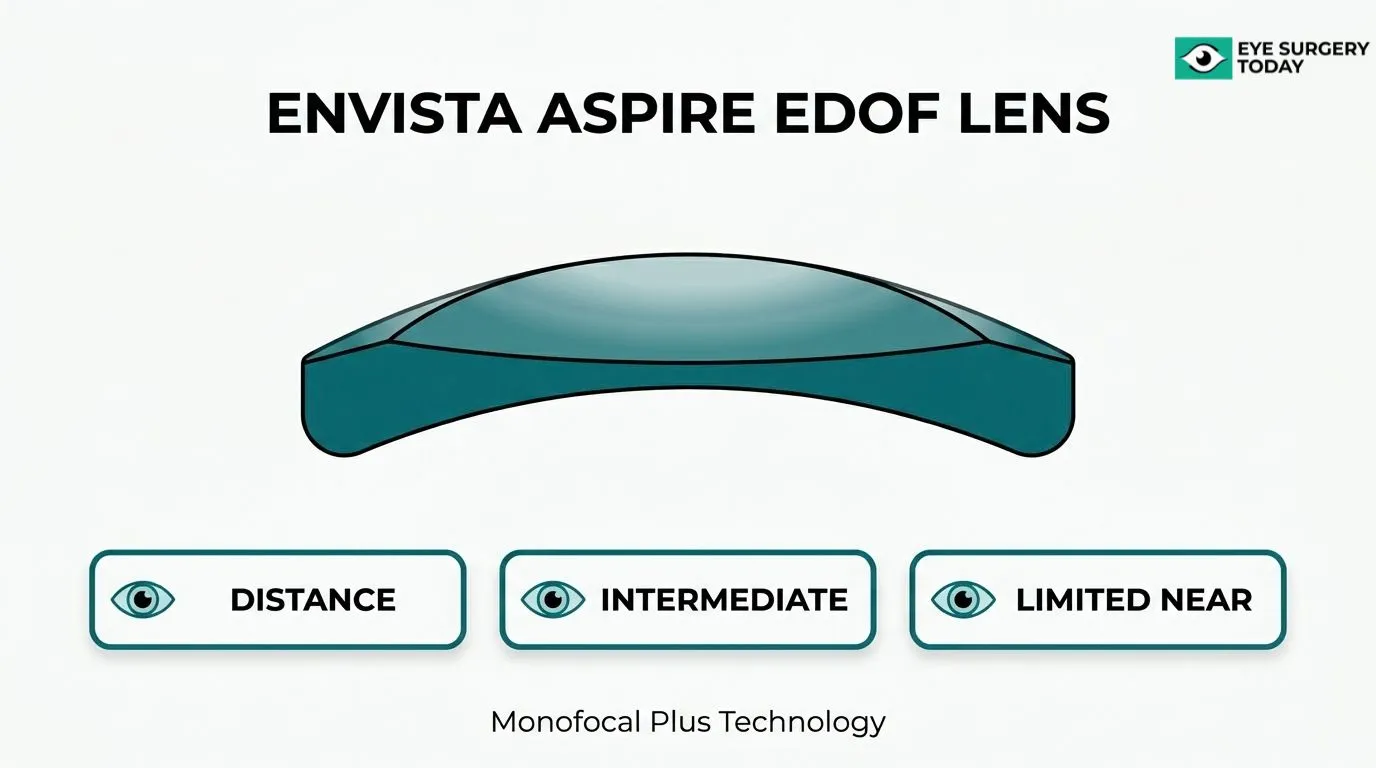
The enVista Aspire is a monofocal plus intraocular lens from Bausch + Lomb that uses a modified posterior aspheric surface to provide a continuous depth of focus from distance to intermediate vision during cataract surgery. It received FDA approval in August 2023 and is classified as an enhanced monofocal rather than a full EDOF lens.
This guide covers what EDOF technology means and how the Aspire works, clinical visual performance across distances, comparisons to other IOL types, benefits and limitations, candidate selection, and what to expect from the surgical experience.
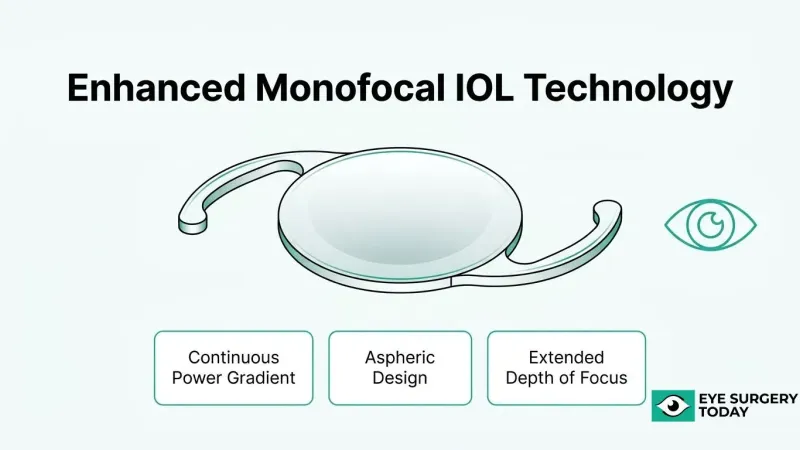
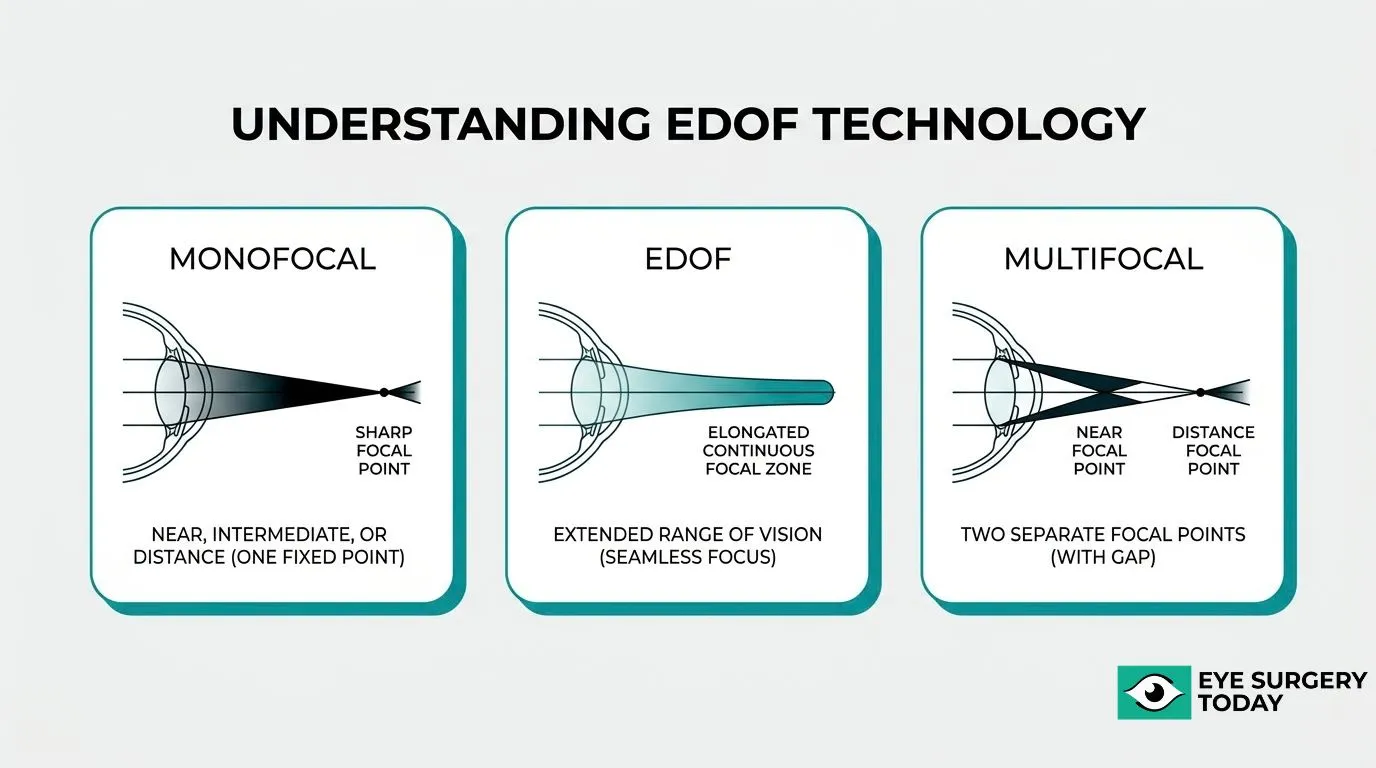
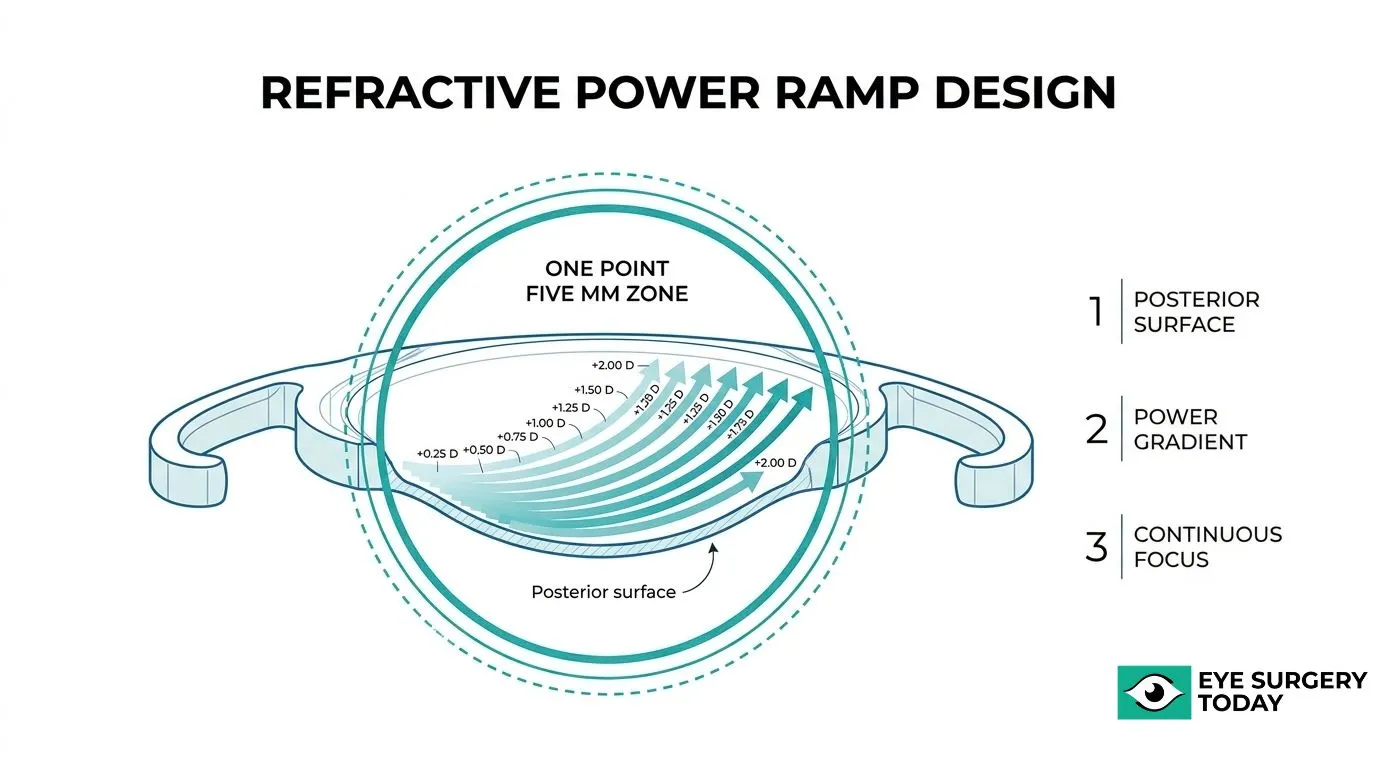
EDOF lenses create one elongated focal zone instead of splitting light into separate focal points, and the Aspire achieves this through a refractive power ramp within its central 1.5 mm optical zone rather than diffractive ring patterns.
Clinical outcomes suggest strong distance acuity, with most implanted eyes reaching 20/25 or better uncorrected, and functional intermediate vision suited to computer use and daily tasks. Near vision at reading distance is more limited, and glasses may still be needed for fine print.
Compared to standard monofocals, the Aspire may offer meaningful intermediate gains; compared to multifocals, it trades some near reach for a lower risk of glare and halos. Its purely refractive design avoids the light-splitting trade-offs associated with diffractive optics.
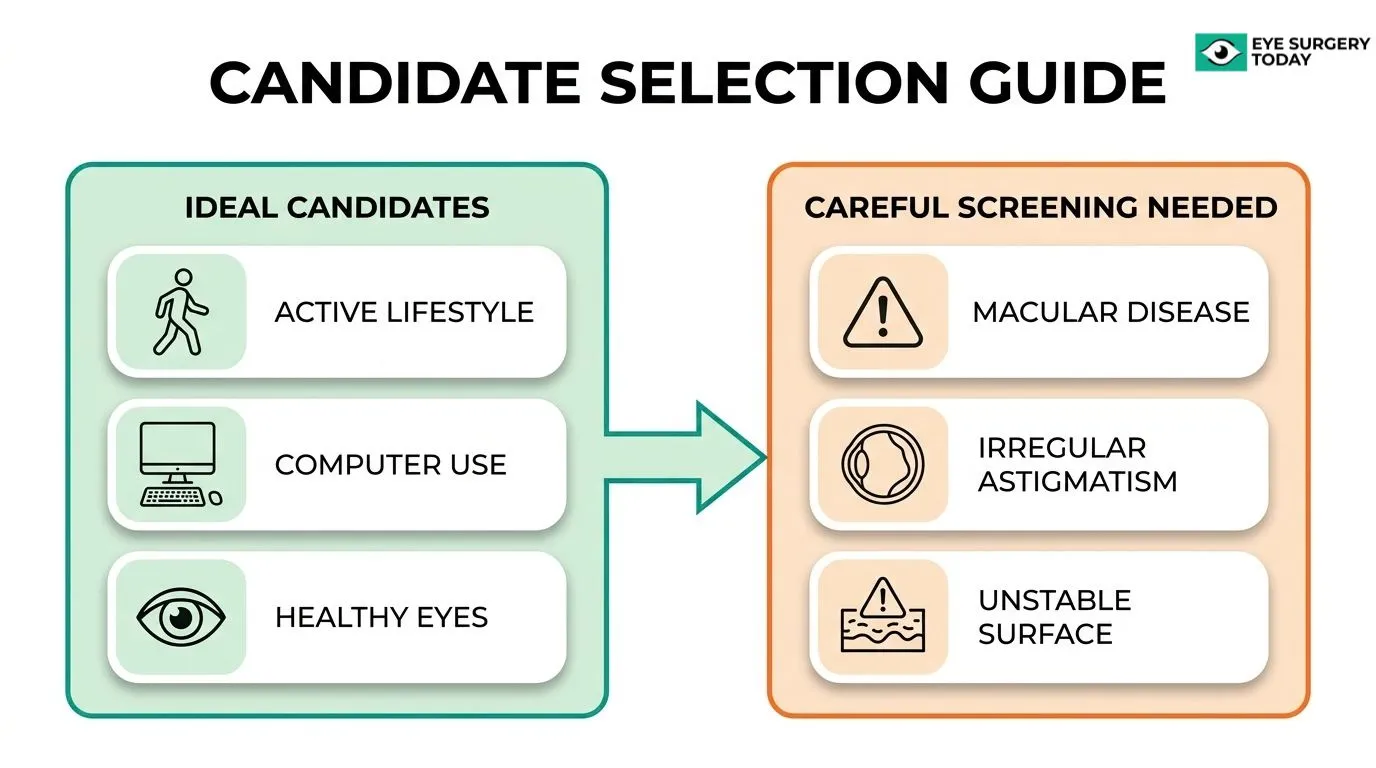
Ideal candidates prioritize dependable distance and intermediate vision while accepting potential reading glass use. Patients with irregular astigmatism, macular disease, or unstable ocular surfaces require careful screening before considering this lens.
What Does EDOF Mean in the Context of IOLs?
EDOF stands for Extended Depth of Focus, a category of intraocular lens technology designed to create a continuous range of clear vision rather than a single fixed focal point. Understanding how EDOF lenses differ from monofocal and multifocal IOLs is essential context for evaluating the enVista Aspire.
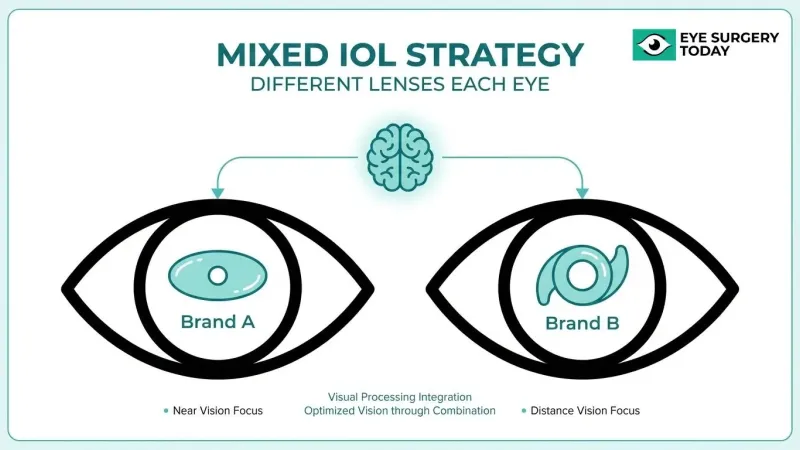
According to the European Society of Cataract and Refractive Surgeons (ESCRS), while multifocal IOLs have two distinct foci with blurry vision in between, EDOF IOLs work by having one elongated focal area that gives an extended depth of focus. This distinction matters clinically: multifocal lenses split incoming light between focal points, which can introduce contrast loss and dysphotopsia, whereas EDOF lenses stretch a single focal zone across a broader range.
The American Academy of Ophthalmology notes that standard monofocal lenses are designed to provide the best possible vision at one distance, with most patients opting for distance correction. Accommodating IOLs attempt near vision through ciliary muscle action, but EDOF lenses take a different optical approach entirely, using lens design modifications to elongate the focal region without splitting light into multiple discrete foci.
For patients weighing IOL options, EDOF represents a middle ground: broader coverage than a monofocal, with fewer optical side effects than a traditional multifocal.
What Is the enVista Aspire Lens Specifically?
The enVista Aspire is a monofocal plus intraocular lens (IOL) developed by Bausch + Lomb to provide a continuous depth of focus from distance to intermediate. The following sections cover who manufactures it, what condition it treats, and how it differs from other lenses in the enVista family.
Who Makes the enVista Aspire Lens?
The enVista Aspire lens is made by Bausch + Lomb, a global ophthalmic surgical company. Bausch + Lomb commercially launched the enVista Aspire monofocal and toric IOLs in the European Union after receiving a CE Mark, and the FDA approved both the monofocal (EA) and toric (ETA) models on August 21, 2023. Health Canada issued its approval on March 6, 2025.
What Eye Condition Is the enVista Aspire Designed to Treat?
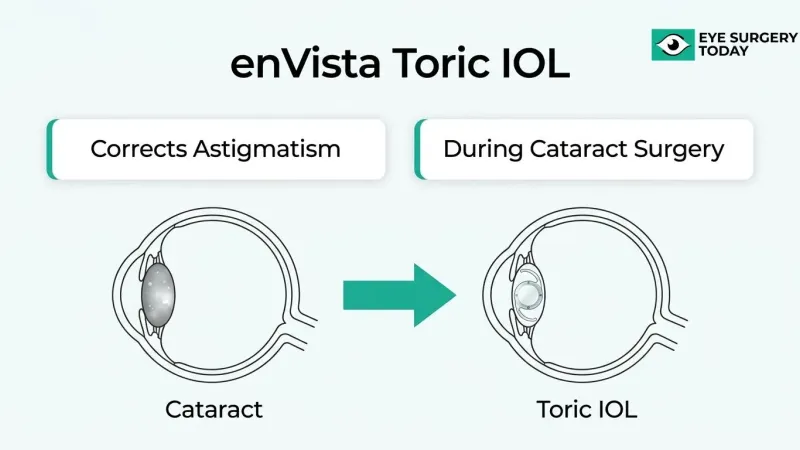
The enVista Aspire is designed to treat cataracts by replacing the clouded natural lens with an artificial IOL during cataract surgery. It is indicated for adult patients undergoing cataract surgery who require pseudophakic correction, with the toric model (ETA) addressing concurrent corneal astigmatism.
How Is the enVista Aspire Different From Other enVista Lenses?
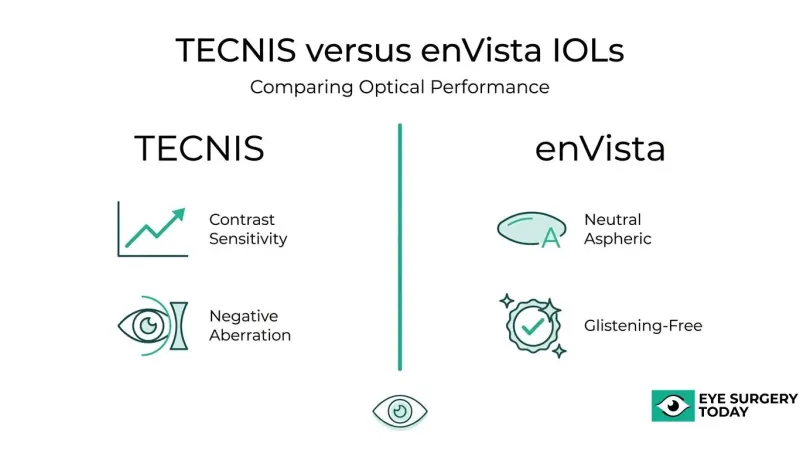
The enVista Aspire differs from standard enVista monofocal IOLs through a key optical modification: its posterior aspheric surface uses higher-order aspheric coefficients to create a small, continuous increase in power within the central 1.5 mm diameter. According to Bausch + Lomb’s published specifications, this design is intended to extend depth of focus from distance to intermediate, which standard enVista monofocals do not attempt. It uses the same hydrophobic acrylic, glistening-free, UV-absorbing material platform as the broader enVista portfolio but adds the “monofocal plus” optical engineering that standard models lack.
How Does the enVista Aspire Extend Depth of Focus?
The enVista Aspire extends depth of focus through a refractive modification to its posterior aspheric surface, creating a gradual power increase across the central optical zone. The following sub-sections explain the specific technology involved, the optical mechanism used, and the resulting focal range.
What Technology Does the enVista Aspire Use to Stretch Focus?
The technology the enVista Aspire uses to stretch focus is a higher-order aspheric modification applied to the posterior surface of the lens. Specifically, according to Bausch + Lomb’s published specifications, the Aspire IOL creates a small, continuous increase in IOL power within the central 1.5 mm diameter zone. This graduated power shift gently elongates the focal point rather than splitting light into separate foci. It is worth noting that, per the same specifications, clinically meaningful extension of the depth of focus has not been demonstrated in clinical trials, which places this lens in the “monofocal plus” category rather than a full EDOF classification.
Does the enVista Aspire Use Diffraction, Refraction, or Both?
The enVista Aspire uses refraction only, not diffraction. The lens achieves its focal extension entirely through the aspheric shape of its posterior surface, which continuously varies IOL power across the central optical zone. Diffractive IOLs, by contrast, use concentric ring patterns etched into the lens surface to split incoming light into multiple focal points. The Aspire’s purely refractive design avoids the light-splitting trade-offs associated with diffractive optics, which may help explain the lens’s favorable dysphotopsia profile relative to multifocal designs.
How Wide Is the Focal Range the enVista Aspire Provides?
The focal range the enVista Aspire provides spans primarily from distance to intermediate vision. According to the European Society of Cataract and Refractive Surgeons (ESCRS), EDOF IOLs produce one elongated focal area rather than two distinct foci separated by a blur zone, as seen with multifocal IOLs. The Aspire’s continuous increase in IOL power within its 1.5 mm central zone is designed to extend usable focus from far distance through mid-range tasks such as computer use. Near vision at reading distance may remain limited, and patients should discuss realistic expectations with their surgeon before implantation.
What Vision Distances Does the enVista Aspire Cover?
The enVista Aspire covers distance and intermediate vision as its primary focal range, with limited functional near vision. The sections below detail clinical performance at each distance: distance, intermediate, and near.
How Well Does the enVista Aspire Perform at Distance Vision?
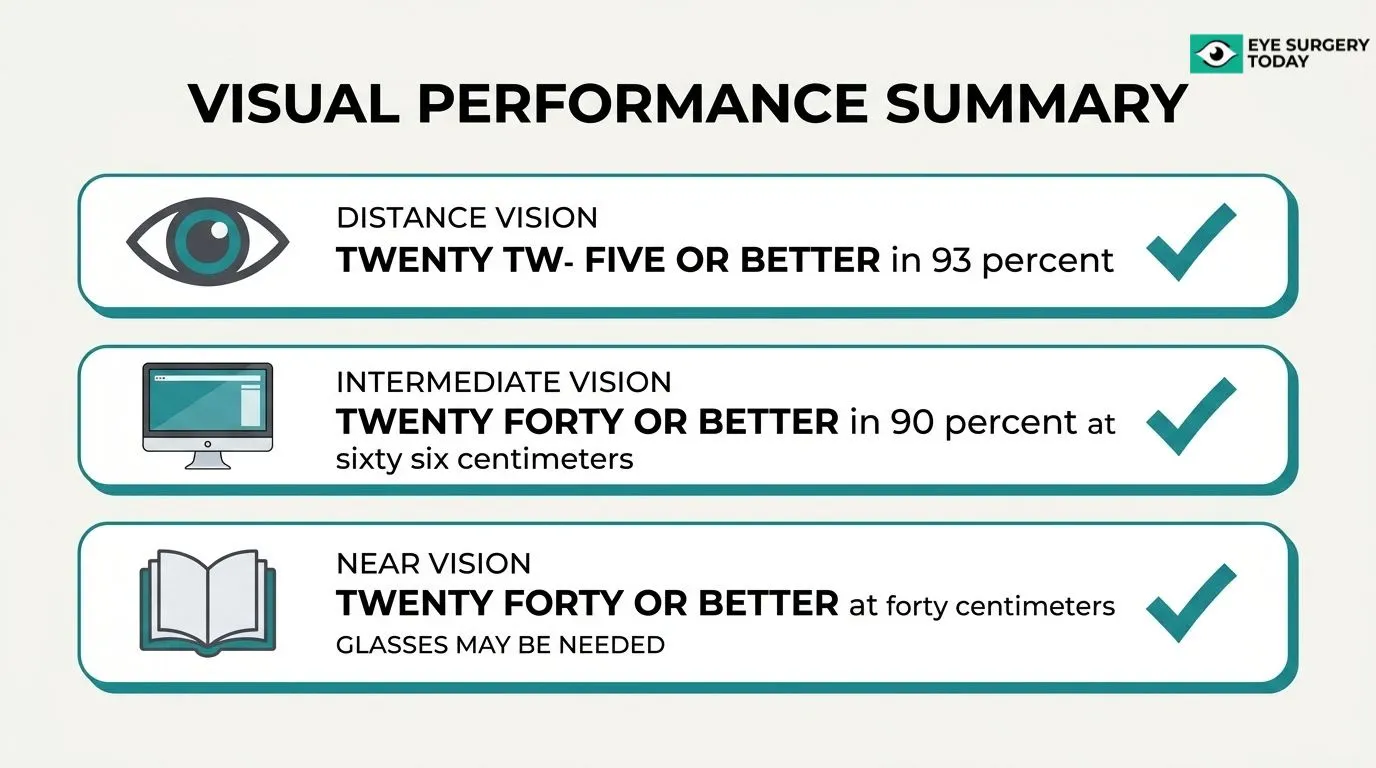
Distance vision performance of the enVista Aspire is strong, reflecting its monofocal-plus foundation. According to a prospective observational study published in the Journal of Refractive Surgery, mean uncorrected distance visual acuity (UDVA) was 20/22, with 93.1% of eyes achieving 20/25 or better, while mean corrected distance visual acuity (CDVA) was 20/20 in all eyes.
Clinicians at Ophthalmology 360 note that their preferred candidates prioritize dependable distance vision but would also value functional intermediate vision, with the understanding that reading glasses may still be required. Patients with irregular astigmatism or an unstable ocular surface may see reduced refractive predictability at distance.
How Well Does the enVista Aspire Handle Intermediate Vision?
Intermediate vision performance of the enVista Aspire represents its primary clinical advantage over standard monofocal lenses. In the same PubMed prospective study, mean distance-corrected intermediate visual acuity (DCIVA) at 66 cm was 20/34, with 90% of eyes achieving 20/40 or better.
This intermediate strength makes the enVista Aspire well suited for patients who regularly use computers, cook, or perform tasks in the 60 to 80 cm range without needing glasses.
Does the enVista Aspire Provide Functional Near Vision?
The enVista Aspire does provide some near vision, though results are more limited than at distance or intermediate. In a prospective observational study published in Journal of Refractive Surgery, mean distance-corrected near visual acuity (DCNVA) at 40 cm was 20/38, with 83% of eyes achieving 20/40 or better.
Reading glasses may still be needed for sustained fine print tasks. The Aspire is not designed as a near-vision solution, so patients with strong near-vision priorities may benefit from discussing alternative IOL options with their surgeon.
How Does the enVista Aspire Compare to Other IOL Types?
The enVista Aspire sits between a standard monofocal and a full multifocal IOL, offering extended intermediate reach without the optical complexity of diffractive designs. The comparisons below cover standard monofocals, multifocals, and other EDOF lenses.
How Does the enVista Aspire Compare to a Standard Monofocal IOL?
The enVista Aspire compares to a standard monofocal IOL by offering meaningfully better intermediate and near visual acuity while preserving reliable distance correction. A standard monofocal is designed to correct vision at one distance only, typically distance, leaving patients dependent on glasses for intermediate and near tasks.
Clinical data from comparable EDOF technology illustrates the gap. A study published in Clinical Ophthalmology enrolled 32 subjects with bilateral implantation of either the AcrySof IQ Vivity EDOF lens or the AcrySof IQ Monofocal. The EDOF group showed statistically significant improvements in distance-corrected intermediate VA (logMAR 0.11 vs. 0.33, p = 0.003) and distance-corrected near VA (logMAR 0.29 vs. 0.54, p = 0.001) compared to the monofocal group.
The enVista Aspire occupies this same enhanced-monofocal category, extending useful vision into the intermediate range without requiring a fundamentally different optical platform.
How Does the enVista Aspire Compare to a Multifocal IOL?
The enVista Aspire compares to a multifocal IOL by trading some near vision reach for a significantly lower risk of visual disturbances such as glare and halos. Multifocal IOLs use diffractive rings to create two or more distinct focal points, which can improve reading vision but also split incoming light and introduce photic phenomena that some patients find disruptive.
The enVista Aspire uses a single elongated focal zone rather than discrete foci, meaning light is not divided between competing focal points. According to the European Society of Cataract and Refractive Surgeons, EDOF lenses work by creating one elongated focal area, whereas multifocal IOLs have two distinct foci with blurry vision in between. This design choice makes the enVista Aspire a more conservative option: patients who prioritize visual quality and low dysphotopsia risk over maximum near independence are generally better served by this approach than by a full multifocal.
How Does the enVista Aspire Compare to Other EDOF Lenses?
The enVista Aspire compares to other EDOF lenses as a monofocal-plus design, meaning it sits at the conservative end of the EDOF spectrum relative to broader-range options like the TECNIS Symfony (ZXR00) or AcrySof IQ Vivity.
Research comparing two established EDOF lenses, the RAO200E and the TECNIS Symfony DFT015, found no significant difference in binocular corrected distance or intermediate acuity, though the Symfony showed better defocus curve performance at higher levels of defocus (p = 0.03), while the RAO200E produced smaller halo size. This illustrates that even within the EDOF category, trade-offs in near extension versus dysphotopsia profile differ by design.
The enVista Aspire prioritizes a monofocal-like visual quality and safety profile over maximizing the depth of focus range, making it a strong choice for patients with ocular pathology or quality-of-vision sensitivity who still want functional intermediate sight.
What Are the Benefits of the enVista Aspire Lens?
The benefits of the enVista Aspire lens center on three key areas: reduced spectacle dependence for intermediate tasks, stable visual quality in low-light environments, and a lower dysphotopsia profile compared to multifocal IOLs.
Does the enVista Aspire Reduce Dependence on Reading Glasses?
The enVista Aspire may reduce dependence on reading glasses for intermediate-distance tasks, though reading glasses may still be required for near tasks such as fine print. A prospective observational study published via PubMed found that 90% of eyes achieved 20/40 or better distance-corrected intermediate visual acuity at 66 cm, a functional threshold for computer and dashboard use. Near vision results were more modest, with 83% of eyes achieving 20/40 or better at 40 cm. For patients who primarily need relief from intermediate-range tasks rather than reading, the enVista Aspire represents a practical, low-compromise option.
How Does the enVista Aspire Perform in Low-Light Conditions?
The enVista Aspire performs in low-light conditions through its monofocal-plus optical design, which avoids the light-splitting mechanisms used in multifocal IOLs. Because the lens does not divide incoming light across multiple focal points, more usable light reaches the retina, supporting contrast sensitivity in dim environments. Clinicians noted in Ophthalmology 360 that candidates who prioritize dependable distance vision tend to perform well with this lens, which aligns with low-light demands such as night driving.
Does the enVista Aspire Cause Less Glare and Halos Than Multifocals?
The enVista Aspire is associated with a lower rate of glare and halos compared to multifocal IOLs. According to a study published in Ophthalmology and Therapy, visual disturbances were reported by only 11.1% of EA IOL patients, with blurred vision being the most common complaint rather than classic dysphotopsia symptoms such as halos or starbursts. Because the lens uses a single elongated focal zone rather than discrete ring-based focal points, it avoids the optical interference patterns that typically generate halo phenomena in multifocal designs.
What Are the Limitations or Drawbacks of the enVista Aspire?
The limitations of the enVista Aspire include continued dependence on reading glasses for near tasks, reduced suitability for patients with significant astigmatism, and compromised outcomes in eyes with pre-existing ocular disease. The sections below address each of these drawbacks in detail.
Will You Still Need Glasses After Getting the enVista Aspire?
Yes, you may still need glasses after getting the enVista Aspire, particularly for near-distance reading tasks. The lens is optimized for distance and functional intermediate vision, but it does not fully replace near vision correction. According to a prospective observational study published in the Journal of Refractive Surgery, mean distance-corrected near visual acuity was 20/38, with 83% of eyes achieving 20/40 or better at 40 cm. This means roughly 1 in 6 patients may not reach functional near acuity without correction. Patients who routinely read small print, work with fine detail, or rely heavily on close-range tasks should expect to keep reading glasses available.
Is the enVista Aspire Suitable for Patients With Astigmatism?
The enVista Aspire monofocal (EA) model is not designed to correct astigmatism. The clinical outcomes data from a PubMed-indexed prospective study were measured in patients with healthy eyes and normal visual potential, representing an ideal-case population. Patients with irregular corneal astigmatism or prior corneal refractive surgery may not achieve comparable results. For patients with measurable corneal astigmatism, the enVista Aspire Toric (ETA) variant may be a more appropriate option, though candidacy depends on individual ocular assessment.
What Happens If You Have Pre-Existing Eye Conditions?
Pre-existing eye conditions can significantly reduce the visual outcomes achievable with the enVista Aspire. According to Bausch + Lomb surgical documentation, patients with conditions such as corneal endothelial disease, macular degeneration, retinal degeneration, glaucoma, and chronic drug miosis may not achieve the visual acuity of patients without such problems. Additional risk factors include intraoperative complications such as posterior capsular rupture or inability to place the IOL in the capsular bag, which can compromise lens stability. Patients with any of these conditions require careful preoperative evaluation before the enVista Aspire is considered a suitable option.
Who Is a Good Candidate for the enVista Aspire Lens?
Good candidates for the enVista Aspire are patients seeking reliable distance and functional intermediate vision after cataract surgery, while accepting that reading glasses may still be needed. The sections below cover active and technology-dependent patients, as well as those who should avoid this lens.
Is the enVista Aspire Right for Active or Technology-Dependent Patients?
Active or technology-dependent patients are among the strongest candidates for the enVista Aspire, as the lens is optimized for the distance-to-intermediate range most used in screen-heavy or outdoor lifestyles. Patients who regularly use computers, drive, or engage in sports benefit most from this visual profile.
Visual side effects remain relatively low. According to a study published in Ophthalmology and Therapy (Springer Nature), visual changes at any time point were reported by 11.1% of EA IOL patients, with blurred vision being the most common complaint, affecting three patients, followed by brighter images in two patients. Less frequent reports included photopsia, temporary arc, and dry eye sensation. For patients prioritizing visual reliability over near reading independence, this risk profile is generally acceptable.
Are There Patients Who Should Avoid the enVista Aspire?
Patients who should avoid the enVista Aspire include those with pre-existing ocular conditions that reduce refractive predictability or limit visual potential. According to Bausch + Lomb surgical labeling, the following conditions may disqualify or complicate candidacy:
- Prior corneal refractive surgery or irregular corneal astigmatism
- Severe corneal dystrophy or corneal endothelial disease
- Macular degeneration or retinal degeneration
- Glaucoma or optic nerve atrophy
- Chronic drug miosis
- Intraoperative complications such as posterior capsular rupture or inability to place the IOL in the capsular bag
Patients with these conditions may not achieve the visual acuity outcomes seen in healthy-eye clinical studies. Careful preoperative screening is essential before recommending this lens.
What Can You Expect During and After the Procedure?
The enVista Aspire is implanted using the same surgical approach as standard cataract surgery, with recovery and visual adaptation following a predictable pattern. The sections below cover the implantation process, early recovery, and the adjustment timeline.
How Is the enVista Aspire Implanted During Cataract Surgery?
The enVista Aspire is implanted during cataract surgery through a small corneal incision, ranging from 2.2–2.6 mm, using a compatible injector system. The surgeon removes the clouded natural lens, then folds and inserts the hydrophobic acrylic IOL into the capsular bag, where it unfolds and self-positions. Because the enVista Aspire integrates into a standard monofocal surgical workflow, it requires no new techniques for most cataract surgeons. According to a prospective study presented at the 2025 ASCRS Annual Meeting (N = 50), the median uncorrected distance visual acuity one hour after surgery was 0.994 decimal, suggesting functional vision may be restored very quickly after implantation.
What Is the Recovery Like After Receiving the enVista Aspire?
Recovery after receiving the enVista Aspire follows the same general timeline as standard cataract surgery. Most patients can expect mild light sensitivity, blurred vision, and some discomfort in the first few days, which typically resolve within one to two weeks. In a published prospective observational study of 29 eyes implanted with the enVista Aspire, visual changes were reported in 11.1% of patients in the EA group, with blurred vision being the most common complaint, followed by brighter images. These effects were generally transient. Your surgeon may recommend anti-inflammatory and antibiotic eye drops during the initial healing period.
How Long Does It Take to Adjust to the enVista Aspire Lens?
Adjustment to the enVista Aspire lens typically takes a few weeks to several months, as the brain neuroadapts to the new optics. Because the Aspire is a monofocal plus design rather than a fully multifocal IOL, the neuroadaptation demand is lower, which most patients find makes the transition more gradual and comfortable. Distance vision tends to stabilize earliest, while intermediate vision quality may continue to improve over time. Patients with more demanding visual needs, such as extended screen use, benefit from realistic expectations set before surgery about the pace of this adjustment process.
What Questions Should You Ask Your Surgeon About the enVista Aspire?
The questions you should ask your surgeon about the enVista Aspire cover candidacy, realistic vision expectations, astigmatism management, and out-of-pocket costs. The sections below provide specific questions organized by topic to help you prepare for a productive pre-surgical consultation.
Questions About Your Candidacy
Your candidacy questions for the enVista Aspire should focus on whether your ocular health, lifestyle, and visual goals align with what this lens realistically delivers.
Consider asking:
- Am I a good candidate given my corneal health, astigmatism level, and any pre-existing conditions such as macular disease or glaucoma?
- Do I have irregular corneal astigmatism or prior refractive surgery that could reduce my refractive predictability with this lens?
- Is the enVista Aspire toric (ETA) model more appropriate for my level of corneal astigmatism?
- Based on my daily activities, is an intermediate-optimized monofocal a better fit than a multifocal or trifocal IOL?
According to Ophthalmology 360, surgeons report preferring the enVista Aspire for patients who prioritize dependable distance vision and would value functional intermediate vision, while remaining cautious when ocular pathology, irregular astigmatism, or an unstable ocular surface is present.
Questions About Expected Visual Outcomes
Your expected visual outcome questions for the enVista Aspire should clarify what “functional” vision at each distance actually means in daily life.
Consider asking:
- What uncorrected distance and intermediate acuity should I realistically expect after bilateral implantation?
- Will I still need reading glasses for near tasks like reading fine print or looking at my phone?
- How does my pupil size and lighting environment affect my intermediate vision with this lens?
- What defocus curve results have your patients typically achieved with the enVista Aspire?
A prospective observational study published in PubMed found that among 29 eyes implanted with the enVista Aspire, mean uncorrected distance visual acuity (UDVA) was 20/22, with 93.1% achieving 20/25 or better, while distance-corrected near visual acuity averaged 20/38, suggesting reading glasses remain likely for many patients.
Questions About Side Effects and Long-Term Lens Performance
Your side-effect questions for the enVista Aspire should probe both short-term visual disturbances and long-term lens stability.
Consider asking:
- What visual changes, such as blurred vision, photopsia, or halos, have your patients reported after implantation?
- How does the glistening-free hydrophobic acrylic material affect long-term optical clarity?
- Is posterior capsule opacification a concern with this lens, and how would it be managed?
- If I am dissatisfied with the visual outcome, what options are available?
Published data from Ophthalmology and Therapy (Springer Nature) showed that visual changes were reported by 11.1% of patients receiving the enVista Aspire monofocal (EA), with blurred vision being the most frequently reported visual change followed by brighter images and isolated cases of intermittent inferior photopsia or occasional temporary arc.
Questions About Cost and Insurance Coverage
Your cost and insurance questions for the enVista Aspire should distinguish between what Medicare or private insurance covers and what you may pay out of pocket for this enhanced monofocal option.
Consider asking:
- Does my insurance classify the enVista Aspire as a standard or premium IOL, and what does that mean for my cost?
- Will Medicare cover the lens itself, or only the basic cataract surgery facility and physician fees?
- Are there financing options available if out-of-pocket costs apply?
- What is the total estimated cost difference between this lens and a standard monofocal IOL?
According to Medicare.gov, covered cataract surgery in a hospital outpatient or ambulatory surgical center setting requires patients to pay 20% of the Medicare-approved amount after meeting the Part B deductible, but premium lens upgrades typically involve additional patient costs not covered by Medicare.
Bringing a written list of these questions to your consultation gives your surgeon the context needed to match the enVista Aspire to your specific visual lifestyle and ocular health profile.
How Can Eye Surgery Today Help You Learn More About IOL Options?
Eye Surgery Today offers surgeon-reviewed educational resources to help patients understand IOL choices, including EDOF lenses. The sections below cover what resources are available and summarize the key takeaways from this article.
Does Eye Surgery Today Offer Resources Specifically About EDOF and IOL Choices?
Eye Surgery Today does offer resources specifically about EDOF and IOL choices, including surgeon-reviewed guides, articles, and educational content covering cataract surgery, advanced lens options, and patient decision-making. The platform was built to bridge the gap between complex ophthalmic technology and patient understanding, translating clinical evidence into clear, accessible language. For patients researching options like the enVista Aspire, Eye Surgery Today provides the context needed to have more informed conversations with their surgical team.
What Are the Key Takeaways About the enVista Aspire EDOF Lens We Covered?
The key takeaways about the enVista Aspire EDOF lens covered in this article are:
- The enVista Aspire is a monofocal plus IOL from Bausch + Lomb, FDA-approved in August 2023, designed to optimize distance and intermediate vision through a modified posterior aspheric surface.
- It uses refractive optics rather than diffraction, which may contribute to a lower dysphotopsia profile compared to multifocal lenses.
- Clinical data suggest strong distance outcomes, with 93.1% of eyes achieving 20/25 or better uncorrected distance acuity, and functional intermediate performance.
- Reading glasses may still be required for near tasks, making patient selection and expectation-setting critical.
- Patients with irregular astigmatism, macular disease, or other ocular comorbidities may not be ideal candidates.
Eye Surgery Today can help you explore these topics further and prepare for a more confident conversation with your surgeon.