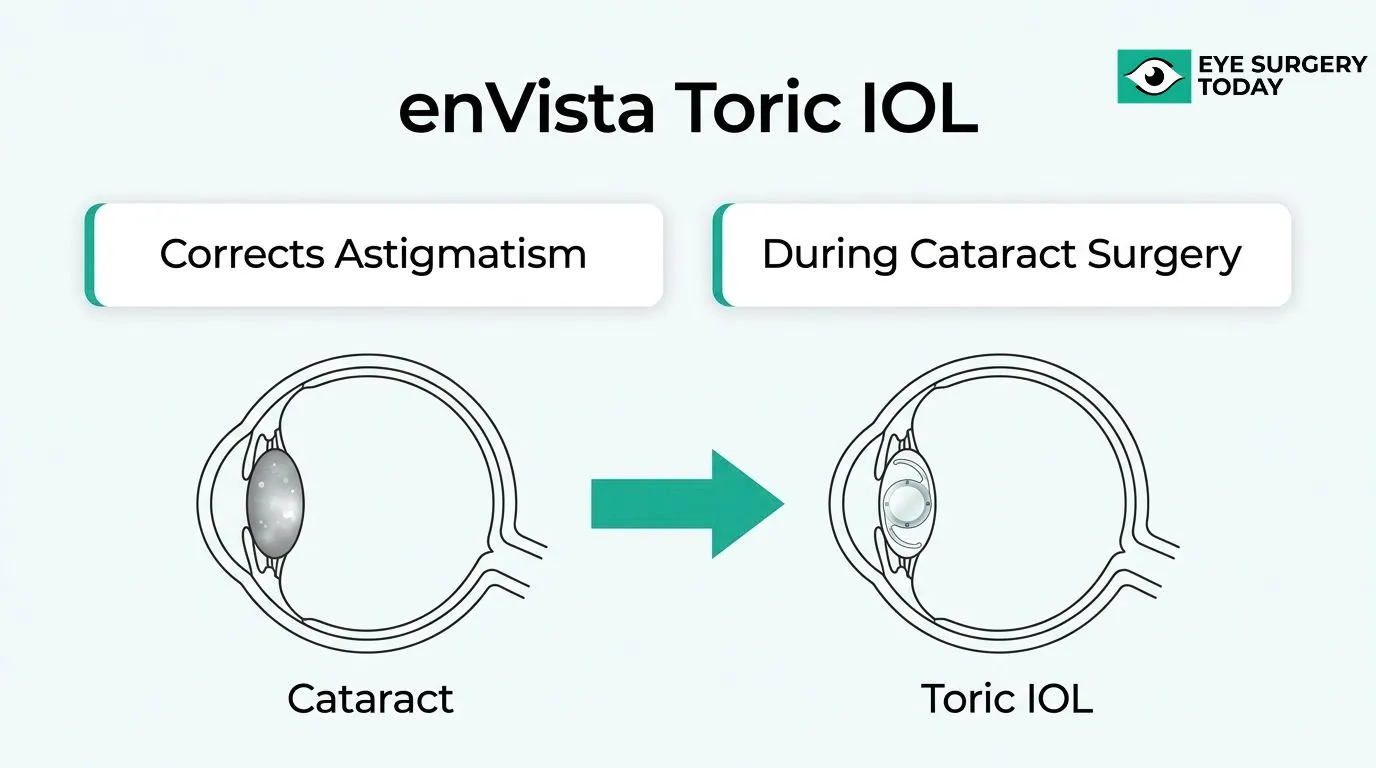
The enVista Toric IOL is an FDA-approved, one-piece hydrophobic acrylic intraocular lens that corrects regular corneal astigmatism at the time of cataract surgery, replacing the eye’s clouded natural lens with a toric implant containing built-in cylinder power.
This guide covers astigmatism and its impact on cataract outcomes, the enVista Toric’s design and surgical mechanism, patient candidacy, expected visual results, risks and side effects, comparisons with competing toric platforms, and cost considerations.
Astigmatism is highly prevalent among cataract patients, and leaving it untreated during lens replacement can result in continued dependence on glasses for both distance and near vision. The enVista Toric addresses this by neutralizing corneal astigmatism simultaneously with cataract removal.
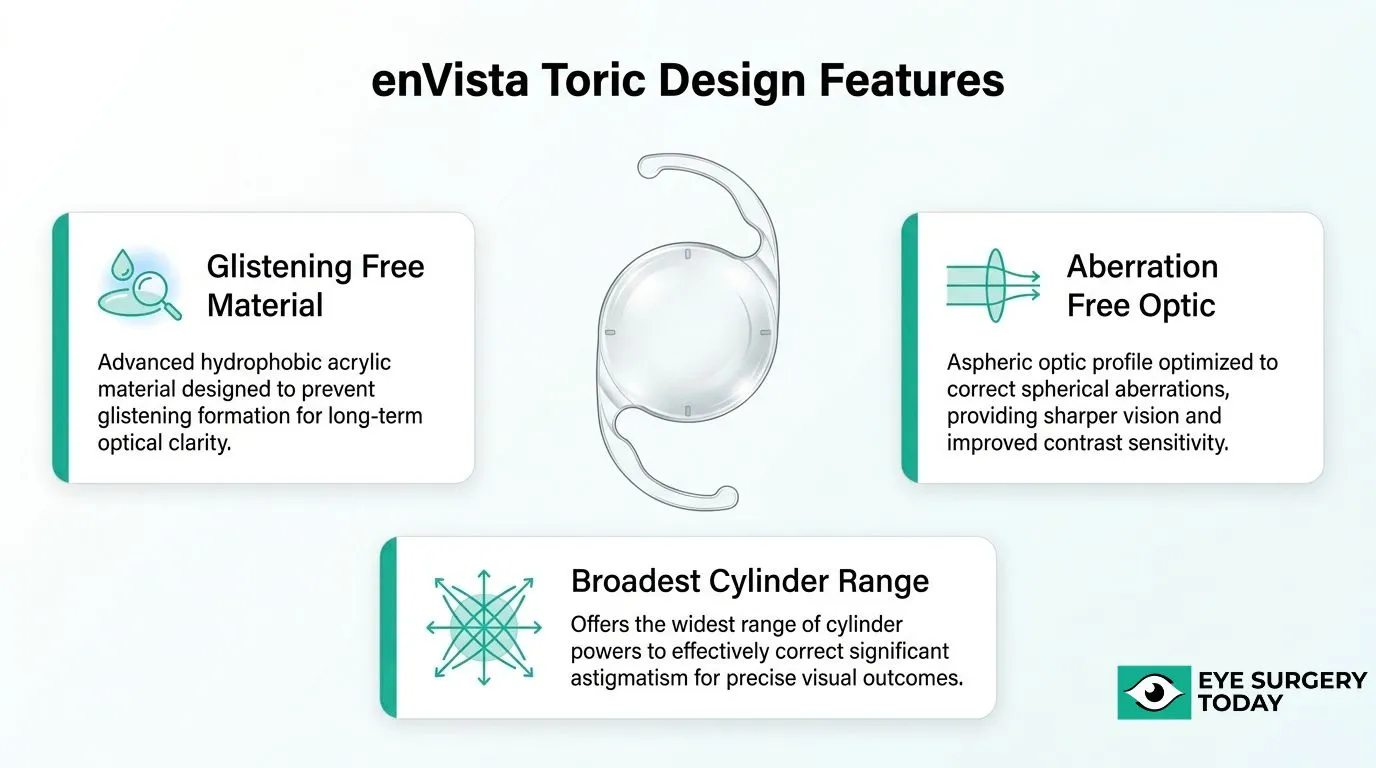
The lens features an aberration-free aspheric optic, glistening-free material, and the broadest cylinder range among U.S.-approved monofocal toric platforms, including half-step increments that may benefit patients with low or borderline astigmatism. Precise axis alignment during surgery is critical, as even small rotational deviations can meaningfully reduce astigmatic correction.
Clinical evidence suggests that most patients may achieve uncorrected distance visual acuity of 20/32 or better, with strong rotational stability in the weeks following implantation. As a monofocal design, however, the lens optimizes distance focus; reading glasses are typically still needed.
Good candidates have regular corneal astigmatism, while patients with irregular astigmatism or conditions such as keratoconus may not be eligible. Because the enVista Toric is classified as an advanced technology lens, out-of-pocket costs beyond standard Medicare coverage can range from $1,500 to $4,000 per eye depending on location and insurance.
What Is Astigmatism and Why Does It Matter During Cataract Surgery?
Astigmatism is a refractive condition that affects how the eye focuses light, and it matters during cataract surgery because leaving it untreated can significantly reduce the quality of vision after the procedure. The sections below cover how astigmatism is defined, how common it is in cataract patients, and what happens when it goes unaddressed at the time of surgery.
What Is Astigmatism?
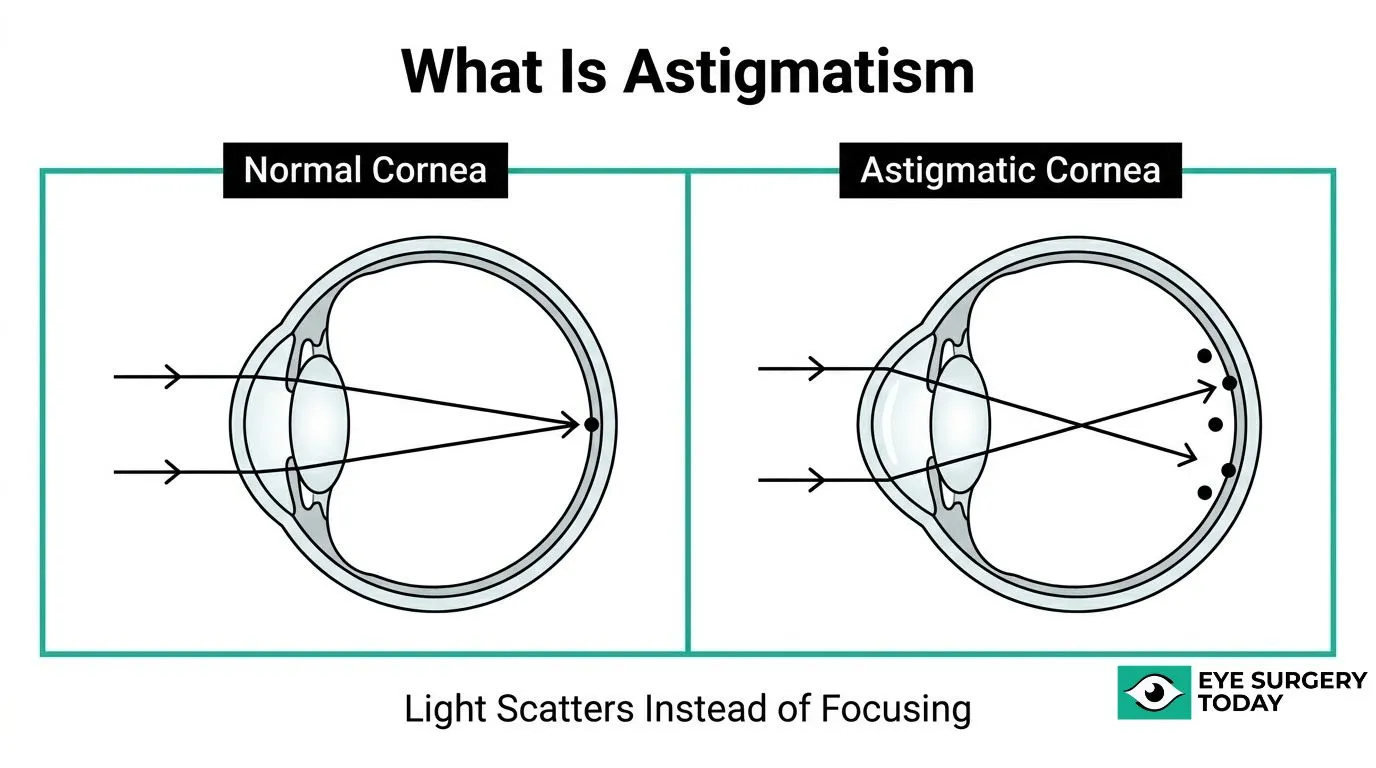
Astigmatism is a common eye problem that can make vision blurry or distorted. According to the National Eye Institute, it occurs when the cornea or natural lens has a different shape than normal preventing light from focusing cleanly on the retina. Rather than a perfectly round surface, an astigmatic cornea curves more steeply in one direction, like the side of a football, which scatters incoming light across multiple focal points instead of one.
How Common Is Astigmatism in Cataract Surgery Patients?
Astigmatism is highly prevalent among patients undergoing cataract surgery. A large-scale analysis published in the British Journal of Ophthalmology examined 110,468 eligible eyes and found that 78% had preoperative corneal astigmatism of 0.5 diopters or more, while 42% measured 1.0 diopters or higher. That same analysis found that visual acuity tended to worsen postoperatively as the degree of uncorrected astigmatism increased.
Why Does Untreated Astigmatism Matter After Cataract Surgery?
Untreated astigmatism matters after cataract surgery because it can leave patients dependent on glasses for both distance and near vision, even after the cataract has been removed. The University of Utah Moran Eye Center notes that a standard single-focus IOL corrects either distance or near vision but cannot address astigmatism, meaning patients with uncorrected astigmatism would require spectacles for nearly all visual tasks. Addressing astigmatism at the time of lens implantation gives patients the best opportunity for clear, unaided distance vision post-surgery.
What Is the enVista Toric IOL?
The enVista Toric IOL is a premium intraocular lens designed to correct astigmatism at the time of cataract surgery, replacing the eye’s cloudy natural lens. The sections below cover how it differs from a standard IOL, what makes its design distinctive, and who manufactures it.
How Is the enVista Toric Different From a Standard IOL?
The enVista Toric IOL differs from a standard IOL in that it incorporates built-in cylinder power to correct corneal astigmatism, while a standard monofocal IOL corrects only spherical refractive error. A standard IOL restores focus at one distance but leaves astigmatism untreated, which typically means patients still require glasses for both distance and near vision. The enVista Toric addresses astigmatism simultaneously with cataract removal, reducing dependence on corrective lenses for distance vision.
What Makes the enVista Toric Lens Design Unique?
The enVista Toric lens design is unique because it combines aberration-free aspheric optics, glistening-free hydrophobic acrylic material, and the broadest cylinder power range among U.S.-approved monofocal toric platforms. According to the U.S. Food and Drug Administration, the lens received approval on June 8, 2018 as the enVista MX60T: a one-piece, ultraviolet-absorbing, hydrophobic acrylic posterior chamber IOL with an aspheric optic free of spherical aberration. Its SureEdge posterior squared step edge provides a 360-degree PCO barrier. Seven cylinder powers span +1.25 D to +5.75 D, covering spherical equivalents from +6.0 D to +30.0 D in 0.5 D increments. Bausch + Lomb notes it is the only U.S. toric platform treating half-step cylinders up to 3.5 D at the IOL plane, with the lowest available cylinder treatment starting at 1.25 D (under 1.0 D at the corneal plane). That half-step increment capability is a meaningful clinical advantage for patients with low or borderline astigmatism who would otherwise receive no correction at all.
Who Manufactures the enVista Toric IOL?
The enVista Toric IOL is manufactured by Bausch + Lomb, a global ophthalmic medical device company. Bausch + Lomb markets the lens under its Bausch + Lomb Surgical division, which develops and distributes cataract surgery equipment and IOL platforms. The enVista platform, of which the toric model MX60T is a part, represents the company’s monofocal IOL line designed for routine and astigmatism-correcting cataract procedures.
How Does the enVista Toric Correct Astigmatism During Cataract Surgery?
The enVista Toric corrects astigmatism by replacing the eye’s cloudy natural lens with a specially designed IOL that has built-in cylinder power, neutralizing corneal astigmatism at the time of cataract removal. The following sections cover axis alignment, rotational stability, and how outcomes compare to a non-toric IOL.
How Is the enVista Toric Aligned to Match a Patient’s Astigmatism Axis?
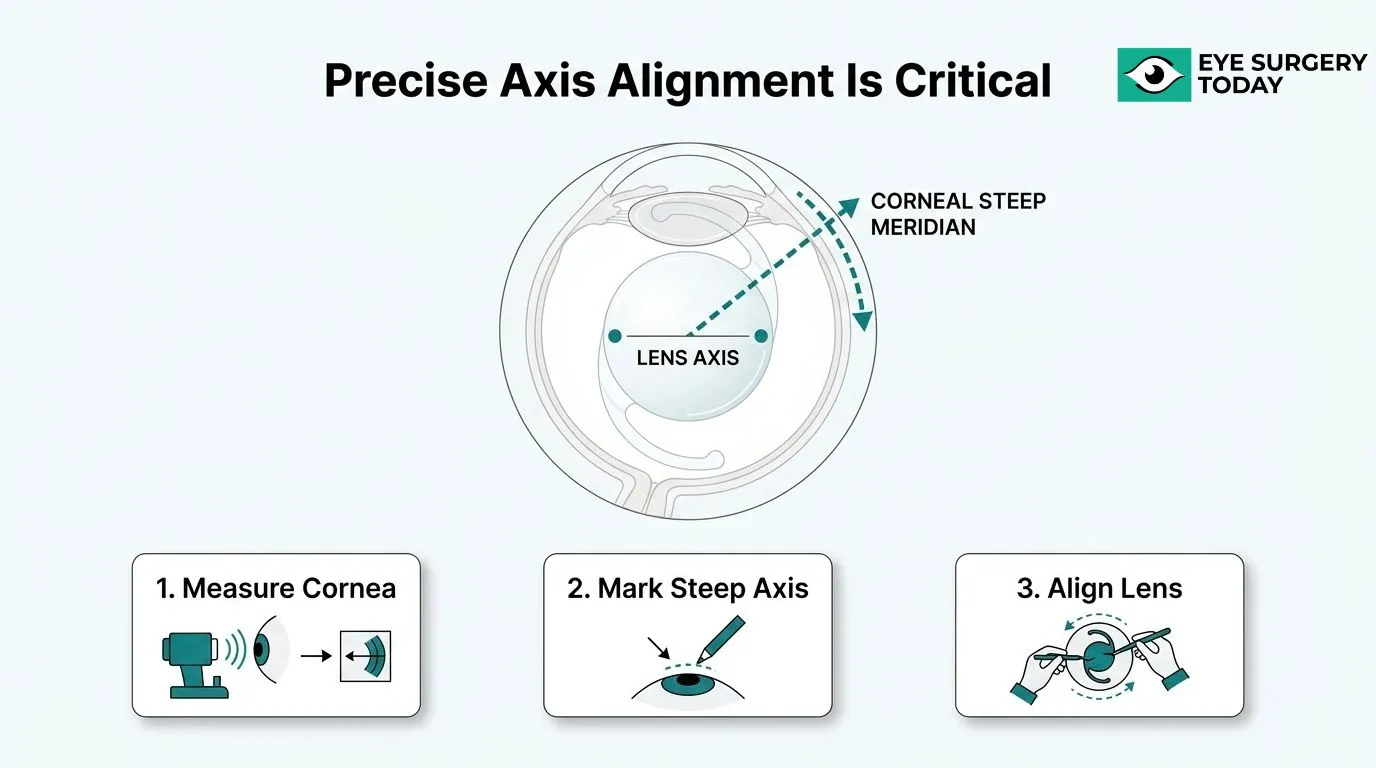
The enVista Toric is aligned by orienting the lens’s cylinder axis to precisely match the steep meridian of the patient’s corneal astigmatism during surgery. Preoperative measurements map the cornea’s curvature, and the surgeon marks the eye to guide lens placement at the correct angle.
Precise alignment is critical. According to a review published in Frontiers in Medicine, a misalignment of approximately 1° reduces astigmatic correction by roughly 3.3%, and a 30° deviation may not only fail to correct astigmatism but actually introduce it on a new axis. Digital marking systems and intraoperative guidance platforms have significantly improved alignment accuracy over manual marking techniques, making them the preferred approach in contemporary toric IOL surgery.
What Happens If the Lens Rotates After Implantation?
Lens rotation after implantation reduces the effectiveness of the enVista Toric’s astigmatic correction. Even modest postoperative rotation can meaningfully degrade visual outcomes, because the cylinder power is no longer counteracting the cornea’s steep meridian.
Clinical data from the Journal of Cataract & Refractive Surgery found that 97.4% of enVista Toric eyes demonstrated rotation of 5 degrees or less between the operative visit and days 30 to 60, indicating strong rotational stability in the vast majority of patients. When clinically significant rotation does occur, a repositioning procedure can realign the lens and restore correction. Rotational stability is arguably the single most important performance variable for any toric IOL, and results in this range are reassuring for patients and surgeons alike.
How Does the enVista Toric Restore Vision Compared to a Non-Toric IOL?
The enVista Toric restores vision more completely than a non-toric IOL for patients who have meaningful corneal astigmatism, because a standard monofocal lens leaves residual cylinder uncorrected. A patient receiving a non-toric IOL would still require distance and near glasses to compensate for untreated astigmatism after surgery.
A randomized parallel-group study cited by the National Library of Medicine found that 61% of patients with toric IOLs achieved spectacle-free distance vision at six months, compared with 39% of patients who received a standard control IOL. With accurate alignment, the enVista Toric can meaningfully reduce or eliminate dependence on distance correction that a non-toric lens simply cannot provide.
Who Is a Good Candidate for the enVista Toric IOL?
Good candidates for the enVista Toric IOL are cataract patients with regular corneal astigmatism who want to reduce their dependence on distance glasses after surgery. The following H3s cover mild astigmatism candidacy, moderate-to-high astigmatism candidacy, and eye conditions that may disqualify a patient.
Is the enVista Toric Right for Patients With Mild Astigmatism?
The enVista Toric may be right for patients with mild astigmatism, including those with as little as 0.5 D of corneal astigmatism. A study published in the British Journal of Ophthalmology analyzed 110,468 eligible eyes and found that 78% had preoperative corneal astigmatism of 0.5 D or greater, confirming how common even low-grade astigmatism is among cataract patients.
Toric IOLs can correct mild astigmatism effectively, though the benefit is most measurable when regular astigmatism is present. According to Robert J. Cionni, MD, writing for the American Academy of Ophthalmology, toric IOLs are intended for regular astigmatism only, not irregular astigmatism associated with conditions such as keratoconus, radial keratotomy, or penetrating keratoplasty.
Patients with with-the-rule or oblique astigmatism tend to maintain visual gains long-term, making them particularly well-suited candidates.
Is the enVista Toric Right for Patients With Moderate to High Astigmatism?
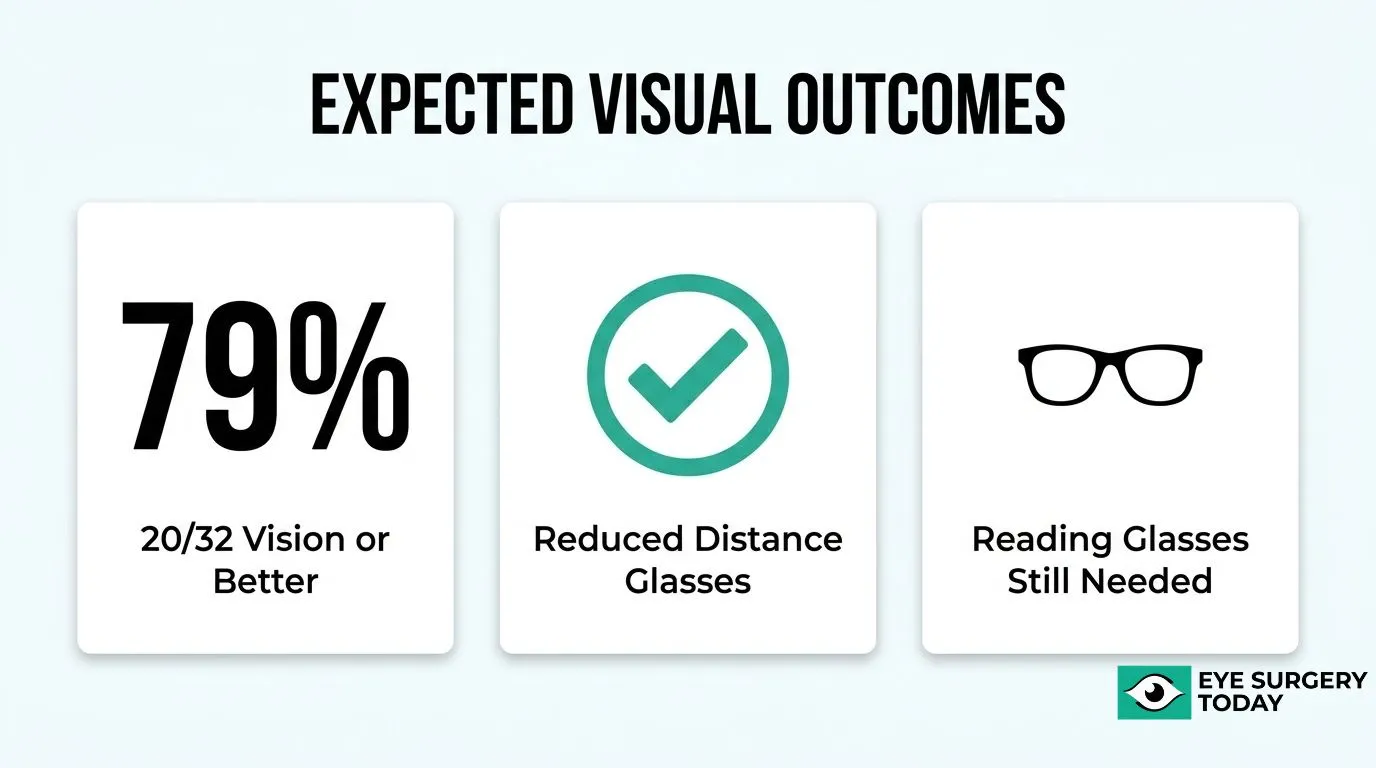
The enVista Toric is well-suited for patients with moderate to high regular astigmatism, offering seven cylinder powers up to +5.75 D at the IOL plane to address a wide correction range. Research published in the Journal of Cataract and Refractive Surgery found that 79.2% of patients achieved uncorrected distance visual acuity of 20/32 or better postoperatively, with 97.4% of eyes maintaining lens rotation of 5 degrees or less between the operative visit and days 30 to 60.
For patients with higher astigmatism levels, a toric IOL can meaningfully reduce the need for postoperative spectacles for distance, an outcome that standard monofocal lenses cannot provide on their own.
Are There Eye Conditions That May Disqualify a Patient From Getting the enVista Toric?
The eye conditions that may disqualify a patient from the enVista Toric include irregular astigmatism, keratoconus, a history of radial keratotomy, and prior penetrating keratoplasty. These conditions distort the corneal surface in ways that make toric IOL axis alignment unreliable, reducing the likelihood of achieving the intended correction.
Rotational stability is also a key eligibility factor. A 10-degree deviation from the intended axis can reduce astigmatic correction by approximately 35%, according to a review published in the Medical Journal Armed Forces India. Patients with anatomical factors that increase IOL rotation risk may not achieve satisfactory outcomes.
Cost may also be a practical barrier: according to a study published in PLOS ONE, toric and other advanced-technology IOLs are not covered under Medicare, with patient out-of-pocket costs ranging from $1,500 to $4,000 per eye. Patients should discuss both clinical candidacy and financial eligibility with their surgeon before proceeding.
What Visual Outcomes Can Patients Expect From the enVista Toric?
Visual outcomes from the enVista Toric center on distance vision improvement and reduced glasses dependence. The following sections cover whether patients still need glasses, how distance vision improves, and where near or intermediate vision limitations apply.
Will Patients Still Need Glasses After the enVista Toric Implant?
Patients will likely still need reading glasses after the enVista Toric implant, as the lens is a single-focus design. Single-focus IOLs allow an eye to see either far away or close up, but not both, according to the University of Utah Moran Eye Center. Without astigmatism correction, patients would typically require glasses for both distance and near tasks after cataract removal. The enVista Toric addresses the distance component by correcting astigmatism at the time of surgery, meaningfully reducing dependence on distance glasses. Reading glasses, however, remain necessary for most patients.
How Does Distance Vision Improve With the enVista Toric?
Distance vision improves substantially with the enVista Toric. According to a study published by the National Library of Medicine, 90% of eyes in the Dallas Parkland Health and Hospital population achieved uncorrected distance visual acuity (UDVA) of 20/40 or better, and 61% of toric IOL patients had spectacle-free distance vision at six months, compared with 39% of control IOL patients.
What Are the Limitations of the enVista Toric for Near or Intermediate Vision?
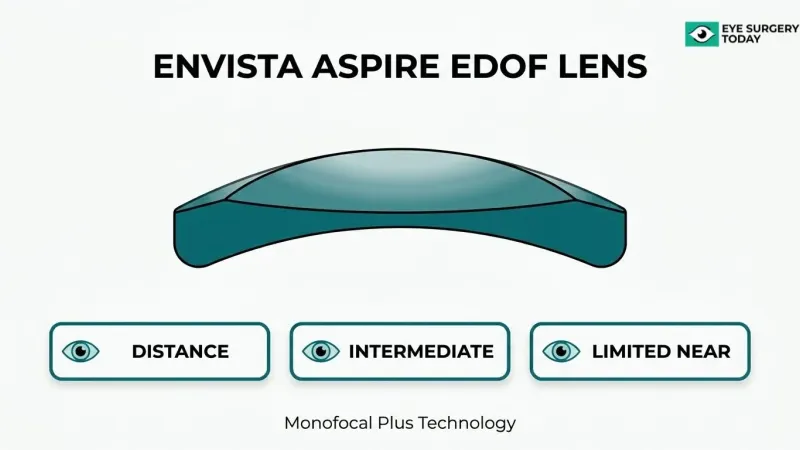
The key limitation of the enVista Toric for near or intermediate vision is that it does not provide multifocal correction. Because it is a monofocal toric lens, it corrects the refractive error caused by astigmatism and optimizes distance focus, but it cannot simultaneously provide sharp near or intermediate vision without optical aids. Patients requiring clear near vision for reading or screen use will generally need corrective lenses for those tasks after surgery.
What Are the Risks and Side Effects of the enVista Toric IOL?
The risks and side effects of the enVista Toric IOL include both general cataract surgery complications and concerns specific to toric lens technology, particularly rotation and misalignment. The sections below cover the most common post-surgical side effects and the distinct risks that arise when a toric lens shifts from its intended axis.
What Are the Most Common Side Effects After enVista Toric Surgery?
The most common side effects after enVista Toric surgery are those shared across all cataract procedures, such as light sensitivity, blurred vision during healing, and dysphotopsia. Dysphotopsia refers to visual disturbances including halos, starbursts, arcs, and streaks caused by light interacting with the implanted lens. According to EyeWiki from the American Academy of Ophthalmology, persistent negative dysphotopsia symptoms occur in approximately 3% of patients at one year after surgery, while up to 49% may experience positive dysphotopsia symptoms. Most light-related disturbances diminish as the eye adapts over weeks to months. Patients should report any persistent or worsening visual disturbances to their surgeon promptly.
What Are the Risks Specific to Toric Lens Rotation or Misalignment?
The risks specific to toric lens rotation or misalignment center on the loss of astigmatic correction when the lens shifts from its intended axis. According to a study published in the Medical Journal Armed Forces India, a deviation of just 10 degrees reduces astigmatic correction by approximately 35%, with every single degree of rotation reducing correction by roughly 3.5%. A 30-degree rotation may not only eliminate correction but could introduce astigmatism on a new axis entirely. Repositioning surgery is sometimes required to restore alignment and correct residual astigmatism. Precise preoperative marking and intraoperative guidance systems are critical tools for minimizing this risk.
How Does the enVista Toric Compare to Other Toric IOL Options?
The enVista Toric compares favorably to other US-approved toric IOL platforms primarily through its half-step cylinder increments and lowest available correction threshold. The H3 sections below examine how it specifically stacks up against the AcrySof IQ Toric and the Tecnis Toric.
How Does the enVista Toric Compare to the AcrySof IQ Toric?
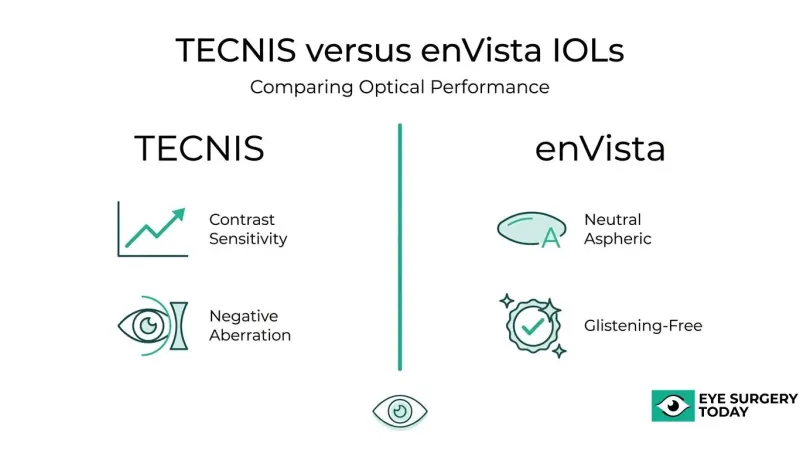
The enVista Toric compares to the AcrySof IQ Toric most notably in rotational stability, where a key difference exists. According to a study published in Ophthalmology and Therapy, the AcrySof IQ Toric demonstrated greater rotational stability than both the TECNIS and enVista Toric IOLs. Where the enVista platform holds a distinct advantage, however, is in cylinder range: it offers half-step increments and the lowest available correction of 1.25 D at the IOL plane, a granularity the AcrySof platform does not match among US-approved monofocal toric options.
How Does the enVista Toric Compare to the Tecnis Toric IOL?
The enVista Toric compares to the Tecnis Toric IOL as an approximate equal in rotational stability. A study published in the American Journal of Ophthalmology noted that only one known investigation had directly compared rotation rates between the two lenses, finding no statistically significant difference. For patients and surgeons weighing these two options, the enVista’s half-step cylinder increments and glistening-free hydrophobic acrylic material may offer practical advantages that rotational data alone does not capture.
What Is the Cost of the enVista Toric IOL?
The cost of the enVista Toric IOL depends on Medicare coverage status, insurance plan, and geographic location. The two H3 sections below cover what Medicare pays and what patients should expect to budget out of pocket.
Does Medicare or Insurance Cover the enVista Toric IOL?
Medicare does cover cataract surgery, but coverage for the enVista Toric IOL is partial. According to Medicare.gov, after meeting the Part B deductible, patients pay 20% of the Medicare-approved amount for both the intraocular lens and the implantation procedure. However, the toric IOL is classified as an advanced technology lens, which means any charge exceeding the standard covered amount becomes the patient’s responsibility, per Centers for Medicare & Medicaid Services guidance. Final costs also vary based on the type of facility, whether the surgeon accepts assignment, and any supplemental insurance the patient holds.
What Out-of-Pocket Costs Should Patients Budget for the enVista Toric?
Out-of-pocket costs for the enVista Toric IOL can range from $1,500 to $4,000 per eye. According to a study published in PLOS ONE, advanced technology IOLs are not fully covered under Medicare, with patient costs varying by lens type and U.S. location. Patients with astigmatism who want to reduce dependence on distance glasses after cataract surgery should discuss both lens options and total cost with their surgeon before scheduling. Reviewing coverage details with an insurance coordinator before surgery is one of the most practical steps a patient can take to avoid unexpected expenses.
How Can Surgeon-Reviewed Resources Help Patients Explore IOL Options Like the enVista Toric?
Surgeon-reviewed resources help patients explore IOL options by translating clinical evidence into clear, accessible guidance. The H3s below cover what Eye Surgery Today offers and key takeaways from this article.
Does Eye Surgery Today Offer Surgeon-Reviewed Guides on Toric IOLs and Cataract Surgery?
Eye Surgery Today offers surgeon-reviewed guides on toric IOLs and cataract surgery, designed to help patients navigate decisions that surgeons encounter daily. Patients commonly arrive with questions such as “What are my intraocular lens options?”, “Which lens is right for me?”, and “Are all IOLs covered by insurance?” According to Duke Health, patients who want to avoid distance glasses after cataract surgery and have astigmatism may find a toric lens appropriate. Eye Surgery Today’s content addresses these exact questions using evidence drawn from peer-reviewed sources, including the Journal of Cataract & Refractive Surgery, and coverage guidance from Medicare.gov. For patients facing an IOL decision, having access to surgeon-reviewed education before a consultation is one of the most underutilized advantages available.
What Are the Key Takeaways About the enVista Toric IOL We Covered?
The key takeaways about the enVista Toric IOL are:
- The enVista Toric is a hydrophobic acrylic, aberration-free toric IOL FDA-approved to correct regular astigmatism during cataract surgery.
- It offers the lowest available cylinder treatment of 1.25 D at the IOL plane and uniquely treats half-step cylinders up to 3.5 D.
- Clinical evidence suggests strong distance vision outcomes, with most patients achieving 20/32 or better uncorrected visual acuity.
- Precise alignment is essential; even small rotational deviations can meaningfully reduce astigmatic correction.
- The enVista Toric is not appropriate for irregular astigmatism or conditions such as keratoconus.
- Advanced technology IOLs typically require out-of-pocket costs, so patients should review coverage details with their surgeon.
Understanding these points helps patients enter their cataract consultation better prepared to discuss whether the enVista Toric fits their visual goals.