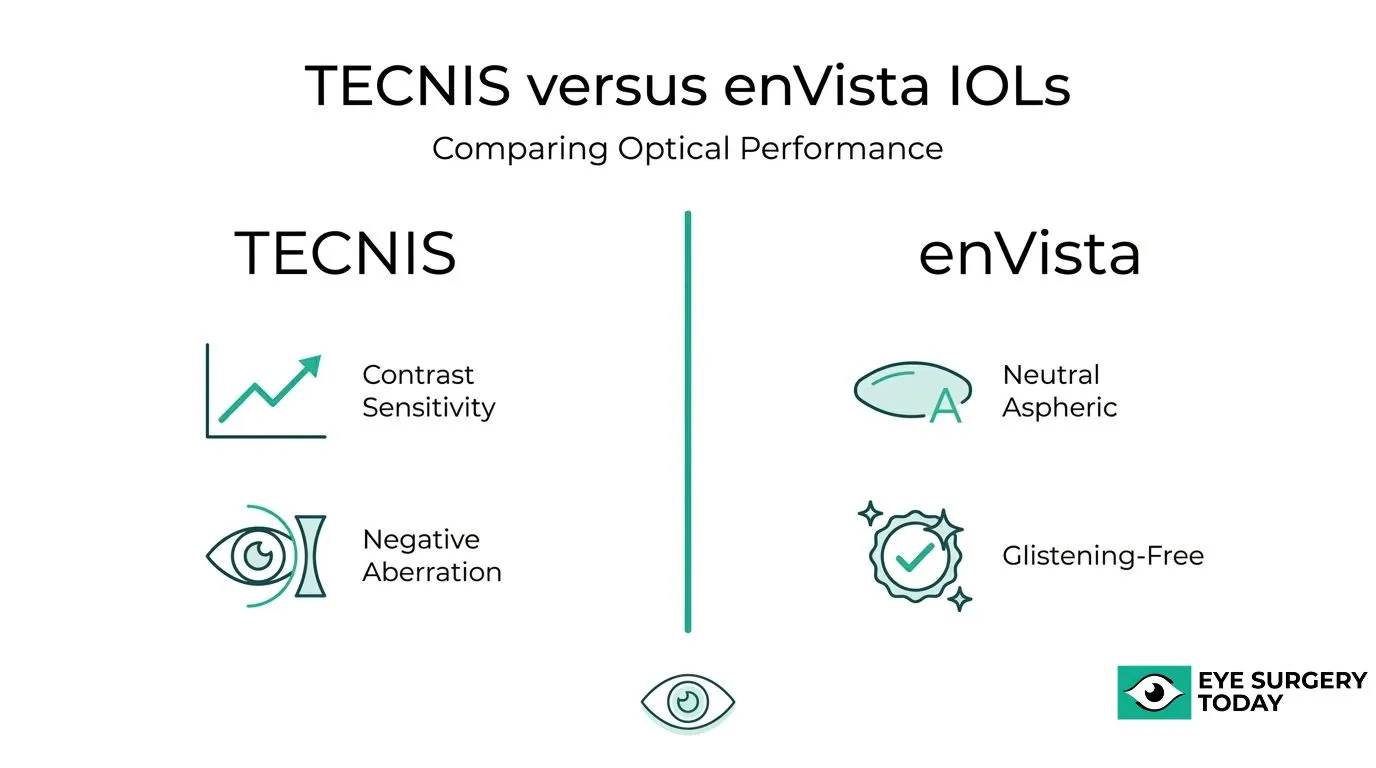
TECNIS and enVista are UV-filtering monofocal intraocular lenses (IOLs) that produce clinically similar color vision and contrast sensitivity outcomes in head-to-head testing, with meaningful differences emerging primarily in aspheric design philosophy and lens material properties.
This guide covers optical and material differences between the two lenses, contrast sensitivity performance across lighting conditions, color vision and spectral transmission effects, aspheric design influence on visual quality, dysphotopsia risk, patient selection criteria, clinical study outcomes, and how to evaluate IOL options with a surgeon.
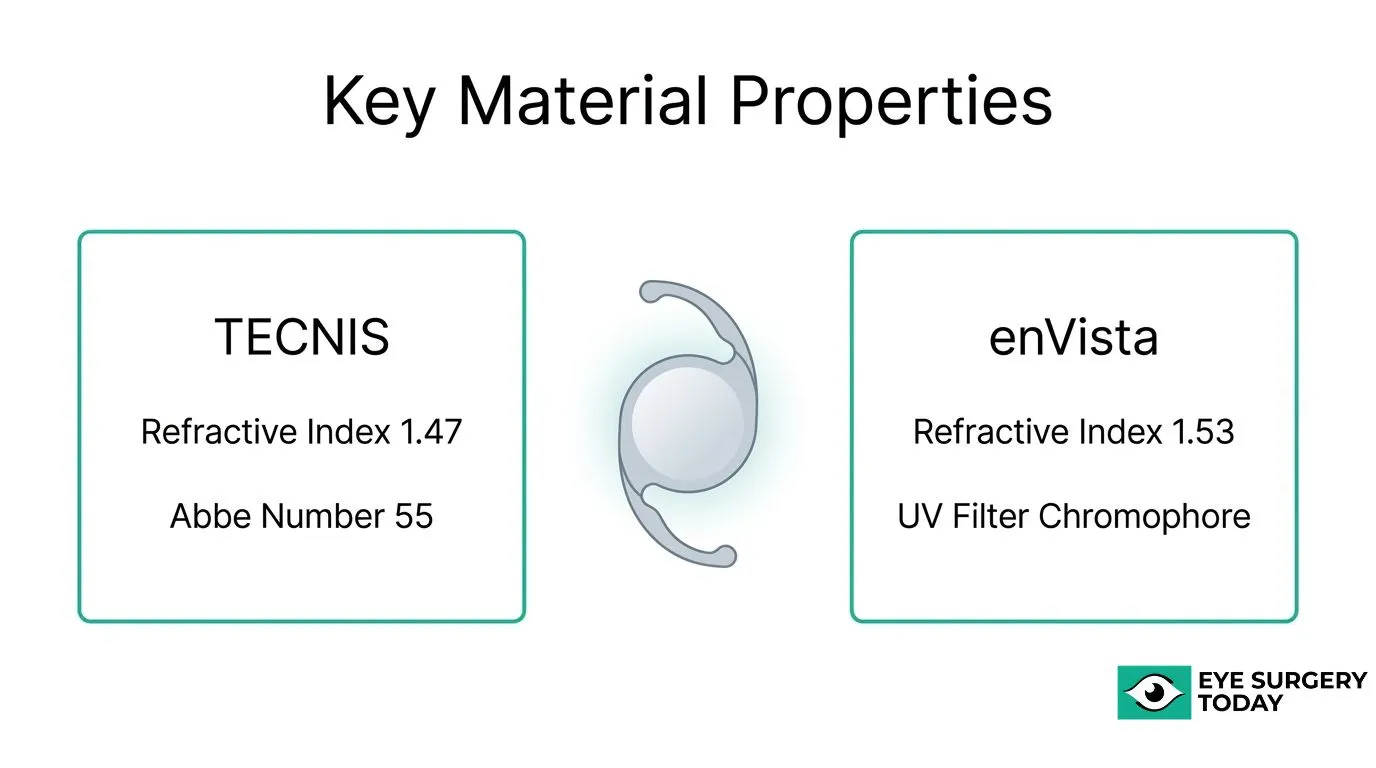
TECNIS uses a hydrophobic acrylic with a refractive index of 1.47 and an Abbe number of 55, while enVista achieves a higher refractive index of 1.53 in a glistening-free formulation. Neither lens incorporates blue-light filtering, and both rely on UV-absorbing chromophores to block harmful short wavelengths.
In direct clinical comparison, photopic contrast sensitivity testing with and without glare revealed no statistically significant differences between the two lenses. Under mesopic conditions, aspheric IOL designs broadly showed improved contrast sensitivity, with the distinction between TECNIS’s negative aberration correction and enVista’s neutral aspheric profile potentially mattering most for patients with larger pupils in dim light.
Both lenses preserve the visible spectrum without clinically meaningful color distortion. Research comparing clear IOLs and blue-light-filtering lenses found only minor chromaticity coordinate differences, reinforcing that neither TECNIS nor enVista is likely to alter perceived color for most patients.
The choice between these two IOLs may depend less on gross optical performance gaps and more on individual corneal aberration profiles, pupil dynamics, retinal health history, and specific visual demands such as nighttime driving or tolerance for optical artifacts.
What Are the Key Optical Differences Between TECNIS and enVista IOLs?
The key optical differences between TECNIS and enVista IOLs involve their lens materials, refractive indices, and light transmission profiles. The sections below cover how each lens filters light and how their materials compare in optical performance.
How Does TECNIS Achieve Its Light Transmission Profile?
TECNIS achieves its light transmission profile through a UV-absorbing hydrophobic acrylic material. According to The Open Ophthalmology Journal, the TECNIS 1-piece IOL uses an ultraviolet light-filtering hydrophobic acrylic material, blocking harmful UV wavelengths while transmitting visible light. The lens carries a refractive index of 1.47 at 35°C and an Abbe number of 55, optical properties that support high-fidelity image formation with minimal chromatic aberration.
How Does enVista Achieve Its Light Transmission Profile?
enVista achieves its light transmission profile through a hydrophobic acrylic copolymer with an integrated UV-absorbing chromophore. The MX60 lens optic is composed of a hydroxyethyl methacrylate-polyethylene glycol phenyl ether acrylate-styrene copolymer, cross-linked with ethylene glycol dimethacrylate. This formulation provides UV filtration at the material level, with 10% transmittance at 389 nm for a +20.0 diopter lens, per Bausch + Lomb IFU data.
How Do Their Lens Materials Differ in Optical Performance?
The lens materials differ primarily in refractive index and chromatic dispersion characteristics. TECNIS uses a refractive index of 1.47, while enVista’s hydrophobic acrylic achieves 1.53, a higher index that allows for a thinner lens profile at equivalent powers. Both are UV-absorbing and neither incorporates blue-light filtering. A study published in Translational Vision Science and Technology (ARVO) found only minor differences in color appearance between blue-light-filtering IOLs, clear IOLs, and a young natural lens, suggesting that blue-light filtering has minimal effects on perceived color.
How Do TECNIS and enVista Compare on Contrast Sensitivity?
TECNIS and enVista compare closely on contrast sensitivity, with clinical data showing no statistically significant difference between the two monofocal IOLs under standard testing conditions. The sections below cover direct head-to-head performance, enVista’s post-implantation results, and low-light behavior.
Does TECNIS Provide Better Contrast Sensitivity Than enVista?
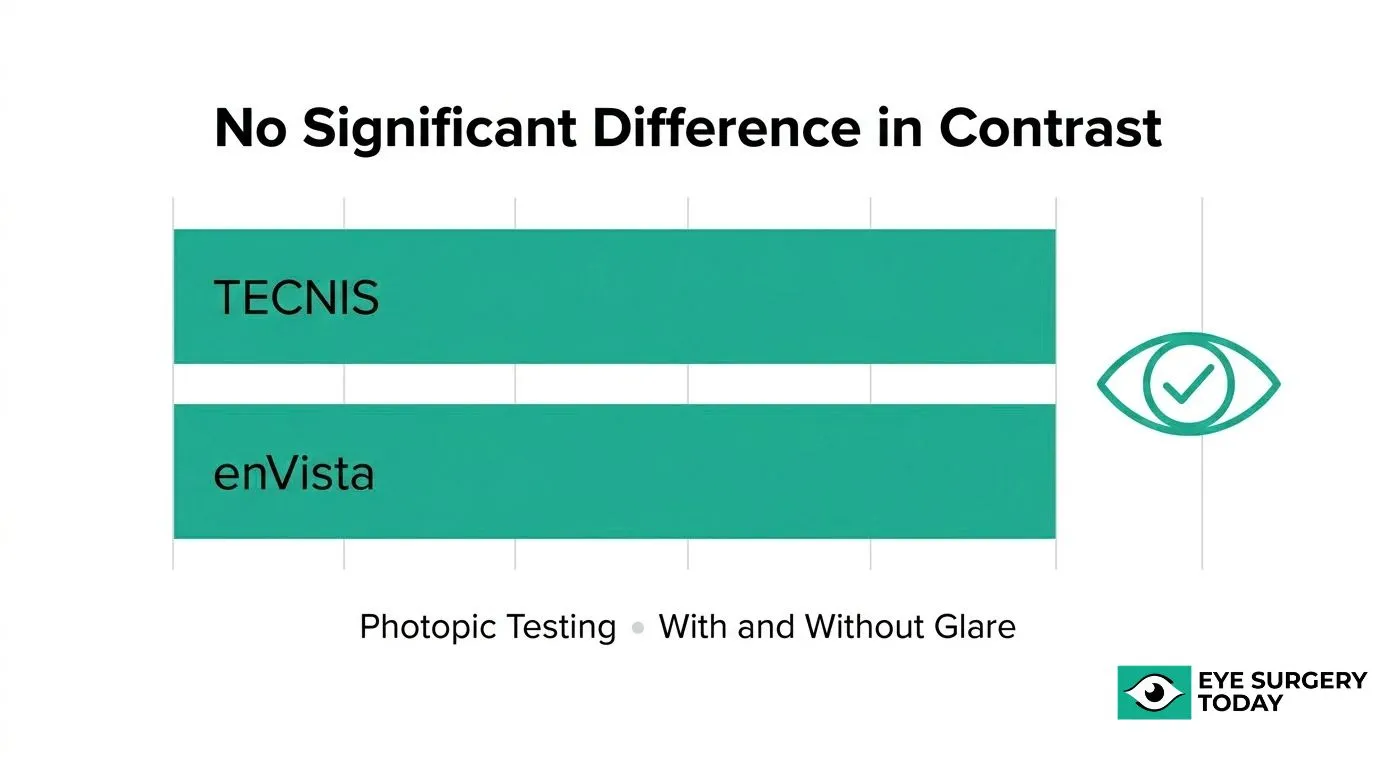
TECNIS does not provide better contrast sensitivity than enVista in direct clinical comparison. A 20222019 study published in the Philippine Journal of Ophthalmology evaluated 62 eyes across three IOL groups, including 24 eyes with the Tecnis ZCB00 and 22 eyes with the EnVista MX60. Photopic contrast sensitivity testing, with and without glare, revealed no statistically significant differences between the two lenses. Both are monofocal designs, which matters clinically: the Graefes Arch Clin Exp Ophthalmology notes that multifocal IOLs may reduce contrast sensitivity in patients with or at risk for diabetic retinopathy, making monofocal options like TECNIS and enVista preferable for that population. For most patients, neither lens has a meaningful contrast sensitivity advantage over the other.
How Does enVista Perform on Contrast Sensitivity After Implantation?
enVista performs comparably to TECNIS on contrast sensitivity after implantation. The same 2019 Philippine Journal of Ophthalmology study found no statistically significant difference in photopic contrast sensitivity between the EnVista MX60 and Tecnis ZCB00 groups across all spatial frequencies tested, both with and without glare. enVista’s aberration-free neutral aspheric design preserves the cornea’s existing optical profile rather than correcting for spherical aberration, which can be advantageous in patients whose corneal aberration profiles are atypical. In practice, enVista delivers consistent, predictable contrast sensitivity outcomes for most cataract patients.
Which IOL Performs Better for Contrast Sensitivity in Low-Light Conditions?
Neither TECNIS nor enVista has been shown to be definitively superior in low-light contrast sensitivity in head-to-head monofocal comparisons, but aspheric IOL design broadly favors mesopic performance. According to a study published in the Journal of Cataract and Refractive Surgery, aspheric Tecnis IOL showed improved contrast sensitivity at spatial frequencies of 3, 6, 12, and 18 cycles per degree (cpd) in both photopic and mesopic conditions, with peak improvement of 54% (0.27 log units) at 18 cpd under mesopic conditions. Both TECNIS and enVista incorporate aspheric optics, though their aberration profiles differ: TECNIS uses negative spherical aberration correction while enVista uses a neutral design. This distinction may matter most for patients with larger pupils in dim light, where aberration management has a greater impact on functional vision.
How Do TECNIS and enVista Affect Color Vision After Cataract Surgery?
TECNIS and enVista produce comparable color vision outcomes after cataract surgery. The sections below examine each lens individually and then compare how their light-filtering properties influence color perception.
Does TECNIS Alter the Way Patients Perceive Colors?
TECNIS does not significantly alter color perception after cataract surgery. Both TECNIS and enVista MX60 showed no significant difference in color vision after a 3-month follow-up, according to a study published in International Ophthalmology. The TECNIS 1-piece IOL uses an ultraviolet light-filtering hydrophobic acrylic material that blocks wavelengths harmful to the retina while transmitting the visible spectrum largely intact. For most patients, colors may actually appear more vivid post-surgery simply because the yellowed, opaque cataract has been removed.
Does enVista Alter the Way Patients Perceive Colors?
enVista does not significantly alter color perception in clinical outcomes. The same International Ophthalmology comparison found no meaningful color vision difference between enVista and TECNIS at three months post-implantation. enVista’s UV-absorbing chromophore filters ultraviolet light without blocking visible wavelengths, preserving the natural color spectrum patients experience. The restoration of a clear optical medium after cataract removal tends to drive perceived color improvement more than the lens material itself.
How Do Blue Light Filtering Properties Affect Color Perception in Each Lens?
Blue light filtering properties affect color perception differently depending on the wavelengths each IOL blocks. Standard UV-only filters, as used in both TECNIS and enVista monofocal lenses, do not meaningfully shift color appearance. Research published in the Korean Journal of Ophthalmology found that violet-light filtering IOL ZFR00V steeply attenuated light under 430 nm but transmitted nearly all light at 440 nm or greater, a cutoff that minimally affects daytime color discrimination. A separate analysis in Translational Vision Science and Technology found that blue-light filtering IOL chromaticity coordinates were not significantly different from clear IOLs, with only minor color appearance differences observed. For patients considering TECNIS or enVista, neither lens introduces clinically meaningful color distortion under typical lighting conditions.
Does the Aspheric Design of Each IOL Influence Visual Quality?
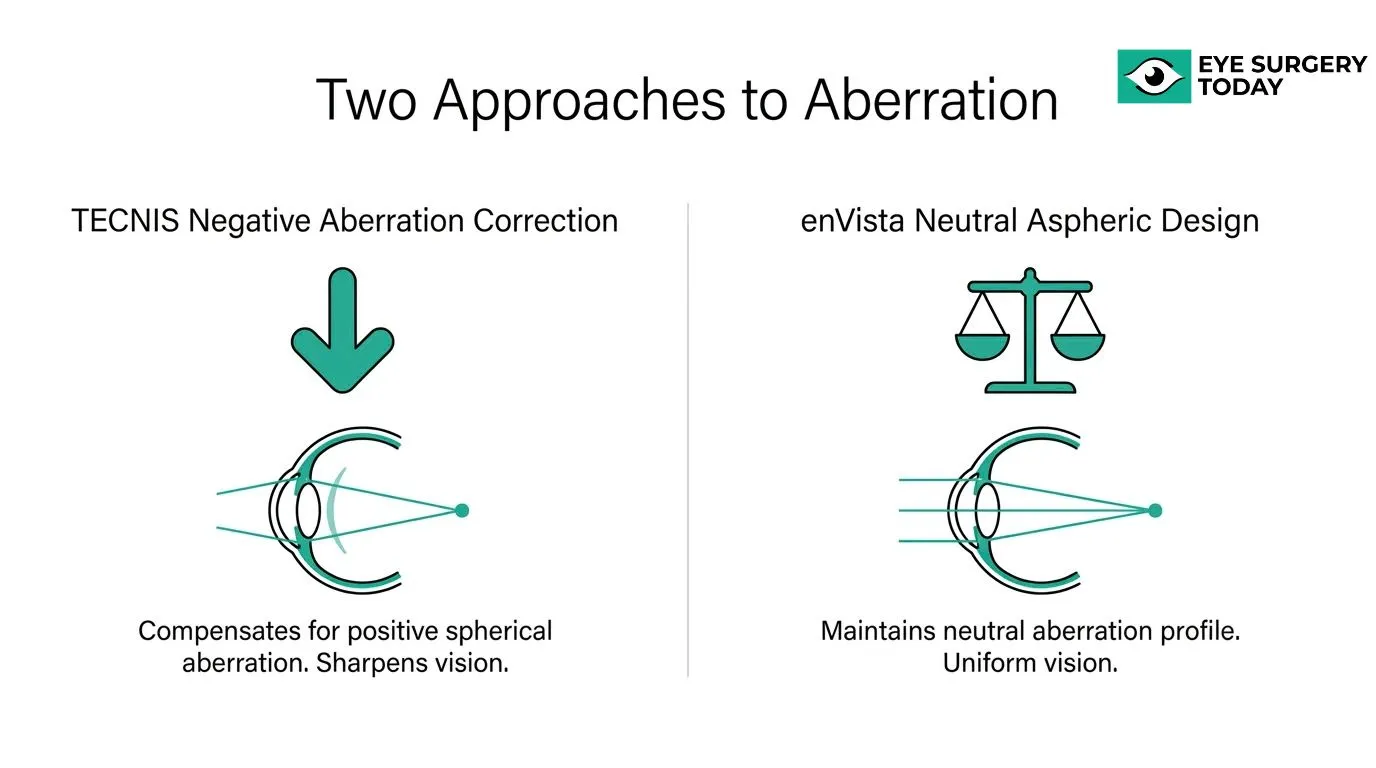
The aspheric design of an IOL directly influences visual quality by shaping how the lens handles spherical aberration. TECNIS and enVista both use aspheric optics, but with different approaches: TECNIS employs aberration-correcting asphericity, while enVista uses a neutral aspheric profile.
How Does TECNIS Use Aspheric Optics to Improve Visual Clarity?
TECNIS uses aspheric optics to improve visual clarity by introducing negative spherical aberration (SA) into the lens design. According to a study published in Biomedical Optics Express, aberration-correcting aspheric lenses mimic the optical condition of young eyes, where the crystalline lens introduces negative SA to counterbalance the natural positive corneal SA. By compensating for corneal spherical aberration, TECNIS may help preserve contrast and edge sharpness, particularly under low-light conditions where pupil dilation increases the influence of aberrations on image quality.
How Does enVista Use Aspheric Optics to Improve Visual Clarity?
enVista uses aspheric optics to improve visual clarity through a neutral aspheric design, meaning it introduces zero spherical aberration rather than correcting for corneal SA. A study published in Eye found that the enVista IOL carries a neutral aspheric profile, unlike lenses such as the AcrySof IQ, which applies negative SA correction. This approach preserves the eye’s natural aberration state and may benefit patients with atypical corneal profiles where a corrective lens could overcorrect or undercorrect the total aberration balance.
Does Asphericity Affect Contrast Sensitivity Under Mesopic Conditions?
Asphericity does affect contrast sensitivity under mesopic conditions, with aberration-correcting designs showing measurable advantages in low-light settings. A study published in the Journal of Cataract and Refractive Surgery found that eyes implanted with an aspheric Tecnis IOL demonstrated better contrast sensitivity across spatial frequencies of 3, 6, 12, and 18 cpd in both photopic and mesopic conditions, with peak mesopic improvement reaching 54% (0.27 log units) at 18 cpd. Whether TECNIS or enVista delivers superior mesopic contrast depends on an individual patient’s corneal aberration profile. For patients with high positive corneal SA, a correcting lens like TECNIS may offer a more clinically meaningful benefit.
How Does Dysphotopsia Risk Compare Between TECNIS and enVista?
Dysphotopsia risk between TECNIS and enVista depends largely on lens material properties and optical edge design. The sections below examine glare and halo patterns for TECNIS and the specific design features enVista uses to minimize edge-related optical disturbances.
Are Halos or Glare More Common With TECNIS Than enVista?
Halos or glare are not clearly more common with TECNIS than enVista based on available clinical comparisons. Both lenses share foundational material characteristics that influence dysphotopsia risk. According to a study published in Ophthalmology and Therapy, the TECNIS ZCB00 and ICB00 are made of the same hydrophobic acrylic material with a refractive index of 1.47 at 35°C and an Abbe number of 55. A higher Abbe number indicates lower chromatic dispersion, which can reduce halos related to light scattering. Neither lens has demonstrated a clinically meaningful advantage over the other in dysphotopsia rates based on published head-to-head data, making material analysis the most useful comparison point for patients evaluating edge glare risk.
How Does enVista’s Design Reduce Edge Glare and Internal Reflections?
The enVista IOL reduces edge glare and internal reflections through a combination of its sharp 360-degree square posterior edge and a glistening-free hydrophobic acrylic material. The square posterior edge minimizes posterior capsule opacification and creates a barrier that limits light scatter at the lens perimeter. Its glistening-free formulation eliminates the fluid-filled microvacuoles found in some other hydrophobic lenses, which are a known source of internal light scattering over time. This combination makes enVista a clinically practical choice for patients with heightened sensitivity to optical artifacts after cataract surgery.
Which Patients May Benefit More From One IOL Over the Other?
Patient candidacy for TECNIS versus enVista depends on several individual factors, including visual quality priorities, ocular health history, and pupil behavior. The sections below address ideal candidates for each lens, retinal disease considerations, and how pupil size may influence the decision.
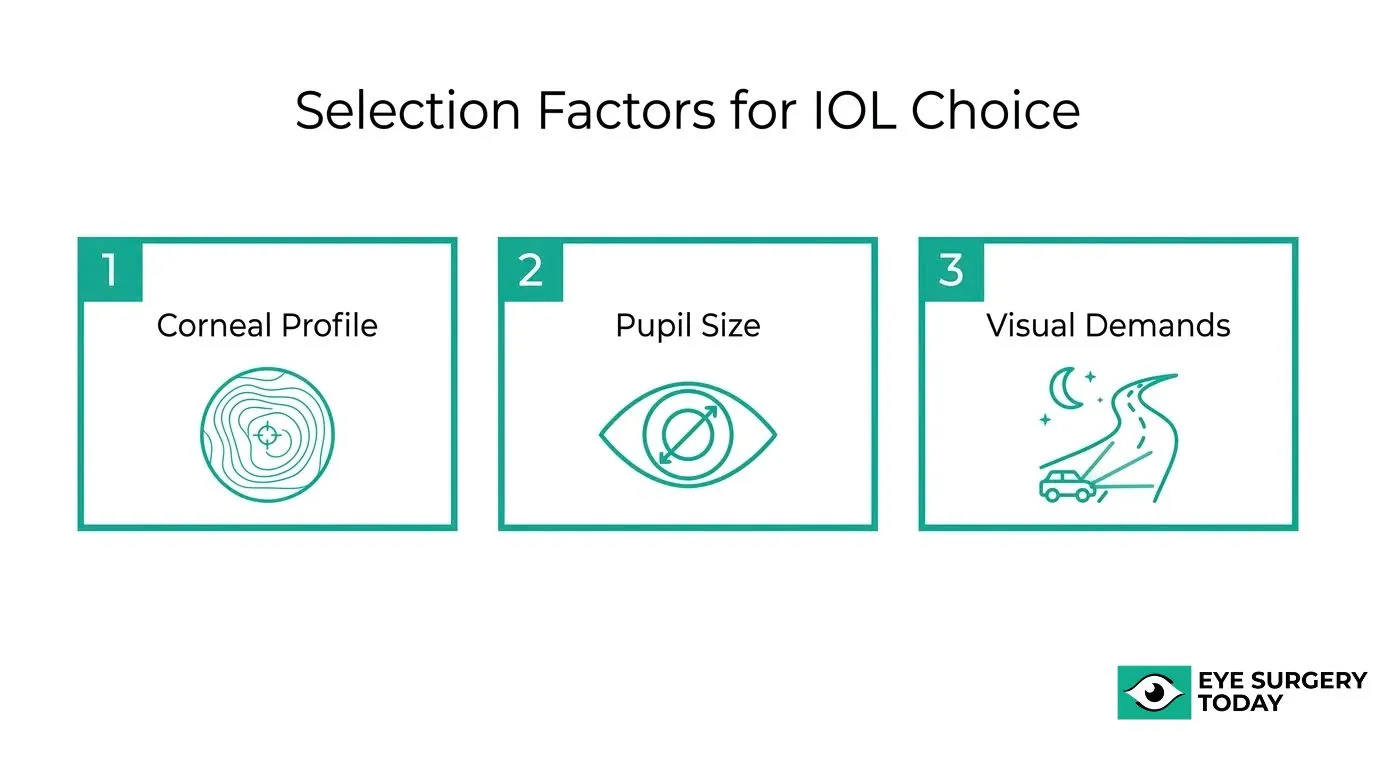
Who Is an Ideal Candidate for TECNIS Based on Visual Quality Needs?
An ideal candidate for TECNIS based on visual quality needs is someone who prioritizes contrast-optimized vision, particularly in low-light or mesopic conditions. TECNIS uses a negative-aberration-correcting aspheric design, which counterbalances positive corneal spherical aberration to replicate the optical profile of a younger eye. This may benefit patients with active nighttime demands, such as driving after dark, where contrast sensitivity at higher spatial frequencies matters most. Patients with larger pupils may also gain proportionally more benefit from aberration correction, since greater aperture exposes more corneal spherical aberration for the lens to offset.
Who Is an Ideal Candidate for enVista Based on Visual Quality Needs?
An ideal candidate for enVista based on visual quality needs is someone whose corneal aberration profile is irregular or atypical, making a fixed negative-aberration lens a less predictable fit. The enVista MX60 uses a neutral aspheric design, meaning it adds zero spherical aberration rather than correcting for a fixed assumed corneal value. This approach may suit patients with prior refractive surgery, flatter corneas, or corneal irregularity, where the surgeon cannot reliably predict how much aberration correction is appropriate. Preserving the eye’s natural aberration balance, rather than attempting to correct it, can be the more stable strategy in these cases.
How Does a History of Retinal or Macular Disease Affect the Choice?
A history of retinal or macular disease affects the IOL choice primarily by narrowing the range of appropriate lens options. The Graefes Arch Clin Exp Ophthalmology notes that patients with diabetic retinopathy or macular risk may not be suitable for multifocal IOLs, since those designs can reduce contrast sensitivity. Between TECNIS and enVista, both are monofocal platforms, so neither carries the contrast sensitivity penalty associated with multifocal optics. However, any condition that limits baseline macular function makes maximizing contrast sensitivity a priority, which shifts the discussion toward which aspheric design best suits that patient’s corneal profile.
How Does Age-Related Change in Pupil Size Influence the IOL Decision?
Age-related change in pupil size influences the IOL decision because older patients typically have smaller, less reactive pupils. With a smaller scotopic pupil, less of the corneal periphery is engaged, which means the contrast-enhancing effect of a negative-aberration-correcting lens like TECNIS may be reduced compared to younger patients with larger pupils. The neutral aspheric design of enVista, which does not apply a fixed aberration-correction assumption, may perform more consistently across the narrower pupil range typical of older adults. Surgeons often factor measured photopic and scotopic pupil diameter into pre-operative IOL selection for this reason.
With both lenses offering comparable measured contrast sensitivity outcomes in direct studies, the clinical decision ultimately rests on corneal aberration profiling and the patient’s specific visual demands.
What Do Clinical Studies Say About Visual Outcomes for These Two IOLs?
Clinical studies say that TECNIS and enVista IOLs produce comparable visual outcomes across key measures, including visual acuity, contrast sensitivity, color vision, and aberrometry. The sections below examine TECNIS outcomes, enVista outcomes, and real-world surgeon observations separately.
What Does the Research Show for TECNIS Visual Performance Outcomes?
The research shows that TECNIS visual performance outcomes are strong across multiple functional measures. A study published in International Ophthalmology found no significant difference in corrected distance visual acuity (CDVA, P > 0.99), uncorrected distance visual acuity (UDVA, P = 0.46), spherical equivalent refractive error (P = 0.63), contrast sensitivity with and without glare, color vision, and RMS aberrometric values between TECNIS and enVista after a 3-month follow-up. Additionally, a ClinicalTrials.gov registered study (NCT05025345) enrolled 228 subjects, with 107 implanted with the TECNIS test lens, providing controlled comparative data on visual performance.
What Does the Research Show for enVista Visual Performance Outcomes?
The research shows that enVista visual performance outcomes are clinically equivalent to TECNIS across the same measured endpoints. The International Ophthalmology study cited above included 22 eyes implanted with the enVista MX60 IOL; photopic contrast sensitivity without and with glare revealed no statistically significant differences between groups. enVista’s neutral aspheric design preserves the eye’s existing corneal aberration profile rather than correcting it, which suits patients whose corneal spherical aberration falls within a normal range.
Do Surgeons Observe Consistent Differences in Real-World Patient Results?
Surgeons do not consistently observe meaningful differences in real-world visual outcomes between TECNIS and enVista in standard cataract populations. The published comparative data support equivalence across acuity, contrast sensitivity, and color vision. In clinical practice, IOL selection tends to be guided by individual corneal aberration profiles, pupil dynamics, and patient lifestyle priorities rather than a consistent performance gap between these two lenses. When outcomes do diverge, the cause is more often patient-specific anatomy than an inherent superiority of one implant over the other.
How Can Patients Evaluate IOL Options With Their Eye Care Team?
Patients can evaluate IOL options by combining surgeon-reviewed educational resources with a structured conversation about their individual visual goals, ocular health history, and the measurable performance differences between lenses like TECNIS and enVista.
Can a Surgeon-Reviewed Educational Resource Help Patients Compare IOL Options?
Yes, a surgeon-reviewed educational resource can help patients compare IOL options by translating clinical data into accessible language before a consultation. Resources grounded in peer-reviewed ophthalmology literature, such as those reviewed by practicing cataract surgeons, allow patients to arrive at appointments with informed questions about contrast sensitivity thresholds, spectral transmission, and aspheric design trade-offs. According to EyeWorld’s 2023 coverage of lens options in glaucoma patients, even surgeons weigh contrast sensitivity impact carefully when selecting between monofocal and advanced IOLs. Surgeon-reviewed platforms like Eye Surgery Today are particularly well-suited for this purpose, offering unbiased, evidence-based comparisons without the promotional framing common to manufacturer websites.
What Are the Key Takeaways About How TECNIS and enVista Handle Color Vision and Contrast Sensitivity?
The key takeaways are that both TECNIS and enVista are UV-filtering monofocal IOLs that produce clinically similar color vision and contrast sensitivity outcomes in head-to-head testing, with meaningful differences emerging primarily in aspheric design philosophy and spectral filtering approach. TECNIS uses a UV-absorbing hydrophobic acrylic material with negative spherical aberration correction, while enVista employs a neutral aspheric design. According to Dr. Packer, as cited in Review of Ophthalmology, a 0.3 log-unit decline from normative contrast sensitivity values is considered clinically significant, making this benchmark a useful reference point when reviewing outcomes for either lens. For most patients, the choice between these two IOLs hinges less on gross optical differences and more on individual corneal aberration profiles and lighting priorities.