20/20 vision is a Snellen acuity measurement that captures the eye’s ability to resolve fine detail at a fixed distance; it is not a complete measure of visual health or surgical success after cataract surgery.
This guide covers the meaning and limitations of 20/20 acuity, clinical reasons surgeons target alternative refractive outcomes, how pre-existing eye conditions can cap achievable vision, the role of IOL selection and monovision strategies, functional vision versus chart-measured acuity, and the risks associated with aggressive distance targeting.
20/20 measures only letter recognition under controlled lighting. Contrast sensitivity, glare tolerance, depth perception, and reading endurance fall outside its scope, which is why international guidelines define good functional vision as 20/40 or better rather than requiring 20/20.
Surgeons may intentionally target mild myopia or set each eye to a different focal distance when a patient’s daily life centers on screens, reading, or arm’s-length tasks. Strategies like pseudophakic mini-monovision can preserve stereopsis while reducing spectacle dependence across multiple distances.
Conditions such as macular degeneration, diabetic retinopathy, glaucoma, and corneal damage impose biological ceilings on recoverable acuity that no lens implant can overcome. In these cases, the surgical goal shifts toward maximizing functional improvement within the limits the underlying condition allows.
Monofocal, multifocal, and extended depth of focus lenses each produce distinct visual profiles and require different refractive targets. Lifestyle factors, including night driving frequency and occupational visual demands, often determine which lens category best serves the patient.
Aggressively pursuing 20/20 in both eyes can result in dysphotopsia, loss of intermediate and near functional vision, or neuroadaptation failure, leaving patients dissatisfied despite technically successful surgery.
What Does 20/20 Vision Actually Mean?
20/20 vision is a measure of visual acuity, not a measure of overall visual health. The following sub-sections explain how the 20/20 standard is defined, what it does and does not capture, and why surgeons use additional metrics when planning cataract surgery outcomes.
What Is the 20/20 Vision Standard?
The 20/20 vision standard is a Snellen acuity benchmark indicating that a person can read letters at 20 feet that someone with normal vision can also read at that distance. According to the National Eye Institute, visual acuity is assessed using a Snellen chart and reflects the eye’s ability to resolve fine detail at a set distance. While 20/20 is widely treated as the gold standard for “normal” sight, it measures only one narrow dimension of vision. Contrast sensitivity, depth perception, and peripheral awareness are all excluded from this single metric, which is why surgical success cannot be reduced to one number on a chart.
What Does 20/20 Vision Not Measure?
20/20 acuity does not measure functional vision, which is how well a person actually uses their sight during daily activities. The National Institutes of Health defines functional vision as the ability to perform activities of daily living, noting it may not be well predicted by Snellen acuity alone, particularly in patients with reduced contrast sensitivity and glare. A patient can test at 20/20 and still struggle with night driving, reading fine print, or using a computer. This gap between chart performance and real-world usability is central to why cataract surgery targets are planned around lifestyle, not just acuity scores.
How Is 20/20 Vision Used as a Surgical Benchmark?
Surgeons use 20/20 as one reference point within a broader framework called target refraction, the planned postoperative refractive outcome. The ESCRS Position Statement defines good functional vision as a presenting visual acuity of 6/12 (20/40) or better, which serves as the primary outcome measure in many international cataract surgery guidelines. Reaching or exceeding 20/40 uncorrected distance acuity is the clinical threshold for a successful outcome; 20/20 is a desirable result, not a universal requirement. This distinction matters because it shifts surgical planning from a single number toward a range of vision goals aligned with each patient’s needs.
Why Do Surgeons Sometimes Target Something Other Than 20/20?
Surgeons sometimes target something other than 20/20 because a patient’s lifestyle, pre-existing eye conditions, and daily visual demands often make full distance correction the wrong goal. The following sub-sections cover the four most common scenarios where a different refractive target serves the patient better.
What If a Patient Prefers Better Near Vision?
A patient who prefers better near vision may benefit from a target refraction that intentionally leaves one or both eyes with mild myopia, trading sharp unaided distance sight for clearer reading without glasses. Pseudophakic mini-monovision, where one eye targets distance and the other targets intermediate vision with a 0.5 to 1.0 diopter difference, preserves better stereopsis than conventional monovision, according to research published in the Survey of Ophthalmology. This approach works well for patients whose daily life centers on screens, books, or detailed close work rather than driving or sport. In practice, mini-monovision is frequently underused as a first-line strategy, despite offering a meaningful quality-of-life advantage for near-dominant patients who want to reduce dependence on reading glasses.
What If a Patient Has Pre-Existing Eye Conditions?
A patient with pre-existing eye conditions may be unable to achieve 20/20 even when surgery goes perfectly, making an aggressive distance target unrealistic and potentially misleading. Conditions such as age-related macular degeneration, diabetic retinopathy, and glaucoma impose biological ceilings on recoverable acuity that no IOL or refractive target can overcome. In these cases, the surgeon’s goal shifts from maximizing Snellen acuity to maximizing functional improvement within the limits the underlying condition allows.
What If a Patient Needs Intermediate Vision for Daily Tasks?
A patient who needs intermediate vision for daily tasks may be poorly served by a strict 20/20 distance target. According to the National Institutes of Health, functional vision reflects how well a person performs activities of daily living, which Snellen acuity alone may not predict, particularly in patients with reduced contrast sensitivity and glare. Aggressively targeting 20/20 in both eyes can deprive patients of the intermediate focal range needed for computer use, cooking, or dashboard reading, according to Mivision. For patients whose lives are built around arm’s-length tasks, an intermediate-weighted target often delivers greater day-to-day satisfaction.
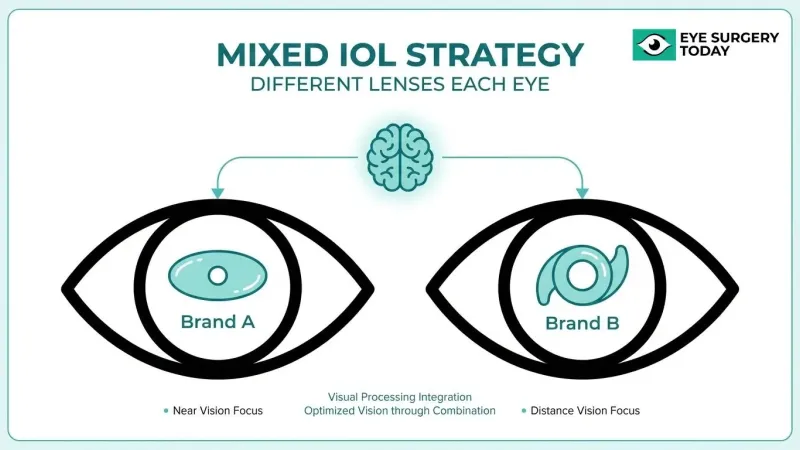
What If Both Eyes Are Set for Different Distances on Purpose?
Both eyes being set for different distances on purpose is the defining principle of monovision and mini-monovision strategies, where each eye is assigned a distinct refractive target to cover a broader visual range without relying on multifocal optics. One eye typically targets distance clarity while the other targets near or intermediate vision, and the brain learns to favor the more appropriate eye depending on the task. This deliberately asymmetric approach trades some binocular depth perception for reduced spectacle dependence across multiple focal distances, making it particularly valuable for patients who are poor candidates for premium IOLs.
What Eye Conditions Can Limit Visual Outcomes After Surgery?
Several pre-existing eye conditions can limit post-surgical visual acuity even when cataract surgery is performed successfully. The H3s below cover four of the most common: macular degeneration, diabetic retinopathy, glaucoma, and corneal damage.
How Does Macular Degeneration Affect Post-Surgical Acuity?
Macular degeneration affects post-surgical acuity by damaging the central retina, which no intraocular lens can repair. According to the American Academy of Ophthalmology, cataract surgery in patients with age-related macular degeneration (AMD) may improve overall brightness and peripheral vision, but often does not restore the ability to perform fine-detail tasks like reading due to this central retinal damage. Surgeons can remove the cataract successfully, yet the underlying macular pathology remains the dominant limiting factor for functional outcomes.
How Does Diabetic Retinopathy Affect Post-Surgical Acuity?
Diabetic retinopathy affects post-surgical acuity by reducing the likelihood of achieving sharp corrected distance vision after cataract removal. According to the Journal of Cataract and Refractive Surgery, patients with diabetic retinopathy are less likely to achieve a corrected distance visual acuity of 20/20 after cataract surgery compared to those without diabetes. Retinal microvasculature damage from chronic hyperglycemia compromises the photoreceptor layer, making the refractive target less meaningful when the retina itself cannot process high-resolution detail.
How Does Glaucoma Affect Post-Surgical Acuity?
Glaucoma affects post-surgical acuity primarily through optic nerve damage that reduces visual field and contrast sensitivity, independent of lens clarity. Elevated intraocular pressure associated with glaucoma can cause irreversible nerve fiber loss, meaning that even a perfectly implanted IOL cannot recover vision where the nerve has been compromised. Published data in the British Journal of Ophthalmology indicates that up to 31% of children are identified as having glaucoma or being monitored as glaucoma suspects five years after cataract surgery, highlighting how closely the two conditions interact.
How Does a Damaged Cornea Affect Post-Surgical Acuity?
A damaged cornea affects post-surgical acuity by distorting how light is focused onto the retina before it even reaches the new IOL. Conditions such as corneal scarring, keratoconus, or significant endothelial cell loss introduce irregular astigmatism and reduce optical quality that no lens implant can fully compensate for. In practice, corneal health is one of the most underweighted variables in pre-surgical patient counseling, and surgeons who address corneal irregularities before setting refractive expectations tend to produce more satisfied patients.
What Is Monovision and Why Would a Surgeon Recommend It?
Monovision is a refractive strategy where one eye is corrected for distance vision and the other is corrected for near or intermediate vision, reducing dependence on glasses after cataract surgery. Surgeons recommend it when a patient wants functional range across distances without paying for premium multifocal IOLs.
How Does Monovision Work After Cataract Surgery?
Monovision works by intentionally creating a small refractive difference between the two eyes using monofocal IOLs. The dominant eye typically receives a distance-focused IOL, while the non-dominant eye is set for near or intermediate range. The brain learns to use each eye selectively depending on the visual task, a process of neuroadaptation that most patients manage well over time.
A refined version called pseudophakic mini-monovision sets the inter-eye difference at 0.5 to 1.0 diopter, which, according to a review in Survey of Ophthalmology, preserves better stereopsis than conventional monovision. This smaller offset reduces depth-perception disruption while still providing a useful range of focus.
Why Would a Surgeon Choose Monovision Over a Multifocal IOL?
A surgeon may choose monovision over a multifocal IOL when a patient prioritizes contrast sensitivity, has concerns about halos and glare, or is working within a tighter budget. Multifocal IOLs offer higher rates of spectacle independence overall, but they carry increased risk of dysphotopsia. Monovision avoids those optical side effects while still reducing everyday reliance on reading glasses.
A meta-analysis found monovision was less effective than multifocal IOLs for achieving complete spectacle independence (RR 0.53; 95% CI 0.34 to 0.82), yet it remains a clinically sound and lower-cost approach for carefully selected patients. For individuals who drive frequently at night or require sharp contrast for detailed work, monovision is often the more practical choice.
What Role Does IOL Selection Play in Target Refraction?
IOL selection directly determines the refractive target a surgeon plans for after cataract surgery. The three primary lens categories, monofocal, multifocal, and extended depth of focus (EDOF), each produce a distinct visual outcome and require different target refraction strategies.
How Do Monofocal Lenses Influence the Vision Target?
Monofocal lenses influence the vision target by focusing light at a single fixed distance, typically optimized for either distance or near vision, but not both. Because they offer no range of focus, the refractive target must be chosen deliberately based on the patient’s lifestyle priorities.
According to the American Optometric Association, patient lifestyle considerations, such as frequent night driving or professional needlework, are critical in IOL selection. Monofocal lenses may be preferred for patients who need maximum contrast sensitivity, particularly those who drive at night, while multifocals suit patients who prioritize spectacle independence.
For many patients, monofocal lenses paired with a deliberate refractive target remain the most predictable and optically clean option available.
How Do Multifocal Lenses Influence the Vision Target?
Multifocal lenses influence the vision target by distributing light across multiple focal points to support both distance and near vision simultaneously. This design uses diffractive or refractive optics but introduces a trade-off: a higher risk of halos and glare compared to monofocal lenses.
Systematic review data shows that monovision was inferior to multifocal IOLs in achieving complete spectacle independence (RR 0.53; 95% CI 0.34 to 0.82), confirming that multifocals deliver better independence from glasses overall, though at a higher side-effect profile.
When spectacle independence is the primary goal, multifocal IOLs offer a measurable advantage, but only for patients who can neurologically adapt to the optical trade-offs involved.
How Do Extended Depth of Focus Lenses Influence the Target?
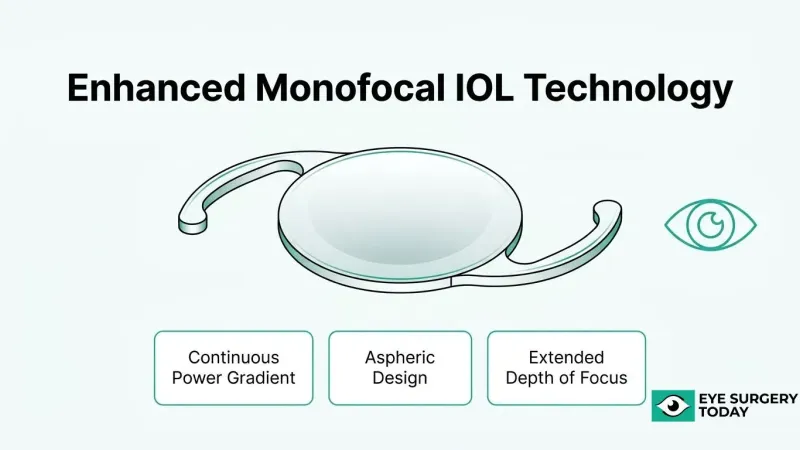
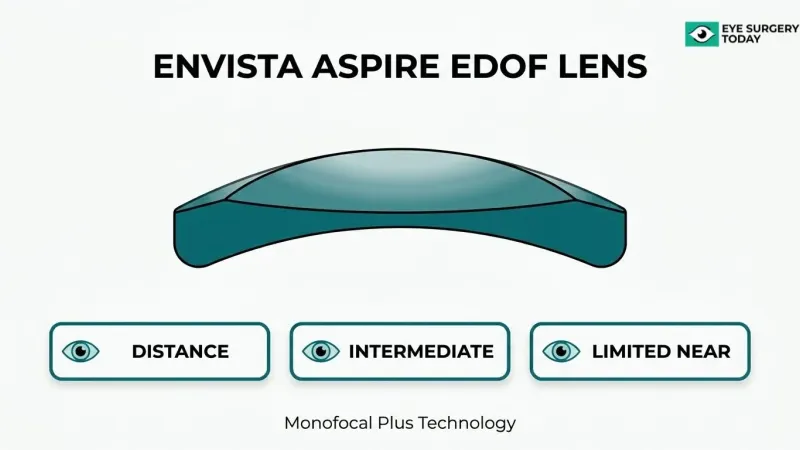
Extended depth of focus lenses influence the target by elongating the focal range rather than creating discrete focal points, producing a continuous corridor of clear vision from distance through intermediate. This positions EDOF lenses between monofocal and multifocal options in both performance and visual side-effect risk.
A systematic review and meta-analysis published in Cureus comparing enhanced monofocal and EDOF lenses found meaningful differences in visual performance across the focal range, supporting EDOF as a clinically relevant middle-ground option.
For patients who need reliable intermediate vision, such as screen users or drivers, EDOF lenses allow surgeons to set a refractive target that prioritizes functional range without the full halos-and-glare risk of a multifocal design.
How Is Functional Vision Different From 20/20 Acuity?
Functional vision and 20/20 acuity measure different aspects of sight. The sections below explain what each term means, why they can diverge after cataract surgery, and what the “unhappy 20/20” phenomenon reveals about true surgical success.
What Is 20/20 Visual Acuity?
20/20 visual acuity is the measure of the eye’s ability to resolve fine detail, assessed using a Snellen chart where 20/20 represents reading letters at 20 feet that a person with normal vision can also read at that distance, according to the National Eye Institute. It captures one narrow dimension of sight: letter recognition at a fixed distance under controlled lighting. Contrast sensitivity, glare tolerance, depth perception, and reading endurance are not reflected in this number at all. A patient can leave surgery with a perfect Snellen score and still struggle in real-world conditions.
What Is Functional Vision?
Functional vision is how well a person uses their vision to perform activities of daily living. According to a study published on NIH PubMed, Snellen acuity alone may not predict functional vision, particularly in patients who experience reduced contrast sensitivity and glare. Tasks such as reading a menu in dim light, recognizing faces, or driving at dusk require far more than letter resolution at 20 feet. This broader capability is what most patients actually care about after surgery.
What Is the “Unhappy 20/20” Problem?
The “unhappy 20/20” problem is a clinical scenario where high Snellen acuity is achieved but functional vision remains compromised. According to a study published in the MDPI Journal of Clinical Medicine, this outcome can result from dry eye disease or optical aberrations that a Snellen chart simply cannot detect. Separately, research published by the American Academy of Ophthalmology indicates that neuroadaptation failure after multifocal IOL implantation can cause persistent dissatisfaction even when 20/20 is confirmed at the chart. Treating 20/20 as the sole definition of success leaves this patient group without a clear explanation or path forward.
What Should Patients Discuss With Their Surgeon Before Surgery?
The most productive pre-surgery conversations focus on two areas: how your lifestyle shapes the right vision target, and what questions reveal whether your expectations align with realistic outcomes. The headings below cover both.
What Lifestyle Factors Should Guide the Vision Target?
The lifestyle factors that should guide the vision target include daily visual demands such as night driving, screen use, reading habits, and occupation-specific tasks like detailed needlework or precision work.
According to the American Optometric Association, frequent night drivers may benefit from monofocal lenses, which preserve maximum contrast sensitivity, while patients who prioritize spectacle independence across multiple distances may be better served by multifocal options. As Dr. Ashley Brissette notes in Cataract and Refractive Surgery Today, selecting the appropriate IOL requires taking the patient’s age, refraction, axial length, and visual expectations into account.
Patients who split their time between a computer screen and distance tasks often find that a rigid focus on 20/20 distance acuity leaves intermediate vision underserved. Sharing a detailed picture of a typical day with your surgeon is one of the most clinically useful things a patient can do before any lens decision is made.
What Questions Help Clarify Realistic Expectations?
The questions that help clarify realistic expectations are those that probe both the surgical plan and the tradeoffs built into it. Patients benefit from asking their surgeon directly about what vision target is planned for each eye and why, which IOL types are being considered, and what visual side effects such as halos or reduced contrast sensitivity may follow.
Additional questions worth raising include whether glasses will still be needed for certain tasks, how pre-existing conditions may limit the achievable outcome, and what the recovery timeline looks like for visual stabilization. Framing questions around daily function rather than a specific acuity number tends to produce more meaningful answers. The clearer a patient is about what they need their vision to do, the more precisely a surgeon can tailor the refractive target to match.
What Are the Possible Risks of Chasing a 20/20 Outcome?
The possible risks of chasing a 20/20 outcome include optical side effects, functional vision trade-offs, and neuroadaptation challenges that can leave patients dissatisfied despite technically successful surgery. The following risks explain why aggressive 20/20 targeting can sometimes work against a patient’s real-world vision needs.
Dysphotopsia and Optical Side Effects
Dysphotopsia is a significant risk when premium IOLs are selected primarily to achieve maximum distance acuity. According to Cataract and Refractive Surgery Today, dysphotopsia, including positive symptoms such as halos and glare or negative symptoms like a dark crescent in peripheral vision, is a common reason for patient dissatisfaction after otherwise successful cataract surgery. Multifocal lenses, often chosen to reach 20/20 without glasses, carry a higher incidence of these visual disturbances than monofocal alternatives. Patients who frequently drive at night or work in low-contrast environments are particularly vulnerable, and this risk is frequently underestimated during pre-surgical planning.
Loss of Functional Near and Intermediate Vision
Aggressively targeting 20/20 distance vision in both eyes can lead to a loss of intermediate and near functional vision, resulting in patient frustration with tasks like computer use or reading, according to Mivision Ophthalmic Journal. Snellen acuity measures a narrow performance metric and does not capture how well a person performs daily activities. A patient who achieves 20/20 but cannot comfortably use a smartphone or read a menu may reasonably feel their surgery fell short, even if the clinical result appears optimal on paper.
Neuroadaptation Failure
Neuroadaptation failure is a recognized risk when multifocal IOLs are selected to maximize acuity across distances. According to the American Academy of Ophthalmology, neuroadaptation to multifocal IOLs involves functional changes in specific brain regions, and failure to adapt can lead to persistent dissatisfaction despite achieving 20/20 Snellen acuity. Not every patient successfully completes this adaptation process, and those who do not may experience lasting visual disturbance with no straightforward corrective option. Understanding a patient’s neurological and lifestyle profile before surgery is the most effective way to reduce this risk.
How Can Patients Evaluate Their Own Post-Surgery Success?
Patients can evaluate their own post-surgery success by measuring outcomes across several dimensions, not just Snellen acuity. The subsections below cover functional performance, comfort with daily tasks, and when to seek follow-up care.
Assess Functional Vision, Not Just the Snellen Chart
Functional vision is how well a patient performs real-world activities such as reading, driving, and computer work, and it may not align with Snellen chart results. A patient who tests at 20/20 but struggles with glare at night or difficulty reading a menu has achieved high acuity without full functional success.
The most practical self-assessment questions include:
- Can you read a book or phone screen without glasses (if spectacle independence was a stated goal)?
- Do nighttime halos or glare interfere with driving?
- Can you perform your primary occupational or recreational tasks comfortably?
- Has contrast sensitivity improved compared to your pre-surgery baseline?
According to research published in the MDPI Journal of Clinical Medicine, a meaningful subset of patients achieve high Snellen acuity yet report reduced functional vision due to dry eye disease or optical aberrations, a pattern sometimes called the “unhappy 20/20” outcome.
Know When Results Meet Your Pre-Surgical Goals
Post-surgery success meets the individual patient’s pre-surgical goal when the outcomes match what was discussed and agreed upon with the surgeon before the procedure. If the surgical plan targeted intermediate vision for computer use rather than distance acuity, success is measured against that intermediate target, not a 20/20 standard.
Patients should return to their notes or recall conversations about:
- The refractive target their surgeon planned.
- Whether spectacle independence was prioritized or accepted as partial.
- Any trade-offs acknowledged in advance, such as halos with multifocal lenses or reduced near vision with monofocal lenses.
Neuroadaptation also plays a role: some visual disturbances, such as mild halos, may diminish over weeks as the brain adjusts to the new intraocular lens.
Recognize Signs That Warrant a Follow-Up Appointment
Signs that warrant a follow-up appointment after cataract surgery include persistent blurred vision, worsening glare, eye pain, or outcomes that fall clearly short of the surgical plan. These may indicate treatable causes such as residual refractive error, posterior capsule opacification, or ocular surface disease rather than a permanent limitation.
Patients should contact their surgeon promptly if they experience:
- Blurred vision that does not improve within the expected recovery window.
- Significant halos or glare that worsen rather than improve over time.
- Asymmetry between eyes that was not part of the planned outcome.
- Any sudden change in vision, floaters, or flashes of light.
Early follow-up allows the surgical team to distinguish between expected neuroadaptation and a complication requiring intervention, making timely communication one of the most effective tools in a patient’s own recovery toolkit.
How Should You Approach Vision Goals With Surgeon-Reviewed Resources?
Approaching vision goals after cataract surgery means understanding that surgical success extends beyond a single number on a chart. The H3s below cover how Eye Surgery Today’s guides support realistic expectation-setting and what the most important takeaways are for patients navigating this topic.
Can Eye Surgery Today’s IOL and Cataract Surgery Guides Help You Set Realistic Expectations?
Eye Surgery Today’s IOL and cataract surgery guides can help you set realistic expectations by translating surgeon-level knowledge into clear, accessible patient education. These surgeon-reviewed resources address the full range of outcome measures, including visual acuity, refractive target, pseudophakia, spectacle independence, and contrast sensitivity, which together define surgical success more accurately than a Snellen chart alone.
According to the Swedish National Cataract Register, emmetropia is targeted in approximately 78.1% of eyes undergoing cataract surgery, yet many patients also prioritize spectacle independence, which multifocal intraocular lenses can better support compared to monofocal lenses. The ESCRS Position Statement defines good functional vision as 6/12 (20/40) or better, a benchmark that reflects real-world usability rather than a pursuit of perfection. Clinical guidelines also emphasize optimizing the ocular surface before surgery to ensure biometry accuracy and reliable target refraction. Understanding these standards before your consultation gives you a meaningful framework for evaluating what your surgeon recommends and why.
What Are the Key Takeaways About Why 20/20 Isn’t Always the Goal After Cataract Surgery?
The key takeaways about why 20/20 isn’t always the goal after cataract surgery center on the gap between chart-measured acuity and real-world functional vision. Several factors may limit or redirect the surgical target:
- Pre-existing conditions matter. Patients with diabetic retinopathy are less likely to achieve a corrected distance visual acuity of 20/20 after cataract surgery compared to those without diabetes, according to research published in the Journal of Cataract and Refractive Surgery.
- Lifestyle drives IOL selection. Vision goals should reflect how you actually live, including whether you prioritize distance clarity, near reading, or intermediate tasks like screen use.
- Spectacle independence is a valid primary goal. For many patients, freedom from glasses at specific distances matters more than hitting a specific acuity number.
- Functional vision is the broader measure. Contrast sensitivity, glare tolerance, and the ability to perform daily activities are outcomes that 20/20 acuity does not capture on its own.
- Dysphotopsia is a real trade-off. Halos, glare, and peripheral dark crescents can cause dissatisfaction even when excellent acuity is achieved, particularly with certain IOL types.
Surgeon-reviewed resources from Eye Surgery Today can help you walk into your consultation prepared, knowing the right questions to ask and the full picture of what a successful outcome can look like for your specific situation.