The sharpness-versus-range trade-off in cataract lenses is the optical compromise every intraocular lens (IOL) must make between peak image clarity at one distance and functional vision across multiple distances. No single IOL can maximize both simultaneously because the physics of light focus requires that any extension of focal range reduces the contrast and resolution available at each individual point.
This guide covers the optical physics behind the trade-off, how sharpness and range are defined and measured, the performance characteristics of each major lens category, lifestyle-based lens selection, candidacy limitations, and combination strategies that may offer a customized balance.
Optical physics constrains every IOL because a fixed lens cannot flex like the natural crystalline lens. Splitting light into multiple foci or inducing controlled aberrations to elongate focal range directly reduces peak image contrast, making consistent sharpness across all distances physically unachievable with current technology.
Sharpness encompasses both visual acuity (measured via logMAR charts at near, intermediate, and far distances) and contrast sensitivity, which reflects real-world performance in dim environments. Optical aberrations, particularly spherical aberration, can degrade functional clarity even when chart acuity appears adequate.
Range of vision spans near tasks like reading, intermediate distances like computer screens, and the difference between continuous focal zones and fixed focal points. Each lens design addresses these distances differently, with direct implications for spectacle independence.
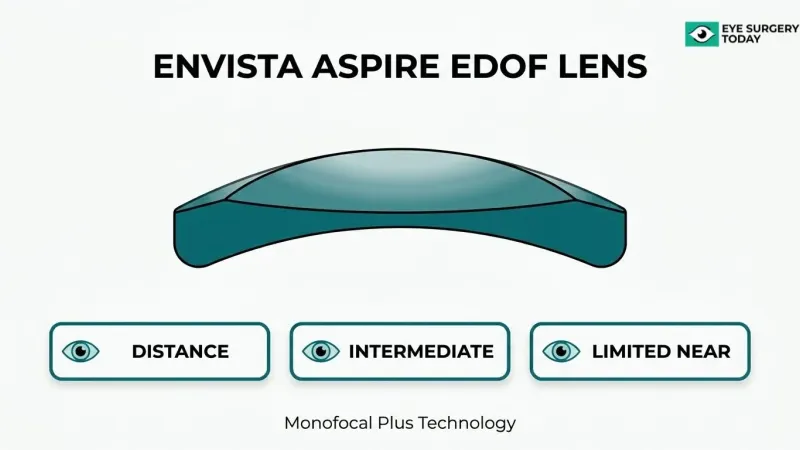
Monofocal lenses concentrate all light at one focus for superior contrast sensitivity, while multifocal and trifocal designs split light across multiple foci to extend range at the cost of reduced contrast and possible halos. EDOF lenses elongate a single focal zone as a middle path, offering fewer photic side effects than diffractive multifocals.
Lifestyle factors, pre-existing eye conditions, and personal tolerance for visual disturbances shape which trade-off position may serve each patient best. Combination strategies such as monovision or mix-and-match implantation can distribute the compromise across both eyes for a more tailored outcome.
Why Do Cataract Lenses Require a Trade-Off Between Sharpness and Range?
Cataract lenses require a trade-off because the optical physics governing light focus make it impossible for a single fixed lens to simultaneously deliver peak clarity at all distances. The sections below explain how physical optics impose this constraint, how splitting light across focal points reduces image quality, and why no current single IOL fully escapes this limitation.
How Does Optical Physics Limit Lens Performance?
Optical physics limits lens performance by constraining how a fixed-power implant can bend and focus light. A natural crystalline lens flexes to shift focus between distances, a process called accommodation. An IOL cannot flex, so any attempt to extend its focal range involves optical compromises, such as inducing aberrations or redirecting light, each of which reduces peak image quality at any single distance.
Pupil size adds another layer of constraint. According to a study published in the Journal of Clinical Medicine (Miret et al., 2026), the optical performance of premium IOLs is highly sensitive to pupil diameter; the RayOne EMV, for example, relies on positive spherical aberration to elongate its focal range but shows limited near vision benefit as pupil size increases. This sensitivity means that a lens engineered to perform across a range will behave differently under varying lighting conditions, making consistent, predictable sharpness across all distances physically unachievable with current IOL technology.
What Is the Relationship Between Light Splitting and Image Clarity?
The relationship between light splitting and image clarity is fundamentally inverse: redirecting light to create multiple focal points reduces the intensity and contrast available at each individual focus. Diffractive multifocal IOLs use annular concentric grooves called diffractive kinoforms to slow and divide light into two or more simultaneous foci. According to Alcon Science, this light-splitting mechanism results in a reduced overall modulation transfer function (MTF) and lower contrast sensitivity compared to monofocal lenses.
A simultaneous vision IOL produces a retinal image containing both in-focus and out-of-focus components at the same moment, requiring the visual cortex to suppress the blurred signals and extract the sharpest one. This neural adaptation takes time and does not fully eliminate the competing blur, which is why contrast sensitivity remains measurably lower than with a single-focus design. In practical terms, more focal points mean each point receives less dedicated light, and less dedicated light means a softer, lower-contrast image.
Why Can’t a Single Intraocular Lens Maximize Both Sharpness and Range?
A single intraocular lens cannot maximize both sharpness and range because the optical strategies required for each directly undermine the other. Achieving the highest possible contrast and resolution at one distance demands that all available light converge at a single, tightly defined focal point. Extending range requires either splitting that light across multiple foci or introducing controlled aberrations that smear the focal zone, both of which reduce peak image contrast.
This is not a manufacturing limitation but a consequence of fundamental wave optics. Any energy diverted to a second or third focal point is energy unavailable at the primary focus, and any aberration introduced to elongate depth of field degrades the MTF at the intended distance. Current IOL engineering works within this constraint rather than around it, which is why every lens category represents a deliberate position on the sharpness-range spectrum rather than a solution to it.
What Does Sharpness Mean in the Context of Cataract Lenses?
Sharpness in cataract lenses refers to two measurable qualities: visual acuity (how clearly defined objects appear) and contrast sensitivity (how well the eye distinguishes objects from their background). The following sections cover how each is measured and what degrades them.
How Is Visual Acuity Measured After Cataract Surgery?
Visual acuity after cataract surgery is measured using standardized logMAR or Snellen charts at three distances: near, intermediate, and far. LogMAR scoring is more precise clinically; a score of 0.00 corresponds to 20/20 Snellen acuity, while lower (more negative) values indicate sharper-than-average performance.
Benchmark results vary by lens design. According to a 2025 multicenter study of 476 eyes reported in The Ophthalmologist, the TECNIS PureSee refractive EDOF lens achieved binocular uncorrected distance acuity of -0.02 logMAR, intermediate acuity of 0.12 logMAR, and near acuity of 0.25 logMAR. These figures illustrate how acuity testing captures the distance-specific sharpness trade-offs inherent to each IOL design.
What Is Contrast Sensitivity and Why Does It Matter?
Contrast sensitivity is the visual system’s ability to detect differences in luminance between an object and its background, particularly under low-light or low-contrast conditions. Unlike a Snellen chart, which uses high-contrast black letters on white, contrast sensitivity testing reveals how well a patient sees in real-world environments such as driving at dusk or recognizing faces in dim rooms.
It matters because a lens can produce 20/20 acuity on a chart yet still impair functional vision if contrast sensitivity is reduced. Diffractive multifocal lenses, which split incoming light across multiple focal points, inherently reduce the modulation transfer function, making contrast sensitivity a critical metric when evaluating premium IOL performance.
How Do Optical Aberrations Affect Perceived Sharpness?
Optical aberrations affect perceived sharpness by distorting the light wavefront before it reaches the retina, producing blurred or degraded images even when acuity measures appear acceptable. Spherical aberration is the most clinically significant type in IOL optics.
According to a 2007 study published in the Yonsei Medical Journal, spherical aberration is significantly higher in multifocal IOL groups compared to monofocal groups, contributing to lower contrast sensitivity and increased reports of halos and glare. These dysphotopsias are not merely cosmetic: they represent a measurable reduction in functional sharpness, particularly in mesopic (dim-light) conditions. For patients prioritizing crisp, undistorted vision across all lighting environments, aberration profiles are often as important as logMAR acuity scores when selecting an IOL.
What Does Range of Vision Mean in Cataract Lenses?
Range of vision in cataract lenses refers to the span of distances at which a patient can see clearly after IOL implantation. The H3s below cover functional near vision, intermediate vision, and the difference between continuous range and fixed focal points.
What Is Functional Near Vision in a Cataract Lens?
Functional near vision in a cataract lens is the ability to see clearly at close distances, typically 33 to 40 centimeters, covering tasks like reading print, viewing medication labels, or using a smartphone. Not all IOLs deliver this capability equally. A multifocal lens dedicates a portion of its optical power specifically to a near focal point, while a monofocal set for distance provides little to no unaided near clarity. According to Dr. John A. Hovanesian, writing in Cataract & Refractive Surgery Today (2019), mixing the Restor +2.5 D in the dominant eye with the Restor +3.0 D in the nondominant eye has become a preferred approach to balance distance, intermediate, and near vision. This “blended” strategy reflects how surgeons often compensate for the inherent limits of any single near-vision target.
What Is Intermediate Vision and Why Is It Important?
Intermediate vision is clarity at arm’s length distances, roughly 60 to 80 centimeters, covering activities such as reading a computer screen, viewing a car dashboard, or cooking. It is important because it represents the most common working distance in daily modern life, yet traditional bifocal IOLs largely ignored it, leaving patients dependent on glasses for mid-range tasks. Extended depth of focus and trifocal designs specifically added intermediate coverage to address this gap. For many patients, intermediate performance matters more than near acuity in practice.
How Is Continuous Range Different From Fixed Focal Points?
Continuous range means the IOL provides uninterrupted clarity across a broad span of distances, whereas fixed focal points means the lens creates two or three discrete zones of sharp focus with gaps between them. A multifocal IOL with fixed near and distance foci may leave intermediate distances noticeably blurry, while an EDOF lens stretches focus gradually without discrete jumps. A 2025 analysis published in Translational Vision Science & Technology (Wu et al.) found multifocal IOLs achieve spectacle-independence rates of 86.0% to 90.9%, with lifetime societal costs between $5,780.79 and $15,944.76, reflecting strong functional value despite their fixed-focus architecture. Continuous designs trade some peak sharpness for smoother transitions between distances, making them well suited to patients who move fluidly between tasks throughout the day.
How Does a Monofocal Lens Prioritize Sharpness Over Range?
A monofocal lens prioritizes sharpness by directing all available light to a single focal point, producing maximum optical clarity at one chosen distance. The sections below cover the clarity levels monofocal lenses can achieve, which distances they sacrifice, and when that focused sharpness may be the right trade-off.
What Level of Clarity Can a Monofocal Lens Achieve?
The level of clarity a monofocal lens can achieve is exceptionally high at a single, pre-selected focal distance, typically set for distance vision. Because the lens concentrates all incoming light onto one focal point rather than splitting it, it produces stronger contrast sensitivity and a higher modulation transfer function than diffractive multifocal designs. According to the British Journal of Ophthalmology, monofocal IOLs excel in distance vision and contrast sensitivity, particularly in low-illuminance (mesopic) conditions, where multifocal IOLs often show statistically significant performance drops. This optical efficiency makes monofocal lenses especially valuable for patients whose priority is crisp, high-contrast distance vision in varied lighting environments.
What Visual Distances Does a Monofocal Lens Sacrifice?
The visual distances a monofocal lens sacrifices are near and intermediate ranges. Once the surgeon targets distance vision, activities such as reading, smartphone use, and computer work typically require corrective glasses or contact lenses. Intermediate vision, the range used for dashboard displays and kitchen tasks, is similarly limited. This is not a flaw in the lens itself; it is the direct result of the same single-focus design that produces its superior sharpness. Patients who understand this trade-off before surgery tend to adapt more readily to glasses for close tasks.
When Might Maximum Sharpness Outweigh Range of Vision?
Maximum sharpness may outweigh range of vision in several well-defined clinical situations, including:
- Patients with pre-existing macular disease, glaucoma, or corneal irregularities, where contrast sensitivity is already reduced and a multifocal lens may further compromise visual quality.
- Frequent night drivers, who benefit from the higher contrast sensitivity and reduced dysphotopsia risk that a single-focus design provides.
- Perfectionists and contrast-sensitive patients, who may find even mild halos or reduced contrast from multifocal optics unacceptable.
- Patients with previous keratorefractive surgery, where increased corneal aberrations raise the risk of visual degradation with multifocal designs.
In clinical practice, a monofocal lens is often the most defensible choice when ocular health conditions limit multifocal candidacy or when a patient’s primary daily demand is high-quality distance vision.
How Do Multifocal Lenses Prioritize Range Over Sharpness?
Multifocal lenses prioritize range by splitting incoming light across multiple focal points, extending vision from near to far. The sections below cover what this trade-off costs in contrast sensitivity, what visual disturbances may occur, and what spectacle independence patients can realistically expect.
How Much Contrast Sensitivity May Be Lost With Multifocal Lenses?
Contrast sensitivity loss is one of the most clinically significant trade-offs multifocal lenses carry. Monofocal IOLs outperform multifocal designs in distance vision and contrast sensitivity, particularly under low-illuminance (mesopic) conditions, where multifocal IOLs often show statistically significant performance drops, according to the British Journal of Ophthalmology.
A key contributor is spherical aberration. A 2007 study published in the Yonsei Medical Journal found that spherical aberration is significantly higher in multifocal IOL groups than in monofocal groups, which directly reduces contrast sensitivity and increases reports of halos and glare.
This effect is compounded in certain patients. Multifocal IOLs are generally discouraged in patients with significant macular disease, glaucoma, or corneal irregularities, since these conditions already reduce contrast sensitivity before any lens is implanted, and the multifocal design can worsen it further. Surgeons who screen candidates carefully tend to report better patient satisfaction outcomes, and pre-existing ocular pathology remains the most important exclusion criterion.
What Visual Disturbances Are Possible With Multifocal Lenses?
The visual disturbances possible with multifocal lenses include halos, glare, and starbursts, particularly in low-light or nighttime conditions. These photic phenomena result from the light-splitting mechanism inherent to diffractive multifocal designs, which distributes light energy across focal points rather than concentrating it at one.
Most patients adapt neurally over time, and many report reduced awareness of these disturbances within months of surgery. However, a subset remains symptomatic enough to consider intervention. According to the American Academy of Ophthalmology, IOL exchange is a feasible option for dissatisfied patients and can achieve favorable refractive and visual outcomes, though most dissatisfied patients can be managed conservatively without exchange.
How Much Spectacle Independence Can Multifocal Lenses Provide?
Spectacle independence with multifocal lenses is generally high across near, intermediate, and distance tasks. A meta-analysis of 13 studies (n=513) published in Ophthalmology and Therapy found that the AcrySof PanOptix trifocal IOL achieved a complete spectacle independence rate of 91.6%, with patients meeting 20/20 visual acuity benchmarks at near, intermediate, and far distances.
This level of independence makes multifocal lenses particularly well-suited for patients who want to minimize reliance on reading glasses for daily activities such as smartphone use, reading printed text, and distance viewing. Spectacle independence is arguably the primary reason patients choose multifocal designs despite the contrast trade-offs they accept in exchange.
With spectacle independence and visual side effect risks both understood, the next consideration is how extended depth of focus lenses may offer a middle path between sharpness and range.
How Do Extended Depth of Focus Lenses Balance Sharpness and Range?
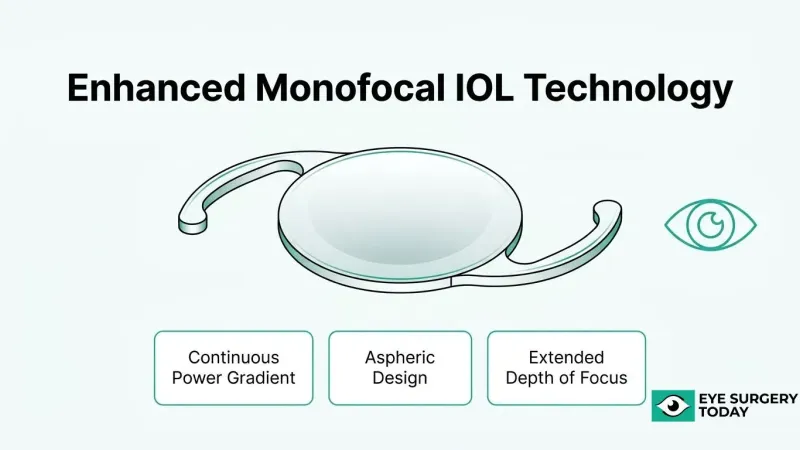
Extended depth of focus (EDOF) lenses balance sharpness and range by elongating a single focal point into a continuous focal zone, rather than splitting light into two or three fixed foci. The sections below cover the vision range EDOF lenses can offer, how their sharpness compares to monofocal designs, and which visual side effects patients may experience.
What Range of Vision Can an EDOF Lens Offer?
The range of vision an EDOF lens can offer spans distance and intermediate distances well, with near vision that is functional but more limited than trifocal designs. According to a 2025 multicenter study reported by The Ophthalmologist, the TECNIS PureSee, a purely refractive EDOF lens, achieved binocular uncorrected visual acuity of -0.02 logMAR at distance and 0.12 logMAR at intermediate across 476 eyes, with near acuity measuring 0.25 logMAR. This places near performance roughly equivalent to reading moderately sized print, which satisfies most daily tasks but may still require reading glasses for very fine text.
How Does EDOF Sharpness Compare to a Monofocal Lens?
EDOF sharpness at distance is close to monofocal performance, though a slight trade-off exists because the focal zone is intentionally elongated. Monofocal lenses concentrate all available light into a single focal point, producing the highest possible contrast sensitivity and image clarity at one distance. EDOF lenses distribute optical energy across a broader zone, which modestly reduces peak distance sharpness in exchange for a continuous range extending from far to intermediate.
What Are the Possible Visual Side Effects of EDOF Lenses?
The possible visual side effects of EDOF lenses include glare, halos, and starbursts, though these occur at notably lower rates than with diffractive multifocal designs. In a study of the TECNIS PureSee presented at the 2025 ESCRS Annual Congress by Goslings et al., only 3% of patients reported being “very bothered” by glare, 1% by halos, and 3% by starbursts. For patients who prioritize reduced dysphotopsia while still gaining an extended focal range, purely refractive EDOF designs represent a clinically meaningful improvement over diffractive alternatives.
How Does a Trifocal Lens Differ From a Bifocal Multifocal Lens?
A trifocal lens differs from a bifocal multifocal lens primarily in the number of focal points it creates and how it distributes light across near, intermediate, and distance zones. Both designs use diffractive optics, but their light-splitting strategies produce meaningfully different visual outcomes. The sections below examine how each design manages light distribution and which may cause more nighttime visual disturbances.
How Does Light Distribution Differ Between Trifocal and Bifocal Designs?
Light distribution differs between trifocal and bifocal designs in the number of focal points each creates and the optical mechanism each uses. Diffractive IOLs use annular concentric grooves, called diffractive kinoforms, to slow light propagation and split it into multiple foci, while refractive IOLs achieve multifocality through surface power variations based on Snell’s law, according to the Journal of Clinical Medicine.
A bifocal design splits light between two focal points, typically distance and near, leaving intermediate vision underserved. A trifocal design adds a dedicated third focal point for intermediate distances, such as arm’s length tasks. Research published in Scientific Reports found that trifocal IOLs provide significantly better uncorrected near visual acuity than hybrid multifocal-EDOF lenses, though hybrid designs often outperform at intermediate distances. For patients who rely on both reading and computer use, the three-point architecture of a trifocal generally offers a more complete functional range.
Which Design May Produce More Halos or Glare at Night?
Trifocal lenses may produce more halos or glare at night than bifocal or hybrid multifocal-EDOF designs. According to a 2021 study published in Nature Scientific Reports, photic phenomena such as halos are reported more frequently with trifocal IOLs compared to hybrid multifocal-EDOF designs, with a relative risk of 1.318. This reflects the trade-off that comes with superior near vision: splitting light three ways introduces more competing out-of-focus images that can manifest as nighttime optical disturbances.
Purely refractive designs tend to produce fewer of these symptoms. In a study of the TECNIS PureSee lens, only 3% of patients reported being very bothered by glare and 1% by halos, illustrating the lower dysphotopsia burden of non-diffractive architectures.
Patients who drive frequently at night should weigh this trade-off carefully when comparing trifocal and bifocal or EDOF options with their surgeon.
How Do Lifestyle and Visual Demands Affect Lens Choice?
Lifestyle and visual demands directly shape which IOL trade-off makes the most sense for each patient. The following sections address four common scenarios: frequent night driving, reading and close work, computer use, and active living with minimal glasses.
What Lens Trade-Off May Suit Someone Who Drives Frequently at Night?
The lens trade-off most likely to suit someone who drives frequently at night is a monofocal or EDOF lens, prioritizing contrast sensitivity over near-vision range.
Diffractive multifocal IOLs split incoming light across multiple focal points, which reduces contrast sensitivity under low-illuminance conditions, precisely the environment night drivers encounter most. Halos and glare around oncoming headlights are well-documented concerns with these designs. A monofocal lens set for distance, or a purely refractive EDOF design, preserves sharper contrast in mesopic conditions while accepting the trade-off of needing reading glasses for close tasks.
For frequent night drivers, contrast quality generally matters more than spectacle independence at near distances.
What Lens Trade-Off May Suit Someone Who Reads or Does Close Work Often?
The lens trade-off most likely to suit someone who reads or does close work often is a trifocal multifocal IOL or a monovision strategy, accepting some reduction in contrast sensitivity in exchange for functional near vision.
Trifocal designs, such as the AcrySof PanOptix, are optimized to deliver near, intermediate, and distance focal points simultaneously. According to a 2023 meta-analysis published in Ophthalmology and Therapy (Zhu et al., N=513), the PanOptix achieved a spectacle independence rate of 91.6%, with 20/20 benchmarks across all three distances. The trade-off is a modest reduction in contrast sensitivity and a higher likelihood of noticing halos under low light. For avid readers, that exchange is often worth accepting.
What Lens Trade-Off May Suit Someone Who Works at a Computer Most of the Day?
The lens trade-off most likely to suit someone who works at a computer most of the day is an EDOF lens, which extends the focal range through the intermediate zone without the steeper contrast penalties of diffractive multifocals.
Intermediate vision, typically around 60 to 80 centimeters, corresponds to most screen distances. EDOF lenses elongate the depth of focus across this range while maintaining stronger contrast sensitivity than trifocal designs. The trade-off is limited functional near vision at very close distances, such as reading fine print, which may still require low-power reading glasses. For professionals spending most of their visual day at screen distance, this balance often represents a practical middle ground.
What Lens Trade-Off May Suit an Active Person Wanting Minimal Glasses?
The lens trade-off most likely to suit an active person wanting minimal glasses is a trifocal IOL or a mix-and-match strategy combining different lens powers between eyes, accepting the associated photic side effects in exchange for broad spectacle independence.
Active individuals who move between near tasks, intermediate activities, and outdoor distance vision benefit most from a lens strategy that covers the full range. The key trade-off is increased susceptibility to halos and glare, particularly in bright outdoor light or at night. Patients with high physical activity levels who are also sensitive to visual disturbances may find that an EDOF lens paired with monovision fine-tuning offers a more tolerant visual experience across varied lighting conditions.
Discussing daily visual priorities with your surgeon is the most reliable way to align lens selection with how you actually live.
Who May Not Be a Good Candidate for Range-Focused Lenses?
Not every patient is suited to multifocal or EDOF lenses. Two key factors — pre-existing eye disease and a patient’s personal visual expectations — often determine whether a range-focused lens will satisfy or frustrate.
How Do Pre-Existing Eye Conditions Affect Multifocal Candidacy?
Pre-existing eye conditions affect multifocal candidacy by reducing baseline contrast sensitivity, which multifocal optics compromise further. According to a 2020 review published in Graefe’s Archive for Clinical and Experimental Ophthalmology, multifocal IOLs are generally discouraged in patients with significant macular disease, glaucoma, or corneal irregularities because these conditions already impair contrast sensitivity before the lens is ever implanted.
Relative contraindications also include previous keratorefractive surgery, which introduces additional corneal aberrations, and zonular insufficiency, which can cause lens decentration and severe visual degradation. In these patients, the light-splitting mechanism of a diffractive multifocal lens compounds an already compromised optical system, making a monofocal lens the safer, sharper choice.
Why Might Perfectionists or Contrast-Sensitive Patients Prefer Monofocal Lenses?
Perfectionists or contrast-sensitive patients may prefer monofocal lenses because these lenses deliver the highest possible image quality at a single focal distance without the optical compromises inherent in multifocal designs. Patients who are highly attuned to visual quality, such as graphic designers, surgeons, or night drivers, often find that even mild reductions in contrast sensitivity or subtle dysphotopsia are unacceptable in daily life.
Monofocal lenses do not split incoming light across multiple foci, so they preserve the full modulation transfer function of the optical system. For quality-first patients, the trade-off of wearing reading glasses is a reasonable concession compared to adapting to halos or reduced low-light clarity.
What Are the Possible Risks of Choosing the Wrong Sharpness-Range Balance?
The risks of choosing the wrong sharpness-range balance range from persistent visual disturbances to long-term dissatisfaction with daily vision quality. The following sections cover what happens when visual quality falls short of expectations and whether a lens exchange is a viable path forward.
What Happens If a Patient Is Unhappy With Visual Quality After Implantation?
A patient who is unhappy with visual quality after implantation may experience symptoms such as halos, glare, reduced contrast sensitivity, or difficulty with near or distance tasks, depending on which lens type was chosen. These symptoms can affect driving, reading, and screen use in ways that feel difficult to adapt to.
The good news is that most cases can be managed without surgery. According to the American Academy of Ophthalmology, most dissatisfied multifocal IOL patients can be managed conservatively, without requiring lens exchange. Conservative options may include glasses for specific tasks, neuro-adaptation time, or optical adjustments such as residual refractive error correction.
That said, dissatisfaction is more likely when patient expectations are misaligned with what a chosen lens can realistically deliver, which is why thorough pre-surgical counseling is one of the most undervalued steps in the entire process.
Can a Cataract Lens Be Exchanged If the Trade-Off Feels Wrong?
Yes, a cataract lens can be exchanged if the trade-off feels wrong, though the procedure carries added surgical complexity compared to the original implantation. IOL exchange is technically feasible and, when appropriate, can achieve favorable refractive and visual outcomes, according to the American Academy of Ophthalmology.
Exchange is generally considered when conservative management has failed and the patient’s quality of life remains significantly impacted. The decision depends on factors such as how long the original lens has been in place, the integrity of the capsule, and the surgeon’s assessment of surgical risk.
Because exchange is not without complication risk, it reinforces why selecting the right lens from the outset matters enormously. Understanding the realistic trade-offs before surgery is far preferable to correcting a poor match afterward.
How Can Combining Lens Strategies Offer a Customized Balance?
Combining lens strategies allows surgeons to tailor visual outcomes by assigning different IOL types to each eye, addressing individual priorities for sharpness and range that no single lens can fully satisfy alone. The sections below cover monovision and blended vision concepts, followed by mix-and-match implantation techniques.
What Is Monovision or Blended Vision With Cataract Lenses?
Monovision with cataract lenses is an approach where one eye is targeted for clear distance vision and the other for near or intermediate vision, creating a combined functional range across both eyes. Blended vision is a softer variation, using lenses with overlapping focal zones to reduce the abrupt perceptual shift between eyes that traditional monovision can produce.
According to Dr. John A. Hovanesian, writing in Cataract & Refractive Surgery Today (2019), mixing the Restor +2.5 D in the dominant eye with the Restor +3.0 D in the nondominant eye has become a preferred approach to balance distance, intermediate, and near vision. This strategy works because the brain integrates slightly different inputs from each eye, suppressing blur and emphasizing the sharpest available image at any given distance. For patients who adapt well, blended vision can approximate spectacle independence without the full contrast trade-offs of a bilateral multifocal implant.
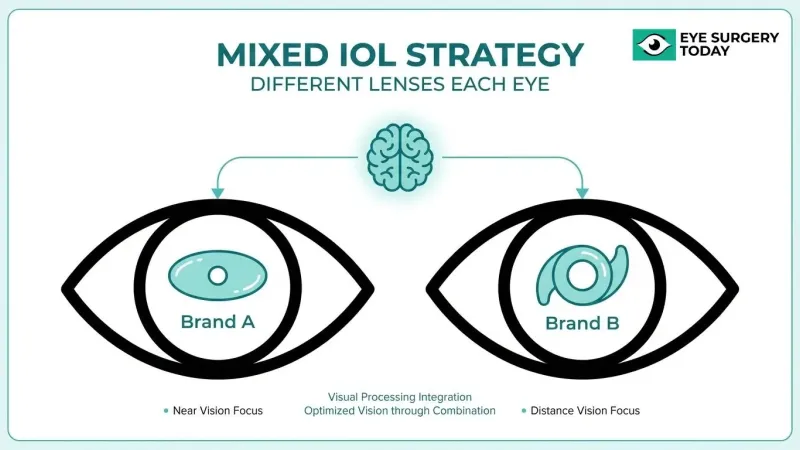
How Does Mix-and-Match Implantation Work?
Mix-and-match implantation works by placing two different IOL designs, one in each eye, to cover complementary focal strengths that a single lens type cannot achieve bilaterally. A common pairing combines an EDOF lens in the dominant eye for strong distance and intermediate performance with a trifocal or higher-add multifocal in the nondominant eye to extend near coverage.
Surgeons select pairings based on each patient’s visual demands, dominant eye, pupil dynamics, and tolerance for dysphotopsia. The dominant eye generally receives the lens that prioritizes sharpness and contrast, since it leads in visually demanding tasks like driving. This approach is worth considering for patients whose lifestyle spans both screen-heavy work and outdoor activities, as it distributes the sharpness-versus-range trade-off across two complementary optical systems rather than forcing one lens to compromise on all fronts.
How Can Eye Surgery Today Help You Navigate Cataract Lens Trade-Offs?
Eye Surgery Today offers surgeon-reviewed educational content designed to help patients understand the sharpness-versus-range trade-off before choosing an intraocular lens. The sections below cover how expert-reviewed guidance supports decision-making and what key takeaways readers should carry forward.
Can Surgeon-Reviewed Guidance on Advanced IOL Options Help You Decide?
Yes, surgeon-reviewed guidance on advanced IOL options can help you decide by translating complex clinical trade-offs into clear, actionable information. Choosing between a monofocal, EDOF, or trifocal lens involves weighing optical physics, lifestyle needs, pre-existing eye conditions, and personal tolerance for visual side effects, none of which is straightforward without clinical context.
Eye Surgery Today provides surgeon-reviewed resources that explain how each lens category performs across real-world visual demands. According to Cataract & Refractive Surgery Today (John A. Hovanesian, MD, 2019), even surgeons tailor their implantation strategies per patient, combining different lens powers across each eye to optimize the distance-intermediate-near balance. That level of nuance is rarely visible to patients navigating brochures alone.
For most patients, the biggest risk is choosing a lens that fits a general profile rather than their specific visual demands. Surgeon-reviewed education closes that gap.
What Are the Key Takeaways About Sharpness Versus Range in Cataract Lenses?
The key takeaways about sharpness versus range in cataract lenses center on one fundamental principle: no single lens maximizes both. Every IOL category involves a deliberate optical compromise, and understanding that trade-off is the foundation of an informed decision.
The most important conclusions from this topic are:
- Monofocal lenses deliver the sharpest distance vision and best contrast sensitivity but sacrifice near and intermediate range.
- Multifocal and trifocal lenses expand range significantly but may reduce contrast sensitivity and increase dysphotopsia risk.
- EDOF lenses offer a middle path, extending depth of focus with fewer photic side effects than diffractive designs.
- Patient-specific factors, including lifestyle, pre-existing eye conditions, and tolerance for visual disturbances, matter as much as lens optics.
- Combination strategies, such as mix-and-match implantation, can offer personalized balance when no single lens fully matches a patient’s needs.
Understanding these trade-offs before surgery gives patients the foundation to have a more productive conversation with their surgical team.