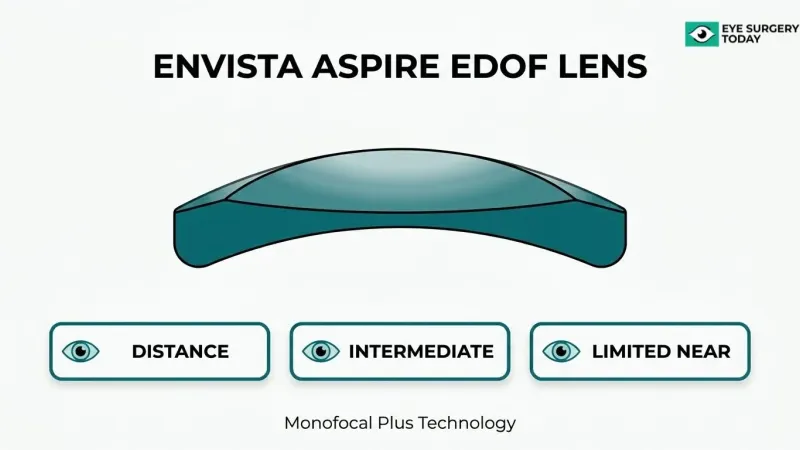
IOL choice after LASIK is the process of selecting an intraocular lens for cataract surgery in an eye whose cornea has been permanently reshaped by prior laser vision correction. Because LASIK alters anterior corneal curvature without changing the posterior surface, standard measurement tools and power formulas may produce inaccurate results, making lens selection more complex than in eyes without refractive history.
We cover how prior LASIK complicates biometry and IOL calculations, the types of lenses available to post-LASIK patients, how monofocal and premium IOLs each perform in these eyes, the risks and candidacy requirements for premium designs, and what to discuss with your surgeon before making a final decision.
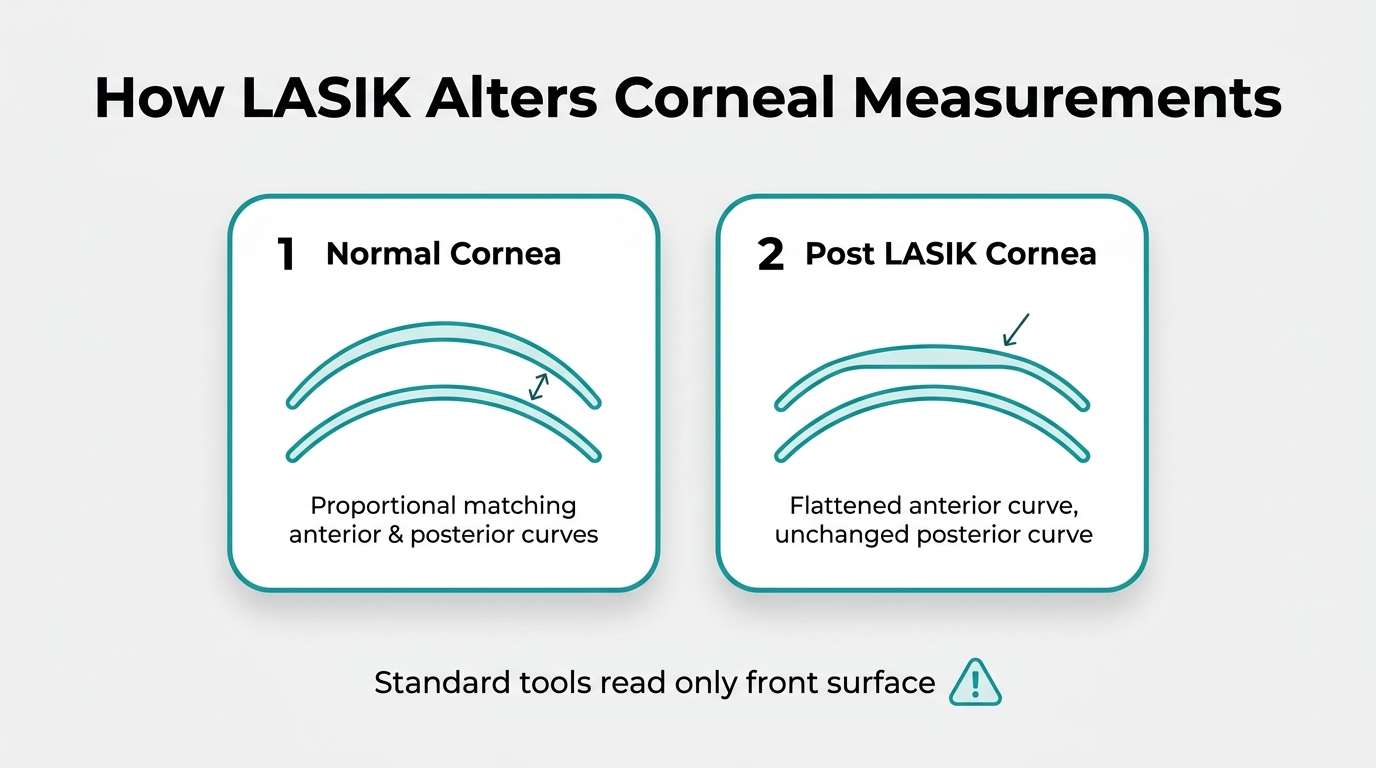
LASIK changes the cornea’s anterior-to-posterior curvature ratio, which can invalidate standard keratometric readings and lead to refractive surprises in a significant percentage of post-refractive surgery cases. Specialized formulas such as Barrett True-K and the ASCRS Post-Refractive IOL Calculator may help improve power calculation accuracy.
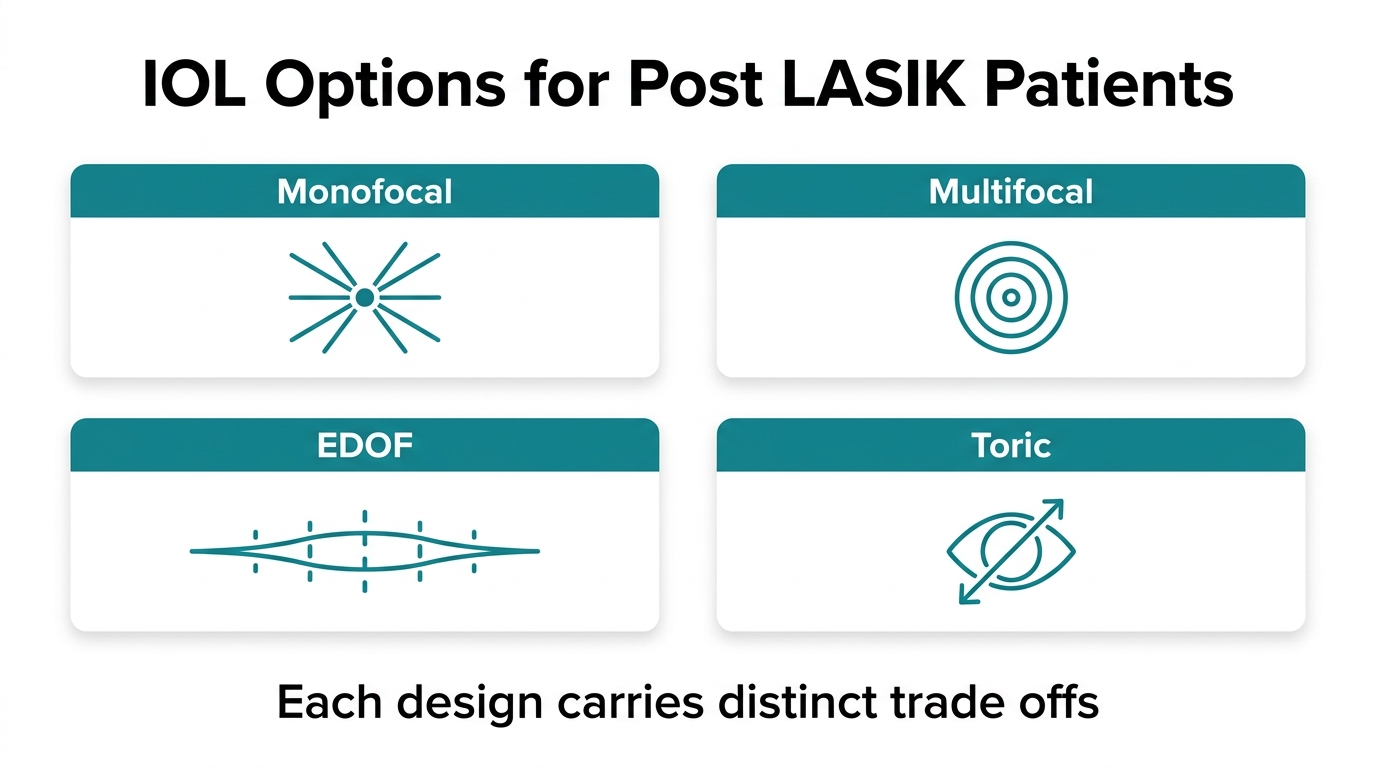
Monofocal, multifocal, extended depth of focus, and toric IOLs are all options for post-LASIK patients, though each carries distinct trade-offs. Monofocal lenses tend to deliver more predictable visual quality in altered corneas, while premium designs may offer broader functional range at the cost of increased photic phenomena risk.
Multifocal IOLs are associated with a higher likelihood of halos and glare compared to monofocal lenses, and this risk can compound in corneas carrying residual higher-order aberrations from LASIK. Candidacy for premium lenses depends on corneal regularity, aberration profile, lifestyle demands, and tolerance for potential side effects.
A thorough preoperative workup, including topography, wavefront analysis, and a detailed LASIK history review, is essential for guiding the right lens choice. Setting realistic outcome expectations with your surgeon can help align IOL selection with both your visual goals and your eye’s optical profile.
Why Does a History of LASIK Complicate IOL Selection?
A history of LASIK complicates IOL selection because it permanently alters the cornea’s shape in ways that confuse standard measurement tools. The following sections explain how corneal changes affect biometry, what refractive surprises are and why they occur, and which formulas surgeons use to improve accuracy.
How Does LASIK Alter Corneal Measurements for IOL Calculations?
LASIK alters corneal measurements for IOL calculations by modifying only the anterior corneal curvature while leaving the posterior curvature unchanged. This disrupts the normal anterior/posterior (AP) curvature ratio, invalidating the standard keratometric index extrapolation that IOL formulas rely on to estimate net corneal power, according to EyeWiki (American Academy of Ophthalmology). Because standard keratometry reads a reshaped front surface and incorrectly assumes a matching change in the back, it produces an inaccurate corneal power value. That error flows directly into the IOL power calculation, increasing the risk of a poor refractive outcome.
What Is the Risk of a Refractive Surprise After LASIK?
The risk of a refractive surprise after LASIK is substantial: refractive surprises occur in up to 20–30% of post-refractive surgery eyes due to altered corneal geometry and increased biometric measurement difficulty, according to a review in Clinical Optometry (Dove Press). A second compounding problem involves effective lens position (ELP) prediction. Standard formulas use the reduced post-LASIK corneal power to estimate lens depth, yielding a shallower position than actually exists and causing systematic underestimation of the required IOL power. Pseudophakic eyes, in which the natural lens has been replaced by an IOL, require precise biometry to avoid this outcome, making careful formula selection critical.
Which IOL Calculation Formulas Work Best for Post-LASIK Eyes?
The IOL calculation formulas that work best for post-LASIK eyes are specialized options designed to account for altered corneal geometry. According to a study published in Eye and Vision (London), the ASCRS average and Barrett True-K no history formulas yielded significantly higher percentages of refractive prediction error within ±0.5 D than other common methods in myopic laser refractive surgery eyes. For post-LASIK eyes with axial length above 26 mm and keratometry between 38 and 40 D, the Barrett True-TK formula produced significantly lower absolute prediction errors than the Haigis-L formula (Scientific Reports, Nature). Intraoperative aberrometry (IA) offers a comparable alternative to Barrett formulas overall, with a specific advantage over Barrett True-K no history in post-hyperopic laser vision correction eyes.
Surgeons navigating this landscape may use multiple specialized formulas in parallel rather than relying on any single method.
What Types of IOLs Are Available for Post-LASIK Patients?
The types of IOLs available for post-LASIK patients include monofocal, multifocal, extended depth of focus (EDOF), and toric lenses. Each design carries distinct trade-offs in a cornea that has been surgically altered, so the right choice depends on the individual’s corneal health, residual astigmatism, and visual goals.
Monofocal IOLs
Monofocal IOLs are single-focus lenses that correct vision at one distance, typically distance, requiring glasses for near tasks. In post-LASIK eyes with significant higher-order aberrations (HOAs) or irregular astigmatism, a monofocal IOL is often the most predictable option because it does not add the optical complexity of diffractive or multifocal optics on top of an already compromised cornea. According to Cataract & Refractive Surgery Today, patients with significant corneal HOAs or irregular astigmatism from prior LASIK may achieve better visual quality with a monofocal design than with premium alternatives. The Light Adjustable Lens (LAL) is also worth discussing with your surgeon, as it allows post-implant refractive fine-tuning.
Multifocal IOLs
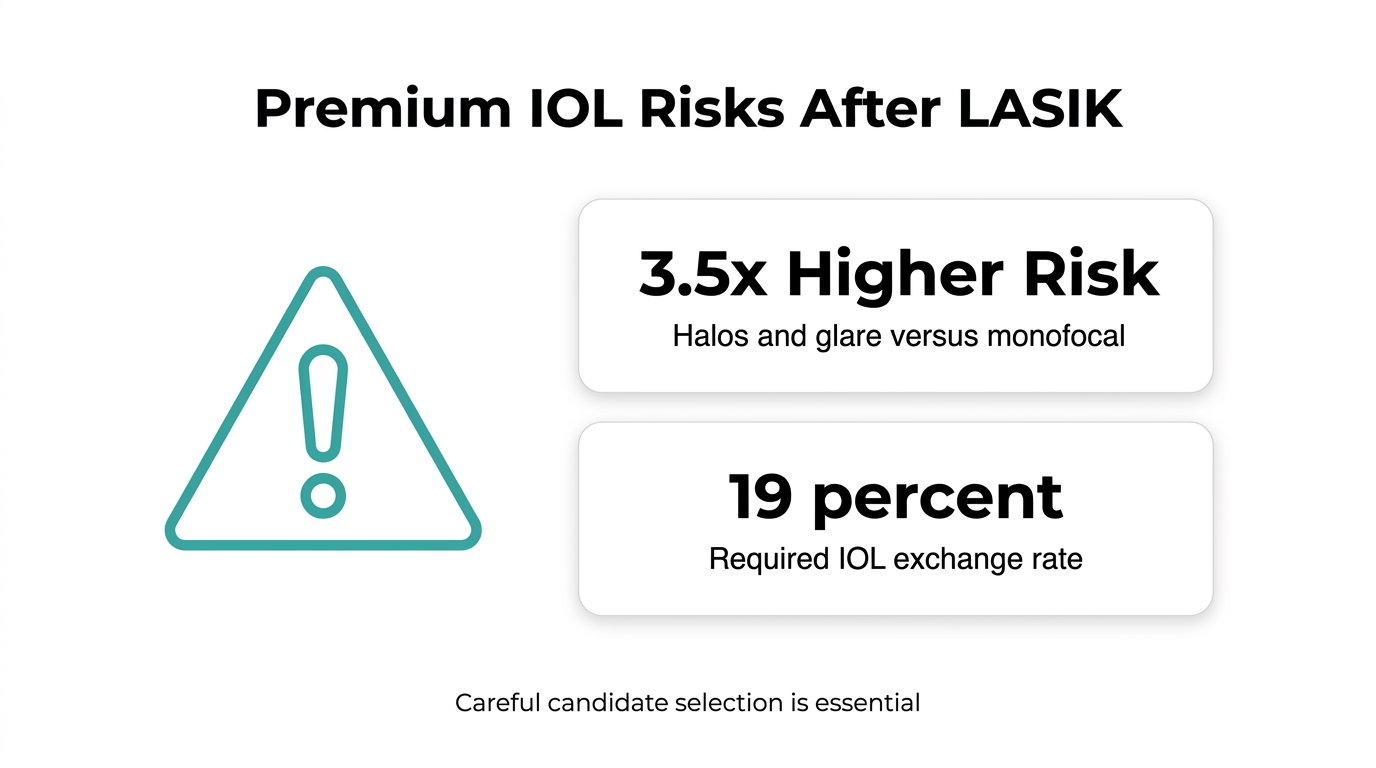
Multifocal IOLs use diffractive or refractive ring zones to split light between distance, intermediate, and near focal points, reducing dependence on glasses. However, this design carries meaningful risk in post-LASIK eyes. A Cochrane review reported that multifocal IOLs are 3.5 times more likely to cause photic phenomena such as halos and glare compared to monofocal IOLs. Research cited by Nicole Fram, MD in EyeWorld found that up to 19% of post-LASIK patients required an IOL exchange due to diffractive dysphotopsia after multifocal or EDOF implantation. This exchange rate underscores why thorough preoperative screening is non-negotiable before selecting a multifocal lens.
Extended Depth of Focus IOLs
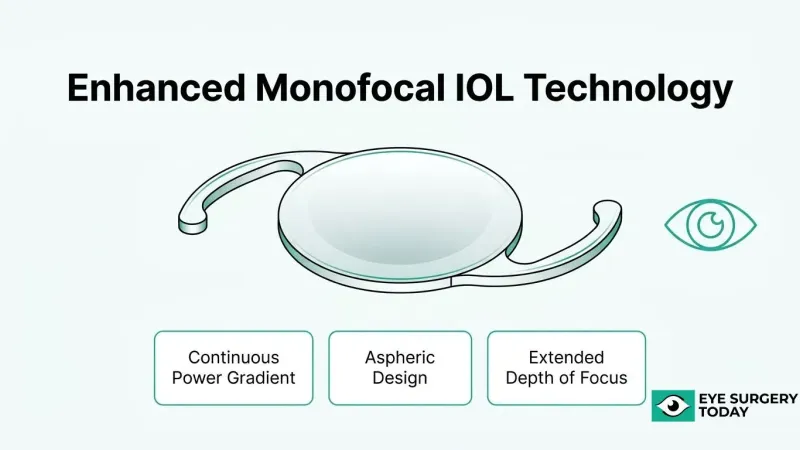
Extended depth of focus (EDOF) IOLs elongate the focal range rather than splitting light into distinct focal points, producing a continuous range of vision from distance to intermediate. Compared to multifocal IOLs, EDOF designs generally produce fewer halos and glare, making them a more tolerable option for some post-LASIK patients. That said, the same 19% IOL exchange figure cited by Fram, MD covers both diffractive multifocal and EDOF technologies combined, indicating that EDOF lenses are not without risk in this population. Corneal aberration profiling before surgery is important when evaluating premium IOL candidacy.
Toric IOLs
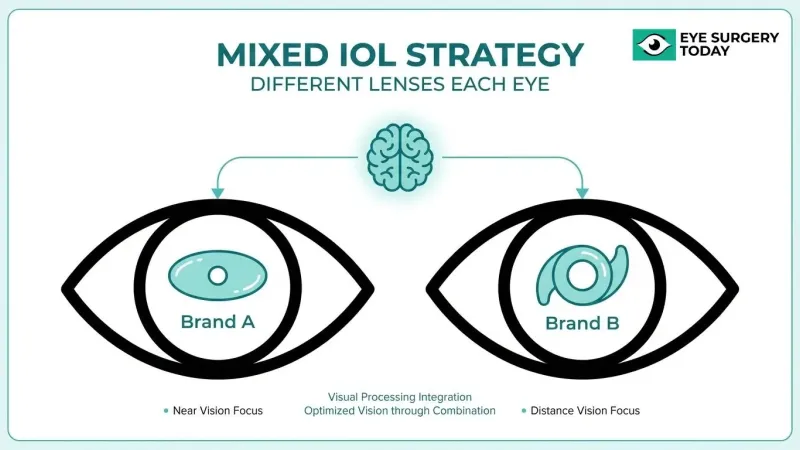
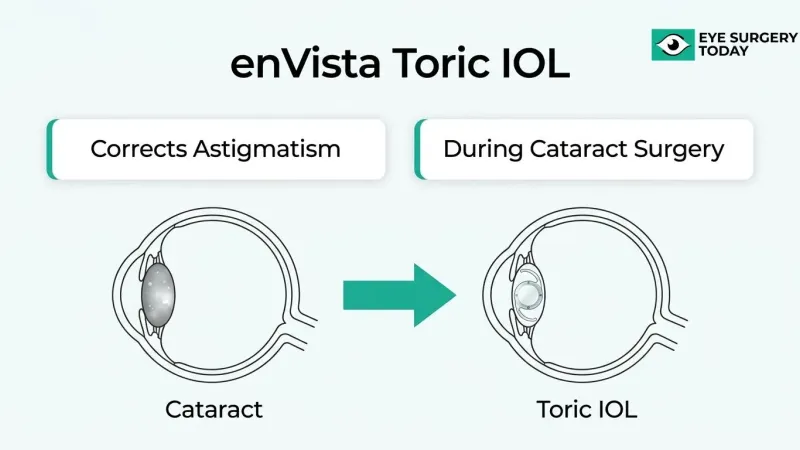
Toric IOLs are lenses engineered to correct corneal astigmatism by incorporating cylindrical power aligned to the steepest corneal meridian. Post-LASIK eyes that retain measurable regular astigmatism may benefit from a toric platform, but accurate axis alignment depends on reliable corneal topography, which can be harder to obtain after refractive surgery. Toric technology is available in both monofocal and premium formats, so it can be combined with EDOF or standard monofocal optics depending on the patient’s overall candidacy profile.
How Do Monofocal Lenses Perform in Post-LASIK Eyes?
Monofocal IOLs can deliver reliable, predictable distance vision in post-LASIK eyes, though glasses are typically still needed for near tasks. The sections below cover expected visual outcomes, when monofocal lenses are the safer clinical choice, and realistic spectacle expectations.
What Visual Outcomes Can Post-LASIK Patients Expect with Monofocal IOLs?
Visual outcomes with monofocal IOLs in post-LASIK patients are generally more predictable than those achieved with diffractive premium lenses. Monofocal designs avoid the optical splitting that makes diffractive multifocal and EDOF lenses problematic in corneas already altered by refractive surgery. According to research cited by Nicole Fram, MD, published by EyeWorld (ASCRS), up to 19% of post-LASIK patients required an IOL exchange due to diffractive dysphotopsia when implanted with diffractive multifocal or EDOF technology. That figure alone supports careful consideration for monofocal lenses particularly for patients who prioritize visual quality over spectacle independence.
When Might a Monofocal IOL Be the Safer Choice After LASIK?
A monofocal IOL may be the safer choice after LASIK when a patient presents with significant corneal higher-order aberrations, irregular astigmatism, or a history of large-zone myopic ablation. These conditions increase the risk of compounding optical distortions with any diffractive or multifocal platform. According to Cataract & Refractive Surgery Today, in patients with significant corneal higher-order aberrations or irregular astigmatism from prior LASIK, a monofocal IOL or the Light Adjustable Lens may be preferred over multifocal designs to minimize visual quality degradation. Managing expectations up front and targeting emmetropia with a monofocal lens is more defensible than chasing spectacle independence with a premium lens in a compromised optical system.
Will You Still Need Glasses with a Monofocal IOL After LASIK?
Yes, you will most likely still need glasses for some tasks with a monofocal IOL after LASIK. Monofocal lenses provide a single focal point, typically optimized for distance, meaning reading glasses or bifocals are usually required for near and intermediate vision. Some surgeons offer monovision targeting, where one eye is set for distance and the other for near, which may reduce overall glasses dependence. However, monovision tolerance is individual and should be trialed with contact lenses before surgical commitment. Even with a prior history of excellent uncorrected vision from LASIK, the monofocal IOL resets the visual system around a single focal range.
How Do Premium Lenses Perform in Post-LASIK Eyes?
Premium IOLs can deliver excellent results after LASIK, but prior corneal changes introduce specific optical challenges. The headings below cover how multifocal IOLs, EDOF lenses, and higher-order aberrations interact with a post-LASIK cornea.
How May Multifocal IOLs Affect Vision Quality After Prior LASIK?
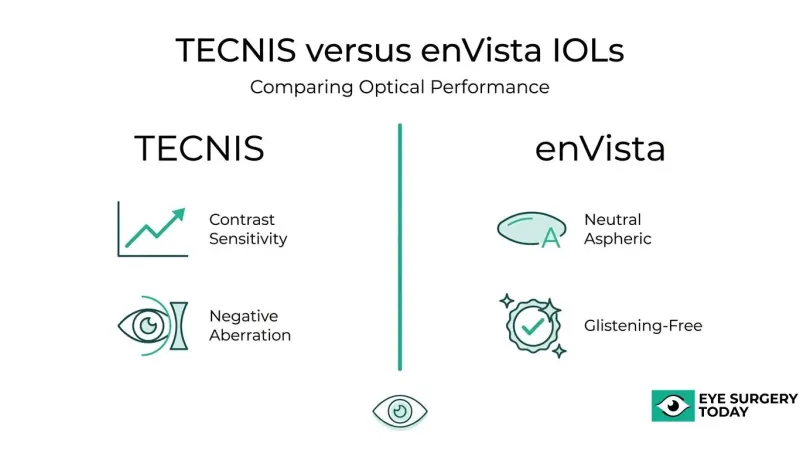
Multifocal IOLs may affect vision quality after prior LASIK by amplifying pre-existing optical irregularities introduced by the refractive procedure. LASIK reshapes the anterior corneal surface, which can alter how light is distributed across a diffractive lens. In eyes that previously underwent hyperopic laser vision correction, a Therapeutic Advances in Ophthalmology review recommends using an IOL with positive spherical aberration or an aberration-free design to balance the negative spherical aberration that prior surgery induced. Without this compensation, contrast sensitivity and night vision may be noticeably reduced. For patients already considering multifocal IOLs, the type of original LASIK correction matters more than many people realize.
How Do Extended Depth of Focus IOLs Compare in Post-LASIK Patients?
Extended depth of focus (EDOF) IOLs generally compare more favorably than diffractive multifocal lenses in post-LASIK patients. EDOF designs use a single elongated focal point rather than multiple discrete zones, producing fewer light-splitting artifacts on an already altered corneal surface. This makes them a more forgiving option when residual higher-order aberrations are present but not severe. Surgeons often consider EDOF lenses a middle-ground choice: offering a wider range of functional vision than a standard monofocal while generating less dysphotopsia risk than a full diffractive multifocal design.
Can Higher-Order Aberrations from LASIK Worsen with Premium IOLs?
Higher-order aberrations (HOAs) from LASIK can make premium IOL selection more complex, particularly diffractive multifocal designs. LASIK-induced HOAs such as coma and spherical aberration interact additively with the optical profile of diffractive lenses, degrading contrast and sharpness. According to EyeWorld (ASCRS), preoperative workup for post-refractive cataract patients should include corneal topography with Placido imaging and wavefront or ray-tracing technology to quantify HOAs before any IOL is selected. In patients with significant HOAs or irregular astigmatism from prior LASIK, a monofocal IOL or the Light Adjustable Lens (LAL) may be preferred over multifocal designs to minimize visual quality degradation. Thorough HOA mapping is an important step before committing to any premium lens in this population.
How Does Prior LASIK for Nearsightedness vs Farsightedness Affect IOL Choice?
Prior LASIK for nearsightedness and farsightedness creates distinct corneal geometry changes that affect IOL power calculation in different ways. The two H3s below explain the specific challenges each correction type introduces.
Which IOL Challenges Arise After Myopic LASIK?
The IOL challenges after myopic LASIK center on systematic underestimation of corneal power, which can cause the eye to end up more farsighted than planned after cataract surgery. Myopic LASIK flattens the anterior corneal surface while leaving the posterior curvature unchanged, disrupting the normal anterior-to-posterior curvature ratio. Standard keratometry reads this flattened anterior surface and applies an unchanged posterior estimate, producing a corneal power value that is too low. According to a 2020 meta-analysis published in Eye and Vision (London), this leads to errors in effective lens position prediction, causing standard formulas to underestimate the required IOL power and resulting in hyperopic refractive surprise. The greater the original myopic correction, the more pronounced this measurement error tends to be, making specialized formulas such as Barrett True-K important for these patients.
Which IOL Challenges Arise After Hyperopic LASIK?
The IOL challenges after hyperopic LASIK differ meaningfully from those seen after myopic correction. Hyperopic LASIK steepens the central cornea, inducing negative spherical aberration rather than the positive aberration typical of myopic treatments. According to a 2024 study published in Therapeutic Advances in Ophthalmology, an IOL with positive spherical aberration or an aberration-free design is recommended after hyperopic LASIK to offset this negative spherical aberration and preserve optical quality. Additionally, research published in Clinical Ophthalmology found that intraoperative aberrometry showed a statistical advantage over the Barrett True-K no history formula specifically in post-hyperopic LASIK eyes, suggesting that real-time intraoperative measurement may improve accuracy in this subgroup. Careful IOL design selection, beyond power calculation alone, is a distinguishing factor for hyperopic LASIK patients.
What Are the Potential Risks and Complications of Premium IOLs After LASIK?
The potential risks and complications of premium IOLs after LASIK include photic phenomena, refractive surprises, and the possibility of requiring an IOL exchange. Each of these outcomes carries distinct implications for post-LASIK patients considering multifocal or EDOF lenses.
How Likely Are Halos and Glare with a Premium IOL in a Post-LASIK Eye?
Halos and glare with a premium IOL in a post-LASIK eye are considerably more likely than with a monofocal lens. According to a Cochrane review cited in Frontiers in Ophthalmology (2024), multifocal IOLs are 3.5 times more likely to cause photic phenomena such as halos and glare compared to monofocal IOLs. Prior LASIK compounds this risk, because altered corneal optics from refractive surgery add higher-order aberrations that interact with the diffractive rings of multifocal designs. For patients who already experienced night-vision sensitivity after LASIK, this compounding effect is often underestimated during preoperative counseling.
What Happens If a Refractive Surprise Occurs with a Premium IOL?
A refractive surprise with a premium IOL means the patient ends up with an unintended residual prescription, which is more disruptive with multifocal or EDOF lenses than with monofocal designs. Because premium IOLs have fixed focal zones, even a modest refractive error significantly degrades the quality of vision across all distances. Management options may include spectacle correction, contact lenses, laser enhancement, or IOL exchange, depending on the magnitude and type of error.
Can a Premium IOL Be Exchanged If Results Are Unsatisfactory?
Yes, a premium IOL may be exchanged if results are unsatisfactory, though the procedure carries greater surgical risk than the original implantation. According to research cited by Nicole Fram, MD, in EyeWorld (ASCRS), up to 19% of post-LASIK patients required an IOL exchange due to diffractive dysphotopsia after multifocal or EDOF implantation. IOL exchange is typically performed within the first few weeks while the lens is easiest to remove, but capsular scarring increases difficulty over time. This exchange rate underscores why careful candidate selection in post-LASIK eyes is essential before committing to a premium lens.
Who Is a Good Candidate for a Premium IOL After LASIK?
Good candidates for a premium IOL after LASIK are patients who meet specific corneal health, lifestyle, and diagnostic criteria. The following sections cover the ocular requirements, visual goals, and pre-surgical tests that help define candidacy.
What Corneal and Ocular Health Criteria Should Be Met?
The corneal and ocular health criteria for premium IOL candidacy after LASIK include a regular corneal topography pattern, stable refraction, and the absence of significant higher-order aberrations or irregular astigmatism. LASIK inherently alters the anterior corneal surface, and any residual irregularity can amplify optical distortions when a diffractive or multifocal design is overlaid on top.
According to a 2018 clinical guideline published in Cataract & Refractive Surgery Today, patients with significant corneal higher-order aberrations or irregular astigmatism from prior LASIK may be better served by a monofocal IOL or the Light Adjustable Lens rather than a multifocal design, to avoid visual quality degradation. Candidates should also have a healthy macula and retina, as no IOL technology can compensate for underlying retinal disease.
In practice, the post-LASIK cornea raises the candidacy bar considerably. Only patients whose prior LASIK produced a clean, symmetric result are likely to tolerate premium optics well.
How Do Lifestyle and Visual Goals Influence Candidacy?
Lifestyle and visual goals influence premium IOL candidacy after LASIK by determining whether the optical trade-offs of diffractive or multifocal designs align with the patient’s daily demands. Patients who prioritize spectacle independence for reading and intermediate tasks and who do not frequently drive at night are stronger candidates, because premium IOLs carry a higher risk of photic phenomena in low-light conditions.
Patients who perform high-contrast detail work, such as professional photographers or pilots, are generally poor candidates for diffractive multifocal technology after LASIK, given the compounding risk of halos and glare. Those with realistic expectations about residual glasses use and who understand that post-LASIK biometry carries inherent uncertainty make more appropriate candidates overall.
What Diagnostic Tests Help Determine Candidacy After LASIK?
The diagnostic tests that help determine premium IOL candidacy after LASIK include manifest refraction, pachymetry, corneal topography with Placido imaging, and wavefront or ray-tracing technology to assess higher-order aberrations. According to best-practice guidance published by EyeWorld (ASCRS) in 2023, this full preoperative diagnostic workup is recommended for all post-refractive cataract patients before an IOL is selected.
These tests serve two functions: they characterize the optical quality of the post-LASIK cornea, and they provide the input data needed for specialized IOL power formulas such as the Barrett True-K or the ASCRS Post-Refractive IOL Calculator. Patients whose topography reveals irregular astigmatism or elevated coma may be better suited to simpler lens designs before the surgical plan is finalized.
How Should You Compare Premium vs Monofocal IOLs After LASIK?
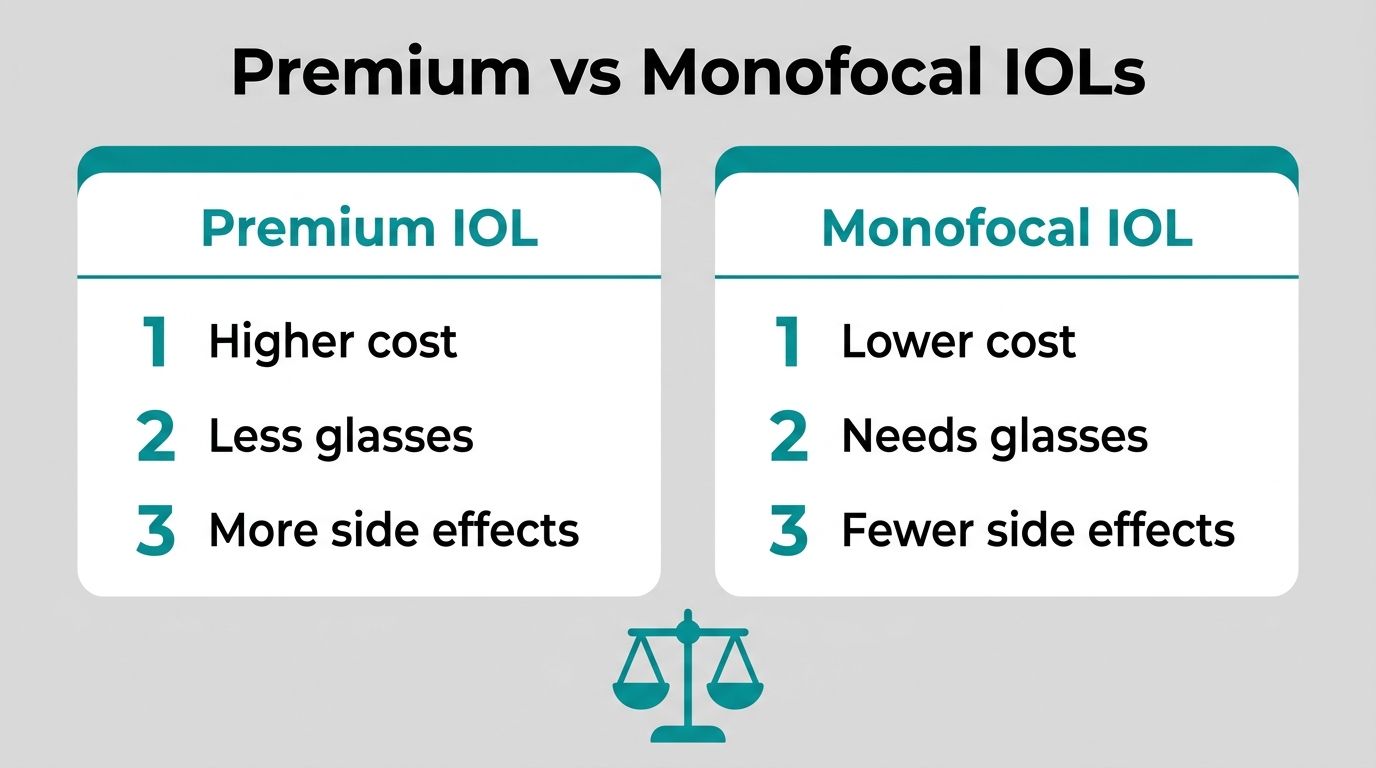
Comparing premium and monofocal IOLs after LASIK involves weighing three key factors: out-of-pocket cost, spectacle independence, and tolerance for visual side effects. Each H3 below addresses one of these decision points directly.
How Do Out-of-Pocket Costs Differ Between Premium and Monofocal IOLs?
Out-of-pocket costs differ significantly between premium and monofocal IOLs, primarily because advanced technology lenses are not fully covered by standard insurance or Medicare. According to Better Vision Guide, refractive IOLs typically range from $1,995 to $2,500 per lens out-of-pocket, meaning bilateral implantation can approach $5,000 before accounting for surgical fees. Monofocal IOLs, by contrast, are largely covered as medically necessary for cataract removal, leaving patients responsible for little beyond standard copays. For post-LASIK patients already facing a higher risk of refractive surprise, the financial stakes of a premium lens that underperforms are meaningfully greater than with a monofocal.
How Does Spectacle Independence Compare Between the Two Options?
Spectacle independence compares differently between premium and monofocal IOLs: premium lenses such as multifocal and extended depth of focus designs are engineered to reduce reliance on glasses across multiple distances, while monofocal IOLs correct vision at one fixed focal point and typically require reading glasses for near tasks. In post-LASIK eyes, however, existing higher-order aberrations can reduce the functional benefit of premium optics, making the promise of spectacle independence less reliable than in non-refractive surgery patients. Monofocal IOLs, though more limited in range, deliver more predictable optical performance in corneas altered by prior laser correction.
How Does Tolerance for Visual Side Effects Factor into the Decision?
Tolerance for visual side effects factors heavily into the IOL decision because post-LASIK corneas already carry an increased aberration burden that can amplify photic phenomena. A Cochrane review cited in Frontiers in Ophthalmology found that multifocal IOLs are 3.5 times more likely to cause halos and glare compared to monofocal IOLs, and this risk compounds in eyes with irregular or flattened corneal profiles from prior LASIK. Patients who are sensitive to nighttime glare or who work in low-light environments may find a monofocal lens more tolerable. Discussing your personal threshold for these trade-offs honestly with your surgeon is one of the most practical steps toward the right IOL choice.
What Should You Discuss with Your Surgeon Before Choosing an IOL?
The questions you bring to your surgical consultation directly shape the quality of your IOL decision. The two most important areas to cover are your complete LASIK history and what visual outcomes are realistically achievable given your corneal profile.
Which Questions About Your LASIK History Should You Bring Up?
The questions about your LASIK history you should bring up include the type of correction performed, the amount of tissue removed, and whether original surgical records are available. Your surgeon needs this data because LASIK modifies only the anterior corneal curvature, which alters the anterior/posterior curvature ratio and invalidates standard keratometric calculations used to estimate IOL power. Without these records, your care team may use no-history formulas such as Barrett True-K, which carry a higher margin of uncertainty. Ask specifically whether your cornea shows significant higher-order aberrations or irregular astigmatism, as these findings may favor a monofocal IOL over a premium design.
How Can You Set Realistic Expectations for Visual Outcomes?
Setting realistic expectations for visual outcomes means understanding that post-LASIK eyes carry a higher risk of refractive surprise than eyes without prior corneal surgery. According to a review published in Clinical Optometry (Dove Press), refractive surprises occur in up to 20 to 30% of post-refractive surgery cataract cases. Ask your surgeon what target refraction is planned, whether a lens enhancement or adjustment is possible if results miss the mark, and how your prior LASIK correction affects the likelihood of spectacle independence. Understanding these variables before surgery allows you to weigh premium IOL costs against the realistic probability of achieving your vision goals.
How Can Eye Surgery Guidance Help You Choose the Right IOL?
Choosing the right IOL after LASIK requires more than a single consultation. The sections below cover how surgeon-reviewed resources address the most common patient questions, and what actionable conclusions the full article supports.
Can Eye Surgery Today’s Cataract Surgery Resources Help Post-LASIK Patients Decide?
Eye Surgery Today’s cataract surgery resources can help post-LASIK patients decide by translating complex clinical evidence into clear, accessible guidance. Patients frequently ask questions such as “What is the best IOL after LASIK?” and “How accurate is cataract surgery after laser eye surgery?” — questions that require more than a generic answer. ESCRS clinical guidelines recommend that specialized formulas must be used for any patient with a history of corneal refractive surgery to account for altered corneal geometry. Eye Surgery Today content can help explain these complexities, covering calculation methods, IOL candidacy criteria, and the diagnostic workup required before surgery.
What Are the Key Takeaways About IOL Choice After LASIK?
The key takeaways about IOL choice after LASIK center on three principles: accurate biometry, realistic expectations, and careful candidacy assessment. Standard IOL formulas are unreliable in post-LASIK eyes; specialized tools such as the Barrett True-K or the ASCRS Post-Refractive IOL Calculator are essential. Premium lenses, while offering spectacle independence, carry a higher risk of dysphotopsia and are not suitable for every corneal profile. Monofocal lenses remain the lower-risk default for patients with significant higher-order aberrations. Discussing your full LASIK history with your surgeon, including whether your correction was myopic or hyperopic, is an important step before committing to any lens. Eye Surgery Today’s resources support that conversation with patient-friendly educational information.