Pre-operative eye scans, measurements, and dilation before cataract surgery are a series of clinical examinations that map ocular anatomy, calculate intraocular lens power, and assess overall eye health prior to the procedure.
This guide covers the specific scans and imaging technologies used, the biometric measurements taken and how they influence lens selection, the pupil dilation process and what surgeons evaluate, preparation steps and medication considerations, potential risks of pre-op testing, and how existing conditions like prior LASIK or high myopia may require adjusted protocols.
Scans such as optical biometry, OCT, corneal topography, B-scan ultrasound, and specular microscopy each target a different structural layer of the eye. Together, they may reveal hidden pathology that standard examination alone can miss, helping surgeons set realistic outcome expectations.
Biometric measurements, including axial length, keratometry, anterior chamber depth, and white-to-white diameter, feed directly into IOL power calculation formulas. The accuracy of these inputs can significantly affect post-operative refraction, making quality checks and repeat protocols a standard part of the workflow.
Pupil dilation with drops like tropicamide or cyclopentolate typically takes 25 to 55 minutes and allows the surgeon to evaluate the lens, posterior capsule, and retina through a structured dilated exam. Effects generally last 4 to 8 hours, requiring arranged transportation home.
Preparation involves removing contact lenses in advance (one week for soft lenses; two or more weeks for rigid gas-permeable), reporting all medications including alpha-blockers, and planning for temporary post-dilation light sensitivity. Patients with prior refractive surgery, dense cataracts, or extreme axial lengths may need specialized formulas or alternative imaging modalities to achieve reliable results.
Why Are Pre-Operative Eye Tests Required Before Cataract Surgery?
Pre-operative eye tests are required before cataract surgery to ensure surgeons have a precise, complete picture of each patient’s ocular health before operating. The H3 sections below cover the clinical rationale, the specific goals of pre-op testing, and the volume context for this standard of care.
Why Is Pre-Operative Testing Clinically Essential?
Pre-operative testing is clinically essential because cataract surgery outcomes depend on accurate measurements taken before the procedure begins. According to the European Society of Cataract and Refractive Surgeons (ESCRS), a series of essential preoperative examinations must be conducted prior to cataract surgery to ensure a comprehensive understanding of the patient’s ocular health and to determine the desired target refraction. Without this data, selecting the correct intraocular lens (IOL) power and anticipating surgical complications becomes guesswork.
What Are the Goals of Pre-Operative Eye Tests?
The goals of pre-operative eye tests are to assess ocular health, calculate the correct IOL power, detect hidden pathology, and identify patient-specific risk factors. These objectives guide every scan and measurement taken during the pre-op appointment, from biometry and corneal mapping to retinal imaging. As Dr. Margaret Wang French of UT Southwestern Medical Center states, “Every successful cataract surgery begins with a successful pre-operative evaluation and extensive planning.”
Is Routine Medical Testing Also Required Before Cataract Surgery?
Routine medical testing before cataract surgery, such as blood work or EKGs, is not clinically required for most patients. A Cochrane Database of Systematic Reviews analysis of 21,531 surgeries found that routine preoperative medical testing did not reduce the risk of adverse events, reporting an odds ratio of 1.00 (95% CI 0.86 to 1.16). Eye-specific pre-operative testing, however, remains essential and is distinct from these general medical evaluations.
What Eye Scans Are Performed Before Cataract Surgery?
The eye scans performed before cataract surgery include optical biometry, optical coherence tomography (OCT), corneal topography, B-scan ultrasound, and specular microscopy. Each scan targets a different aspect of ocular health to guide surgical planning.
What Does Optical Biometry Measure?
Optical biometry measures the structural parameters of the eye needed to calculate the correct intraocular lens (IOL) power. Devices like the Lenstar LS 900 can obtain nine parameters in a single measurement session, including corneal thickness, keratometry, white-to-white distance, anterior chamber depth, and retinal thickness, according to a 2015 study published in PLOS One. This comprehensive data capture makes optical biometry the clinical standard for pre-surgical IOL planning.
What Does Optical Coherence Tomography Reveal?
Optical coherence tomography (OCT) reveals detailed cross-sectional images of the macula and retina. Before cataract surgery, OCT can detect hidden retinal pathology that a standard fundoscopic exam may miss, such as epiretinal membranes or early macular degeneration. Identifying these conditions preoperatively allows surgeons to set realistic visual outcome expectations and adjust the surgical plan accordingly.
What Does Corneal Topography Show?
Corneal topography shows the curvature and surface shape of the cornea in precise detail. According to the European Society of Cataract and Refractive Surgeons (ESCRS), topography is essential for identifying irregular astigmatism and corneal diseases like keratoconus, both of which may necessitate adjustments in IOL selection or surgical approach. For patients receiving toric or premium lenses, this scan is particularly critical.
What Does a B-Scan Ultrasound Detect?
A B-scan ultrasound detects posterior segment abnormalities in eyes where a dense cataract blocks direct fundal visualization. A study published in the Journal of Dr NTR University of Health Sciences found that B-scan ultrasound identified posterior segment abnormalities in 44% of such cases, with degenerative vitreous opacities present in 18% and retinal detachment in 7%. This scan is indispensable when optical clarity is too poor for standard retinal imaging.
What Does Specular Microscopy Assess?
Specular microscopy assesses the health of the corneal endothelium, specifically measuring cell density and polymegathism (variation in cell size). According to research published in PMC by Rizzuto et al. (2025), these measurements are essential for evaluating whether the endothelium can withstand the mechanical stress of phacoemulsification. Patients with low endothelial cell counts may face a higher risk of corneal decompensation after surgery, making this scan a vital part of risk stratification.
What Eye Measurements Are Taken Before Cataract Surgery?
Eye measurements taken before cataract surgery include axial length, keratometry, anterior chamber depth, and white-to-white corneal diameter. Together, these values determine the precise intraocular lens power needed for each patient.
How Is Axial Length Measured?
Axial length is measured using optical biometry devices such as the IOLMaster or Lenstar LS 900, which use low-coherence interferometry to calculate the distance from the corneal surface to the retina. This measurement is among the most critical inputs for IOL power calculation, as inaccuracies in axial length can significantly affect post-operative refractive outcomes.
According to a study published in PLOS One, the IOLMaster and Lenstar LS 900 show similar measurement failure rates of 35% to 38% in cataractous eyes, with posterior subcapsular cataracts being the primary cause of acquisition failure. To ensure data reliability, the IOLMaster protocol requires a minimum of five consecutive readings, each with a signal-to-noise ratio greater than 2.0. For eyes with extreme axial lengths, such as those with high myopia, formulas like Barrett Universal II and machine learning models like Hill-RBF may be used to improve predictive accuracy.
How Is Keratometry Used to Map Corneal Curvature?
Keratometry measures the curvature of the cornea by calculating its refractive power, expressed in diopters. These values feed directly into IOL power formulas, and errors in keratometry contribute to the overall error in IOL power calculation alongside axial length inaccuracies and effective lens position prediction.
How Is Anterior Chamber Depth Measured?
Anterior chamber depth (ACD) is measured as the distance from the corneal endothelium to the front surface of the natural lens. Optical biometry devices capture this parameter as part of a single-session measurement. ACD helps surgeons predict where an implanted IOL will sit inside the eye, which directly influences the effective lens position and, consequently, the accuracy of the IOL power calculation.
How Is White-to-White Corneal Diameter Measured?
White-to-white (WTW) corneal diameter is the horizontal distance across the visible cornea, measured from limbus to limbus. Optical biometry devices like the Lenstar LS 900 capture WTW as one of nine parameters in a single measurement session. This value helps surgeons select appropriately sized IOLs and phakic lens implants, reducing the risk of improper fit or postoperative complications.
How Do Pre-Operative Measurements Help Choose the Right IOL?
Pre-operative measurements help choose the right IOL by providing the precise ocular data surgeons need to calculate the correct lens power and predict postoperative refraction. The subsections below cover IOL power calculation formulas, the role of measurement accuracy, and how individual eye anatomy influences lens selection.
How Is IOL Power Calculated From Measurements?
IOL power is calculated using mathematical formulas that combine axial length, keratometry, and anterior chamber depth to predict where a lens will sit inside the eye and how it will focus light. According to a meta-analysis published in International Ophthalmology (Springer), the Kane formula achieved a significantly lower Mean Absolute Error than Barrett Universal II, SRK/T, and Haigis in highly myopic patients. The formula’s accuracy depends directly on the quality of the biometric inputs — errors in axial length or keratometry compound within the calculation and shift the refractive outcome. For most patients, even a small improvement in formula selection translates to a meaningfully better chance of spectacle independence after surgery.
How Does Measurement Accuracy Affect IOL Selection?
Measurement accuracy affects IOL selection because the total error in IOL power calculation reflects the combined errors of axial length measurement, keratometry, and the formula’s prediction of the effective lens position, as noted in a review published in Acta Ophthalmologica. A miscalculation in any single parameter can shift the final lens power by a full diopter or more, pushing the patient toward unexpected nearsightedness or farsightedness. This risk is especially relevant for premium IOL options, such as toric or multifocal lenses, where precise targeting is essential to achieve the intended outcome.
How Does Eye Anatomy Influence the Choice of IOL Type?
Eye anatomy influences IOL type selection through several measurable characteristics that determine candidacy for specific lens designs:
- Axial length identifies high myopes or hyperopes who may require formula adjustments or specialized lens powers.
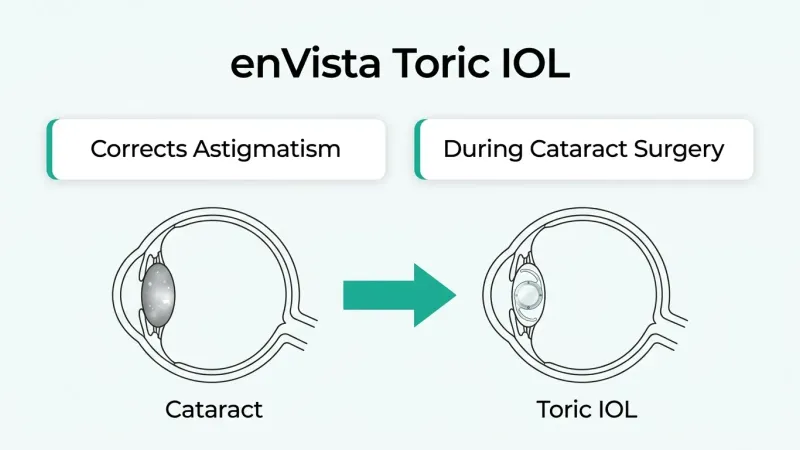
- Corneal astigmatism (from keratometry and topography) determines whether a toric IOL is appropriate to correct irregular focusing.
- Anterior chamber depth guides whether an extended-depth-of-focus or multifocal lens can be positioned correctly to perform as designed.
- Pupil size influences how a patient will respond to multifocal optics, particularly in low-light conditions.
- Macular and retinal status (from OCT) informs whether a premium IOL can deliver the visual quality it promises.
Together, these anatomical inputs allow the surgical team to match each patient’s unique eye to the IOL most likely to meet their vision goals.
What Happens During Pupil Dilation Before Cataract Surgery?
Pupil dilation before cataract surgery allows the surgeon to examine the lens and surrounding structures with a clear, unobstructed view. The following sections cover the drops used, how long dilation takes, what the surgeon evaluates, and how long the effects last.
What Dilating Eye Drops Are Typically Used?
The dilating eye drops typically used before cataract surgery include tropicamide and cyclopentolate, either alone or in combination. Tropicamide 1% achieves its optimal mydriatic effect 25 to 30 minutes after administration, according to StatPearls (NCBI Bookshelf). A combination of 1% cyclopentolate and 1% tropicamide produces a faster onset of 5 to 10 minutes, with maximal dilation reached at approximately 55 minutes. Both agents work by temporarily relaxing the iris muscles, widening the pupil to give the surgeon an unobstructed view of the lens and posterior structures.
How Long Does It Take for Pupils to Fully Dilate?
Pupils fully dilate in roughly 25 to 55 minutes, depending on the drops used. Tropicamide 1% alone reaches peak effect within 25 to 30 minutes, while the cyclopentolate-tropicamide combination takes closer to 55 minutes for maximal effect. Staff typically administer the drops in rounds, spacing them to build the dilation gradually. Patients should expect to wait in a pre-operative area during this process before the surgeon begins the examination.
What Does the Surgeon Evaluate Once Your Eyes Are Dilated?
Once eyes are dilated, the surgeon evaluates structures that are inaccessible without a widened pupil, including the crystalline lens, the posterior capsule, and the retina. According to the American Academy of Ophthalmology, pre-operative documentation must include 12 elements of the dilated eye exam, covering a mental status assessment and a plan for any additional required workup. The surgeon also screens for surgical risk factors such as phacodonesis (lens instability from prior trauma), pupil size, and use of alpha-blockers like tamsulosin, which can complicate intraoperative pupil management.
Patients sometimes report spending only a few minutes with their surgeon before the procedure. While that interaction may feel brief, the dilated exam itself follows a structured clinical protocol that captures the data points needed for safe surgical planning.
How Long Do the Effects of Dilation Last After the Appointment?
The effects of dilation typically last 4 to 8 hours after the appointment, depending on the drops administered. Tropicamide 1% generally reverses within this window, though some individuals may experience blurred near vision or light sensitivity for longer. During this period, driving is unsafe, and bright light can cause significant discomfort. Patients should arrange a ride home and bring sunglasses to the appointment to manage photosensitivity comfortably during recovery.
How Should You Prepare for Your Pre-Operative Eye Exam?
Preparing for your pre-operative eye exam involves three key steps: stopping contact lens wear, reporting all medications, and arranging transportation for after the appointment.
What Should You Stop Wearing Before Your Measurements?
Contact lenses should be removed before your pre-operative measurements because they can temporarily alter corneal shape, producing inaccurate biometry readings. According to clinical guidelines from the Royal College of Ophthalmologists, soft contact lenses should be left out for at least one week, while hard (rigid gas-permeable) lenses require a minimum of two weeks before measurements are taken. Hard lens wearers may occasionally need up to 12 weeks of cessation before corneal measurements stabilize, according to the American Academy of Ophthalmology. Arriving with distorted corneal data risks selecting an incorrectly powered IOL, so this step is non-negotiable.
What Medications Should You Report Before the Exam?
Medications you should report before the exam include alpha-blockers such as tamsulosin (Flomax), blood thinners, and any eye drops you use regularly. Alpha-blockers in particular are associated with a condition called intraoperative floppy iris syndrome, which can complicate cataract surgery. Your surgical team needs a complete medication list to adjust their technique or pre-operative protocol accordingly. Reporting everything, including supplements, gives your care team the full picture they need to plan safely.
Should You Arrange Transportation After Dilation?
Yes, you should arrange transportation after dilation, as dilating drops temporarily blur near vision and increase light sensitivity. Tropicamide 1%, a commonly used dilating agent, typically reverses within 4 to 8 hours according to StatPearls (NCBI Bookshelf), but driving during that window is inadvisable. Plan for a driver or ride service to take you home so the appointment can proceed fully without rushing any part of the dilation process.
What Are the Possible Risks or Side Effects of Pre-Op Testing?
The possible risks or side effects of pre-op testing are generally minor, but patients should be aware of two primary concerns: adverse reactions to dilating drops and the potential impact of measurement errors on surgical planning.
Can Dilating Drops Cause an Adverse Reaction?
Yes, dilating drops can cause an adverse reaction, though serious reactions are uncommon. According to the American Academy of Ophthalmology, while rare, dilating drops can provoke allergic reactions, systemic effects such as increased blood pressure, and acute angle-closure glaucoma attacks. Patients with a history of narrow angles carry a higher baseline risk and should inform their care team before drops are administered. For most patients, side effects are limited to temporary light sensitivity and blurred near vision, which resolve as the drops wear off.
Can Measurement Errors Affect Surgical Outcomes?
Yes, measurement errors can affect surgical outcomes, particularly when inaccuracies occur in axial length or keratometry readings. These parameters are fundamental inputs for intraocular lens power calculation, and errors in either value compound through the formula, shifting the predicted refractive result. According to a review published in Acta Ophthalmologica, the total error in IOL power calculation is often considered the sum of errors in axial length, keratometry, and the formula’s prediction of effective lens position. Modern devices and repeat measurement protocols reduce this risk significantly, making strict quality checks a standard part of the pre-operative workflow.
What Happens If Your Eye Measurements Need to Be Repeated?
Eye measurements may need to be repeated when initial readings are unreliable, inconsistent, or blocked by a dense cataract. The following sub-sections cover why readings fail, what the repeat protocol involves, and how clinicians resolve persistent measurement challenges.
Why Would a Reading Be Flagged as Unreliable?
A reading is flagged as unreliable when the signal quality falls below the device’s minimum threshold for accuracy. For the IOLMaster, this means failing to acquire five consecutive axial length measurements each with a signal-to-noise ratio greater than 2.0, according to a 2015 study published in PLOS One. Dense posterior subcapsular cataracts are the primary cause of acquisition failure, with measurement failure rates ranging from 35% to 38% in cataractous eyes.
Common reasons a reading may be flagged include:
- Dense or mature cataracts blocking the optical path
- Patient movement or poor fixation during the scan
- Significant media opacity reducing signal quality
- Inconsistency between consecutive measurements
What Happens During a Repeat Measurement Session?
During a repeat measurement session, the technician or surgeon reattempts the scan under optimized conditions, such as improved patient positioning or adjusted fixation targets. The Lenstar LS 900 protocol requires at least three reliable measurements to confirm data consistency. If optical biometry continues to fail, the clinical team may switch to a complementary modality, such as B-scan ultrasound, which can still evaluate the posterior segment even when dense opacity prevents optical scanning.
Can Measurements Still Be Inaccurate After Repeating?
Yes, measurements can still carry residual inaccuracy even after repeating, because IOL power calculation error reflects the combined sum of axial length measurement error, keratometry error, and formula-based prediction error for effective lens position. Clinicians address this by cross-referencing multiple device readings, selecting the most appropriate IOL formula for the eye’s specific characteristics, and documenting any remaining uncertainty before finalizing the surgical plan.
How Do Pre-Op Scans Differ for Patients With Existing Conditions?
Pre-op scans differ for patients with existing conditions because standard measurement tools may produce less accurate readings when the eye’s anatomy or optical properties have been altered. The H3 sections below cover adjustments for prior refractive surgery, dense cataracts, and extreme refractive errors.
How Are Measurements Adjusted for Prior LASIK or PRK?
Measurements are adjusted for prior LASIK or PRK eyes by switching from standard IOL power formulas to specialized alternatives designed for altered corneal geometry. Conventional keratometry systematically underestimates the true corneal power in post-refractive eyes, which can lead to a hyperopic surprise after surgery. The Barrett True-K formula has been evaluated for its reliability in estimating corneal power when pre-refractive surgery data is unavailable, making it a preferred tool in this scenario. Providing your surgical team with any pre-LASIK records greatly improves calculation accuracy.
How Are Measurements Adjusted for Dense or Mature Cataracts?
Measurements are adjusted for dense or mature cataracts by substituting optical biometry with ultrasound-based alternatives when the lens opacity blocks light transmission. B-scan ultrasonography becomes the primary tool for visualizing the posterior segment, and according to a study published via ResearchGate, it carries a reported sensitivity of 64.2% and a specificity of 100% for evaluating posterior segment structures in these eyes. While sensitivity is moderate, its perfect specificity means a positive finding is highly reliable, making it a clinically valuable safeguard before surgery.
How Are Measurements Adjusted for High Myopia or Hyperopia?
Measurements are adjusted for high myopia or hyperopia by selecting advanced IOL calculation formulas that perform more accurately at extreme axial lengths. A meta-analysis published in International Ophthalmology (Springer) found that the percentage of eyes reaching within ±0.50 D of the refractive target was significantly higher for the Kane formula compared to SRK/T (P=0.003) and Haigis (P=0.0001) in highly myopic patients. For most patients with extreme refractive error, selecting a modern formula like Kane or Barrett Universal II over legacy alternatives is one of the highest-impact decisions in surgical planning.
How Can Surgeon-Reviewed Education Help You Prepare for Cataract Surgery?
Surgeon-reviewed education can help you prepare for cataract surgery by translating complex clinical processes into clear, actionable knowledge. The H3s below cover how Eye Surgery Today’s guides support pre-op understanding and the key takeaways from this article.
Can Eye Surgery Today’s Expert-Reviewed Guides Help You Understand Your Pre-Op Appointment?
Yes, Eye Surgery Today’s expert-reviewed guides can help you understand your pre-op appointment by explaining what each examination involves and why it matters. According to clinical guidelines from the European Society of Cataract and Refractive Surgeons (ESCRS), a series of essential preoperative examinations must be conducted before cataract surgery to ensure a comprehensive understanding of ocular health and to determine the desired target refraction. Many patients arrive at their pre-op appointment without knowing what to expect, which can heighten anxiety and reduce the quality of shared decision-making with their surgeon. Eye Surgery Today’s surgeon-reviewed content bridges that gap, helping patients ask better questions and feel more confident on the day.
What Are the Key Takeaways About Pre-Operative Eye Scans, Measurements, and Dilation Before Cataract Surgery?
The key takeaways about pre-operative eye scans, measurements, and dilation before cataract surgery are that thorough preparation directly shapes surgical outcomes. As Margaret Wang French, M.D., states: “Every successful cataract surgery begins with a successful pre-operative evaluation and extensive planning.” Several clinically important points are worth remembering:
- Macular OCT screening detects pathology in 13.7% of eyes that appear normal on standard examination alone, according to a study published in Eye (Nature).
- Post-dilation evaluation identifies risk factors such as phacodonesis, pupil size, and use of alpha-blockers like tamsulosin (Flomax).
- Hard contact lens wearers may need up to twelve weeks of cessation before corneal measurements stabilize, according to the American Academy of Ophthalmology.
- Common patient fears, including fear of vision loss, can be significantly reduced through clear, reliable pre-operative education.
Eye Surgery Today’s surgeon-reviewed guides distill this clinical complexity so patients can approach their pre-op appointment prepared, informed, and confident.