Visual range after cataract surgery is the span of distances at which a patient can see clearly once an intraocular lens (IOL) replaces the eye’s clouded natural lens. Functional vision zones include near (33–40 cm), intermediate (60–80 cm), and distance (6 meters or beyond), and the IOL type implanted is the primary factor determining which zones receive the sharpest focus.
This guide covers how visual range is defined and measured, how different IOL types shape what you can see, what patients may realistically expect at each distance zone, the factors and risks that can influence outcomes, and how to match your lens choice to your lifestyle.
Ophthalmologists assess post-surgical vision using standardized tools such as ETDRS charts and defocus curves, while optical biometry helps ensure precise IOL power calculations before the procedure. These measurements give surgeons a complete profile of how each visual zone is performing after implantation.
Monofocal, multifocal, extended depth of focus (EDOF), and toric IOLs each deliver different visual coverage. Monofocal lenses optimize a single distance, trifocal designs may provide strong performance across all three zones, and EDOF lenses offer a continuous range from distance through intermediate with a smoother optical profile.
Pre-existing astigmatism, coexisting conditions such as macular degeneration, and IOL power calculation accuracy can all narrow the functional range a lens is designed to deliver. Posterior capsule opacification and residual refractive error are among the most common post-surgical developments that may reduce clarity over time.
Choosing the right visual range target involves weighing daily habits, occupational demands, and tolerance for optical trade-offs like nighttime glare against the goal of reduced spectacle dependence.
What Does Visual Range Mean in Cataract Surgery?
Visual range in cataract surgery refers to the span of distances at which a patient can see clearly after their natural lens is replaced with an intraocular lens (IOL). The following sections explain the three functional vision zones and how ophthalmologists measure them after surgery.
What Is the Difference Between Near, Intermediate, and Distance Vision?
The difference between near, intermediate, and distance vision lies in the working distance each zone covers. According to the American Academy of Ophthalmology, near vision operates at approximately 33–40 cm (reading a smartphone or book), intermediate vision at 60–80 cm (a computer screen or car dashboard), and distance vision at 6 meters (20 feet) or beyond (driving, reading street signs).
Not all IOLs cover every zone equally. A study published in Nature Scientific Reports found that trifocal IOLs such as the FineVision PodFT provide superior binocular near acuity at 33 cm compared to EDOF IOLs such as the Tecnis Symfony, which showed significantly worse near vision (p=0.002). A Cochrane Library systematic review of 815 citations also noted that multifocal IOLs improve uncorrected near vision, but patients should be counseled on trade-offs including reduced contrast sensitivity and increased night vision disturbances.
Understanding which zone matters most to your daily life is, in practice, the most important starting point for any IOL conversation with your surgeon.
How Do Ophthalmologists Measure Visual Range After Surgery?
Ophthalmologists measure visual range after surgery using standardized visual acuity charts, biometry tools, and defocus curve testing. The Early Treatment Diabetic Retinopathy Study (ETDRS) chart is the gold standard for clinical acuity measurement, offering greater precision than the Snellen chart, particularly between the 20/100 and 20/200 lines where the Snellen lacks sufficient data points, according to The Ophthalmologist.
The World Health Organization classifies best-corrected visual acuity (BCVA) outcomes as “good” when at least 90% of eyes achieve 6/12 (20/40) or better post-surgery. For IOL power calculation, optical biometry using swept-source optical coherence tomography (SS-OCT) may provide higher precision than ultrasound, as it measures optical axial length along the visual axis to the center of the macula.
These measurement tools together give surgeons a complete picture of how well each visual zone is performing after lens implantation.
How Do Intraocular Lenses Determine Your Visual Range?
Intraocular lenses determine your visual range by replacing the eye’s clouded natural lens with an artificial lens engineered to focus light at one or more specific distances. The type of IOL implanted is the single most influential factor in what you will and will not see clearly after cataract surgery. The H3 sections below cover four primary IOL types: monofocal, multifocal, extended depth of focus, and toric.
What Visual Range Does a Monofocal IOL Provide?
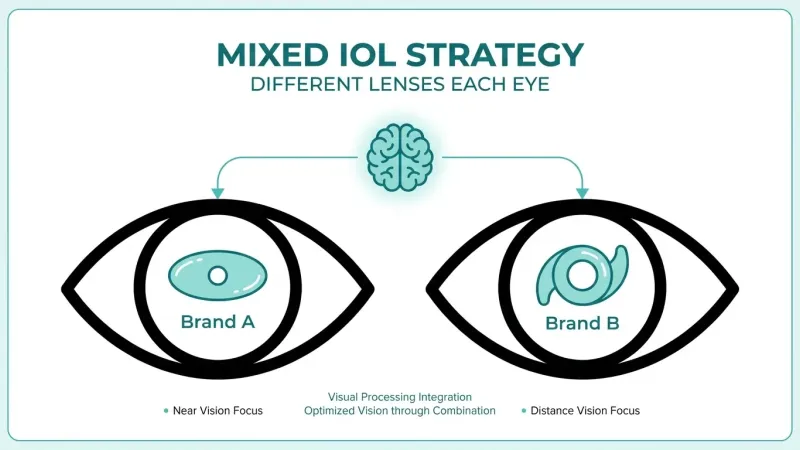
A monofocal IOL provides clear vision at one fixed focal distance, most commonly set to distance. Because the lens has a single focus point, patients typically see well for tasks such as driving and recognizing faces but will generally require reading glasses for near tasks like viewing a phone or a book. Some patients opt for monovision, where each eye is targeted at a different distance, to extend functional range without switching lenses.
What Visual Range Does a Multifocal IOL Provide?
A multifocal IOL provides vision across near, intermediate, and distance ranges simultaneously by using concentric optical zones that split incoming light between focal points. According to a study published in ScienceDirect, patients with multifocal IOLs reported significantly higher overall satisfaction (4.3 out of 5) compared to those with monofocal IOLs (3.5 out of 5, P < 0.05). However, patients should be aware that the trade-off for this broader range can include reduced contrast sensitivity and increased perception of glare or halos at night.
What Visual Range Does an Extended Depth of Focus IOL Provide?
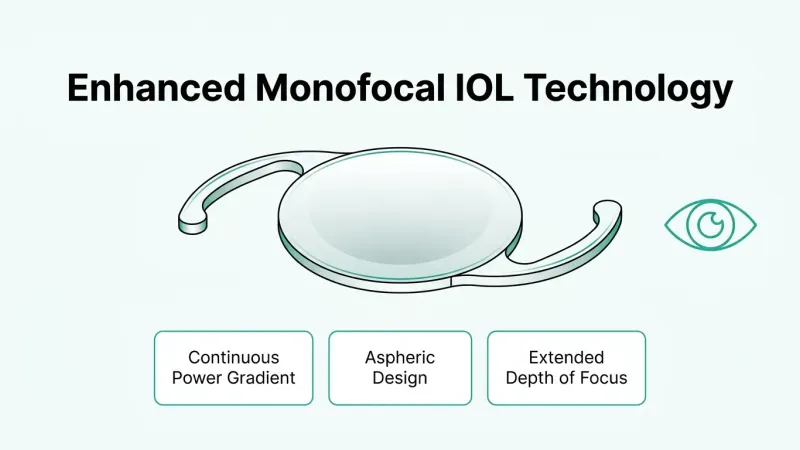
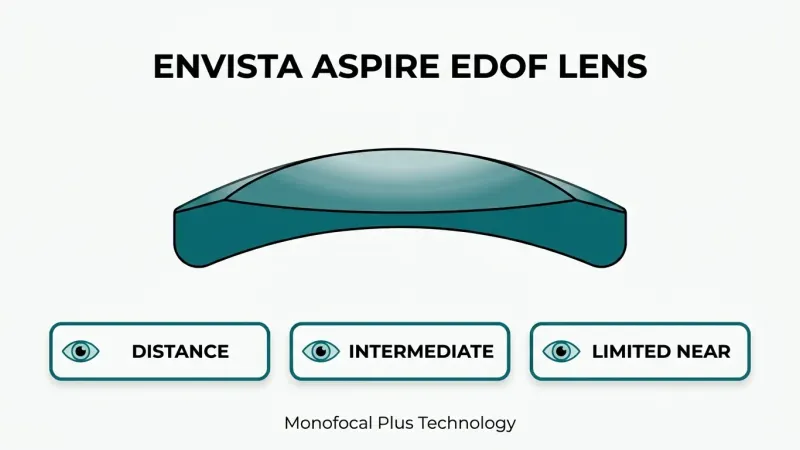
An extended depth of focus (EDOF) IOL provides a continuous range of vision from distance through intermediate by elongating the eye’s focal point rather than splitting it into distinct zones. This design minimizes the abrupt transitions between focal points seen in multifocal lenses. According to research published on ResearchGate, the defocus curve is the gold-standard method for assessing visual performance across a continuous range of distances, and EDOF lenses demonstrate a characteristically gradual defocus profile. Near vision performance is typically weaker than that of trifocal designs.
What Visual Range Does a Toric IOL Provide?
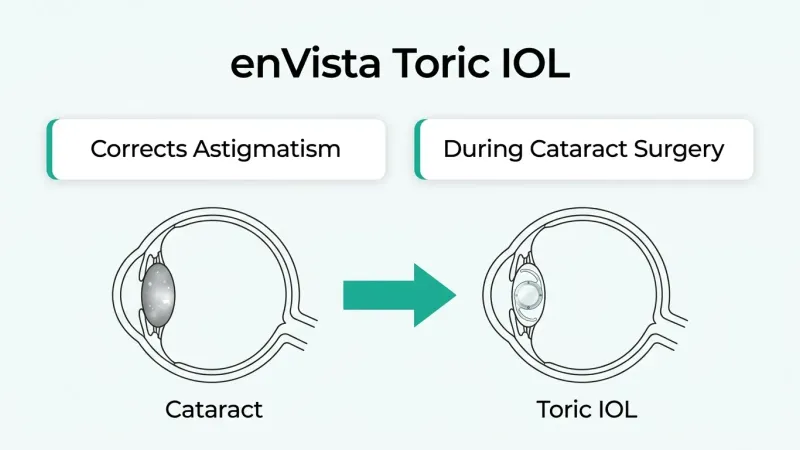
A toric IOL provides corrected distance vision for patients with pre-existing corneal astigmatism, which a standard monofocal IOL cannot address. Toric lenses incorporate an additional corrective power axis that compensates for the irregular corneal curvature causing astigmatism. Toric EDOF variants extend this correction into the intermediate range as well. The visual range a toric IOL delivers is otherwise determined by its focal design, whether monofocal or EDOF, making lens selection a layered decision for patients with astigmatism.
What Visual Range Can You Expect for Distance Vision After Cataract Surgery?
Distance vision after cataract surgery covers everything at 6 meters (20 feet) or beyond, including road signs, faces across a room, and television screens. The sections below explain how clearly you may see at those distances and whether glasses for driving are typically still needed.
How Clearly Can You See Road Signs and Faces at a Distance?
Distance vision clarity after cataract surgery depends heavily on the IOL selected and the precision of the refractive target set before the procedure. Most patients with a monofocal IOL optimized for distance may achieve functional clarity for tasks like reading road signs and recognizing faces without correction.
Clinical data shows that cataract surgery improves real-world performance in tasks such as driving and face recognition, which are often poorly correlated with standard distance visual acuity measurements alone, according to research published in Ophthalmic and Physiological Optics. The defocus curve, considered the gold standard for assessing visual performance across a continuous range of post-surgical distances, helps surgeons predict and verify these outcomes.
That said, clarity is not guaranteed to be uniform across all patients. Conditions such as age-related macular degeneration (AMD) may limit how well distance vision recovers, even after a technically successful procedure.
Will You Still Need Glasses for Driving After Surgery?
Whether you will still need glasses for driving after surgery depends on your IOL type and the refractive target your surgeon planned for you. As Dr. David F. Chang, a clinical professor at the University of California, San Francisco, notes in JAMA (2025): “The goal of modern cataract surgery has shifted from simply restoring vision to achieving a specific refractive target, making IOL selection a lifestyle-based decision.”
Patients who select a monofocal IOL targeted for distance may achieve sufficient unaided clarity for driving in many conditions. Those with multifocal or EDOF IOLs may also achieve strong distance performance while gaining range at intermediate and near distances. However, residual refractive error, night glare, and underlying ocular conditions can all influence whether glasses remain advisable behind the wheel. Discussing your driving habits with your surgeon before surgery is the most reliable way to align your IOL choice with that specific visual goal.
What Visual Range Can You Expect for Intermediate Vision After Cataract Surgery?
Intermediate vision after cataract surgery covers the 60–80 cm range, according to the American Academy of Ophthalmology. This section explains what patients can realistically expect for computer screens, dashboards, and kitchen tasks.
How Well Can You See a Computer Screen After Surgery?
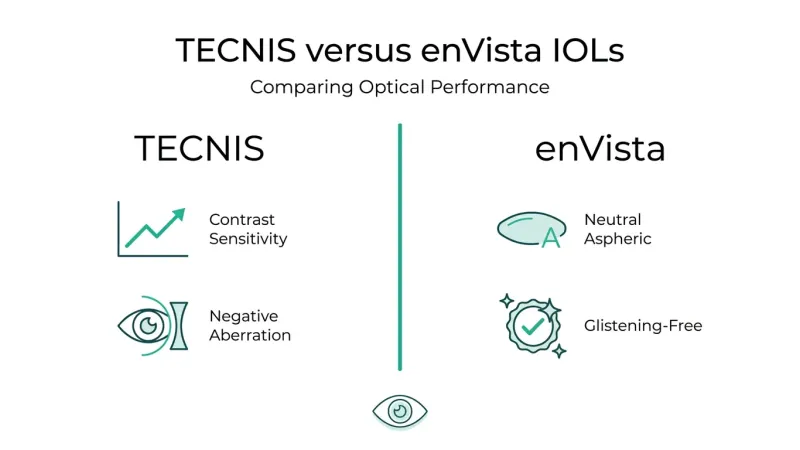
Computer screen visibility after surgery depends largely on the type of IOL implanted. Multifocal and EDOF lenses are specifically designed to target the 60–80 cm intermediate zone where most screens sit. Patients with EDOF IOLs, such as the Tecnis Symfony, typically report comfortable, clear computer vision without glasses in well-lit conditions.
Monofocal IOLs targeted for distance may leave intermediate vision noticeably soft, often requiring reading or computer glasses for screen work. According to a study published in ScienceDirect, patients with multifocal IOLs reported significantly higher overall satisfaction (4.3 ± 0.6) compared to those with monofocal IOLs (3.5 ± 0.7) on a 5-point scale (P < 0.05), reflecting real-world performance across functional distances including intermediate tasks.
For screen-dependent patients, IOL selection is arguably the most consequential pre-surgical decision.
Can You Read a Dashboard or Cook Without Glasses?
Yes, many patients can read a dashboard or cook without glasses after surgery, particularly with premium IOL options. Dashboard displays typically fall within the 60–80 cm intermediate range, and cooking tasks vary between intermediate and near distances.
Clinical data from Ophthalmic and Physiological Optics shows that cataract surgery improves performance in real-world tasks such as driving, face recognition, and fine motor skills like cooking, though these improvements are often poorly correlated with standard distance visual acuity measurements alone. EDOF and trifocal IOLs generally deliver the most consistent intermediate coverage for these daily activities.
With a monofocal lens, spectacles may still be needed for dashboard reading or detailed kitchen work.
What Visual Range Can You Expect for Near Vision After Cataract Surgery?
Near vision after cataract surgery refers to your ability to see clearly at approximately 33–40 cm, covering tasks such as reading books, viewing smartphone screens, and examining fine print. The subsections below explain how well most patients can read without glasses and why some still rely on reading glasses after surgery.
How Well Can You Read a Book or Phone After Surgery?
How well you can read a book or phone after surgery depends largely on the type of intraocular lens implanted. Trifocal IOLs, such as the FineVision PodFT, provide superior binocular near vision at 33 cm compared to EDOF IOLs like the Tecnis Symfony, which perform significantly worse at that distance according to a study published in Nature Scientific Reports (p=0.002). Patients receiving multifocal IOLs also report meaningfully higher overall satisfaction (4.3 out of 5) compared to monofocal IOL recipients (3.5 out of 5), per data published in ScienceDirect.
For patients prioritizing near reading ability, trifocal and full-range IOL options are generally the strongest performers, though your surgeon’s IOL power calculation accuracy plays a critical role in achieving the intended near focus.
Why Do Many Patients Still Need Reading Glasses?
Many patients still need reading glasses after cataract surgery because monofocal IOLs, the most commonly implanted lens type, are set to a single focal point, typically distance, leaving near vision uncorrected. Even with presbyopia-correcting multifocal IOLs, a Cochrane systematic review and meta-analysis of 815 citations found that while uncorrected near vision improves, patients should be counseled on trade-offs including reduced contrast sensitivity and increased night vision disturbances. These optical compromises sometimes lead surgeons to recommend spectacles for sustained near tasks.
Reading glasses remain a practical and common outcome, particularly for patients who choose monofocal lenses or have residual refractive error after surgery.
What Factors May Affect Your Visual Range Outcomes?
Several factors may affect your visual range outcomes after cataract surgery, including pre-existing astigmatism, coexisting eye conditions, and IOL power calculation accuracy. The following sections cover how each of these influences what you can realistically expect to see after surgery.
How Does Pre-Existing Astigmatism Affect Visual Range?
Pre-existing astigmatism affects visual range by causing blurred or distorted vision at multiple distances if left uncorrected during cataract surgery. When the cornea is irregularly curved, standard IOLs cannot compensate for this refractive error, which limits the clarity achieved across near, intermediate, and distance zones.
According to a study published in the MDPI Journal of Personalized Medicine, toric EDOF IOLs such as the Miniwell Toric demonstrate high rotational stability and successful visual outcomes for patients with pre-existing astigmatism seeking extended range of vision. Addressing astigmatism at the time of IOL implantation is one of the most direct ways to maximize the visual range a premium lens is designed to deliver.
How Do Other Eye Conditions Like Macular Degeneration Limit Results?
Other eye conditions like macular degeneration may limit results by restricting the retina’s ability to process the clearer image that a new IOL provides. Even with an optically ideal lens in place, the underlying retinal damage from conditions such as age-related macular degeneration (AMD) can reduce functional visual acuity after surgery.
According to a review published by Herald Open Access, cataract surgery is considered safe in approximately 95% of AMD cases and can meaningfully improve vision and quality of life despite the underlying retinal condition. Your surgeon will evaluate retinal health before recommending a lens type, as premium multifocal or EDOF IOLs may underperform when significant macular disease is present.
How Does IOL Power Calculation Accuracy Influence Outcomes?
IOL power calculation accuracy influences outcomes by determining how closely your postoperative refraction matches your intended visual target. An error in biometric measurement or formula selection can result in a “refractive surprise,” leaving you more dependent on glasses than anticipated even after uncomplicated surgery.
Optical biometry using swept-source optical coherence tomography (SS-OCT) provides higher precision for IOL power calculation than ultrasound, measuring the optical axial length along the visual axis to the center of the macula. In clinical practice, this level of precision is especially important for patients choosing premium IOLs, where even small deviations from the refractive target can meaningfully narrow the functional visual range the lens was selected to provide.
What Are the Possible Risks That Could Limit Visual Range?
Several risks may limit visual range after cataract surgery, including posterior capsule opacification and residual refractive error. The sections below explain how each condition develops and what it may mean for your vision outcomes.
What Is Posterior Capsule Opacification and How May It Blur Vision?
Posterior capsule opacification (PCO) is a condition in which the thin membrane behind the intraocular lens gradually becomes cloudy, reducing visual clarity after cataract surgery. According to data published in Nature Eye, PCO incidence rates for single-piece monofocal IOLs range from 4.7% to 18.6% at three years and 7.1% to 22.6% at five years post-surgery. PCO can cause symptoms similar to the original cataract, such as blurred vision, glare, and reduced contrast, progressively narrowing a patient’s functional visual range. When vision-reducing PCO develops, Nd:YAG laser capsulotomy is the standard corrective procedure and is generally safe and effective. For patients at higher risk, such as those with uveitis, the progression can be faster and more severe.
Can Residual Refractive Error Reduce Your Expected Range?
Residual refractive error can reduce your expected visual range by leaving your eye undercorrected or overcorrected relative to the intended target refraction. According to real-world data from the Swedish National Cataract Register, only approximately 72% of eyes achieve a result within ±0.50 D of the refractive target, while 93% fall within ±1.0 D. That remaining gap matters because even a modest deviation can shift your clearest focal point away from the distance your IOL was designed to optimize. Patients who experience a significant refractive surprise may require glasses, contact lenses, or secondary procedures to recover their expected range. Precise preoperative biometry remains the most effective way to reduce this risk.
Who Is a Good Candidate for Full-Range Vision After Cataract Surgery?
A good candidate for full-range vision after cataract surgery is someone with healthy eyes, realistic expectations, and a lifestyle that benefits from seeing clearly at multiple distances without glasses. Candidacy depends on several ocular, medical, and lifestyle factors that your surgeon will evaluate preoperatively.
Candidates most likely to achieve full-range vision typically share these characteristics:
- Minimal ocular comorbidities: Conditions such as advanced macular degeneration, severe glaucoma, or significant corneal disease may limit how well any premium IOL performs, making full-range outcomes less predictable.
- No significant pre-existing astigmatism (or astigmatism that can be corrected with a toric lens), since uncorrected astigmatism degrades image quality at all distances.
- Active lifestyle demands: Patients who regularly use computers, drive frequently, and read without wanting to switch between glasses are strong candidates for multifocal or EDOF IOLs designed for continuous vision.
- Realistic expectations about night vision: Premium IOLs associated with full-range vision can cause halos or glare in low-light conditions, which disqualifies some patients who drive extensively at night or work in dim environments.
- Stable systemic health: Conditions such as poorly controlled diabetes may increase postoperative risks and affect long-term visual outcomes, requiring careful preoperative evaluation.
According to GoodRx’s review of premium cataract lenses, not every patient is a suitable candidate for premium IOLs, and candidacy should be determined through a thorough consultation that weighs ocular anatomy, corneal health, and personal visual priorities.
How Do You Choose the Right Visual Range Target for Your Lifestyle?
Choosing the right visual range target means matching your IOL selection to your daily visual demands, occupational needs, and tolerance for optical trade-offs. The following H3 sections cover three common lifestyle profiles: driving and outdoor activities, reading and close work, and spectacle independence.
What Should You Consider If You Prioritize Driving and Outdoor Activities?
Patients who prioritize driving and outdoor activities should consider IOLs optimized for sharp, high-contrast distance vision. According to NICE guidelines, access to cataract surgery should not be restricted based on visual acuity thresholds alone, as the impact on activities of daily living such as driving is a critical factor for referral. A monofocal IOL targeted for distance is often the most reliable choice for this profile, delivering consistently clear far vision with minimal optical aberrations. Patients who frequently drive at night should be particularly cautious about multifocal IOLs, which can introduce glare and halos that may impair nighttime driving comfort.
What Should You Consider If You Prioritize Reading and Close Work?
Patients who prioritize reading and close work should focus on IOLs with strong near-vision correction, such as trifocal lenses or multifocal IOLs with a near-dominant design. Near vision tasks such as reading print, using a smartphone, and sewing demand consistent acuity at approximately 33 to 40 cm. The trade-off is reduced distance sharpness compared to a distance-targeted monofocal, so patients should discuss realistic expectations with their surgical team before committing to a near-priority target.
What Should You Consider If You Want Minimal Dependence on Glasses?
Patients who want minimal dependence on glasses should pursue presbyopia-correcting IOLs, such as trifocal or EDOF designs. ESCRS recommendations emphasize that the choice of presbyopia-correcting IOLs should be personalized based on the patient’s desire for spectacle independence, occupational visual needs, and the presence of ocular comorbidities such as glaucoma. Comorbidities like dry eye disease or mild macular changes can reduce the quality benefit of premium IOLs, making thorough preoperative evaluation essential. In practice, spectacle independence is best achieved when realistic expectations are established before surgery, as most patients with advanced premium IOLs still benefit from occasional low-power reading glasses in low-light conditions.
How Can Surgeon-Reviewed Guidance Help You Understand Your Visual Range Options?
Surgeon-reviewed guidance helps you understand your visual range options by translating complex clinical evidence into clear, patient-friendly decisions. The H3 sections below cover Eye Surgery Today’s expert resources and the key takeaways from this article.
Can Eye Surgery Today’s Expert Resources Help You Choose the Right IOL?
Yes, Eye Surgery Today’s expert resources can help you choose the right IOL by providing surgeon-reviewed educational content designed specifically for patients navigating these decisions. Eye Surgery Today offers guides, articles, and surgeon profiles that break down how monofocal, multifocal, EDOF, and toric IOLs each serve different visual lifestyles. With an estimated 53 million Americans living with cataracts, accessible and trustworthy information matters. Eye Surgery Today’s mission is to bridge that knowledge gap, giving every patient the clarity needed to have an informed conversation with their surgeon.
What Are the Key Takeaways About Visual Ranges After Cataract Surgery?
The key takeaways about visual ranges after cataract surgery are that outcomes depend on IOL type, lifestyle priorities, and individual risk factors. The most actionable conclusions from this article are:
- IOL choice determines your range. Monofocal lenses optimize one distance, while trifocal and EDOF lenses extend coverage across near, intermediate, and far vision.
- Complications can arise. According to a PubMed Central study, approximately 28% of patients develop posterior capsule opacification within one year of surgery, with 10% requiring Nd:YAG laser treatment.
- Systemic health affects outcomes. A 2020 study published in JAMA Network Open found that patients with diabetes face a 1.3-fold increased risk of diabetic retinopathy progression following cataract surgery, making preoperative evaluation essential.
- Rare surgical risks exist. Intraoperative floppy iris syndrome affects approximately 1.0% of cataract patients, primarily those using alpha-1 blockers.
- Preparation improves results. Understanding your visual goals before surgery, whether distance clarity, computer use, or reading independence, allows your surgeon to match the right IOL to your lifestyle.
Surgeon-reviewed resources like Eye Surgery Today exist to make this decision-making process less overwhelming for every patient.