A refractive surprise is an unexpected postoperative refractive outcome that deviates meaningfully from the targeted refraction after eye surgery, encompassing residual myopia, hyperopia, astigmatism, or anisometropia.
This guide covers the causes and risk factors behind refractive surprise, how it is diagnosed, the symptoms patients may experience, the correction options available, and the surgical strategies that can help reduce its likelihood.
Refractive surprise after cataract surgery can stem from inaccurate biometry measurements, IOL power calculation errors, prior corneal refractive surgery, lens positioning shifts, and corneal irregularities. Effective lens position estimation alone may account for roughly 35% of the total refractive prediction error in an average eye.
Patients with prior LASIK or PRK, extreme axial lengths, keratoconus, or operative complications may face a meaningfully higher chance of a refractive miss. Registry-level data suggest that roughly 27% of eyes fall outside ±0.50 D of their refractive target after cataract surgery.
Persistent blurred vision, difficulty focusing at specific distances, glare, halos, and interocular imbalance are among the symptoms that may signal a refractive surprise. A structured diagnostic workup, including manifest refraction, corneal topography, and ray tracing aberrometry, can help distinguish optical error from underlying pathology.
Correction pathways range from updated glasses or contact lenses for mild residual error to PRK or LASIK enhancement, IOL exchange, and piggyback lens implantation for larger misses. Newer technologies such as the Light Adjustable Lens may allow non-invasive postoperative refinement, potentially reducing the need for secondary procedures.
Advances in optical biometry, modern IOL formulas, and intraoperative aberrometry continue to improve refractive predictability. We created this guide to help patients understand what a refractive surprise involves and how to navigate it with informed confidence.
What Does Refractive Surprise Mean After Eye Surgery?
A refractive surprise is an unexpected postoperative refractive outcome that deviates meaningfully from the targeted refraction after eye surgery, encompassing residual myopia, hyperopia, astigmatism, or anisometropia. According to the American Academy of Ophthalmology, a “surprise to everyone” outcome affects approximately 0.5% of the refractive patient population. In practical terms, patients may notice that their vision after surgery is noticeably blurrier, more over-corrected, or more under-corrected than their surgeon planned for. Common patient-facing terms for this outcome include “residual refractive error,” “IOL miscalculation,” and “postoperative refractive error.” While some degree of refractive deviation is expected in any surgical outcome, a meaningful miss, one that affects daily visual function, is what clinicians and patients alike call a true refractive surprise. Understanding this distinction early helps patients ask the right questions and seek timely evaluation rather than assuming poor vision is a normal part of recovery.
What Causes a Refractive Surprise After Cataract Surgery?
Refractive surprises after cataract surgery can stem from several distinct sources, including biometry errors, IOL power calculation failures, prior refractive surgery, lens positioning problems, and corneal irregularities. Each of the following sub-sections examines one of these causes in detail.
How Do Inaccurate Biometry Measurements Lead to Refractive Surprise?
Inaccurate biometry measurements lead to refractive surprise by producing an incorrect axial length input, which directly determines the IOL power selected for implantation. According to a cohort study published in the Journal of Cataract & Refractive Surgery (N Manoharan et al.), refractive surprise occurred in 29.9% of phacoemulsification cases when the spherical equivalent deviated by more than ±0.5 D. Applanation ultrasound measurements can read axial length 0.1–0.3 mm shorter than immersion techniques, compounding this error. Optical biometry using partial coherence interferometry offers resolution of approximately 12 μm and precision below 10 μm, making it the more reliable standard. Additionally, patients who experience operative complications are 5.6 times more likely to develop a refractive surprise. Measurement accuracy is the single most modifiable variable in preventing this outcome.
How Can IOL Power Calculation Errors Cause a Refractive Surprise?
IOL power calculation errors cause a refractive surprise by selecting a lens that produces residual myopia, hyperopia, astigmatism, or anisometropia instead of the targeted refraction. Even when biometry measurements are precise, applying the wrong formula for an eye’s anatomical profile introduces systematic prediction error. Patients with premium multifocal IOLs are especially vulnerable; according to Review of Ophthalmology (Robert J. Weinstock, MD), even mild residual astigmatism often requires refinement because these lenses carry high sensitivity to visual inconsistencies. Investigating a calculation error requires manifest refraction, visual acuity testing, Placido disc topography, and ray tracing aberrometry to separate optical miscalculation from underlying pathology.
How Does Previous LASIK or Refractive Surgery Increase the Risk?
Previous LASIK or refractive surgery increases the risk of refractive surprise because corneal ablation permanently alters curvature and stromal tissue, making standard keratometry readings unreliable for IOL power selection. According to Review of Ophthalmology (Neda Shamie, MD), the highest-risk group for a refractive miss includes patients with a history of LASIK, PRK, or radial keratotomy, as well as those with high myopia or hyperopia, keratoconus, or dry eye disease. These altered corneas produce curvature data that most conventional IOL formulas were not designed to interpret accurately, shifting the prediction error upward in magnitude.
How Can Lens Positioning Affect the Refractive Outcome?
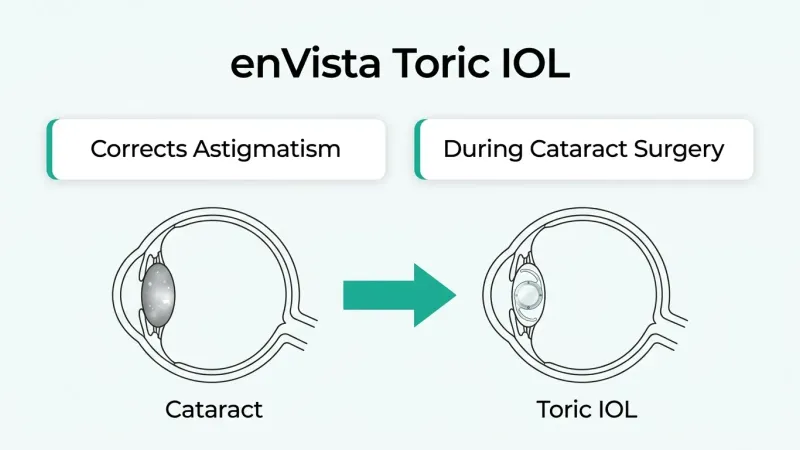
Lens positioning affects the refractive outcome because the IOL’s physical location inside the eye determines the effective lens position (ELP), which governs how the implant focuses light onto the retina. According to a study published in the Journal of Clinical Medicine (via PMC), ELP estimation accounts for approximately 35% of the total refractive prediction error budget in an eye of average adult dimensions, making it the single largest contributor to prediction inaccuracy. A separate analysis in the Journal of Cataract & Refractive Surgery (X Chen et al.) found that 10% of patients experience IOL tilt greater than 5° and decentration greater than 0.5 mm postoperatively, both of which can induce clinically significant astigmatism and coma aberrations. ESCRS guidelines recommend toric IOLs for corneal astigmatism of ≥1.0 D to improve refractive predictability from the outset.
How Do Corneal Irregularities Contribute to Refractive Surprise?
Corneal irregularities contribute to refractive surprise by distorting the light-focusing surface that IOL power calculations depend on, producing unpredictable postoperative refractions even when the lens power itself is correctly calculated. According to Johns Hopkins Medicine (Isa Mohammed, MD), more than 20% of refractive surprises after cataract surgery are attributed to corneal irregularity, underscoring the need for targeted counseling in this patient population. Conditions such as keratoconus, post-ablation ectasia, and irregular astigmatism create non-uniform curvature that standard keratometry cannot fully characterize, meaning the surgical plan begins with flawed input data. This makes pre-operative corneal mapping with topography or tomography essential for identifying at-risk eyes before cataract surgery proceeds.
Who Is Most at Risk for a Refractive Surprise?
The patients most at risk for a refractive surprise share specific anatomical, surgical, or ocular characteristics that make accurate IOL power calculation significantly harder. The following H3 sections outline the highest-risk groups in clinical practice.
Does Prior Corneal Refractive Surgery Increase Risk?
Yes, prior corneal refractive surgery substantially increases the risk of a refractive surprise. Patients with previous LASIK, PRK, or radial keratotomy (RK) represent the highest-risk group for a refractive miss, according to a review in Review of Ophthalmology by Dr. Neda Shamie. These procedures permanently alter corneal curvature, making standard IOL power formulas unreliable. For RK patients specifically, Dr. Lisa Arbisser notes that refraction may not stabilize for one to three months postoperatively, further complicating outcome assessment.
Does High Myopia or Hyperopia Increase Risk?
High myopia and high hyperopia both increase the risk of a refractive surprise. According to Dr. Kevin M. Miller, writing in Review of Ophthalmology, surgeons should anticipate refractive surprises “when an eye is extremely myopic or extremely hyperopic, so in very large or very small eyes.” Axial length extremes make effective lens position estimation less predictable, directly undermining formula accuracy. In practice, high-myopia cases are among the most technically demanding biometry challenges a cataract surgeon faces.
Do Corneal Irregularities and Keratoconus Increase Risk?
Corneal irregularities and keratoconus increase refractive surprise risk by distorting the measurements that IOL power calculations depend on. More than 20% of refractive surprises after cataract surgery are attributed to corneal irregularity, according to Johns Hopkins Medicine’s Dr. Isa Mohammed, underscoring the need for targeted counseling in this population. Conditions such as keratoconus, dry eye disease, and irregular astigmatism all compromise corneal topography data, making standard biometry assumptions invalid. Patients with these conditions benefit most from surgeon transparency about outcome limitations before surgery.
Do Operative Complications Increase Risk?
Operative complications significantly increase the risk of a refractive surprise. Patients who experience surgical complications are 5.6 times more likely to have a refractive surprise compared to those with uncomplicated procedures, according to a study published in Investigative Ophthalmology & Visual Science by T. Bryant et al. Complications such as posterior capsule rupture or zonular instability can shift the IOL’s final position, altering the effective lens position and the resulting refraction unpredictably.
With these risk profiles in mind, understanding how common a refractive surprise actually is helps set realistic expectations for both patients and their care teams.
How Common Is a Refractive Surprise After Cataract Surgery?
Refractive surprise after cataract surgery is more common than many patients expect, with rates varying significantly depending on how the outcome is defined. The sections below cover population-level outcomes, how surgical complications affect risk, and the specific challenge posed by corneal irregularities.
How Often Do Patients Miss Their Refractive Target After Cataract Surgery?
Patients miss their refractive target after cataract surgery at rates that depend heavily on the margin of error used. According to an analysis of 282,811 cataract cases in the EUREQUO registry published in Clinical Optometry, 72.7% of eyes achieved a postoperative spherical equivalent within ±0.50 D, meaning roughly 27% fell outside this threshold. A separate cohort study published in the Journal of Cataract & Refractive Surgery (Manoharan et al.) found that refractive surprise occurred in 29.9% of cases when defined as a deviation greater than ±0.50 D, and in 4.9% of cases when defined as greater than ±1.00 D.
These numbers suggest that meaningful refractive misses are not rare events. For patients choosing premium IOLs, even a small miss can significantly affect satisfaction.
How Do Surgical Complications Affect the Rate of Refractive Surprise?
Surgical complications increase the rate of refractive surprise substantially. According to research published in Investigative Ophthalmology & Visual Science (Bryant et al.), patients who experience operative complications are 5.6 times more likely to have a refractive surprise compared to those with uncomplicated surgeries.
This elevated risk reflects how complications, such as capsular tears or incomplete cortex removal, can disrupt IOL positioning and destabilize the final refractive outcome. Surgeons and patients alike should weigh this when evaluating candidacy and setting postoperative expectations.
How Does Corneal Irregularity Contribute to Refractive Surprise Rates?
Corneal irregularity contributes to refractive surprise rates at a clinically significant level. According to Johns Hopkins Medicine (Dr. Isa Mohammed), more than 20% of refractive surprises after cataract surgery are attributed to corneal irregularity, making it one of the most common identifiable causes.
Irregular corneal surfaces distort both preoperative measurements and the predictive accuracy of IOL formulas, compounding the likelihood of a postoperative miss. Patients with keratoconus, prior corneal surgery, or significant surface disease represent the highest-risk subset within this group and warrant dedicated counseling before surgery.
What Are the Symptoms of a Refractive Surprise?
The symptoms of a refractive surprise are visual disturbances that persist beyond the normal healing window following eye surgery, most commonly blurred vision, difficulty focusing at specific distances, and sensitivity to glare or halos. The sections below cover the key symptom patterns patients should recognise.
Blurred or Hazy Vision After Surgery
Blurred or hazy vision after surgery is the most frequently reported symptom of a refractive surprise, occurring when residual myopia, hyperopia, or astigmatism shifts focus away from the intended target. Patients may notice that objects at near, intermediate, or distance ranges remain consistently unclear despite initial recovery progressing normally.
This symptom pattern differs from the temporary blurring expected in the first days after cataract surgery. When blurring persists or worsens after two to four weeks, it warrants formal assessment of postoperative refraction. In clinical practice, persistent uncorrected blur is often the clearest early signal that a refractive miss has occurred.
Difficulty Reading or Seeing at Distance
Difficulty reading or seeing at distance is a directional symptom that can help identify the type of refractive error involved. Residual myopia tends to impair distance vision while preserving near clarity; residual hyperopia typically does the opposite.
Patients with premium multifocal IOLs may find this symptom especially disruptive. According to Review of Ophthalmology, patients with multifocal lenses who have even mild residual astigmatism often require refinement because multifocal optics are highly sensitive to small refractive inconsistencies.
Glare, Halos, and Starbursts Around Lights
Glare, halos, and starbursts around lights are optical symptoms that can indicate astigmatic or higher-order aberration error following IOL implantation. These phenomena are particularly noticeable in low-light conditions such as night driving.
While some degree of glare is expected during early recovery, symptoms that intensify or fail to resolve may reflect lens tilt, decentration, or residual corneal astigmatism rather than normal adaptation.
Double Vision or Ghost Images
Double vision or ghost images are symptoms associated with significant astigmatic refractive error or IOL misalignment following cataract surgery. A single eye perceiving two overlapping images, known as monocular diplopia, is a recognised presentation of uncorrected cylinder or higher-order aberrations induced by lens tilt.
If double vision affects one eye when the other is covered, it is more likely optical in origin and warrants refractive investigation rather than neurological evaluation.
Anisometropia and Imbalance Between Eyes
Anisometropia is a condition where a meaningful difference in refractive error exists between the two eyes, and it represents a distinct symptom category of refractive surprise. Patients may report difficulty merging the images from each eye, eye strain, headache, or nausea, particularly during tasks requiring binocular coordination.
This symptom is especially common when only one eye has undergone surgery, and the treated eye lands at a refraction that does not complement the untreated eye’s prescription. Addressing the interocular balance is as clinically important as achieving absolute emmetropia in the surgical eye.
How Is a Refractive Surprise Diagnosed?
A refractive surprise is diagnosed through a structured series of clinical tests that distinguish optical errors from underlying pathology. The workup typically covers refraction assessment, corneal mapping, and aberrometry.
What Tests Are Used to Diagnose a Refractive Surprise?
The tests used to diagnose a refractive surprise are manifest refraction, visual acuity measurement, Placido disc topography, and ray tracing aberrometry. According to Ophthalmology Management, this four-step assessment is the recommended first-line approach for investigating any postoperative refractive miss. Manifest refraction quantifies the residual spherical or cylindrical error, while topography reveals corneal irregularities that may be driving the unexpected outcome. Ray tracing aberrometry adds a higher-order analysis, helping clinicians determine whether the error originates from the cornea, the IOL, or both. This layered approach is important because not every refractive surprise shares the same root cause, and applying the wrong corrective strategy without this distinction risks compounding the error.
When Should Diagnosis Begin After Surgery?
Diagnosis of a refractive surprise should begin once the refraction has stabilized, which varies by the type of surgery performed. For most cataract patients, refraction typically settles within four to six weeks postoperatively. However, for patients who have had Radial Keratotomy (RK), Dr. Lisa Arbisser notes that refraction may not be stable for one to three months after surgery, making premature assessment unreliable. Waiting for stability before initiating a diagnostic workup prevents overcorrection decisions based on transient refractive shifts.
How Can a Refractive Surprise Be Corrected?
A refractive surprise can be corrected through several approaches, depending on the size and type of the refractive error. The options covered below include glasses or contact lenses, laser enhancement, IOL exchange, piggyback lens implantation, and light adjustable lens technology.
Can Glasses or Contact Lenses Correct a Refractive Surprise?
Yes, glasses or contact lenses can correct a refractive surprise in many cases. For patients with mild residual refractive error, updated spectacles or contact lenses are the simplest, lowest-risk first step. They carry no surgical risk and can be prescribed as soon as refraction stabilizes, typically within weeks of surgery. However, for patients who chose premium IOLs expecting spectacle independence, relying on glasses afterward may feel like an unsatisfying outcome, making further intervention worth discussing with their surgeon.
Can LASIK or PRK Enhancement Fix a Refractive Surprise?
Yes, LASIK or PRK enhancement can fix a refractive surprise when the residual error is small. According to a Review of Ophthalmology report by Dr. Kevin M. Miller, for small amounts of spherical or spherocylindrical error, PRK or LASIK enhancements are preferred, with PRK often favored in older patients due to fewer dry-eye complications. PRK is generally the more conservative choice in pseudophakic eyes since there is no natural lens flap concern, and the corneal surface tends to heal predictably in this population.
Can an IOL Exchange Procedure Correct a Refractive Surprise?
Yes, an IOL exchange procedure can correct a refractive surprise, particularly when the error is large. According to Dr. Audrey Talley Rostov in Review of Ophthalmology, if a refractive miss is greater than one diopter, an IOL exchange is generally preferred; if it is less than one diopter, laser vision correction such as LASIK or PRK is typically recommended. IOL exchange is a more complex surgical intervention than laser enhancement, so the decision must weigh the magnitude of the error against the patient’s overall ocular health and surgical risk tolerance.
Can a Piggyback Lens Implant Correct a Refractive Surprise?
Yes, a piggyback lens implant can correct a refractive surprise as an alternative to full IOL exchange. In a retrospective study of 15 eyes published in the Journal of Ophthalmology, secondary piggyback IOL implantation achieved a postoperative spherical equivalent ranging from 0.00 to -0.50 D of attempted emmetropia. This approach places a supplementary IOL in the sulcus alongside the existing implant, avoiding the risks of removing an adherent primary lens while still meaningfully correcting residual error.
Can Light Adjustable Lens Technology Help Avoid Correction?
Yes, Light Adjustable Lens (LAL) technology can help avoid the need for correction after cataract surgery. In a clinical trial published in the Journal of Cataract and Refractive Surgery, 67% of eyes were within ±0.25 D and 87% of eyes were within ±0.50 D of the refractive target using the LAL. By allowing non-invasive postoperative refinement through ultraviolet light treatments, the LAL shifts refractive adjustment from the operating room to the clinic, which may substantially reduce the need for secondary surgical correction.
What Are the Possible Risks of Correcting a Refractive Surprise?
The possible risks of correcting a refractive surprise vary depending on the correction method chosen, such as laser enhancement, IOL exchange, or piggyback lens implantation. Each approach carries a distinct risk profile that patients and surgeons must weigh carefully before proceeding.
What Are the Risks of LASIK or PRK Enhancement After Cataract Surgery?
The risks of LASIK or PRK enhancement after cataract surgery include residual refractive error, dry eye exacerbation, corneal haze, and undercorrection or overcorrection of the original refractive surprise. PRK is often favored in older patients because it may carry fewer dry-eye complications than LASIK, according to Dr. Kevin M. Miller writing in the Review of Ophthalmology. However, both procedures carry a small risk of inducing new higher-order aberrations in an eye that has already undergone significant structural change. For patients with pre-existing corneal irregularities, the risk of an unsatisfactory enhancement outcome is meaningfully higher.
What Are the Risks of an IOL Exchange Procedure?
The risks of an IOL exchange procedure include posterior capsule rupture, zonular damage, vitreous loss, corneal endothelial cell loss, and inflammation. Because the capsular bag has contracted around the original implant, removing it is technically more demanding than the primary cataract surgery, and surgical complexity increases the risk of intraoperative complications. IOL exchange is generally reserved for refractive misses greater than one diopter, where the magnitude of the error justifies the added surgical risk over a less invasive alternative like laser enhancement.
What Are the Risks of Piggyback IOL Implantation?
The risks of piggyback IOL implantation include interlenticular opacification, pigment dispersion, elevated intraocular pressure, and inter-lens membrane formation between the two implants. These complications can develop months to years after the secondary implant is placed, meaning patients require long-term follow-up. While a retrospective study published in the Journal of Ophthalmology found that secondary piggyback IOL implantation achieved postoperative spherical equivalents ranging from 0.00 to -0.50 D of attempted emmetropia in 15 eyes, this precision must be balanced against the unique risk profile that a second intraocular implant introduces.
Is There a Risk of Making the Refractive Error Worse During Correction?
Yes, there is a risk of making the refractive error worse during correction, particularly when the underlying cause of the original surprise has not been fully identified. If residual corneal irregularity, lens tilt, or epithelial basement membrane disease is present and unaddressed before an enhancement procedure, the corrective intervention may produce an outcome that is less predictable than the original surgery. Thorough diagnostic workup, including manifest refraction, corneal topography, and aberrometry, is essential before committing to any corrective strategy to minimize this possibility.
How Can Surgeons Reduce the Risk of Refractive Surprise?
Surgeons can reduce the risk of refractive surprise by combining advanced preoperative planning with intraoperative verification technologies. The most impactful tool available today is intraoperative aberrometry.
How Does Intraoperative Aberrometry Help Reduce Refractive Surprise?
Intraoperative aberrometry helps reduce refractive surprise by giving surgeons real-time refractive data while the patient is still on the operating table. Using a system such as ORA (Optiwave Refractive Analysis), surgeons can confirm or revise the selected IOL power before it is permanently implanted, according to Cataract & Refractive Surgery Today Europe. This live feedback loop closes the gap between preoperative calculations and actual surgical conditions, accounting for variables that biometry alone cannot predict. For complex cases, such as post-LASIK eyes or highly myopic patients, this capability is particularly valuable. Intraoperative aberrometry represents one of the most meaningful advances in reducing refractive unpredictability, and surgeons managing high-risk cases should consider it a standard part of the workflow rather than an optional upgrade.
What Should You Ask Your Surgeon About Refractive Surprise?
The questions you should ask your surgeon about refractive surprise focus on your personal risk profile, the measurement tools your surgical team uses, and the correction options available if your outcome misses the target. Understanding these areas before surgery helps you set realistic expectations and prepares you to respond confidently if a refractive miss occurs.
According to Dr. Kevin M. Miller, writing in Review of Ophthalmology, surgeons should anticipate refractive surprises in eyes that are extremely myopic or hyperopic, meaning very large or very small eyes. If you fall into either category, ask your surgeon directly how your eye’s dimensions affect IOL power selection and what contingency plan exists if the result deviates from the refractive target.
Consider asking your surgeon these questions before cataract surgery:
- What biometry technology will you use to measure my eye, and how accurate is it for my specific eye shape?
- Do I have any risk factors, such as prior LASIK, keratoconus, or high myopia, that increase my chance of a refractive surprise?
- Which IOL power formula will you use, and is it validated for eyes with my axial length?
- What is your personal rate of refractive outcomes within ±0.50 D of target?
- If my result misses the target, what correction options, such as laser enhancement or a piggyback lens, would you recommend for my case?
- How long should I wait before my refraction is considered stable enough to plan a correction?
Asking these questions positions you as an informed participant in your surgical outcome rather than a passive recipient of it.
How Can Eye Surgery Today Help You Understand Refractive Surprise?
Eye Surgery Today is a surgeon-reviewed education platform designed to give patients clear, evidence-based guidance on cataract surgery outcomes, including refractive surprise. The sections below cover what surgeon-reviewed resources offer and the key takeaways from this topic.
Can Surgeon-Reviewed Guides Help You Prepare for Cataract Surgery Outcomes?
Yes, surgeon-reviewed guides can help you prepare for cataract surgery outcomes by translating clinical data into practical expectations. Large-scale registry data, such as analysis from the European Registry of Quality Outcomes for Cataract and Refractive Surgery (EUREQUO), shows that most patients achieve outcomes within an acceptable refractive range, though a meaningful minority experience deviation from their target refraction. Understanding these benchmarks before surgery helps patients set realistic expectations and recognize when a follow-up conversation with their surgeon is warranted. Eye Surgery Today synthesizes exactly this type of evidence into accessible, jargon-free guides so patients can approach surgery with confidence rather than uncertainty.
What Are the Key Takeaways About Refractive Surprise?
The key takeaways about refractive surprise are that it is a known, manageable risk of cataract surgery with multiple correction pathways available. Patients in high-risk categories, such as those with prior corneal refractive surgery or extreme axial lengths, benefit most from early, detailed pre-surgical counseling. Correction options range from glasses and laser enhancement to IOL exchange, with the appropriate choice depending on the degree of refractive miss. Advances in biometry, IOL formulas, and intraoperative aberrometry have steadily improved predictability. Understanding these factors before surgery is the most effective way to navigate outcomes confidently.