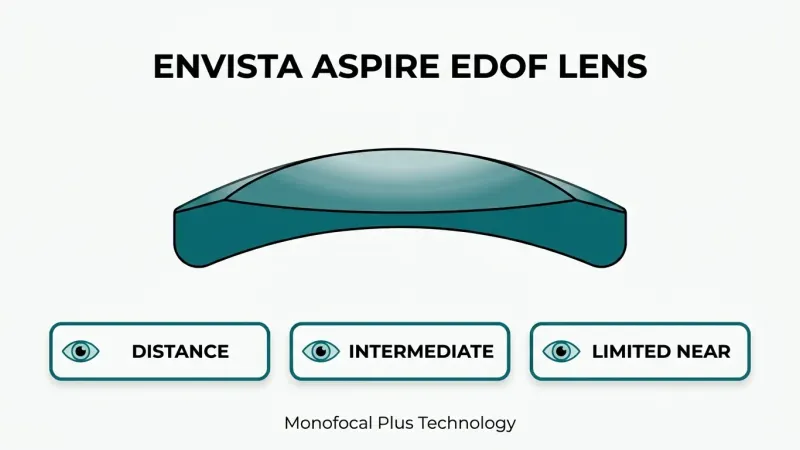
Monofocal, multifocal, and toric intraocular lenses (IOLs) are artificial lenses implanted during cataract surgery, each designed to correct vision differently based on focal range and corneal shape. The right lens depends on the patient’s visual goals, eye health, and tolerance for optical trade-offs.
This guide covers how each lens type works, comparative visual outcomes across key measures, cost and insurance considerations, patient candidacy factors, and possible complications with premium IOLs.
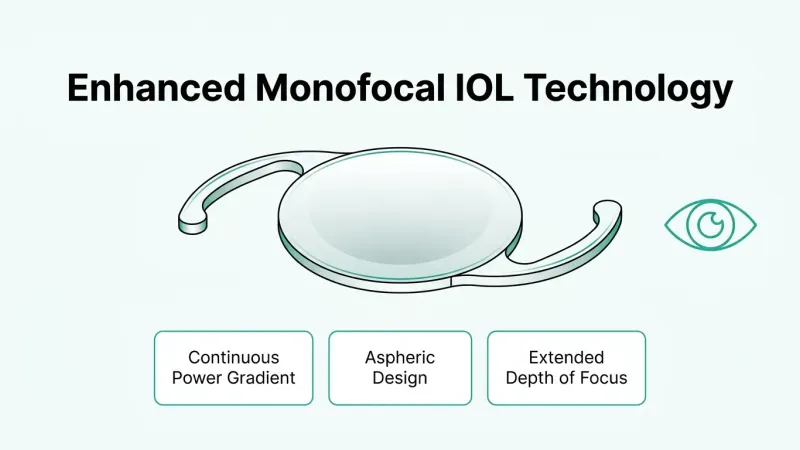
Monofocal lenses focus light at a single distance, delivering sharp, high-contrast vision with minimal halos or glare. They remain the most widely implanted IOL category but typically require glasses for near tasks. Enhanced monofocal designs may offer modest improvements in near acuity while preserving distance quality.
Multifocal lenses split light across multiple focal zones to provide functional vision at near, intermediate, and far distances. They can achieve higher rates of spectacle independence than monofocal lenses, though patients may experience dysphotopsia and reduced contrast sensitivity during a neuroadaptation period that can last several months.
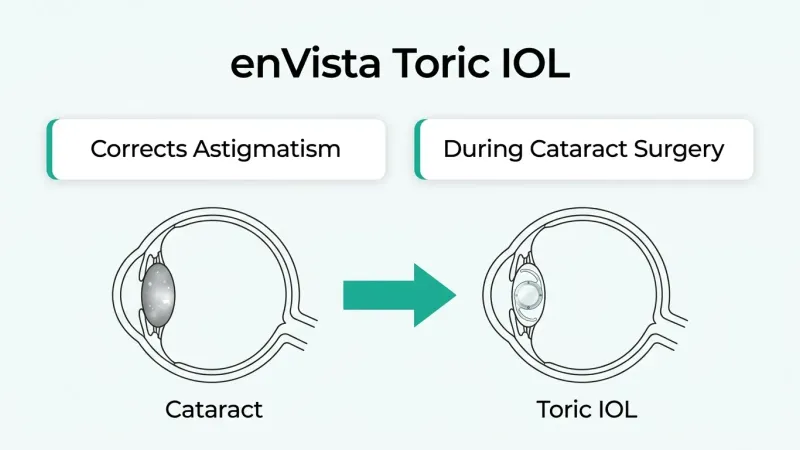
Toric lenses correct corneal astigmatism through precisely oriented optical powers built into the implant. Alignment accuracy is critical; even small degrees of postoperative rotation may reduce corrective effectiveness. These lenses suit patients whose astigmatism would otherwise require glasses after surgery.
Cost varies considerably by lens category. Standard monofocal lenses are generally covered by insurance, while premium multifocal and toric IOLs carry additional out-of-pocket expenses. Candidacy also differs: patients with certain ocular comorbidities may not be suitable for multifocal designs, making preoperative evaluation and open surgeon communication essential steps in the decision process.
What Is an Intraocular Lens Used in Cataract Surgery?
An intraocular lens (IOL) is an artificial lens surgically implanted in the eye to replace the natural lens after it is removed during cataract surgery. IOLs restore visual acuity impaired by cataracts and, in some designs, correct corneal astigmatism as well. The sections below cover how IOLs have evolved, which types are available today, and what the current market looks like.
Modern IOL technology has advanced considerably. According to research published in the Medical Journal, Armed Forces India, IOLs have evolved from conventional cataract extraction to micro-incision surgery performed through incisions as small as 1.4 to 1.8 mm. Most recently, Johnson & Johnson announced FDA approval of the TECNIS PureSee Intraocular Lens in March 2026, described as a breakthrough solution offering improved visual range for U.S. cataract patients.
That rapid innovation reflects significant demand. The global IOL market was valued at USD 5.14 billion in 2025, according to Fortune Business Insights, and is projected to grow substantially through 2033, driven by an aging global population and expanding access to surgical care.
From a clinical standpoint, the lens type selected during cataract surgery shapes every aspect of a patient’s visual outcome, making IOL choice one of the most consequential decisions in the entire process.
What Is a Monofocal Lens?
A monofocal lens is an intraocular lens (IOL) set to correct vision at a single fixed focal distance, typically far, intermediate, or near. The following sections cover how monofocal lenses work, their key benefits, and their known limitations.
How Does a Monofocal Lens Correct Vision at One Distance?
A monofocal lens corrects vision at one distance by focusing all incoming light onto a single focal point, rather than splitting it across near, intermediate, and far ranges. Surgeons set this focal point during preoperative planning, most commonly targeting distance vision, with patients using glasses for close-up tasks afterward.
According to a study published in Scientific Reports, monofocal IOLs remain the most frequently implanted lenses due to their relatively low cost, excellent single-focus vision outcomes, and low incidence of photic phenomena such as halos and glare. For patients who prioritize sharp, high-contrast distance vision over spectacle independence, the monofocal IOL is often the most dependable clinical choice.
What Are the Potential Benefits of Choosing a Monofocal Lens?
The potential benefits of choosing a monofocal lens include:
- Predictable, high-quality vision at the targeted focal distance, typically far range.
- Low incidence of visual disturbances, such as halos, glare, and starbursts, compared to multifocal designs.
- Lower cost relative to premium multifocal or toric IOLs, making them accessible to a broader range of patients.
- Broader candidacy, as monofocal lenses are generally suitable even for patients with certain ocular comorbidities that may disqualify them from premium lenses.
What Are the Possible Limitations of a Monofocal Lens?
The possible limitations of a monofocal lens center on its inability to provide clear vision across multiple distances without spectacle correction. Because the lens is fixed at one focal point, patients targeting distance vision typically still require reading glasses for near tasks such as reading or smartphone use.
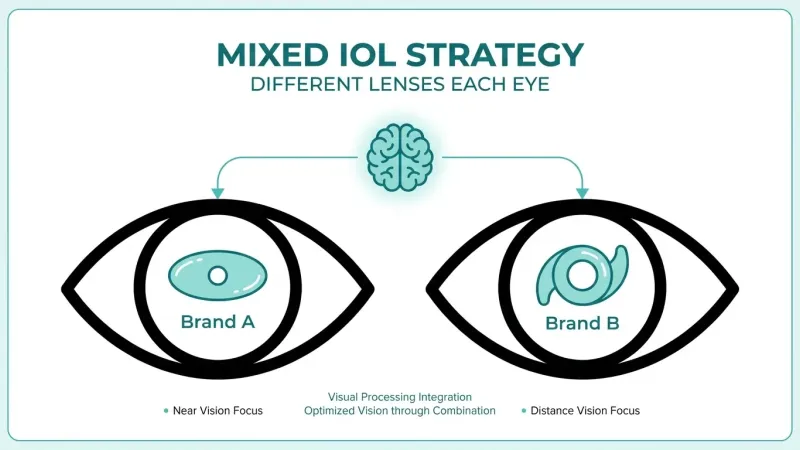
Enhanced monofocal options, such as the TECNIS Eyhance, may offer modest improvements in near visual acuity while maintaining distance quality. However, for patients who want meaningful freedom from glasses at all distances, a standard monofocal IOL is unlikely to meet that expectation without a deliberate monovision strategy discussed with their surgeon.
What Is a Multifocal Lens?
A multifocal lens is an intraocular lens designed to split incoming light across multiple focal points, enabling vision at near, intermediate, and far distances within a single implant. The sections below explain how multifocal lenses work, their potential benefits, and possible side effects.
How Does a Multifocal Lens Provide Vision at Multiple Distances?
A multifocal lens provides vision at multiple distances by using a series of concentric optical zones, each engineered to bend light toward a different focal point. Depending on the lens design, these zones may be refractive, diffractive, or a combination of both, directing light simultaneously to near and distance targets. The brain then selects the clearest image for the task at hand. According to the American Academy of Ophthalmology, multifocal and extended depth-of-focus (EDOF) IOLs offer good distance and near visual acuity and reduce spectacle dependence. This optical approach works well for most patients, but the simultaneous presence of multiple focal points is also the source of the trade-offs discussed below.
What Are the Potential Benefits of Choosing a Multifocal Lens?
The potential benefits of choosing a multifocal lens center on achieving functional vision across a broad range of distances without relying on glasses. Key advantages include:
- Reduced spectacle dependence for near, intermediate, and distance tasks after surgery.
- Functional near vision for activities such as reading, phone use, and cooking.
- Functional distance vision for driving and outdoor activity without corrective lenses.
- Reduced need for reading glasses, which is the most frequent reason patients select a premium IOL over a standard monofocal implant.
For patients who strongly value independence from glasses in daily life, a multifocal IOL is often one of the most practical premium lens options available.
What Are the Possible Side Effects of a Multifocal Lens?
The possible side effects of a multifocal lens are primarily related to how the lens distributes light. Because light is split across focal zones, some visual quality is sacrificed in the process. Common side effects include:
- Halos and glare, particularly around lights at night, such as headlights or streetlamps.
- Reduced contrast sensitivity, making images appear less sharp in low-light or high-glare environments.
- Dysphotopsia, a general term for unwanted light phenomena including starbursts and arcs.
- Neuroadaptation period, during which the brain adjusts to processing multiple focal points simultaneously.
According to a study published in the European Journal of Ophthalmology, multifocal lenses achieved higher rates of spectacle independence than monofocal lenses but had a higher reported frequency of dysphotopsia and worse contrast sensitivity, especially in low light or glare. These side effects often diminish over several months as neuroadaptation progresses, but patients with high visual demands should discuss this trade-off carefully with their surgeon before choosing a multifocal implant.
What Is a Toric Lens?
A toric lens is a type of intraocular lens (IOL) specifically designed to correct astigmatism during cataract surgery. The following H3s cover how toric lenses correct astigmatism, their potential benefits, and their possible limitations.
How Does a Toric Lens Correct Astigmatism?
A toric lens corrects astigmatism by using two different optical powers built into the lens at perpendicular meridians, compensating for the uneven curvature of the cornea or natural lens that causes blurred vision. The lens is positioned at a precise rotational axis during surgery to align its corrective power with the eye’s irregular curvature.
Accurate alignment is critical to achieving good outcomes. According to a study published in Frontiers in Medicine (Lausanne), a misalignment of approximately 1° can reduce astigmatic correction by approximately 3.3%, while a misalignment of 30° may fail to correct astigmatism entirely or even introduce it on a new axis. This precision requirement makes toric IOL implantation more technically demanding than standard lens placement.
What Are the Potential Benefits of Choosing a Toric Lens?
The potential benefits of choosing a toric lens include improved distance vision clarity without glasses for patients who have significant corneal astigmatism, a condition that standard monofocal or multifocal IOLs cannot adequately address on their own. For patients whose astigmatism would otherwise require corrective lenses after surgery, a toric IOL may reduce or eliminate that dependence. Toric lenses also maintain the stable, high-contrast visual quality associated with single-focus designs, making them well suited for patients who prioritize sharp, clear distance vision over a broader range of focal points.
What Are the Possible Limitations of a Toric Lens?
The possible limitations of a toric lens include rotational instability, residual astigmatism, and a narrower focal range compared to multifocal designs. Because the lens must remain precisely aligned to its intended axis, any postoperative rotation can reduce corrective effectiveness. Capsular phimosis due to fibrosis is a recognized cause of toric IOL rotation after otherwise uncomplicated surgery.
Additional limitations include:
- Toric IOLs correct distance vision at a single focal point, meaning reading glasses are still typically needed.
- They do not address irregular astigmatism, which has an unpredictable corneal surface pattern.
- Patients with certain corneal conditions may not achieve the alignment accuracy needed for optimal outcomes.
For patients with significant astigmatism, the toric lens is often the most clinically appropriate choice, but realistic expectations about residual spectacle dependence for near tasks remain important.
How Does Visual Outcome Compare Between Monofocal, Multifocal, and Toric Lenses?
Visual outcomes vary meaningfully across lens types, with each offering distinct trade-offs in clarity, range, and light quality. The sections below compare distance vision, near and intermediate vision, night vision, and spectacle independence.
How Does Distance Vision Compare Across Lens Types?
Distance vision compares across lens types with monofocal IOLs delivering the sharpest, most consistent clarity at a single fixed focal point, typically set for distance. Multifocal and extended depth-of-focus (EDOF) IOLs can also achieve good distance visual acuity, though contrast sensitivity may be slightly reduced compared to monofocal lenses, according to the American Academy of Ophthalmology. Toric IOLs correct underlying corneal astigmatism simultaneously, which can sharpen distance clarity in ways that neither standard monofocal nor multifocal lenses address on their own.
For patients prioritizing crisp, unaided distance vision with the fewest optical compromises, monofocal lenses remain a reliable benchmark.
How Does Near and Intermediate Vision Compare Across Lens Types?
Near and intermediate vision compares across lens types with multifocal IOLs offering the broadest functional range. The AcrySof IQ PanOptix Trifocal IOL, for example, is FDA-approved specifically to improve both intermediate and near visual acuity by mitigating the effects of presbyopia. Standard monofocal lenses do not provide this range, leaving patients dependent on reading glasses for close tasks. Toric IOLs address astigmatism but do not inherently extend depth of focus, so near vision outcomes depend on whether a toric multifocal design is selected.
Patients who ask “Does my lifestyle rely on near vision?” should prioritize this comparison when consulting their surgeon.
How Does Night Vision and Glare Compare Across Lens Types?
Night vision and glare compare across lens types with monofocal IOLs performing more favorably on patient-reported measures. According to a study published on PubMed (NCBI), monofocal IOLs were associated with better patient-reported scores for glare compared with multifocal IOLs, though overall satisfaction remained high in both groups. Multifocal lens designs split incoming light across focal points, which can increase the perception of halos and starbursts around lights at night. Toric lenses, sharing the same single-focus optical design as standard monofocals, carry a similarly low risk of photic disturbance.
How Does Spectacle Independence Compare Across Lens Types?
Spectacle independence compares across lens types with multifocal IOLs achieving the highest rates overall. A study published in the European Journal of Ophthalmology found that multifocal lenses achieved higher rates of spectacle independence than monofocal lenses, but with higher reported frequency of dysphotopsia and worse contrast sensitivity, particularly in low light. Accommodative lenses were not associated with reduced contrast sensitivity or increased dysphotopsia, though they offered only modest improvements in spectacle independence relative to monofocal lenses. Toric IOLs can reduce the need for distance glasses in patients with significant astigmatism, but most still require reading glasses.
Choosing a lens ultimately involves weighing how much freedom from glasses matters against tolerance for potential visual disturbances.
How Does Cost Differ Between Monofocal, Multifocal, and Toric Lenses?
Cost differs between monofocal, multifocal, and toric lenses primarily based on lens complexity and whether the procedure qualifies as standard or premium. The sections below cover typical costs for each lens type and what insurance may cover.
How Much Does a Monofocal Lens Typically Cost?
A monofocal lens typically costs the least of the three main IOL categories, making it the most accessible option for most patients. Standard cataract surgery with a monofocal lens is generally covered by Medicare or private insurance, with patients responsible for copays and deductibles. According to All About Vision, in 2026 standard cataract surgery with Medicare averages $343 at a non-hospital facility, with total per-eye costs typically ranging between $1,928 and $2,944 depending on facility type. The monofocal lens itself is included within that standard coverage, leaving patients with little to no separate lens expense.
How Much Does a Multifocal Lens Typically Cost?
A multifocal lens typically costs significantly more out of pocket than a monofocal lens because it is classified as a premium IOL. Insurers and Medicare cover the standard portion of the procedure but not the lens upgrade itself. Patients opting for a multifocal IOL can expect additional out-of-pocket costs ranging from $1,500 to $6,000 per eye beyond standard coverage, according to Clear Vision Center. Given that multifocal lenses aim to reduce long-term dependence on glasses, many patients find the upfront premium worthwhile when weighed against the ongoing cost of corrective eyewear.
How Much Does a Toric Lens Typically Cost?
A toric lens typically costs more than a standard monofocal lens but is generally priced comparably to or slightly below a full multifocal IOL. Like multifocal lenses, toric IOLs are considered premium and carry out-of-pocket costs typically in the $1,500 to $6,000 per eye range beyond base insurance coverage. The added cost reflects the precision engineering required to correct corneal astigmatism at a specific axis. For patients with significant astigmatism, a toric IOL may reduce the need for post-surgical glasses or contact lens correction, making the premium a practical investment.
Does Insurance Cover Premium Cataract Lenses?
Insurance covers the standard cataract surgery procedure and a basic monofocal lens, but generally does not cover the upgrade cost for premium IOLs such as multifocal or toric lenses. Medicare and most private insurers classify premium lens upgrades as elective, meaning patients pay the cost difference out of pocket. The base surgery, facility fees, and anesthesia remain covered under standard benefits. Patients considering a premium IOL should request an itemized cost breakdown from their surgical center before the procedure to understand exactly what their plan covers and what out-of-pocket amount to budget for.
Who Is a Good Candidate for Each Type of Cataract Lens?
The best cataract lens candidate depends on lifestyle, eye health, and visual goals. The following sections cover ideal candidates for monofocal, multifocal, and toric lenses, along with who should avoid multifocal IOLs.
Who May Benefit Most From a Monofocal Lens?
Patients who may benefit most from a monofocal lens are those who prioritize clear, reliable vision at one distance and are comfortable using glasses for other tasks. Monofocal lenses suit patients with budget constraints, those who drive frequently at night, and individuals who have occupations requiring high-contrast vision. Their widespread use reflects genuine clinical value: according to Mordor Intelligence, monofocal lenses accounted for 62.68% of the global IOL market share in 2025. For many patients, particularly older adults with straightforward visual needs, a monofocal lens remains the most practical and predictable choice.
Who May Benefit Most From a Multifocal Lens?
Patients who may benefit most from a multifocal lens are those seeking spectacle independence across multiple distances, particularly active individuals who regularly switch between near tasks such as reading and distance activities such as driving. Good candidates typically have healthy maculae, minimal dry eye, and regular corneal curvature. They should also have realistic expectations about an adjustment period, as the visual system requires time to adapt to a multifocal IOL.
Who May Benefit Most From a Toric Lens?
Patients who may benefit most from a toric lens are those with clinically significant corneal astigmatism, typically 0.75 diopters or more, that would otherwise remain uncorrected after standard cataract surgery. A toric IOL corrects astigmatism at the time of surgery, potentially reducing dependence on glasses for distance vision. Candidates should have stable corneal shape and no irregular astigmatism, as predictable placement is essential for the lens to achieve its intended correction.
Who May Not Be a Good Candidate for Multifocal Lenses?
Patients who may not be good candidates for multifocal lenses are those with ocular comorbidities such as severe dry eye disease, epiretinal membranes, irregular astigmatism, or macular pathology, as these conditions can compromise outcomes. According to the American Academy of Ophthalmology, multifocal and EDOF IOLs offer good visual acuity but reduce contrast sensitivity, which is especially problematic in patients with pre-existing visual compromise. Patients with high visual demands or perfectionistic tendencies regarding their vision may also adapt poorly to the optical trade-offs these lenses involve.
What Are the Possible Risks and Complications of Premium IOLs?
The possible risks and complications of premium IOLs include posterior capsule opacification, toric lens rotation, and dysphotopsias such as halos and glare. The sections below cover each complication, its cause, and whether lens exchange is an option if outcomes fall short.
What Is Posterior Capsule Opacification After Lens Implantation?
Posterior capsule opacification (PCO) is a clouding of the thin membrane behind the IOL that can develop weeks to years after cataract surgery. According to a population-based review published in the British Journal of Ophthalmology, PCO is among the leading surgical complications associated with postoperative visual impairment below 20/60, alongside refractive error and ocular comorbidities. PCO is treatable with a quick, in-office laser procedure called YAG capsulotomy, which restores clarity without requiring a return to the operating room. For most patients, this is a manageable complication rather than a serious long-term concern.
Can a Toric Lens Rotate After Surgery?
Yes, a toric lens can rotate after surgery, and even small shifts may meaningfully reduce its corrective effect. As documented in the Medical Journal of Armed Forces India, capsular bag contraction or capsular phimosis caused by fibrosis is the most consistent cause of toric IOL rotation following otherwise uncomplicated cataract surgery. Rotation disrupts the precise axial alignment the toric design depends on. If significant rotation occurs, surgical repositioning may be necessary to restore astigmatism correction.
What Are Dysphotopsias With Multifocal Lenses?
Dysphotopsias with multifocal lenses are unwanted visual phenomena such as halos, glare, and starbursts, most noticeable in low-light conditions. These occur because the lens divides incoming light across multiple focal points simultaneously. According to a resting-state fMRI study published in Frontiers in Neuroscience, patients implanted with the Tecnis ZMB00 multifocal IOL showed visual cortex activity decreasing at one week postoperatively, recovering to baseline by three months, and continuing to improve at six months, suggesting the brain actively adapts over time. That said, not all patients adapt fully. The American Academy of Ophthalmology notes that multifocal IOLs are generally contraindicated in patients with severe dry eye disease, irregular astigmatism, epiretinal membranes, or macular pathology, as these conditions can worsen outcomes. Dr. Fernando Faria-Correia adds that patients with high visual demands or those who are highly particular about describing visual impairment may not tolerate the compromises multifocal lenses require.
Can a Premium IOL Be Exchanged if Problems Arise?
Yes, a premium IOL can be exchanged if serious problems arise, though it is considered a complex secondary procedure. IOL exchange is typically reserved for cases involving significant refractive surprise, persistent dysphotopsia that does not resolve with neuroadaptation, or lens dislocation. The procedure is generally safer when performed early, before adhesions form between the IOL and the capsular bag. Early, open communication with your surgeon about dissatisfaction is the most practical step toward resolving complications before they become harder to address.
What Should You Ask Your Surgeon When Choosing a Cataract Lens?
Choosing the right cataract lens starts with asking the right questions. The sections below cover what to ask your surgeon and the key takeaways that help you compare monofocal, multifocal, and toric IOL options with confidence.
How Can Eye Surgery Today Help You Research Cataract Lens Options?
Eye Surgery Today can help you research cataract lens options by providing surgeon-reviewed educational content that translates complex IOL decisions into clear, accessible guidance. Cataract surgery is the only approved intervention for cataracts, involving surgical removal of the opacified lens combined with artificial lens implantation, according to StatPearls (NCBI). Knowing this makes the lens selection step easier to understand: once the natural lens is removed, the IOL you and your surgeon choose becomes your permanent vision solution.
Patients benefit from coming to consultations prepared. Key questions worth asking include:
- How many cataract surgeries has your surgeon performed?
- What are their specific patient outcome statistics for the lens type you are considering?
- Are you a candidate for a premium IOL given your ocular health and lifestyle?
Eye Surgery Today’s resources support this preparation by providing unbiased, evidence-based information on each lens category.
What Are the Key Takeaways About Monofocal vs Multifocal vs Toric Lens Differences?
The key takeaways about monofocal vs multifocal vs toric lens differences center on matching lens design to your visual goals, lifestyle, and ocular health. Each IOL type involves real trade-offs that no single lens resolves for every patient.
| Lens Type | Primary Strength | Main Trade-Off |
| Monofocal | Clear single-distance vision, low glare risk | Glasses typically needed for other distances |
| Multifocal | Reduced spectacle dependence at multiple distances | Higher risk of halos, glare, and reduced contrast sensitivity |
| Toric | Corrects astigmatism alongside cataracts | Requires precise alignment; rotation can reduce effectiveness |
Understanding these differences is the foundation of an informed lens decision. Asking your surgeon about surgical volume, personal outcome data, and candidacy for premium IOLs positions you to choose with clarity rather than uncertainty. Eye Surgery Today’s surgeon-reviewed content exists specifically to bridge that knowledge gap.