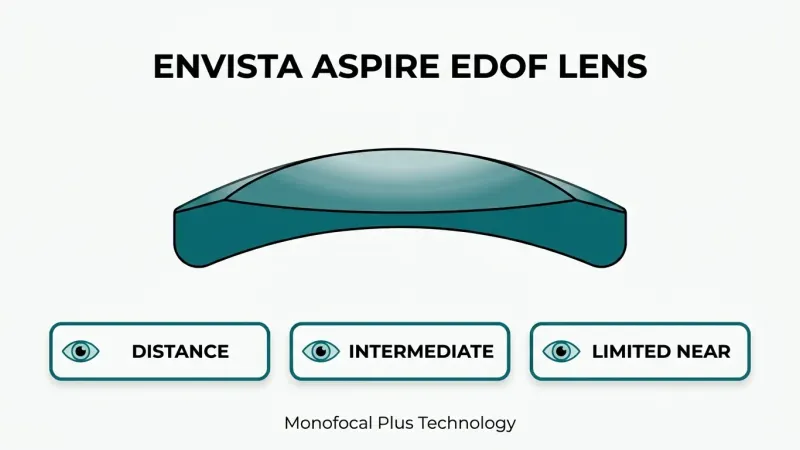
An extended depth of focus IOL is a premium intraocular lens that creates a single, elongated focal point on the retina, producing a continuous range of clear vision from distance through intermediate without splitting light into separate zones.
We cover how EDOF optics work, who may be a good candidate, potential benefits and risks, comparisons to other premium lens types, the surgical experience and recovery process, and how to make a confident lens choice.
EDOF lenses use optical strategies such as diffractive patterns, chromatic aberration correction, and small-aperture designs to stretch one focal zone rather than dividing light into competing images. This mechanism may produce smoother visual transitions and greater tolerance for corneal irregularities like low to moderate astigmatism.
Candidacy depends on overall eye health and lifestyle. Conditions such as macular degeneration, advanced glaucoma, epiretinal membrane, or severe dry eye may limit eligibility, while patients who prioritize distance and intermediate clarity for screens, driving, and daily tasks tend to benefit most.
The potential advantages include improved intermediate vision, reduced glasses dependence for most activities, and fewer visual disturbances compared to traditional multifocal lenses. However, near vision may remain limited; roughly one in four patients with bilateral EDOF implantation may still need reading glasses for fine print.
Possible risks include glare, halos, starbursts (particularly at night), and mildly reduced contrast sensitivity under low-light conditions. These side effects tend to be less pronounced than those associated with multifocal designs, though they are not eliminated entirely.
Premium EDOF lenses generally cost between $2,000 and $4,000 per eye above what insurance covers for a standard monofocal implant, making both clinical and financial factors important parts of the decision.
How Does an Extended Depth of Focus IOL Work?
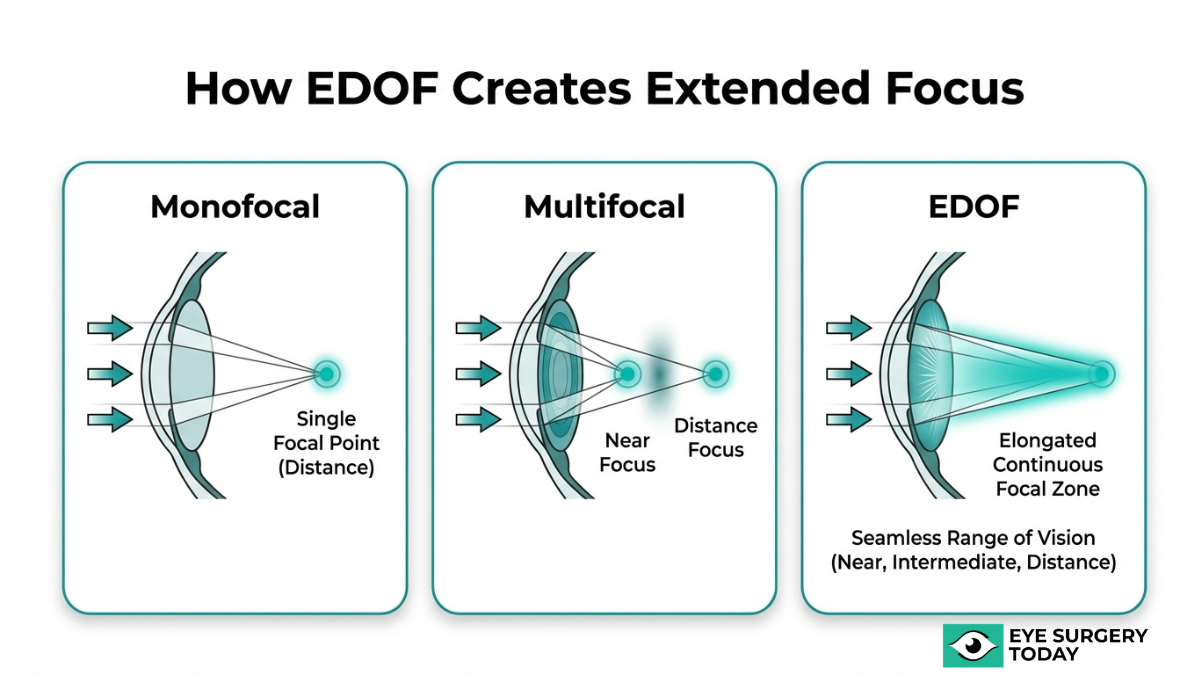
An extended depth of focus IOL works by creating a single, elongated focal point rather than multiple distinct focus points. This design stretches the focus on the retina, producing a continuous range of clear vision from distance through intermediate without the image overlap that can occur with multifocal lenses.
Traditional monofocal IOLs focus light at one fixed distance. Multifocal IOLs split light into separate focal points for near, intermediate, and far. EDOF IOLs take a different approach: they elongate one focal zone so that the transition between distances remains smooth and uninterrupted. Because light is not divided into competing images, the visual experience tends to feel more natural.
Several optical strategies achieve this elongated focus. Some EDOF designs use diffractive patterns on the lens surface to gently extend the focal range. Others rely on chromatic aberration correction or specialized aspheric profiles. Small-aperture IOLs create an extended depth of focus through an opaque mask, sometimes called the pinhole effect, which blocks peripheral light rays from entering the eye.
According to the European Society of Cataract and Refractive Surgeons, low to moderate irregular asymmetric astigmatism does not affect the visual performance of an EDOF IOL. This optical tolerance makes the technology suitable for a broader range of corneal profiles than some patients might expect.
The result is a lens that prioritizes distance and intermediate clarity while offering functional, though not always crisp, near vision. For patients seeking reduced spectacle dependence with fewer visual disturbances than traditional multifocals, this optical mechanism represents a meaningful advancement in IOL technology.
Understanding how an EDOF IOL works is one step; determining whether it fits your visual needs is the next.
Who May Be a Good Candidate for an Extended Depth of Focus IOL?
A good candidate for an extended depth of focus IOL is typically someone with healthy retinas, no significant ocular disease, and realistic visual expectations. Eligibility depends on specific eye conditions and lifestyle needs.
What Eye Conditions Could Affect EDOF IOL Eligibility?
Eye conditions that could affect EDOF IOL eligibility include macular degeneration, glaucoma, epiretinal membrane, and severe dry eye. According to the American Academy of Ophthalmology, multifocal and EDOF lenses are generally not recommended for people with vision loss from glaucoma, macular degeneration, or other eye diseases.
Conditions that may limit candidacy include:
- Epiretinal membrane, which can cap postoperative acuity and reduce the benefit of a premium lens.
- Severe dry eye, particularly if significant enough to contraindicate laser vision correction.
- Advanced glaucoma or macular degeneration, where underlying retinal or optic nerve damage limits achievable visual quality.
Not every diagnosis is disqualifying, however. Mild, pre-perimetric open-angle glaucoma may still allow safe EDOF implantation with favorable outcomes. Low to moderate irregular asymmetric astigmatism has also been shown to have minimal impact on EDOF visual performance. A thorough preoperative evaluation by an ophthalmologist remains essential for determining whether these conditions fall within acceptable thresholds.
What Lifestyle Factors Help Determine EDOF IOL Suitability?
Lifestyle factors that help determine EDOF IOL suitability include daily visual demands, occupation, hobbies, and tolerance for minor optical side effects. EDOF lenses perform best for individuals who prioritize distance and intermediate vision, such as those who spend significant time driving, using computers, or engaging in outdoor activities.
Candidates who may benefit most include:
- Professionals relying on screens at arm’s length throughout the workday.
- Active individuals who value glasses-free distance and intermediate vision for sports or travel.
- People comfortable using reading glasses occasionally for fine print or prolonged close-up tasks.
Patients who frequently work in low-light environments should consider that EDOF designs may slightly reduce contrast sensitivity under dim conditions. Someone whose daily life revolves heavily around detailed near work, such as fine embroidery or watchmaking, might find a trifocal IOL more suitable. Candidacy ultimately requires balancing these personal priorities with clinical findings, making shared decision-making between patient and surgeon the most reliable path to satisfaction.
What Are the Potential Benefits of an Extended Depth of Focus IOL?
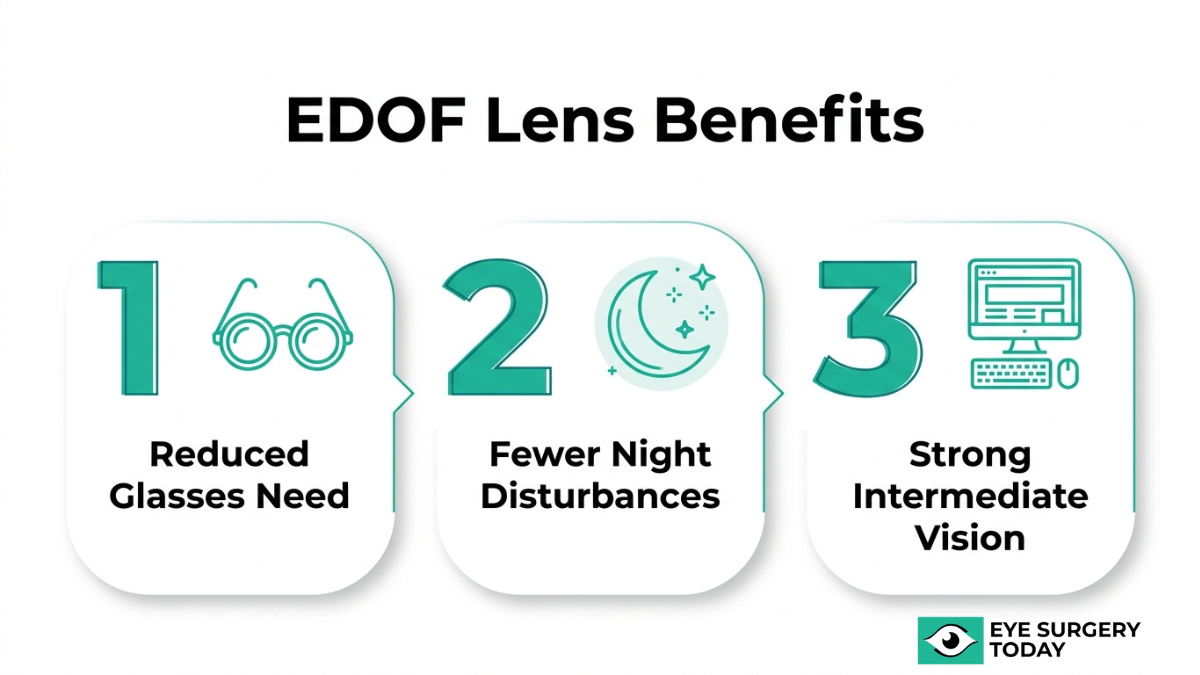
The potential benefits of an extended depth of focus IOL include improved intermediate vision, reduced glasses dependence, fewer visual disturbances than multifocal lenses, and a more natural range of focus.
How May an EDOF IOL Improve Intermediate Vision?
An EDOF IOL may improve intermediate vision by elongating the focal point on the retina, which extends the range of clear focus beyond what a standard monofocal lens provides. Activities at arm’s length, such as computer work, cooking, and reading a dashboard, fall within this intermediate zone.
According to Cataract & Refractive Surgery Today, the ANSI standard for EDOF criteria requires that at least 50% of patients achieve a monocular distance-corrected intermediate visual acuity of 0.2 logMAR (20/32) or better. Research published in the American Journal of Ophthalmology also found that a monofocal EDOF IOL demonstrated similar distance and intermediate visual performance as a trifocal EDOF IOL, with low values of dysphotopsia in both groups. For patients whose primary visual demands center on screens and mid-range tasks, this intermediate performance often represents the most meaningful daily improvement.
How May an EDOF IOL Reduce Dependence on Glasses?
An EDOF IOL may reduce dependence on glasses by providing functional vision across a continuous focal range, from distance through intermediate. Because the lens stretches a single elongated focal point rather than splitting light into separate zones, many patients find they can move through daily routines without reaching for corrective eyewear.
Reading glasses may still be needed for prolonged fine print or small text, yet the overall reliance on spectacles tends to decrease substantially for everyday activities. In practical terms, this continuous focal design makes the transition between distance and intermediate tasks feel seamless, which is why many surgeons consider EDOF technology one of the most balanced approaches for patients seeking broader independence from glasses after cataract surgery.
How Does an EDOF IOL Compare to Multifocal IOLs for Visual Disturbances?
An EDOF IOL compares favorably to multifocal IOLs for visual disturbances because it stretches a single focal point rather than splitting light into discrete zones. EDOF IOLs are designed to create a continuous range of vision while minimizing the overlapping of images seen with multifocal lenses, according to a study published in the American Journal of Ophthalmology.
Multifocal IOLs use diffractive, light-splitting optical designs that can increase the incidence of dysphotopsia, such as halos, glare, and starbursts, compared to monofocal controls. While EDOF lenses are not free from these effects, the rates tend to be lower. Key differences include:
- EDOF IOLs produce fewer overlapping retinal images, which may reduce halo and glare perception.
- Multifocal IOLs may reduce contrast sensitivity more noticeably under mesopic conditions.
- EDOF IOLs provide similar intermediate visual outcomes to trifocal designs but may offer significantly less near vision.
This tradeoff is worth noting: patients who prioritize visual comfort and fewer nighttime disturbances often find EDOF technology a more tolerable option, even if it means occasionally using reading glasses for fine print.
How May an EDOF IOL Provide a More Natural Range of Vision?
An EDOF IOL may provide a more natural range of vision by producing one continuous, elongated focal zone instead of multiple fixed focal points. This design mimics how the eye gradually shifts focus between distances, resulting in smoother visual transitions without the abrupt jumps that can occur with multifocal optics.
Because there is no split between separate distance, intermediate, and near zones, the brain processes the visual input more intuitively. Patients often describe the experience as closer to how they saw before presbyopia began affecting their near focus. Some EDOF designs, including small-aperture models, achieve this extended range through the pinhole effect, which blocks peripheral light rays and sharpens focus across a broader depth of field. This optical continuity is what makes EDOF lenses feel less “artificial” than multifocal alternatives, and it remains one of the strongest reasons surgeons may recommend them for patients who value visual quality over maximum near acuity.
Understanding these potential benefits helps frame the other side of the decision: the possible risks and side effects that may accompany EDOF implantation.
What Are the Possible Risks and Side Effects of an EDOF IOL?
The possible risks and side effects of an EDOF IOL include visual disturbances, near vision limitations, potential need for enhancement procedures, and reduced contrast sensitivity.
What Halos or Glare Issues Can Occur With an EDOF IOL?
Halos or glare issues that can occur with an EDOF IOL include halos, glare, and starbursts, particularly in low-light environments such as nighttime driving. These visual disturbances, collectively known as dysphotopsia, result from how the lens optic splits or redirects incoming light. According to a phase 4 study published in the Spanish Archives of Ophthalmology, EDOF IOL recipients reported visual disturbance rates of 28.7% for glare, 11.3% for halos, and 17.6% for starbursts in the past week. While these symptoms tend to be mild for most patients and often diminish during the neuroadaptation period, they can be bothersome for individuals who frequently drive at night or work in dimly lit settings. Patients considering an EDOF lens should discuss their daily visual demands with their ophthalmologist to weigh this trade-off against the benefits of extended focus.
What Near Vision Limitations May Persist With an EDOF IOL?
Near vision limitations that may persist with an EDOF IOL primarily involve tasks requiring fine, up-close focus, such as reading small print or threading a needle. EDOF lenses prioritize distance and intermediate clarity, so close-range sharpness can fall short of what multifocal or trifocal designs deliver. According to a study published in the Journal Français d’Ophtalmologie, spectacle independence with bilateral EDOF implantation reached 100% for distance, 93% for intermediate, yet only 73% for near vision. This gap means roughly one in four patients may still need reading glasses for sustained near tasks. For patients whose daily routines center on prolonged close-up work, this limitation is worth weighing carefully during the lens selection conversation with their surgeon.
What Is the Risk of Needing an Enhancement After EDOF Implantation?
The risk of needing an enhancement after EDOF implantation is relatively low but not negligible. Residual refractive error, where the post-surgical prescription does not perfectly match the target, is the most common reason an enhancement procedure may be recommended. Laser vision correction, such as LASIK or PRK, can often address minor residual astigmatism or spherical error after the eye has fully healed. Another potential secondary procedure involves Nd:YAG laser capsulotomy to treat posterior capsule opacification, a clouding that can develop behind the implanted lens over time. Your ophthalmologist may recommend waiting several weeks after surgery before evaluating whether an enhancement is appropriate, since vision can continue to stabilize during the early recovery period.
Can an EDOF IOL Cause Reduced Contrast Sensitivity?
Yes, an EDOF IOL can cause reduced contrast sensitivity, particularly under mesopic (low-light) conditions. Because EDOF optical designs redistribute light to extend the focal range, a small portion of incoming light energy is diverted away from producing maximum sharpness at any single point. According to a review published by the National Center for Biotechnology Information, presbyopia-correcting IOLs, including EDOF designs, may reduce contrast sensitivity compared to monofocal IOLs, especially in dim lighting. In practical terms, this can make it harder to distinguish objects against similarly toned backgrounds, such as reading gray text on a white page in a dimly lit room. For most patients, the reduction is subtle and rarely impacts daily activities in well-lit environments. However, individuals whose occupations or hobbies demand peak contrast perception in low light should factor this trade-off into their IOL decision.
With these risks outlined, understanding how an EDOF IOL compares to other premium lens types can help clarify which option best fits your visual goals.
How Does an EDOF IOL Compare to Other Premium IOL Types?
An EDOF IOL compares to other premium IOL types by offering a continuous range of focus with fewer visual disturbances, though with trade-offs in near vision. The following subsections compare EDOF lenses to multifocal, trifocal, accommodating, and monofocal IOLs.
How Does an EDOF IOL Compare to a Multifocal IOL?
An EDOF IOL compares to a multifocal IOL primarily in how each lens creates its range of vision. Multifocal IOLs split light into distinct focal points for near, intermediate, and distance, while EDOF lenses stretch a single focal point to produce a continuous visual range. This fundamental optical difference has practical consequences for both clarity and comfort.
Because multifocal IOLs divide light between separate zones, overlapping images can occur between focal points. EDOF designs minimize this overlap, which may result in fewer visual disturbances. However, multifocal lenses typically provide stronger dedicated near vision, making them a better fit for patients who prioritize reading without glasses.
According to a study published in NCBI, diffractive, light-splitting optical designs can increase the incidence of dysphotopsia, such as halos, glare, and starbursts, compared to monofocal controls. For patients sensitive to nighttime visual disturbances, an EDOF lens often represents the more comfortable compromise between spectacle freedom and optical quality.
How Does an EDOF IOL Compare to a Trifocal IOL?
An EDOF IOL compares to a trifocal IOL by delivering similar intermediate vision but weaker near performance. Trifocal lenses create three distinct focal points for distance, intermediate, and near, offering broader spectacle independence across all ranges. EDOF lenses, by contrast, prioritize a smooth transition from distance through intermediate without discrete focal zones.
According to a meta-analysis published in NCBI, EDOF IOLs provide similar intermediate visual outcomes to trifocal diffractive IOLs but significantly worse near visual outcomes. This trade-off means patients who frequently read fine print or do close-detail work may benefit more from a trifocal design.
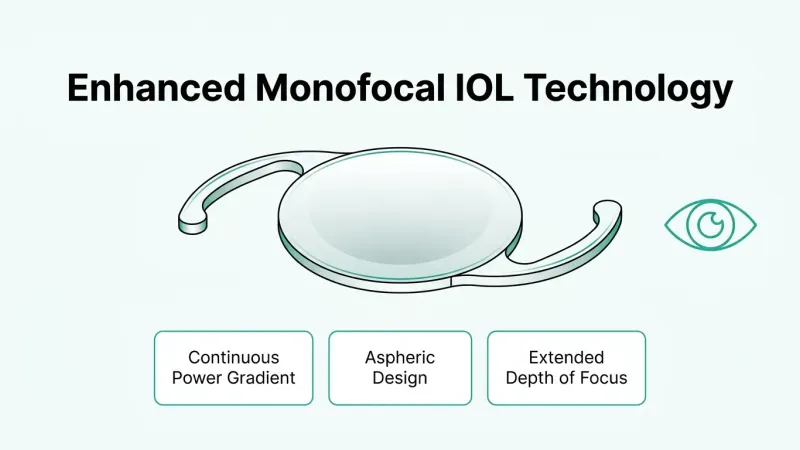
Where EDOF lenses gain an advantage is in optical quality. Enhanced monofocal lenses used with mini-monovision techniques have demonstrated less dysphotopsia than trifocal IOLs in comparative studies. For patients who value visual comfort and can tolerate occasional reading glasses, an EDOF IOL often strikes a practical balance between function and fewer side effects.
How Does an EDOF IOL Compare to an Accommodating IOL?
An EDOF IOL compares to an accommodating IOL through a fundamentally different mechanism of action. Accommodating lenses are designed to shift position inside the eye in response to ciliary muscle contraction, mimicking the natural focusing process of a younger lens. EDOF lenses achieve their extended range through a fixed optical design rather than physical movement.
In clinical practice, accommodating IOLs have delivered inconsistent results. The degree of lens movement varies between patients, and the accommodative range often diminishes over time as the capsular bag stabilizes. EDOF lenses, because they rely on a static optical principle, tend to provide more predictable intermediate vision without depending on postoperative biomechanical factors.
Most ophthalmologists now consider EDOF technology a more reliable option for extending depth of focus. Accommodating IOLs remain available, but their market presence has declined as newer EDOF and trifocal platforms have demonstrated more consistent visual outcomes across larger patient populations.
How Does an EDOF IOL Compare to a Monofocal IOL?
An EDOF IOL compares to a monofocal IOL by providing a broader functional range of vision at the cost of slightly increased visual disturbances. Monofocal lenses deliver sharp focus at one fixed distance, typically set for far vision, requiring glasses for intermediate and near tasks.
According to a study published in Nature’s Eye Journal, enhanced EDOF IOLs significantly favored intermediate-distance spectacle independence, with an odds ratio of 7.85 compared to monofocal IOLs. This substantial difference makes EDOF lenses particularly valuable for patients who spend significant time at computer screens or dashboard distances.
The trade-off involves optical side effects. Monofocal IOLs produce the least dysphotopsia of any lens category, with minimal halos or glare. EDOF designs may introduce mild visual disturbances, and presbyopia-correcting lenses can reduce contrast sensitivity under low-light conditions. For patients who prioritize the crispest possible single-distance vision with the fewest side effects, a monofocal IOL remains the benchmark.
Understanding these comparisons can help guide a more productive conversation with your ophthalmologist about which lens best fits your visual priorities.
What Should You Expect During EDOF IOL Surgery and Recovery?
You should expect a brief outpatient procedure followed by a gradual visual recovery period lasting several weeks. The surgical steps, healing timeline, and follow-up schedule are outlined below.
EDOF IOL surgery follows the same well-established phacoemulsification technique used in standard cataract surgery. Your ophthalmologist removes the clouded natural lens through a small corneal incision, then inserts the EDOF intraocular lens into the existing capsular bag. The entire procedure typically takes 10 to 30 minutes per eye and is performed under local or topical anesthesia on an outpatient basis.
Most patients notice improved distance and intermediate vision within the first few days, though early fluctuations in clarity are common. According to the American Academy of Ophthalmology, it may take 2 to 3 weeks for vision to stabilize after cataract surgery before an ophthalmologist can determine the final prescription. During this stabilization window, mild light sensitivity, watering, and a gritty sensation are normal responses as the eye heals around the new lens.
Your recovery schedule will generally include several key milestones:
- Day 1: A follow-up exam to check lens positioning and intraocular pressure.
- Week 1: Gradual return to light daily activities while avoiding heavy lifting, swimming, and eye rubbing.
- Weeks 2 to 3: Vision continues to sharpen as the eye settles; most driving restrictions are lifted once your surgeon confirms adequate acuity.
- Month 1 to 3: Final refraction assessment and updated glasses prescription for any residual near vision needs.
Prescribed antibiotic and anti-inflammatory eye drops are used for several weeks postoperatively to prevent infection and manage swelling. Patients should also be aware that posterior capsule opacification can develop months after surgery, sometimes requiring a brief Nd:YAG laser capsulotomy to restore clarity. Because EDOF IOLs use specialized optics, consistent attendance at follow-up appointments helps your surgeon monitor adaptation and address any visual disturbances early. Understanding these costs and coverage details can further prepare you for the process ahead.
How Much Does an Extended Depth of Focus IOL Typically Cost?
An extended depth of focus IOL typically costs between $2,000 and $4,000 per eye as an out-of-pocket expense. This premium sits on top of the base cataract surgery fee, and insurance coverage varies depending on the plan type. Several factors influence the final price a patient pays.
Medicare covers a basic version of cataract surgery that includes a standard monofocal IOL. Patients who choose a premium EDOF lens are responsible for the additional cost difference between the standard and upgraded lens. Most private insurance plans follow a similar structure, covering the medically necessary portion of the procedure while leaving the premium IOL upgrade as a patient expense.
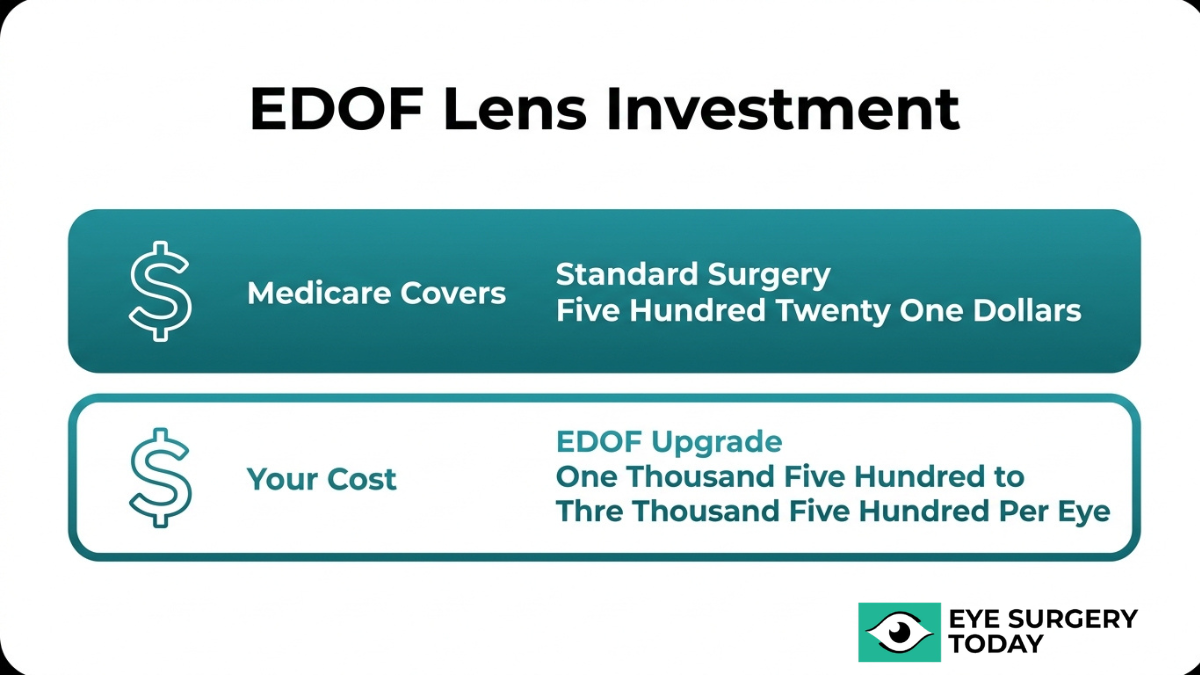
According to Better Vision Guide, the average out-of-pocket cost of cataract surgery in the U.S. is $4,131 per eye. Premium IOLs like EDOF models fall within the $2,000 to $4,000 range. Geographic location also plays a role in pricing. Research presented at the American Society of Cataract and Refractive Surgery found significant variation in cataract surgery pricing across U.S. regions, with self-pay patients in the South Atlantic Region facing disproportionately higher costs.
For patients weighing this investment, the potential reduction in glasses dependence after surgery can offset long-term eyewear expenses. Discussing both the clinical and financial aspects with an ophthalmologist through a shared decision-making approach can help ensure the choice aligns with individual vision goals and budget.
Understanding cost expectations sets the stage for making a confident, well-informed choice about EDOF IOL surgery.
How Can You Make an Informed Decision About EDOF IOL Surgery?
You can make an informed decision about EDOF IOL surgery by weighing clinical evidence, understanding both benefits and risks, and consulting with a qualified ophthalmologist. The sections below cover how Eye Surgery Today can help and the key takeaways to remember.
Can Eye Surgery Today Help You Understand Your IOL Options?
Yes, Eye Surgery Today can help you understand your IOL options. As an education platform founded by nationally recognized ophthalmology key opinion leaders, Eye Surgery Today provides unbiased, evidence-based guides on premium IOL technologies, including extended depth of focus lenses. The platform translates complex clinical data into clear, patient-friendly language so you can approach your consultation with confidence.
Shared decision-making in IOL selection is increasingly emphasized to ensure patient-centered care and optimal satisfaction with visual outcomes. Eye Surgery Today supports this process by offering comprehensive resources that cover candidacy criteria, lens comparisons, cost considerations, and recovery expectations. Rather than replacing your surgeon’s guidance, these resources prepare you to ask better questions and participate more actively in choosing the right lens for your lifestyle.
What Are the Key Takeaways About EDOF IOL Benefits and Risks?
The key takeaways about EDOF IOL benefits and risks center on a favorable trade-off between functional vision range and manageable visual side effects.
- EDOF IOLs stretch a single focal point to create a continuous range of vision across distance and intermediate tasks, which may reduce dependence on glasses for most daily activities.
- Near vision can remain limited; some patients may still need reading glasses for fine print or prolonged close work.
- Visual disturbances such as glare, halos, and starbursts can occur, though EDOF designs typically produce fewer of these symptoms than traditional multifocal lenses.
- Candidacy depends on overall eye health; conditions such as macular degeneration, advanced glaucoma, or significant dry eye may make EDOF lenses unsuitable.
- Cost for premium EDOF lenses generally falls between $2,000 and $4,000 per eye above what insurance covers for standard monofocal implants.
For most patients seeking a balance between spectacle independence and visual quality, EDOF technology represents one of the most practical options available today. Discussing your specific visual demands and eye health history with your ophthalmologist remains the most reliable path to a confident lens choice.