
A cataract surgery day checklist is a structured preparation plan that covers clothing, personal items, arrival steps, and post-operative care for the day of your lens replacement procedure.
This guide covers pre-surgery preparation, what to wear and bring, what happens at the surgery center and during the procedure itself, post-operative recovery and restrictions, and how to organize transportation, home support, and emotional readiness.
Pre-surgery preparation includes confirming medical details and medication adjustments in the days before your procedure, arranging a responsible adult driver, and knowing when to contact your surgical team about illness or eye changes. Loose, comfortable clothing with wide necklines, slip-on shoes, and no makeup, jewelry, or nail polish may help the process run smoothly for both you and the surgical staff.
Bringing the right items, such as your medication list with dosages, photo ID, insurance documents, prescribed eye drops, sunglasses, and sensory devices like hearing aids, can reduce delays during check-in and support accurate pre-operative review. Valuables and unnecessary electronics are generally safer left at home.
At the surgery center, dilating and numbing drops are administered before the procedure, which typically takes 10 to 15 minutes under local anesthesia. Most patients remain awake and may perceive bright light or mild sensation during the operation. Afterward, a protective eye shield is placed over the operative eye, and discharge instructions cover drop schedules, activity limits, and warning signs that warrant urgent contact with your surgeon.
Recovery planning involves avoiding heavy lifting, bending, eye rubbing, and driving until your surgeon clears you. Setting up a safe resting area, scheduling your follow-up appointment in advance, and briefing your caregiver on post-operative instructions can meaningfully reduce stress and support healing in the first 24 hours.
How Should You Prepare in the Week Leading Up to Cataract Surgery Day?
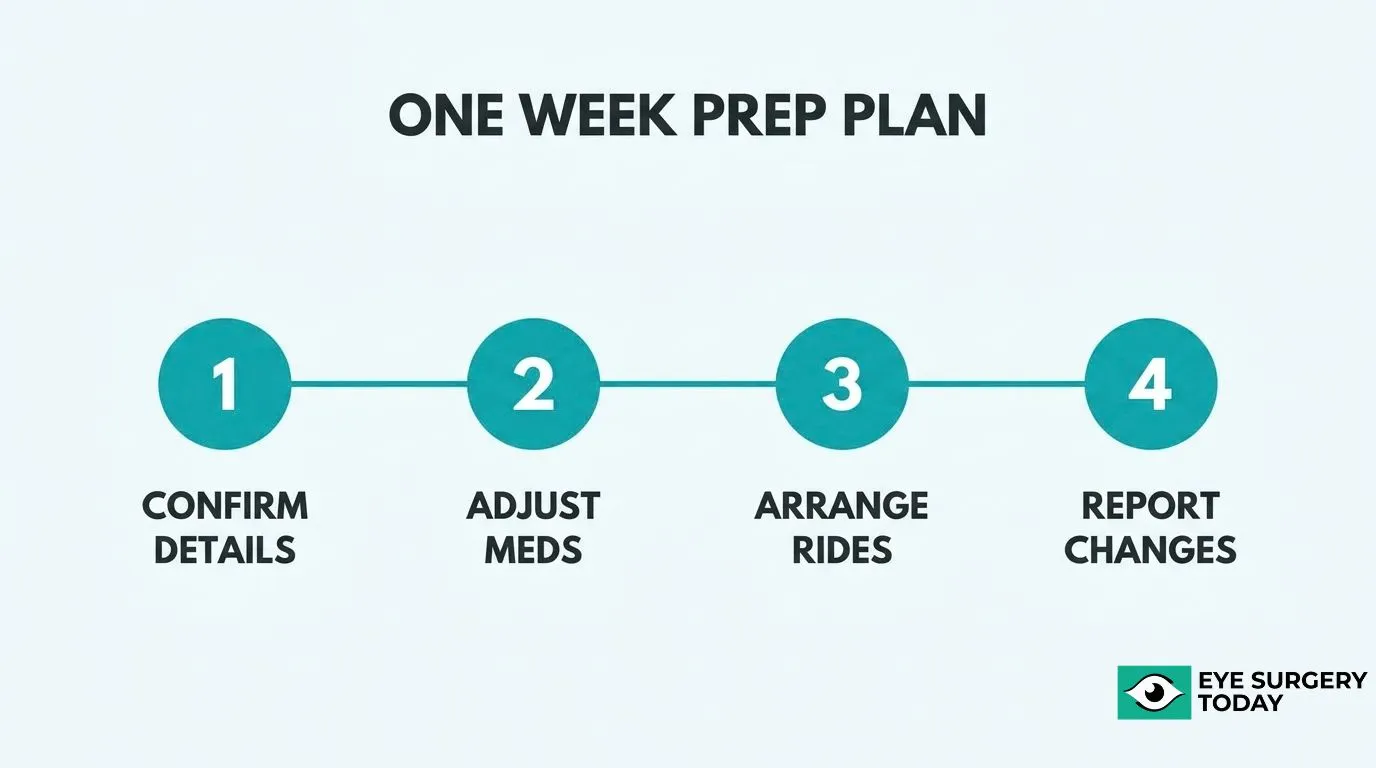
Preparing in the week before cataract surgery involves confirming medical details, adjusting medications, arranging transport, and knowing when to call your surgical team. The H3s below cover each of these steps.
What Medical and Scheduling Steps Should You Confirm in the Days Before Surgery?
The medical and scheduling steps to confirm in the days before surgery include verifying your arrival time, reviewing fasting instructions, and confirming which medications to take or hold. Your surgical center will typically call 24 to 48 hours before your procedure to walk through these details. Use that call to clarify your exact check-in time, whether you need to fast from midnight, and what identification or insurance documents to bring. If you have not received a pre-operative call by the day before surgery, contact the clinic directly. According to the University of Iowa Health Care sighted guide technique tutorial, your designated escort should also be briefed on safe navigation: approaching curbs, stairs, and doorways squarely, never at an angle, and always informing you whether steps go up or down.
How Should You Adjust Medications and Eye Drops Before Surgery Day?
Medications and eye drops should be adjusted only according to your surgeon’s specific instructions, as recommendations vary by drug class and individual health status. Some blood thinners, diabetic medications, and supplements may need to be paused; others should be continued as normal. If your surgeon has prescribed pre-operative antibiotic or anti-inflammatory eye drops, confirm the starting date and dosing schedule. Fourth-generation fluoroquinolones such as gatifloxacin and moxifloxacin are among the most commonly prescribed pre- and post-operative drops, as they provide coverage for the pathogens most associated with post-surgical infection. Never stop or adjust a prescription medication without explicit guidance from your surgical team or prescribing physician.
How Can You Plan Transportation and Support for the Day of Cataract Surgery?
Transportation planning for cataract surgery day requires arranging a responsible adult driver for both the ride to the surgery center and the ride home, as you will be unable to drive after the procedure. The U.S. Food and Drug Administration’s 2018 patient guidance states that you should also arrange transport to your follow-up appointment the following day. According to the Cleveland Clinic, while the surgery itself typically takes 10 to 15 minutes, the full appointment including preparation and recovery may span several hours, so your driver should be prepared to wait. A support person should also plan to stay with you for at least 24 hours post-surgery. Confirming these logistics at least several days before the procedure helps avoid last-minute disruptions.
What Should You Do If You Feel Sick or Your Eyes Change Before Surgery Day?
If you feel sick or notice changes in your eyes before surgery day, contact your surgical team immediately. New onset of fever, a respiratory infection, conjunctivitis, or any sudden change in vision in either eye are conditions that may require your surgery to be postponed. Operating on an eye that is already inflamed or infected significantly increases the risk of serious complications, so surgeons will typically reschedule rather than proceed. Do not assume minor illness is irrelevant; let your care team decide whether it is safe to continue as planned. Proactively reporting changes before the day of surgery gives the team time to adjust your scheduling without unnecessary stress.
What Should You Wear on the Day of Cataract Surgery?
What you wear on the day of cataract surgery matters more than most patients expect. The right clothing, footwear, and grooming choices support patient safety, surgical team access, and your own comfort during a procedure that may last several hours from check-in to discharge. The sections below cover fabrics, colors, necklines, shoes, jewelry, and cosmetics.
What Clothing Fabrics and Fits Are Most Comfortable and Practical for Cataract Surgery?
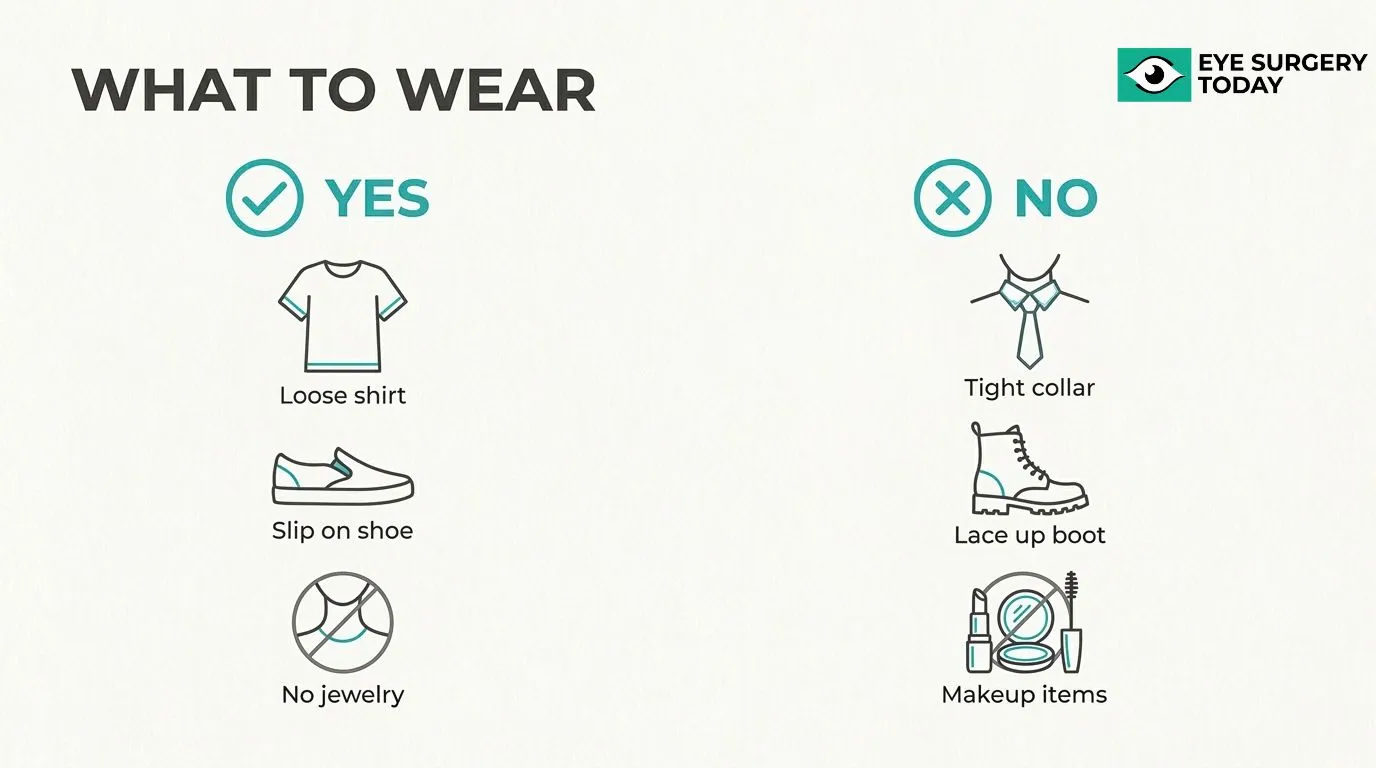
The most comfortable and practical clothing fabrics for cataract surgery are soft, loose-fitting options such as cotton knits, jersey, or fleece. Surgery centers are often cool, so layering a zip-up or button-front top over a comfortable base layer allows staff to adjust your clothing without asking you to lift anything over your head. Avoid tight collars, drawstrings, or structured fabrics that restrict arm movement or require effort to remove.
According to UConn Health’s academic surgical guide, patients should wear loose, comfortable clothing and shoes on surgery day. This is practical advice: you will be reclining during the procedure, and form-fitting or stiff clothing can cause unnecessary pressure and distraction. Loose fits also accommodate any IV access or blood pressure cuffs applied during pre-op preparation.
What Colors and Necklines Are Best for the Surgery Center and Surgical Team?
The best colors for cataract surgery day are light, neutral tones such as white, grey, or pale blue, though no strict color rule exists for patients. What matters more is neckline style: choose a wide scoop neck, V-neck, or front-opening top that gives the surgical team unobstructed access to your head and neck without needing to remove your shirt entirely.
A 2018 consensus statement from the American College of Surgeons, developed collaboratively with AORN, ASA, APIC, AST, CSPS, and The Joint Commission, notes that current scientific evidence does not demonstrate an association between patient attire type and surgical site infection rates. Practically, this means your color choice is a comfort decision, not an infection-control one. Wide necklines simply make pre-op preparation faster and less disruptive for both you and the team.
Which Shoes Are Safest and Easiest to Manage Before and After Surgery?
The safest shoes for cataract surgery are flat, slip-on styles with non-slip soles, such as loafers, slip-on sneakers, or supportive sandals with a back strap. Avoid high heels, flip-flops without heel support, lace-up boots, and any footwear that requires bending over to fasten, since stooping can be difficult after surgery when depth perception may be temporarily altered. Closed-toe designs offer better protection if you are unsteady during the post-op walk to the waiting area.
After surgery, your vision may be blurry and your balance may feel slightly off. A stable, easy-to-don shoe reduces fall risk during that brief transition from recovery area to your waiting driver.
What Jewelry, Accessories, and Hair Products Should You Avoid Wearing to Surgery?
Jewelry, accessories, and hair products to avoid on surgery day include rings, earrings, necklaces, bracelets, facial piercings, hair clips with metal parts, and spray-on or leave-in styling products. UConn Health’s surgical guide specifically instructs patients to leave all jewelry and other valuables at home and to remove all body piercings before surgery.
Metal jewelry can interfere with monitoring equipment and must be removed before entering the surgical area, so bringing it at all creates an unnecessary security risk. Hair products such as sprays, gels, and heavy conditioners are classified alongside makeup and lotions as substances that should not be applied on surgery day, keeping the perioperative environment clean and free from volatile compounds.
How Should You Manage Makeup, Nail Polish, and Skincare on Surgery Day?
Makeup, nail polish, and most skincare products should not be worn on the day of cataract surgery. UConn Health’s surgical guide instructs patients not to use makeup, hair spray, lotions, or oils, and to remove all nail polish before arriving. Fingernail polish is specifically excluded because pulse oximeters used during monitoring are placed on the fingertip, and nail color can interfere with oxygen saturation readings.
Around the eyes, even residual mascara, eyeliner, or eye cream creates a contamination risk in a sterile surgical field. A plain facial wash with water is acceptable; fragrance-free moisturizer may be used on the body but should be avoided near the face and eyes. Keeping your skin product-free that morning is one of the simplest ways to support a smooth, complication-free procedure.
What Personal Items and Documents Should You Bring to Cataract Surgery?
The personal items and documents to bring to cataract surgery fall into four categories: administrative paperwork, medical information, comfort items, and a short list of valuables to leave behind. The sections below cover each category in practical detail.
Which Identification, Insurance, and Payment Documents Are Usually Required?
The identification, insurance, and payment documents usually required for cataract surgery include a government-issued photo ID, your insurance card, and any co-pay or out-of-pocket payment method your surgery center has confirmed in advance. Most facilities also ask for signed consent forms if these were not completed at a pre-operative appointment. Contacting the surgery center the day before to verify their specific document checklist is a practical step that prevents delays on the day itself.
What Medical Information and Medication Lists Should You Bring with You?
The medical information you should bring includes a written list of all current medications with dosage and frequency details. According to a surgical preparation guide from UConn Health, Department of Surgery, Ophthalmology, patients should also bring all sensory and assistive devices, including glasses, hearing aids, and CPAP machines, and arrange for a responsible adult over 18 to accompany them and remain available for 24 hours after surgery. Bringing this information in written form reduces the risk of verbal miscommunication during pre-operative checks.
What Comfort Items Are Helpful to Bring While You Wait at the Surgery Center?
Comfort items helpful for the surgery center waiting period include a light jacket or cardigan (waiting areas are often cool), a small pillow for back support, and a book or podcast loaded on a device you can use before the procedure. Because cataract surgery preparation and recovery together can extend your appointment to several hours, having something calming and low-stimulation helps manage the wait without straining your eyes.
Which Electronics or Valuables Are Better Left at Home on Surgery Day?
Electronics and valuables that are better left at home include jewelry, smartwatches, expensive headphones, and large amounts of cash. Your vision may be blurred after surgery, and coordination is temporarily reduced, making it easy to misplace items. A simple phone for communication with your companion is all that is practically needed. Leaving valuables at home also reduces pre-procedure anxiety and removes any risk of loss in the facility’s changing or recovery areas.
What Cataract-Specific Items or Eye Care Supplies Should You Bring?
Cataract-specific supplies to bring include your prescribed eye drops, current eyeglasses or sunglasses, and any written drop schedules provided during pre-op. The H3s below cover each item in detail.
Which Prescribed Eye Drops Should You Bring on the Day of Surgery?
The prescribed eye drops you should bring on the day of surgery are any antibiotic, anti-inflammatory, or NSAID drops your surgeon dispensed before the procedure. Your surgical team will confirm which drops to apply before you arrive and which to start immediately afterward. According to EyeWiki of the American Academy of Ophthalmology, fourth-generation fluoroquinolones such as gatifloxacin and moxifloxacin are among the most commonly prescribed drops, targeting pathogens like coagulase-negative staphylococci and streptococci. Bringing your bottles ensures the care team can verify the correct formulations are in use, which is especially important if you are managing multiple medications.
Should You Bring Your Current Glasses, Sunglasses, or Contact Lenses to Surgery?
Yes, you should bring your current glasses and a pair of sunglasses to cataract surgery, but contact lenses should be left out before the procedure. UConn Health’s ophthalmology surgical guide lists glasses among the sensory and assistive devices patients should bring on surgery day. Sunglasses are particularly important for the journey home, as post-operative pupils may remain dilated and eyes are sensitive to bright light. Your pre-surgery prescription glasses may still be needed in recovery before your vision fully stabilizes.
Are There Protective Eye Shields or Accessories You Should Bring Yourself?
Protective eye shields are generally provided by the surgery center and do not need to be brought from home. According to Harvard Health Publishing, a clear plastic shield is placed over the eye for the first 24 hours after surgery, then worn at night only for approximately one week. The American Academy of Ophthalmology also notes that your ophthalmologist may ask you to wear eyeglasses or a shield to protect the eye post-operatively. If your clinic has advised you to purchase a shield in advance, confirm the exact type during your pre-op appointment rather than assuming any over-the-counter option is suitable.
What Written Instructions or Schedules for Eye Drops Should You Bring?
The written instructions you should bring are any printed or digital eye drop schedules given to you at your pre-operative appointment. These schedules specify each drop by name, frequency, and the order of administration, which matters when multiple drops are prescribed. Having this document on hand allows surgical center staff to verify your regimen and flag any discrepancies before you leave. Keeping a physical copy, rather than relying on memory alone, reduces the risk of missed doses during the critical first days of healing.
What Should You Do When You Arrive at the Cataract Surgery Center?
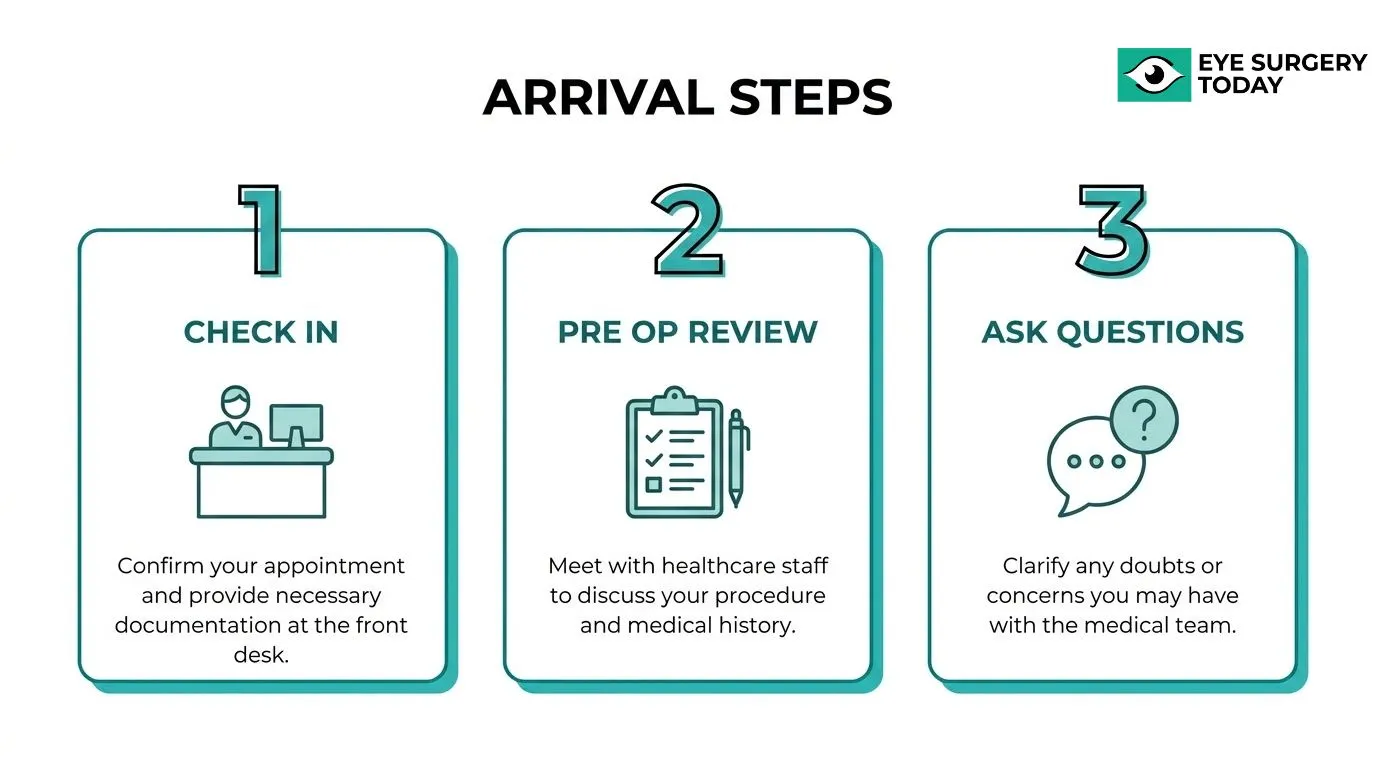
When you arrive at the cataract surgery center, the focus shifts from preparation to process. The following H3s cover check-in timing, pre-op registration, repeated medical checks, and how to raise last-minute questions with your surgical team.
When Should You Arrive and Check In for Your Cataract Surgery?
You should arrive at the cataract surgery center at the time your surgical team specifies, typically 30 to 60 minutes before your scheduled procedure. Early arrival gives staff adequate time to complete administrative check-in, verify your identity, and confirm your consent forms before pre-operative preparations begin.
For patients with diabetes, arrival timing matters beyond paperwork. According to 2024 evidence-based recommendations from the European Society of Cataract and Refractive Surgeons, diabetic patients without diabetic retinopathy should receive a combination of corticosteroid and NSAID eye drops to help prevent cystoid macular edema, while those with diabetic retinopathy may require a supplementary triamcinolone depot. Arriving on time ensures these steps can be completed without rushing.
What Typically Happens During Pre-Op Registration and Consent Review?
Pre-op registration involves verifying your identity, confirming your insurance and payment information, and reviewing your signed consent documents with a member of the care team. A nurse or surgical coordinator will typically walk through the consent form, explaining the procedure, potential risks, and your right to ask questions before proceeding. This is a formal safety step, not a formality to rush through.
What Medical Checks and Eye Measurements May Be Repeated Before Surgery?
Medical checks repeated before surgery may include blood pressure measurement, a review of current medications, and confirmation of fasting compliance. In some centers, biometry measurements or intraocular lens power calculations may be verified again to reduce the risk of an incorrect lens implant. Bringing your full medication list and any prior prescription eyewear supports accurate, efficient pre-operative review.
How Should You Communicate Last-Minute Concerns or Questions to the Team?
You should communicate last-minute concerns to the surgical team directly and clearly, ideally during the pre-operative nursing assessment. Tell the nurse or anesthesia provider about any changes since your pre-operative appointment, such as new medications, a recent illness, or increased anxiety. No question is too minor. Surgical teams routinely address patient concerns at this stage, and raising an issue before the procedure is always safer than staying silent.
Speaking up at check-in is one of the most practical things a patient can do on surgery day. Surgeons and nurses cannot act on information they do not have.
What Can You Expect in the Pre-Operative Area Before Cataract Surgery?
The pre-operative area is where the surgical team completes final preparations before you enter the operating room. This section covers what you will wear, which eye drops and medications are administered, how the surgical eye is prepared, and how to manage any nervousness while you wait.
What Clothing Changes or Surgical Gowns Will You Be Asked to Wear?
Clothing changes in the pre-operative area typically involve exchanging your top for a surgical gown or drape, though most centers allow you to keep your own loose-fitting bottoms and comfortable shoes. Facilities vary in how much they require patients to change, which is one reason wearing simple, non-restrictive clothing on surgery day is recommended. According to a 2018 consensus statement from the American College of Surgeons, current scientific evidence does not demonstrate any association between the type of hat or extent of hair coverage and surgical site infection rates, so head coverings are precautionary rather than medically mandatory. Staff will guide you through exactly what to remove and what to keep on.
What Eye Drops and Medications Are Usually Given Before Cataract Surgery?
Eye drops and medications given before cataract surgery typically include dilating drops to widen the pupil, antibiotic drops to reduce infection risk, and anti-inflammatory drops to minimize swelling. The surgical team may also administer a sedative or oral medication to help you relax before entering the operating room. You will receive numbing eye drops, a regional anesthesia block, or both to prevent pain during the procedure, according to the American Society of Anesthesiologists (medically reviewed June 2024). General anesthesia is rarely needed. These drops are administered in a specific sequence and take time to take effect, which is why pre-operative preparation can feel unhurried.
How Will the Surgical Eye Be Marked and Prepared?
The surgical eye will be marked by a member of the surgical team, most commonly with a skin-safe marker near the brow or eyelid, to confirm the correct eye before you enter the operating room. This is a standard safety step used by surgical centers to prevent wrong-site errors. The area around your eye will also be cleaned with an antiseptic solution, and a sterile drape will be placed over your face during the procedure, leaving only the operative eye exposed. Marking and site verification are among the most important pre-operative safety protocols and should be expected as part of standard care.
How Can You Manage Anxiety or Nervousness While Waiting for Surgery?
Anxiety or nervousness while waiting for cataract surgery can be managed through slow, controlled breathing, focusing on a single calming thought, or speaking with the nursing staff about your concerns. Many centers offer a mild sedative as part of the pre-operative medication protocol for patients who feel especially anxious. It helps to remember that cataract surgery is among the most commonly performed and well-studied procedures in medicine. According to a 2025 report from UCF Health Faculty Physician Practice, board-certified ophthalmologist Dr. Monika Farhangi notes that “cataract surgery offers a permanent solution with a high success rate, few complications and a speedy recovery.” Telling your care team about your anxiety beforehand allows them to adjust their support accordingly.
What Happens During the Cataract Surgery Itself?
Cataract surgery itself is a brief, structured procedure that most patients tolerate well while awake. The sections below cover how long the operation takes, which anesthesia options are used, what sensory experiences to expect, and how the cloudy lens is removed and replaced.
How Long Does Cataract Surgery Usually Take Once You Are in the Operating Room?
Cataract surgery usually takes 10 to 15 minutes once you are in the operating room. The operative portion is short, though preparation and recovery extend your total appointment to several hours. According to the Cleveland Clinic, you should ask your ophthalmologist for the full timeframe so your driver can plan accordingly.
What Type of Anesthesia or Numbing Is Typically Used During Cataract Surgery?
The types of anesthesia used during cataract surgery are numbing eye drops, a regional anesthesia block, or a combination of both. General anesthesia is rarely needed. According to the American Society of Anesthesiologists (medically reviewed June 2024), you will remain awake under monitored sedation, and your eye may perceive very bright light, shadows, or brief bursts of color with topical anesthesia. General anesthesia is typically reserved for patients for whom sedation or local anesthesia carries elevated risk.
What Might You See, Hear, or Feel During Cataract Surgery?
What you might see, hear, or feel during cataract surgery includes bright light or shifting colors through the operated eye, low surgical sounds from equipment, and minimal discomfort. A 2013 case series of 368 patients at a public teaching hospital in Paris, published in BMJ Open, found that 41% reported mild sensation and 31.5% reported no sensation at all during the procedure. Most patients find the experience far less distressing than anticipated, making the sensory reassurance worth discussing with your surgical team beforehand.
How Is the Cloudy Lens Removed and the New IOL Placed During Surgery?
The cloudy lens is removed using a technique called phacoemulsification. According to Mayo Clinic (2026), the surgeon makes a tiny incision in the cornea, inserts a needle-thin ultrasound probe, and uses rapid vibration to break up the cataract before suctioning out the fragments. The surgeon then places an artificial intraocular lens (IOL) into the same capsule that held the natural lens, restoring clear focus.
Understanding each surgical step can meaningfully reduce pre-operative anxiety on the day itself.
What Should You Do Immediately After Cataract Surgery in Recovery?
The immediate post-surgery recovery period covers the first few hours after your procedure ends. The sections below explain what sensations to expect, what discharge instructions you will receive, how to use your eye shield, and when to contact your surgeon.
What Can You Expect to Feel in the First Hour After Surgery?
What you can expect to feel in the first hour after surgery includes mild grogginess, blurred or hazy vision, and some light sensitivity. These sensations are normal responses to the anesthesia and the procedure itself. Your eye may water, feel slightly scratchy, or appear red. Vision often seems foggy before it begins to clear, sometimes within hours, though the timeline varies by individual. This early blurriness does not indicate a complication; it is simply the eye beginning to adjust after the cloudy lens has been removed and the intraocular lens placed.
What Instructions Will the Team Give You Before Leaving the Center?
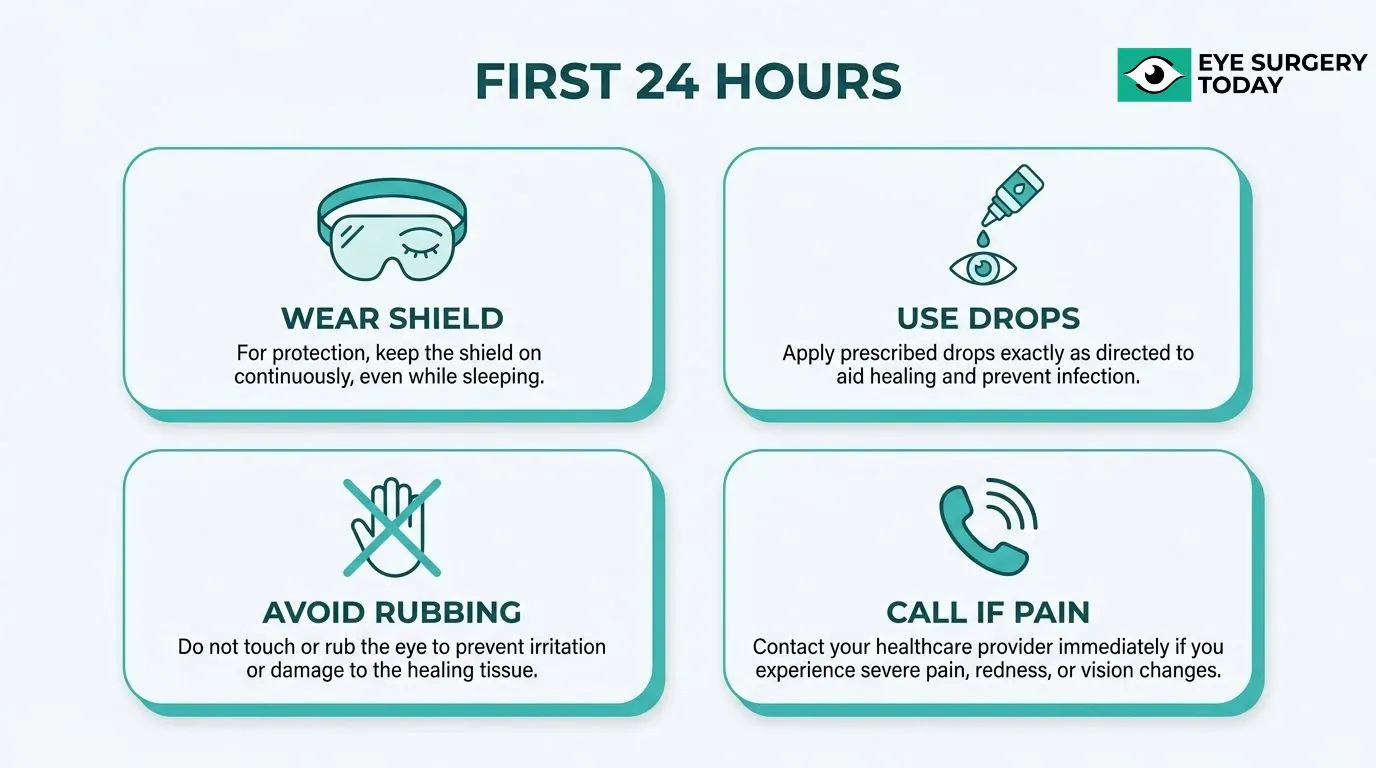
The instructions the team will give you before leaving the center cover your eye drops schedule, activity restrictions, and follow-up appointment details. Staff will review how to instill each prescribed drop, how frequently to use it, and in what order if multiple drops are prescribed. You will be told to avoid rubbing or pressing on the operated eye. A responsible adult must accompany you, as you cannot drive yourself home. Receiving and reviewing these instructions carefully before you leave is one of the most important steps in a smooth recovery; patients who understand their drop regimens from the outset tend to experience fewer complications.
When and How Will You Use Your Eye Shield Right After Surgery?
You will use your eye shield continuously for the first 24 hours after surgery, then at night only for approximately one week to protect the eye while you sleep. The shield guards against accidental contact, such as rubbing during sleep or pressure from a pillow. According to the U.S. Food and Drug Administration’s 2018 guidance, you will also be unable to drive after surgery, so arrange transportation to and from the surgery center and to your follow-up appointment the following day.
When Should You Call Your Surgeon About Pain, Vision Changes, or Other Concerns?
You should call your surgeon promptly if you experience worsening pain, a sudden decrease in vision, increasing redness, or unusual flashes of light after surgery. Mild discomfort and some blurring are expected in the first hours, but escalating symptoms may signal a complication requiring urgent evaluation. Do not wait until your scheduled follow-up if something feels wrong. Having your surgeon’s after-hours contact information on hand before you leave the surgery center is a practical step that is easy to overlook but genuinely important on the day of your procedure.
What Should You Avoid Doing on Cataract Surgery Day?
On cataract surgery day, you should avoid eating and drinking beyond your surgeon’s guidelines, performing strenuous physical activity, driving yourself, and touching or rubbing the operated eye. The sections below cover each restriction and why it matters for a safe recovery.
What Eating and Drinking Restrictions May Still Apply After Surgery?
Eating and drinking restrictions on cataract surgery day typically require fasting from midnight the night before, unless your surgical team instructs otherwise. Even after the procedure, your care team may ask you to wait before resuming normal eating, particularly if you received sedation. Common fasting guidance includes:
- No food or drink after midnight before surgery.
- No alcohol on the day of the procedure.
- Resume eating and drinking only after your care team confirms it is safe.
Following these restrictions reduces anesthesia-related risks and supports a smooth recovery.
What Physical Activities and Movements Should You Avoid on Day One?
The physical activities and movements you should avoid on day one include heavy lifting, vigorous exercise, and bending with your head below your waist. According to Johns Hopkins Medicine’s Wilmer Eye Institute (2026), rigorous exercise and heavy lifting can raise intraocular pressure, and head-down positions such as bending over carry the same risk. Water exposure should also be avoided, as it may introduce infection or irritation before the eye has healed. Avoiding these activities on day one meaningfully protects the surgical incision during its most vulnerable window.
Why Should You Avoid Driving Yourself After Cataract Surgery?
You should avoid driving yourself after cataract surgery because vision remains blurred and unstable in the hours immediately following the procedure, making it unsafe to operate a vehicle. Depth perception and contrast sensitivity may both be temporarily impaired on the operative side. A 2022 meta-analysis published in the International Journal of Ophthalmology, covering 5,878,114 eyes across 39 studies, found a pooled endophthalmitis incidence of 0.092% after phacoemulsification, underscoring how seriously the eye must be protected from any avoidable stress in the early postoperative period. Arranging a trusted adult driver for both the surgical appointment and the follow-up visit the next day is an essential part of the safety plan.
What Rubbing, Touching, or Pressure on the Eye Must You Avoid?
Rubbing, touching, or applying any pressure to the operated eye must be avoided entirely on surgery day and throughout early recovery. According to the American Academy of Ophthalmology, patients should not rub or press on the eye after cataract surgery, and the ophthalmologist may recommend wearing protective eyeglasses or a shield. Even gentle contact can displace the wound, dislodge the intraocular lens, or introduce bacteria. The eye shield provided at discharge exists precisely to prevent accidental pressure during sleep or routine movement, so wearing it consistently is one of the simplest and most important protective steps a patient can take.
How Should You Plan Transportation and Home Support After Cataract Surgery?
Planning transportation and home support after cataract surgery requires arranging a responsible adult driver and preparing your living space before surgery day. The following sections cover who should drive you, how to set up your home, what daily task help you may need, and how caregivers can prepare.
Who Can Safely Drive You Home and Stay with You After Surgery?
The person who can safely drive you home and stay with you after surgery is a responsible adult aged 18 or older. According to a 2018 U.S. Food and Drug Administration guidance, you will be unable to drive yourself, so transportation to and from surgery and to your follow-up appointment the next day must be arranged in advance. UConn Health’s ophthalmology surgical guide further specifies that this person should stay with you for 24 hours after surgery, not simply drop you off.
An adult companion is not optional logistics; it is a genuine safety requirement. Sedation and blurred vision after surgery make independent navigation genuinely hazardous, and having a trusted person present also means someone can act quickly if any concerning symptoms arise.
How Should You Set Up Your Home for Safe Moving Around That Day?
Your home setup for safe moving around on surgery day should reduce fall risk and minimize the need to bend or reach. Because sedation and altered vision can affect balance and depth perception immediately after returning home, a few targeted changes before you leave for surgery can prevent accidents.
Key preparation steps include:
- Clear walking paths of rugs, cords, and clutter that could cause tripping.
- Place commonly needed items, such as medications, water, and snacks, at counter height to avoid bending below the waist.
- Prepare a comfortable resting chair or bed with extra pillows for head elevation.
- Ensure good lighting throughout the home so reduced post-operative vision is less disorienting.
According to the University of Iowa Health Care’s sighted guide technique tutorial, when assisting a person with limited vision, guides should approach curbs, stairs, and doorways squarely rather than at an angle, and always inform the person whether steps go up or down. Applying this principle at home, caregivers should verbally orient the patient to the environment when they arrive.
What Help Might You Need with Meals, Pets, and Chores After Surgery?
The help you might need with meals, pets, and chores after surgery includes any task that requires bending, heavy lifting, or fine motor focus. Johns Hopkins Medicine’s Wilmer Eye Institute advises avoiding rigorous exercise, heavy lifting, and positions that put your head below your waist, such as bending over, because these actions can increase intraocular pressure during early recovery.
Practically, this means:
- Meals should be pre-prepared or ordered in advance; avoid stovetop tasks that require leaning over a pot.
- Pet feeding, litter box cleaning, and dog walking should be handled by another person on surgery day.
- Laundry, vacuuming, and any household task involving lifting or bending should be delegated for at least the first 24 hours.
Preparing a day’s worth of easy, no-cook food before surgery day is one of the most practical things a patient can do independently, ahead of time.
How Can Caregivers Prepare to Support Someone After Cataract Surgery?
Caregivers can prepare to support someone after cataract surgery by understanding the patient’s schedule, restrictions, and emergency contacts before surgery day arrives. Being an effective caregiver on surgery day is far easier when the groundwork is laid in advance.
Useful caregiver preparation steps include:
- Confirm pick-up timing with the surgical center, noting that the full appointment may run several hours even though surgery itself is brief.
- Review the patient’s eye drop schedule and post-operative written instructions received from the surgical team.
- Know which symptoms, such as sudden vision loss, severe pain, or increasing redness, require calling the surgeon rather than waiting.
- Keep the patient’s phone charged and nearby so they can reach the surgeon’s after-hours line if needed.
Caregivers who arrive informed and organized reduce patient stress considerably, and that calm environment supports a smoother first-day recovery.
What Should You Do About Medications, Eye Drops, and Pain Control on Surgery Day?
Medication management on surgery day covers three areas: continuing regular prescriptions safely, following your prescribed eye drop schedule, and choosing appropriate pain relief. The H3s below address each area, plus which medications to pause because they may increase bleeding risk.
When Should You Take Your Regular Medications on the Morning of Surgery?
Regular medications should generally be taken on the morning of surgery with a small sip of water, unless your surgical team has given specific instructions to hold them. This applies to most blood pressure, heart, and thyroid medications. However, instructions vary by drug class and individual health history, so confirm the exact plan with your surgeon or anesthesiologist during your pre-op call. Never adjust or stop any prescription independently before surgery day.
How Should You Start or Continue Prescribed Eye Drops on Surgery Day?
Prescribed eye drops should be used exactly as directed in your pre-operative instructions. Your surgeon may ask you to instill antibiotic or anti-inflammatory drops beginning the day before surgery or on the morning of the procedure itself. According to EyeWiki from the American Academy of Ophthalmology, fourth-generation fluoroquinolones such as gatifloxacin and moxifloxacin are among the most prescribed drops before and after cataract surgery, providing coverage against the most commonly implicated pathogens.
What Over-the-Counter Pain Relief Is Usually Acceptable After Cataract Surgery?
Over-the-counter pain relief that is usually acceptable after cataract surgery is acetaminophen (paracetamol), taken at the standard recommended dose. Discomfort following cataract surgery is typically mild for most patients. According to patient guidance reviewed in April 2026 by Guy’s and St Thomas’ NHS Foundation Trust, over 95 out of 100 people notice a vision improvement after surgery, and severe complications are rare, which means significant post-operative pain is uncommon. Always confirm pain management choices with your surgical team before surgery day.
Which Medications Should You Avoid Because They May Increase Bleeding Risk?
Medications you should avoid because they may increase bleeding risk include certain over-the-counter drugs and supplements, such as aspirin (unless prescribed for a cardiac condition), ibuprofen, naproxen, and blood-thinning supplements including fish oil, vitamin E, and garlic. These agents can affect platelet function or anticoagulation. Your surgical team will provide a specific list during pre-operative instructions; never stop a prescribed anticoagulant such as warfarin or clopidogrel without your prescribing physician’s explicit guidance, as the cardiovascular risk may outweigh the surgical bleeding risk.
What Are the Possible Risks or Complications to Watch for on Surgery Day?
The possible risks and complications to watch for on surgery day include sudden vision loss, worsening pain, signs of infection, and symptoms requiring emergency care. The following H3s cover which symptoms need urgent attention, what discomfort is normal versus concerning, how to recognize early infection, and when to go directly to the emergency department.
Which Vision Changes or Symptoms After Surgery Require Urgent Attention?
The vision changes or symptoms that require urgent attention after cataract surgery include sudden vision loss, a dramatic increase in floaters, flashes of light, and a dark curtain or shadow appearing across your visual field. These may signal retinal detachment or hemorrhage, both of which require immediate evaluation. Significant redness, swelling, or discharge from the operated eye also warrants same-day contact with your surgeon.
What Level of Discomfort Is Normal Versus Concerning After Cataract Surgery?
The level of discomfort that is normal after cataract surgery includes mild grittiness, a slight foreign-body sensation, and light sensitivity in the hours following the procedure. According to a 2013 case series published in BMJ Open involving 368 cases at a public teaching university hospital in Paris, approximately 41% of patients reported only mild sensation and 31.5% reported no sensation at all during the procedure, suggesting that severe post-operative pain is uncommon. Moderate or intense eye pain that worsens rather than improves, particularly if accompanied by nausea or a sudden drop in vision, should be reported to your surgical team promptly.
How Can You Recognize Signs of Infection or Severe Inflammation on Day One?
Signs of infection or severe inflammation on day one include increasing redness, significant eyelid swelling, cloudy or purulent discharge, and progressive blurred or hazy vision. Endophthalmitis, a serious intraocular infection, may present with pain and rapid vision decline. According to a 2022 meta-analysis published in the International Journal of Ophthalmology examining 5,878,114 eyes across 39 studies, the pooled incidence of endophthalmitis after phacoemulsification cataract surgery was approximately 0.092%, confirming it is rare but serious. Prompt recognition on day one is critical, as early treatment significantly improves outcomes.
When Should You Go to the Emergency Department Instead of Waiting to Call?
You should go to the emergency department instead of waiting to call your surgeon when you experience sudden, severe vision loss, eye pain that is intense and unrelenting, or any symptom that cannot wait for a routine callback. Additional situations that warrant emergency care include a visible penetrating injury to the eye, profuse bleeding, or signs of systemic reaction such as chest pain or difficulty breathing after sedation. When in doubt, a brief emergency visit is far safer than waiting, since conditions like acute endophthalmitis or retinal detachment can become irreversible within hours if left untreated.
Who Is a Good Candidate to Follow This Cataract Surgery Day Checklist?
Most adults scheduled for routine cataract surgery can follow this checklist directly. However, certain patient groups, including those with diabetes, anxiety, mobility limitations, or bilateral surgery plans, may need adapted preparation. The H3s below address each of these situations.
How might the checklist differ for people with diabetes or other medical conditions?
The checklist may differ for people with diabetes primarily in how their eye drops and blood sugar management are handled around surgery. According to 2024 evidence-based recommendations from the European Society of Cataract and Refractive Surgeons, diabetic patients without retinopathy should use a combination of corticosteroid and NSAID eye drops to prevent cystoid macular edema, while those with diabetic retinopathy may require an additional triamcinolone depot with postoperative intraocular pressure monitoring. Beyond eye drops, people with systemic conditions such as hypertension or bleeding disorders should confirm with their surgical team which medications to hold or adjust on the morning of surgery. The core checklist items, such as fasting, attire, and transport, still apply.
What extra considerations apply for very anxious patients or those with mobility issues?
Very anxious patients and those with mobility issues may need additional accommodations on surgery day. Useful adjustments include:
- Requesting a pre-surgery call or briefing from the care team to review each step in advance.
- Asking the center about sedation options, since monitored sedation is available alongside topical anesthesia.
- Arranging for a caregiver to remain inside the facility, not just in the parking lot, for reassurance.
- Using a wheelchair or walker if needed, and notifying the center in advance so accessible routes are ready.
Patients with severe anxiety should discuss this with their surgeon before surgery day, as sedation preferences can often be accommodated during pre-admission planning.
How does cataract surgery day planning differ for people having both eyes treated separately?
Cataract surgery day planning differs for people having both eyes treated separately in that each surgery is treated as a fully independent procedure, with its own fasting period, consent process, and transportation arrangement. The interval between surgeries is typically weeks, allowing the first eye to heal and visual acuity to stabilize before the second eye is operated on. Patients should bring their current glasses to each visit, since prescription needs may shift between procedures. NICE Guideline NG77 (2017) identifies that bilateral simultaneous surgery may be appropriate only for select low-risk patients or those for whom repeated general anesthesia poses significant risk, reinforcing that most patients will undergo two separate surgery days with two complete checklists.
What should family members or caregivers know when helping an older adult on surgery day?
Family members and caregivers should know that an older adult cannot drive after surgery and will need direct accompaniment from the center to home. According to surgical guidance from UConn Health’s Department of Ophthalmology, a responsible adult over the age of 18 must stay with the patient for the full 24 hours following surgery. Caregivers should also be prepared to:
- Read discharge instructions aloud if the patient’s vision is temporarily blurred.
- Manage the initial eye drop schedule, which may begin the same day.
- Ensure the patient does not rub or press on the operated eye.
- Guide the patient carefully over steps and curbs, approaching each squarely rather than at an angle, as recommended by University of Iowa Health Care’s sighted-guide protocol.
Older adults with cognitive or hearing impairments may benefit from a caregiver who attends the pre-op briefing to receive instructions directly from the care team.
How Can You Prepare Emotionally and Practically for Cataract Surgery Day?
Preparing emotionally and practically for cataract surgery day reduces anxiety and helps everything run smoothly. The H3s below cover managing fear, relaxation techniques, first-24-hour vision expectations, and involving your support network.
What Can You Do to Manage Fear or Anxiety About Cataract Surgery?
Managing fear or anxiety about cataract surgery starts with understanding how safe and routine the procedure is. According to Dr. Monika Farhangi, a board-certified ophthalmologist and cataract surgeon at UCF Health Faculty Physician Practice, “cataract surgery offers a permanent solution with a high success rate, few complications and a speedy recovery” (University of Central Florida News, 2025).
Practical steps that may help reduce pre-surgery anxiety include:
- Asking your surgical team detailed questions so you know exactly what to expect.
- Reviewing your surgery day schedule in advance to eliminate uncertainty.
- Reminding yourself that the procedure typically lasts 10 to 15 minutes.
- Focusing on the outcome rather than the procedure itself.
Knowledge is genuinely one of the most effective tools against surgical anxiety. Patients who understand the process tend to arrive calmer and recover with fewer stress-related concerns.
How Can You Use Relaxation, Breathing, or Distraction Techniques on Surgery Day?
Relaxation and breathing techniques on surgery day can help calm your nervous system before and during the procedure. Slow, controlled diaphragmatic breathing, where you inhale for four counts and exhale for six, may lower perceived stress and steady your heart rate during pre-operative preparation.
Useful distraction and calming strategies include:
- Listening to music or a podcast during the wait at the surgery center.
- Focusing on a single calming mental image or memory.
- Practicing progressive muscle relaxation while lying in the pre-op area.
- Counting slowly or using a simple mental counting task if you feel tense.
These techniques are low-risk, require no equipment, and can be used right up until the surgical team begins preparation.
What Expectations About Vision and Recovery Should You Set for the First 24 Hours?
Vision expectations for the first 24 hours after cataract surgery are that improvement is likely but not always immediate. Many patients notice brighter, clearer vision within hours, while others experience blurring, haziness, or mild light sensitivity as the eye begins to heal. Both are normal responses.
Key realistic expectations for day one include:
- Vision may fluctuate and may not stabilize for several days.
- Mild discomfort, itching, or a gritty sensation is common and usually temporary.
- A clear plastic eye shield should be worn as instructed to protect the eye.
- Driving is not permitted on surgery day under any circumstances.
Setting accurate expectations reduces the chance of unnecessary alarm. If vision seems worse or very different from what your surgical team described, contact your surgeon promptly.
How Can You Involve Family or Friends in Your Cataract Surgery Day Plan?
Involving family or friends in your cataract surgery day plan means assigning specific support roles before the day arrives. A designated companion should be prepared to drive you to and from the surgery center, assist with check-in paperwork, listen to discharge instructions on your behalf, and stay with you at home for the first 24 hours.
Helpful ways to prepare your companion include:
- Briefing them on the approximate total appointment time, which can be several hours.
- Sharing your post-operative instruction sheet so they know what to watch for.
- Asking them to take notes during the discharge conversation with your surgical team.
- Having them review safe sighted-guide techniques for assisting someone with reduced vision.
A well-prepared companion is not just a convenience; having a reliable support person in place is one of the most practical things you can do to protect your safety and comfort on surgery day.
How Should You Organize Your Home and Schedule for the First 24 Hours After Surgery?
Organizing your home and schedule for the first 24 hours after surgery reduces injury risk and supports healing. The H3s below cover setting up a safe rest space, managing light and screen exposure, booking your follow-up, and planning work and driving restrictions.
How can you set up a safe resting area before you leave for surgery?
A safe resting area can be set up by clearing pathways, positioning a comfortable chair or bed at an accessible height, and placing frequently needed items within arm’s reach before you leave for surgery. Keep your eye shield, prescribed drops, and a glass of water on a nearby surface so you do not need to bend or reach overhead. Harvard Health Publishing notes that you will wear a clear plastic shield over the eye for the full first 24 hours, then at night only for a week, to protect it from contact with pillows or other objects. Dim nightlights in hallways and bathrooms reduce fall risk without straining the healing eye. Preparing this space in advance, rather than after returning home drowsy from sedation, is one of the most practical steps patients often overlook.
What lighting and screen-use habits are best the evening after surgery?
The best lighting habits for the evening after surgery involve keeping indoor light soft and indirect, avoiding glare from overhead fluorescents, and limiting screen time. Bright screens and intense light sources can cause discomfort while the eye adjusts post-operatively. Closing blinds against direct sunlight and using a lamp with a warm, low-intensity bulb creates a comfortable environment. Short periods of television viewing at a comfortable distance are generally tolerable for most patients, but extended phone or tablet use at close range may cause eye fatigue; follow your surgeon’s specific guidance on screen limits.
How should you schedule your first follow-up appointment and rides?
Your first follow-up appointment and ride should be arranged before surgery day, not the morning after. According to 2018 U.S. Food and Drug Administration guidance, you must arrange transportation to and from surgery and to your follow-up appointment the day after surgery, as you will be unable to drive. Confirm the appointment time with your surgeon’s office before you leave for the procedure so your designated driver knows the schedule. Having this locked in before surgery removes a stressful logistic from the recovery period and ensures the clinical team can check your eye pressure, vision, and wound status on time.
What plans should you make for work, driving, and daily tasks in the first days?
Work, driving, and daily task planning for the first days after cataract surgery should account for activity restrictions your surgeon will specify. Johns Hopkins Medicine’s Wilmer Eye Institute advises avoiding rigorous exercise and heavy lifting for a couple of weeks, and avoiding positions that place your head below your waist, since both can increase eye pressure. Driving is not permitted until your doctor confirms it is safe, typically after the first follow-up assessment. Plan for at least one to two days away from desk work if your job involves prolonged screen use, and arrange help with cooking, errands, and pet care in advance. Building this plan before surgery day, rather than improvising during recovery, meaningfully reduces post-operative stress.
How Can Surgeon-Reviewed Guides from Eye Surgery Today Help You Plan Your Cataract Surgery Day?
Eye Surgery Today’s surgeon-reviewed guides translate clinical evidence into clear, actionable checklists for patients preparing for cataract surgery. The sections below cover how these guides support your surgery day preparation and the key takeaways from this article.
How Can Eye Surgery Today’s Surgeon-Reviewed Cataract and IOL Guides Help You Prepare Your Surgery Day Checklist?
Eye Surgery Today’s surgeon-reviewed cataract and IOL guides help you prepare your surgery day checklist by consolidating evidence-based instructions into one accessible resource. According to the National Eye Institute (NIH), a cataract is a cloudy area in the lens of the eye, and surgery is the only way to remove it — yet many patients arrive underprepared simply because clear, trustworthy information is hard to find.
Eye Surgery Today’s guides cover the practical steps that matter most, including:
- What to wear: loose, comfortable clothing with no makeup, lotions, or jewelry.
- What to bring: photo ID, medication list, sensory devices such as hearing aids, and a responsible adult escort.
- What to do: fast from midnight, shower beforehand, and arrange a driver for both surgery day and the following day’s follow-up.
For patients weighing IOL options or anaesthesia types, the guides explain how clinical evidence informs those choices, helping you ask better questions at your pre-op appointment.
What Are the Key Takeaways About Cataract Surgery Day Checklist: What to Wear, Bring & Do We Covered?
The key takeaways from this cataract surgery day checklist are that preparation, logistics, and post-operative care each require deliberate planning before you arrive at the surgery center.
The most actionable conclusions from this article are:
- Wear loose, comfortable clothing; avoid makeup, hair products, jewelry, and nail polish on surgery day.
- Bring your medication list with dosages, photo ID, insurance documents, sensory devices (glasses, hearing aids, CPAP), and a responsible adult over 18 who can stay with you for 24 hours.
- Arrange transportation in advance: the U.S. Food and Drug Administration (2018) confirms you will be unable to drive yourself to or from surgery, or to your follow-up appointment.
- Protect your eye after the procedure: Harvard Health Publishing notes you will wear a clear plastic shield over the eye for 24 hours, then at night only for a week.
- Follow activity restrictions immediately: avoid rubbing the eye, heavy lifting, and water exposure until your surgeon clears you.
Patients who treat the checklist as a planning tool, not just a to-do list, tend to arrive calmer and leave with fewer questions unanswered. Eye Surgery Today’s surgeon-reviewed guides are designed to be that planning tool.