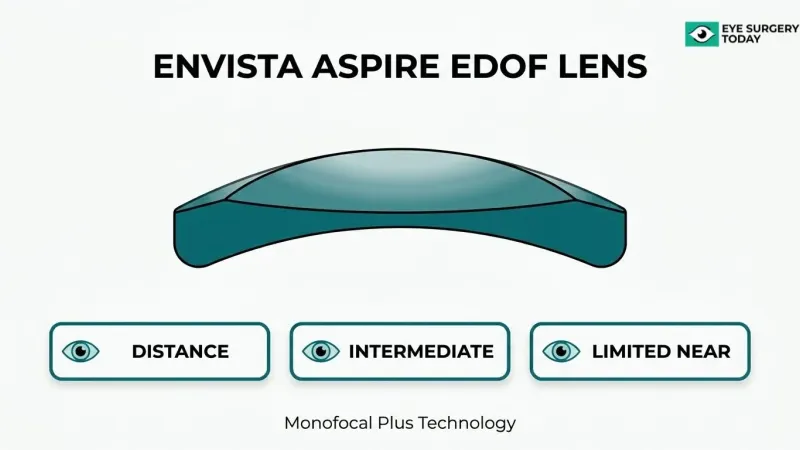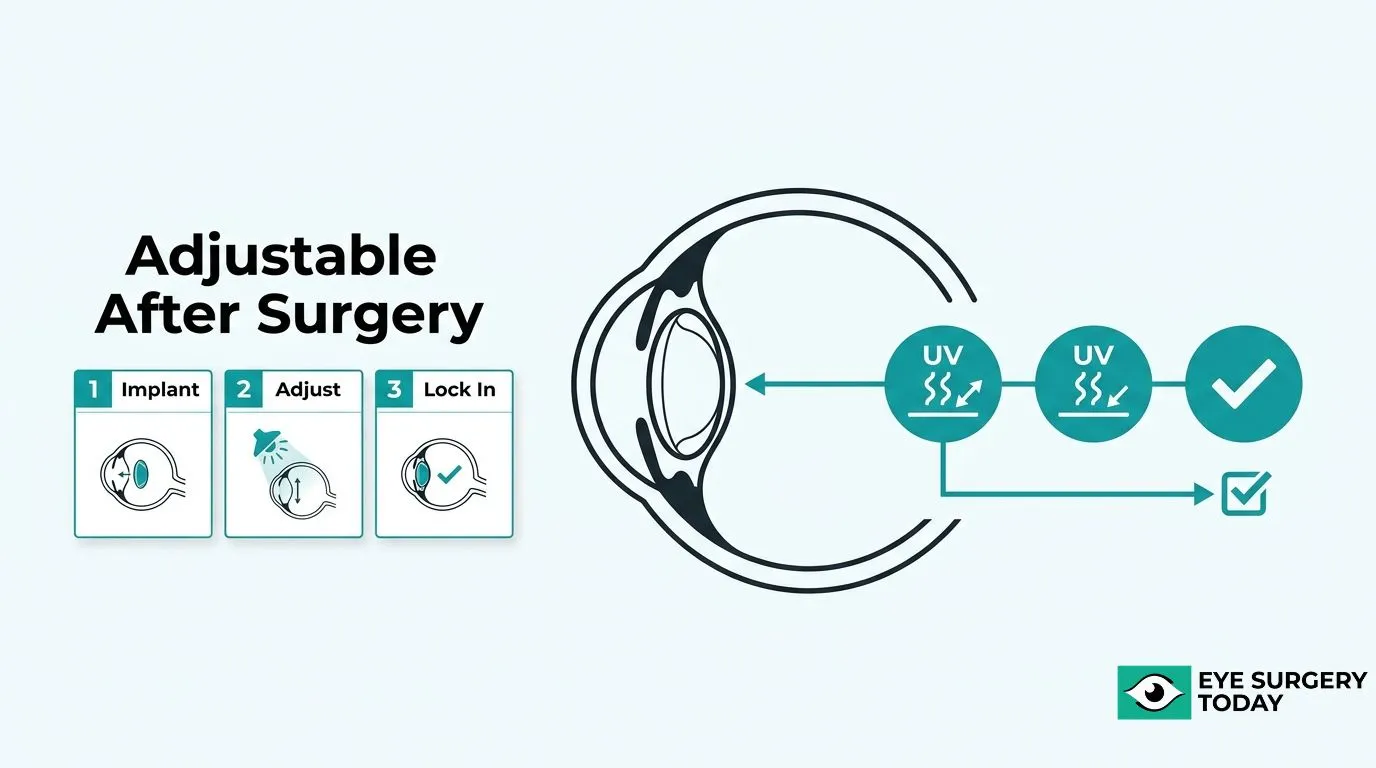
The Light Adjustable Lens (LAL) is a photoreactive silicone intraocular lens that can be customized after cataract surgery through targeted UV light exposure, making it particularly valuable for eyes with prior LASIK, PRK, or radial keratotomy where standard IOL power calculations carry elevated risk of refractive error.
This guide covers how the LAL adjustment mechanism works in surgically altered corneas, why post-refractive eyes are uniquely suited for adjustable optics, candidacy considerations across different refractive histories, potential benefits and risks, the surgical timeline, comparisons to other premium IOLs, and current clinical outcome data.
The LAL uses photochemical polymerization triggered by 365 nm UV light to reshape the implanted lens, and in post-refractive eyes, this process may improve refractive precision from roughly 44% of eyes on target before adjustment to 88% afterward.
Standard IOL formulas consistently underperform in corneas altered by prior refractive surgery because modified curvature profiles break the assumptions these formulas rely on; the LAL’s post-implant adjustability compensates by allowing surgeons to correct the actual residual error rather than relying on preoperative estimates alone.
Candidacy depends on stable refraction, adequate corneal health, and absence of contraindications such as photosensitizing medications or conditions preventing UV delivery to the lens, with specific considerations varying for myopic corrections, hyperopic corrections, and radial keratotomy patients.
The process typically requires 3 to 5 light delivery device visits and mandatory UV-protective eyewear throughout the adjustment period, while potential side effects may include temporary glare, halos, or rare color perception changes.
Registry data show that 93.5% of LAL+ eyes achieved refractive targets within 0.50 D, and in post-RK populations specifically, 74% of eyes reached 20/20 uncorrected distance acuity after adjustment.
How Does the Light Adjustable Lens Work in Post-Refractive Eyes?
The Light Adjustable Lens works by using targeted UV light to alter the refractive power of a photoreactive silicone implant after cataract surgery. The sections below explain how UV adjustment corrects residual error, how prior corneal surgery affects lens programming, and how many treatment sessions the process typically requires.
How Does UV Light Adjustment Correct Residual Refractive Error?
UV light adjustment corrects residual refractive error by triggering photochemical polymerization within the lens’s silicone macromer matrix, reshaping the lens to shift its focal power. This mechanism is especially valuable in post-refractive eyes, where preoperative IOL power calculations are inherently less predictable. According to a registry study published in the Journal of Cataract & Refractive Surgery, 93.5% of eyes achieved a mean refractive spherical equivalent within 0.50 D of target following LAL+ adjustments. In eyes with prior radial keratotomy specifically, LDD adjustments increased the proportion of eyes within ±0.50 D of target from 44% before adjustment to 88% after, a meaningful accuracy gain that standard monofocal lenses cannot offer postoperatively.
How Do Post-Refractive Corneal Changes Affect LAL Programming?
Post-refractive corneal changes affect LAL programming by introducing irregular, altered curvature profiles that standard biometry formulas cannot fully model. Eyes with prior LASIK, PRK, or radial keratotomy have modified anterior corneal surfaces that distort effective lens power estimates. Because the LAL permits correction after implantation, surgeons can observe the patient’s actual refractive response first and then apply targeted UV treatments to fine-tune the result, rather than committing to a fixed power calculated from imperfect corneal data alone. This iterative approach makes altered-cornea programming a strength of the LAL, not a barrier.
How Many Light Treatments Are Typically Needed After Implantation?
The number of light treatments typically needed after LAL implantation is between 3 and 5 total light delivery device (LDD) visits, according to the American Refractive Surgery Council. These visits generally include 1 to 3 adjustment sessions followed by two mandatory lock-in treatments that permanently stabilize the lens power by fully polymerizing all remaining macromers. Certain patients are not eligible for this process: LAL implantation is generally avoided in individuals with a history of photosensitizing medications such as tetracycline or amiodarone, or in those with ocular conditions that prevent adequate UV delivery to the lens.
With a clear picture of how the LAL adjustment process works, the next step is understanding why post-LASIK eyes benefit most from this technology.
Why Is the Light Adjustable Lens Suited for Post-LASIK Eyes?
The Light Adjustable Lens is suited for post-LASIK eyes because prior corneal refractive surgery makes accurate IOL power prediction significantly harder, and the LAL’s post-implant adjustability compensates for that inherent uncertainty. The sections below explain why standard formulas struggle after LASIK, PRK, and RK, and how adjustability reduces refractive surprise.
Why Do Standard IOL Formulas Struggle After LASIK?
Standard IOL formulas struggle after LASIK because prior laser ablation alters the corneal curvature in ways that cause conventional keratometry to underestimate true corneal power, leading to systematic hyperopic refractive surprise. The altered relationship between anterior and posterior corneal curvature breaks assumptions built into traditional vergence formulas. According to a 2022 review published by EyeWorld, the Barrett True-K formula achieved a significantly higher percentage of eyes within ±0.25 D (44.8%) compared to the Haigis-L formula (34.4%), illustrating that even the best available formulas still leave meaningful residual error in this population.
Why Do Standard IOL Formulas Struggle After PRK?
Standard IOL formulas struggle after PRK for the same fundamental reason as post-LASIK eyes: surface ablation changes the anterior corneal shape, making standard keratometric readings unreliable inputs for vergence-based power calculations. Because PRK removes tissue directly from the epithelium and Bowman’s layer without a flap, the effective corneal power can be similarly misjudged. The result is comparable formula inaccuracy, meaning surgeons face the same elevated risk of refractive surprise even when applying post-refractive-optimized calculations.
Why Do Standard IOL Formulas Struggle After RK?
Standard IOL formulas struggle after RK because radial incisions flatten the central cornea in a highly variable and often asymmetric pattern, making both the magnitude and axis of effective corneal power difficult to measure reliably. Corneal instability following RK can also produce diurnal refractive fluctuations, further complicating preoperative biometry and target selection. This variability means formula error in post-RK eyes tends to be larger and less predictable than in post-LASIK or post-PRK populations.
Why Does Post-Implant Adjustability Reduce Refractive Surprise?
Post-implant adjustability reduces refractive surprise because it decouples the accuracy requirement from preoperative biometry alone, allowing the surgeon to correct residual refractive error after the cornea has stabilized following cataract surgery. The American Academy of Ophthalmology recommends using the ASCRS Post-Refractive IOL Calculator to average multiple formulas and reduce the risk of significant refractive surprise, yet residual error still occurs. The LAL addresses this gap directly. Comparative data indicate that the LAL+ maintains similar refractive predictability to the base LAL model while also providing broader depth of focus and reduced anisometropia. In post-refractive eyes, where formula uncertainty is highest, the ability to fine-tune lens power after implantation is arguably the single most impactful feature a premium IOL can offer.
Who Is a Good Candidate for the LAL After Prior Refractive Surgery?
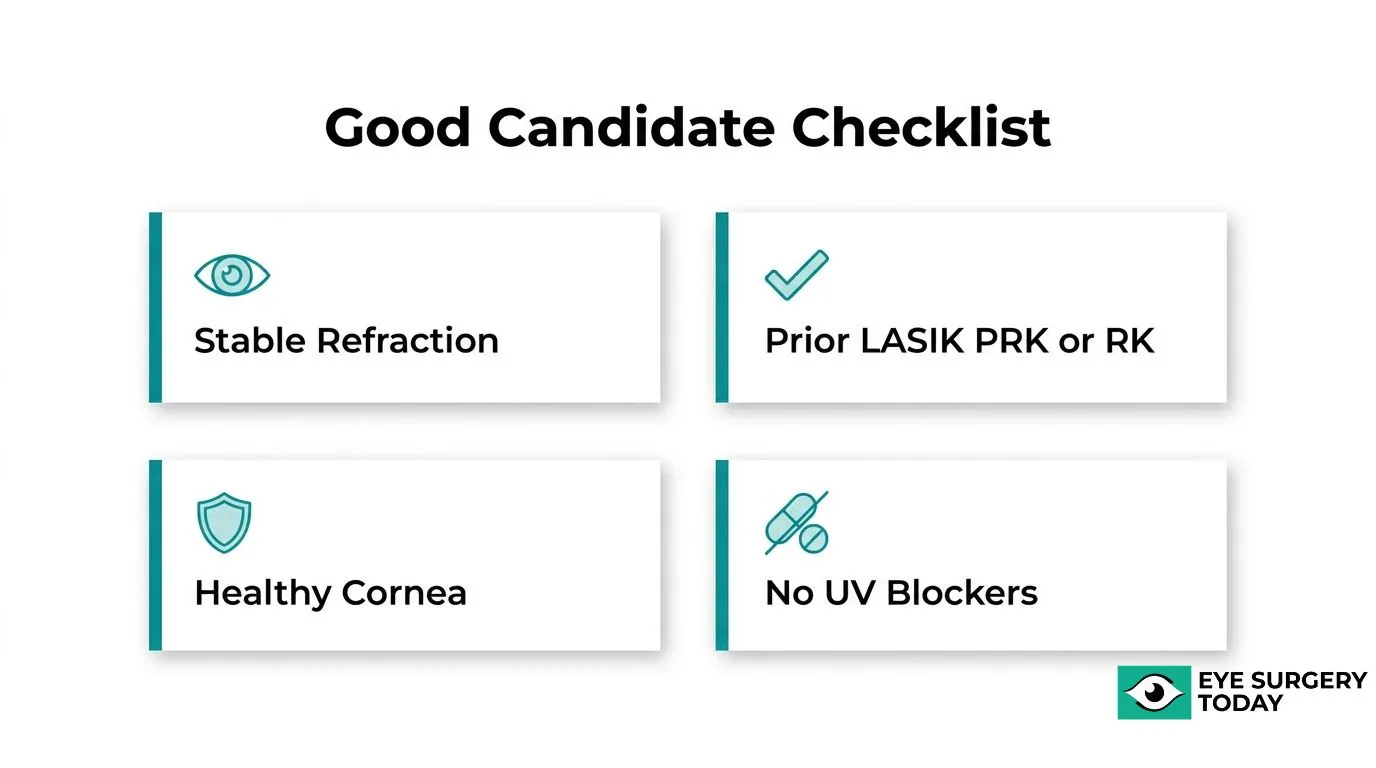
Good candidates for the LAL after prior refractive surgery share several core traits: stable refraction, adequate corneal health, and a history of myopic LASIK, PRK, hyperopic correction, or radial keratotomy. The following sub-sections address each refractive history type and outline when the LAL may not be appropriate.
Who Qualifies After Previous Myopic LASIK or PRK?
Patients who qualify after previous myopic LASIK or PRK are those with a stable refraction, well-centered ablation zone, and no significant corneal irregularities. Because myopic LASIK and PRK flatten the central cornea, standard IOL formulas tend to underestimate true corneal power, increasing the risk of a hyperopic refractive surprise at cataract surgery. The LAL’s post-implant adjustability is particularly valuable here, since any residual refractive error can be corrected non-invasively after the eye stabilizes. Ideal candidates generally have documented pre-LASIK or pre-PRK refraction data available, which supports more accurate IOL power selection before surgery.
Who Qualifies After Previous Hyperopic LASIK or PRK?
Patients who qualify after previous hyperopic LASIK or PRK are those with a stable refraction and no significant corneal ectasia or scarring from their prior procedure. Hyperopic corrections steepen the central cornea rather than flatten it, creating a distinct optical profile that standard formulas also misinterpret, though in the opposite direction from myopic ablations. As with post-myopic patients, post-hyperopic candidates benefit most when their ablation zone is well-centered and corneal topography remains regular. The LAL’s adjustability provides a critical safety net for correcting the myopic shift that can occur when IOL power is miscalculated in this group.
Who Qualifies After Previous Radial Keratotomy?
Patients who qualify after previous radial keratotomy (RK) are those with relatively stable corneas, minimal ongoing hyperopic drift, and no significant wound-related complications such as ruptured incisions. RK presents unique challenges because the spoke-like incision pattern can cause diurnal fluctuation in corneal curvature and unpredictable long-term refractive drift. According to a study reported by Ophthalmology Advisor, 74% of 94 eyes with prior RK achieved uncorrected distance visual acuity of 20/20 or better after LAL implantation and adjustment. The number of RK incisions, whether 4-cut, 8-cut, or 16-cut, and the presence of any subsequent enhancements such as astigmatic keratotomy or LASIK are key factors surgeons evaluate when assessing postoperative refractive stability. Long-term comparative data for the LAL versus multifocal or EDOF lenses in post-RK populations remains limited, so patient counseling on realistic expectations is especially important in this group.
Who May Not Be a Good Candidate Despite Prior Refractive Surgery?
Patients who may not be good candidates despite prior refractive surgery include those with an unstable refraction, decentered or irregular ablation zone, or active ocular surface disease that compromises biometry accuracy. According to a meta-analysis published in Clinical Optometry, refractive surprise occurs at a significantly higher rate in eyes with prior corneal refractive surgery compared to virgin eyes, even when using modern formulas such as Barrett True-K or Haigis-L. While the LAL can correct residual error after implantation, it cannot compensate for poor preoperative measurements caused by irregular corneal topography. Additional disqualifying factors include a history of photosensitizing medications such as tetracycline or amiodarone, conditions that prevent adequate UV delivery to the lens, and inability to comply with the mandatory UV-protective eyewear protocol required throughout the adjustment period.
What Are the Potential Benefits of the LAL for Post-Refractive Patients?
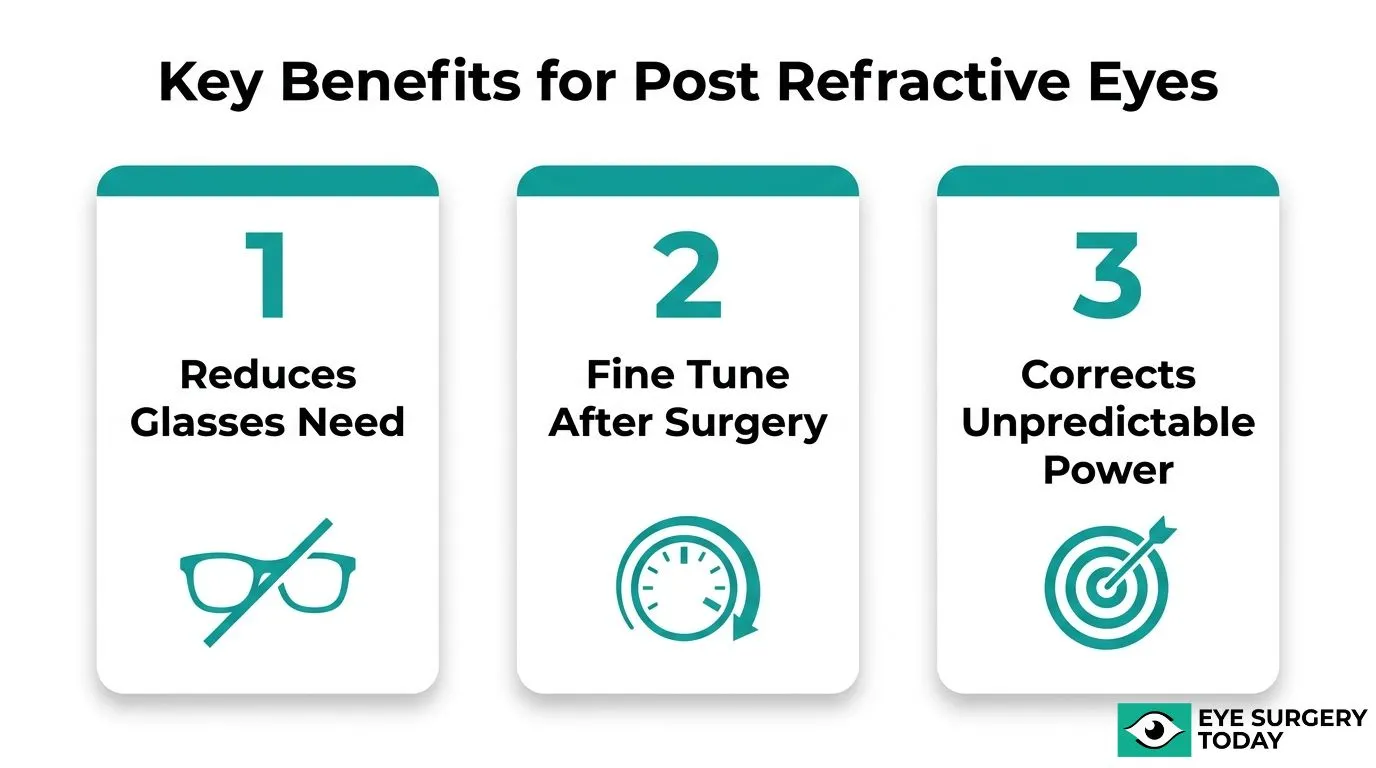
The potential benefits of the LAL for post-refractive patients center on three capabilities: reducing glasses dependence after cataract surgery, enabling postoperative fine-tuning of vision, and correcting the unpredictable corneal power common in previously operated-on eyes.
How May the LAL Reduce Dependence on Glasses After Cataract Surgery?
The LAL may reduce dependence on glasses after cataract surgery by allowing refractive adjustments after implantation, compensating for the IOL power errors that frequently occur in post-refractive eyes. Standard IOL formulas often miss their refractive target in corneas previously altered by LASIK, PRK, or RK, leaving patients dependent on glasses for activities they expected to perform unaided. The American Academy of Ophthalmology recommends using averaged multi-formula calculators for post-refractive eyes precisely because no single formula reliably eliminates this risk. The LAL’s adjustability provides a correction pathway that standard lenses cannot offer once implanted.
How May Postoperative Fine-Tuning Improve Visual Outcomes?
Postoperative fine-tuning may improve visual outcomes by targeting the actual refractive error present in the patient’s eye after healing, rather than relying solely on preoperative predictions. In post-refractive corneas, healing and biometric measurement variability can shift the effective refractive result away from the intended target. With the LAL, surgeons can measure the stabilized postoperative refraction and apply targeted UV light treatments to bring the lens power precisely to that real-world result. This iterative approach addresses residual errors that preoperative planning alone cannot eliminate.
How Does Customized Adjustment Address Unpredictable Corneal Power?
Customized adjustment addresses unpredictable corneal power by enabling individualized power modification after implantation, specific to each eye’s actual refractive state. Post-refractive corneas have non-standard curvature profiles that cause all preoperative formulas to estimate, not measure, the true effective lens power needed. According to Dr. Vance Thompson, founder of Vance Thompson Vision, “The RxLAL is the only FDA-approved IOL that can be customized through a power adjustment after its implantation in the patient’s eye.” This FDA-approved capability is clinically significant for post-refractive patients because it converts an unpredictable preoperative estimate into a verifiable, correctable postoperative outcome.
What Are the Possible Risks and Complications of the LAL?
The possible risks and complications of the LAL include UV exposure restrictions, the potential for incomplete refractive correction, and side effects from the light treatment process. The sections below address each of these in detail.
What UV Exposure Restrictions Apply During the Adjustment Period?
The UV exposure restrictions that apply during the adjustment period are strict and continuous. Patients must wear RxSight-provided UV-protective glasses during all waking hours from the time of LAL implantation until 24 hours after the final lock-in treatment is completed. This requirement exists because any uncontrolled UV exposure during this window may trigger unintended photochemical changes in the lens, permanently shifting its refractive power. According to Heart of America Eye Care, visual disturbances such as glare and halos may be experienced during this adjustment phase before the final lock-in procedure. Patients who are not prepared for this compliance requirement may find it disruptive. In practice, this is one of the most commonly underestimated aspects of LAL candidacy.
What Happens If the Desired Correction Is Not Fully Achieved?
The outcome when the desired correction is not fully achieved depends on how much residual error remains and whether additional adjustment capacity exists within the lens. The LAL’s photoreactive macromers can accommodate a limited range of refractive change, and if the target is not met within that range, options become constrained. In post-refractive eyes particularly, corneal irregularity may limit how precisely the LDD can compensate. Glasses or contact lenses may be needed for residual correction, and enhancement procedures carry their own risks in eyes with prior corneal surgery.
What Are the Potential Side Effects of the Light Treatments?
The potential side effects of the light treatments are generally mild and transient, though some are unique to the LAL system. According to EyeWiki, rare adverse effects include erythropsia (red-tinted vision) and temporary alterations in color perception following UV light exposure sessions. These effects typically resolve on their own as the eye adapts after each treatment. Patients should discuss the full side effect profile with their surgeon before proceeding, particularly if they have occupations or activities that are sensitive to even brief changes in color vision.
What Should You Expect Before, During, and After LAL Surgery?
LAL surgery involves three distinct phases: preoperative measurement, the implantation procedure itself, and a postoperative adjustment and lock-in timeline. Each phase has specific requirements for post-refractive eyes.
What Preoperative Measurements Are Needed for Post-Refractive Eyes?
Preoperative measurements for post-refractive eyes require careful biometry and formula selection, as altered corneal geometry makes standard IOL calculations unreliable. The Barrett True-K formula is recommended as the priority formula for eyes with prior myopic LASIK or PRK, having demonstrated superior IOL power prediction accuracy compared to traditional formulas, according to a 2022 EyeWorld review. The ASCRS Post-Refractive IOL Calculator is also recommended to average multiple formulas and further reduce refractive surprise risk. When these protocols are followed carefully, outcomes improve substantially: in post-refractive emmetropic-goal eyes implanted with the LAL 2.0, 100% of eyes were within ±0.50 D of target at the final postoperative visit, as reported in Clinical Ophthalmology.
What Happens During the LAL Implantation Procedure?
The LAL implantation procedure follows the same surgical steps as standard cataract surgery. The natural crystalline lens is removed via phacoemulsification, and the LAL is inserted into the capsular bag through a small incision. What distinguishes the LAL is that the implantation itself is not the final refractive event — the lens power remains adjustable afterward, which is particularly valuable for post-refractive eyes where intraoperative power predictions carry greater uncertainty.
What Is the Postoperative Light-Adjustment Timeline?
The postoperative light-adjustment timeline typically spans several weeks following implantation. Once the eye stabilizes, usually a few weeks after surgery, the surgeon uses the light delivery device (LDD) to perform one to three adjustment sessions. Each session exposes targeted zones of the lens to 365 nm UV light, shifting lens curvature and refractive power. Patients should expect multiple office visits across this period before the refraction is finalized.
When Is the Final Lock-In Treatment Performed?
The final lock-in treatment is performed after the surgeon and patient confirm the adjusted refraction is satisfactory, typically following the adjustment sessions. Two mandatory lock-in treatments fully polymerize all remaining photoreactive macromers, permanently stabilizing the lens power. According to RxSight, patients must wear RxSight-provided UV-protective glasses during all waking hours from the time of LAL implantation until 24 hours after the final lock-in is completed, as unprotected UV exposure before lock-in can cause uncontrolled refractive changes.
How Does the LAL Compare to Other Premium IOLs for Post-Refractive Eyes?
The LAL differs from multifocal, toric, and EDOF IOLs primarily in its post-implant adjustability, which is particularly valuable when pre-surgical measurements are less predictable. Each comparison below highlights where the LAL holds a clinical advantage and where trade-offs exist for post-refractive patients.
How Does the LAL Compare to Multifocal IOLs After LASIK?
The LAL compares favorably to multifocal IOLs after LASIK because it avoids compounding optical complexity on an already irregular corneal surface. Multifocal IOLs split incoming light into multiple focal points to provide near, intermediate, and distance vision, but this design amplifies optical aberrations in post-LASIK eyes where corneal shape is irregular. That makes patients with prior LASIK significantly more susceptible to halos, glare, and reduced contrast sensitivity when a multifocal lens is used. The LAL, by contrast, functions as a monofocal lens that can be fine-tuned after implantation, keeping the optical profile simpler and more compatible with altered corneal geometry.
How Does the LAL Compare to Toric IOLs After LASIK?
The LAL compares to toric IOLs after LASIK by offering a correction pathway that is not limited to pre-set cylinder axes. Toric IOLs correct astigmatism by aligning a fixed cylindrical power to a calculated corneal axis, but post-LASIK eyes often have irregular or mixed astigmatism that does not conform to standard toric calculations. Rotational misalignment of a toric IOL in these eyes carries greater refractive consequences. The LAL allows the surgeon to measure actual postoperative cylinder, then dial in the appropriate spherocylindrical correction through UV light adjustment, reducing the risk of a significant residual astigmatic error that would otherwise require further intervention.
How Does the LAL Compare to Extended Depth of Focus IOLs After LASIK?
The LAL compares to EDOF IOLs after LASIK by offering adjustable optics rather than a fixed extended range. According to Glaucoma Today, the LAL+ model incorporates a modified aspheric anterior surface that slightly extends the depth of focus compared to the original LAL, providing improved intermediate vision before light treatments are even initiated. This means the LAL+ can function similarly to a mild EDOF lens at baseline, while retaining the ability to further refine sphere and cylinder postoperatively. Standard EDOF IOLs provide a fixed extended range but cannot be modified if a refractive surprise occurs, a meaningful limitation in post-LASIK eyes where IOL power calculation errors are more common.
What Do 2026 Clinical Outcomes Show for the LAL in Post-Refractive Patients?
2026 clinical outcomes show that the LAL delivers strong refractive accuracy and visual performance in post-refractive patients. The data below covers overall predictability, uncorrected visual acuity, and how the LAL+ compares to the original LAL model.
What Refractive Predictability Does the LAL+ Achieve?
Refractive predictability with the LAL+ is high in post-refractive populations. According to a registry analysis published in the Journal of Cataract & Refractive Surgery, 93.5% of eyes achieved a mean refractive spherical equivalent within 0.50 D of target following the adjustment protocol. For a population historically prone to refractive surprise, that level of precision is clinically significant. Post-implant adjustability effectively converts an estimated target into a confirmed outcome, which is difficult to replicate with fixed-power IOLs in altered corneas.
What Uncorrected Visual Acuity Outcomes Are Reported in RK Eyes?
Uncorrected visual acuity outcomes in post-radial keratotomy eyes are meaningfully better with the LAL than historical benchmarks suggest. In a study of 94 eyes with prior radial keratotomy published in the Journal of Cataract & Refractive Surgery, 74% achieved uncorrected distance visual acuity of 20/20 or better after LAL implantation and adjustment. Given the pronounced corneal irregularity and hyperopic drift common in RK patients, these results reflect a strong case for adjustable optics in this subgroup.
How Does the LAL+ Compare to the Original LAL Model?
The LAL+ compares favorably to the original LAL model across several clinically relevant dimensions. Published comparative data indicates that the LAL+ provides broader depth of focus and reduced anisometropia while maintaining similar refractive predictability to the base LAL model. The LAL+ also incorporates a modified aspheric anterior surface that extends depth of focus compared to the original, improving intermediate vision prior to light treatments. For post-refractive patients who value functional intermediate vision during the adjustment window, the LAL+ offers a meaningful practical advantage over its predecessor.
How Can You Make an Informed Decision About the LAL for Post-Refractive Eyes?
Making an informed decision about the Light Adjustable Lens starts with understanding how the technology works, who qualifies, and what realistic outcomes look like. The following sections cover what Eye Surgery Today offers for guidance and the essential takeaways for post-refractive patients.
Can Eye Surgery Today Help You Understand Your Advanced IOL Options?
Yes, Eye Surgery Today can help you understand your advanced IOL options through surgeon-reviewed educational content designed specifically for patients navigating complex decisions like the LAL after prior refractive surgery. For post-refractive patients, where standard IOL formulas carry higher risk of refractive surprise, having clear and accurate information before any consultation is genuinely valuable. Eye Surgery Today translates clinical evidence into accessible language, so you can arrive at your surgeon’s office equipped with the right questions.
What Are the Key Takeaways About the Light Adjustable Lens for Post-Refractive Eyes?
The key takeaways about the Light Adjustable Lens for post-refractive eyes are:
- The LAL corrects residual refractive error after implantation using photoreactive silicone macromers that respond to targeted UV light, a unique capability no standard IOL offers.
- Post-refractive eyes benefit most because standard IOL formulas carry elevated refractive surprise risk in corneas altered by LASIK, PRK, or RK.
- Clinical outcomes are strong: as of early 2026, RxSight reported over 300,000 LAL implants worldwide, according to RxSight Investor Relations.
- Cost requires planning: out-of-pocket expenses typically range from $4,000 to $6,000 per eye, as Medicare does not cover the premium IOL component.
- UV protection is mandatory from implantation until 24 hours after the final lock-in treatment.
- Candidacy is individualized: photosensitizing medications and certain ocular conditions may disqualify some patients.
As Dr. John Doane of Discover Vision Centers notes, the LAL’s adjustability is where personalized vision correction becomes both art and science for each patient.