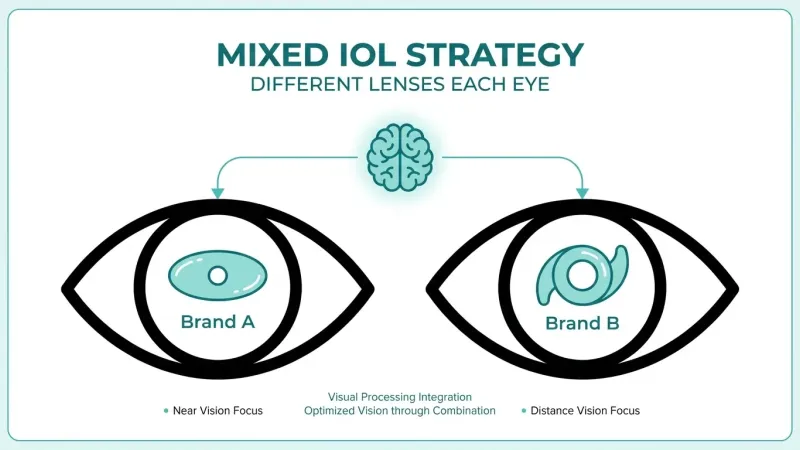
Monovision for cataract surgery is a refractive strategy where one eye receives an intraocular lens targeted for distance vision and the other eye receives a lens targeted for near vision, allowing the brain to draw on each eye selectively depending on the task.
This guide covers how monovision and mini-monovision differ in their refractive targets, candidate selection and pre-surgical trialing, potential benefits and risks of each approach, comparisons with multifocal and extended depth of focus lenses, and recovery expectations including neuroadaptation.
Conventional monovision targets a near-eye correction of -2.50 D to -2.75 D, while mini-monovision uses a much smaller interocular gap, typically -0.50 D to -1.25 D. This reduced separation may preserve binocular function and stereopsis more effectively.
Appropriate candidates are identified through ocular dominance testing and a three-week contact lens trial that simulates the planned correction in daily life. Factors such as lifestyle demands, tolerance for blur, and personality type all influence whether full monovision, mini-monovision, or neither is suitable.
Mini-monovision may reduce spectacle dependence while avoiding the halos and glare associated with multifocal IOL designs. However, any monovision strategy carries potential trade-offs, including reduced contrast sensitivity, compromised intermediate vision, and a neuroadaptation period that can last several months.
When compared directly to multifocal IOLs, monovision strategies may produce similar functional acuity with fewer photic disturbances and lower lens exchange rates, though the decision remains a personalized, surgeon-guided process with no universal clinical guideline for IOL type selection.
What Is Monovision in the Context of Cataract Surgery?
Monovision in cataract surgery is a refractive strategy where each eye is targeted for a different focal distance during intraocular lens (IOL) implantation. The sections below explain how this works mechanically, how conventional and mini-monovision differ, and what anisometropia targets each approach uses.
How Does Monovision Work With Intraocular Lenses?
Monovision works with intraocular lenses by implanting IOLs of deliberately different powers: one eye is targeted for clear distance vision, while the other is targeted for near vision. The brain then suppresses the out-of-focus image from one eye depending on the task, a process called neuroadaptation. Not every patient adapts equally well. According to a review published in the Journal of Cataract and Refractive Surgery, contraindications include amblyopia and conditions involving a strong sighting preference, such as monofixation syndrome. Patients with type-A personalities may be better suited to full distance bilateral correction rather than monovision.
What Is the Difference Between Monovision and Mini-Monovision?
The difference between monovision and mini-monovision is the size of the interocular dioptric power gap. Conventional monovision targets one eye for distance and the other for near, with a large refractive separation. Mini-monovision, also called modified monovision, uses a significantly smaller gap. According to the American Academy of Ophthalmology, clinical practice targets the dominant eye for emmetropia and the nondominant eye between -0.5 D and -0.75 D, with Dr. Cynthia Matossian recommending an interocular difference of no more than 0.75 D. This reduced separation generally preserves binocular function and stereopsis more effectively than the conventional approach.
How Much Anisometropia Is Used in Each Approach?
The anisometropia used in each approach differs substantially between conventional monovision and mini-monovision. Conventional monovision typically targets a near-eye myopic correction of -2.50 D to -2.75 D, creating a large interocular power difference. Mini-monovision uses a much smaller gap, generally between -0.75 D and -1.25 D in the near eye, which reduces the risk of adaptation failure while still providing useful near and intermediate function.
| Approach | Distance Eye Target | Near Eye Target | Interocular Difference |
| Conventional monovision | Emmetropia | -2.50 D to -2.75 D | ~2.50–2.75 D |
| Mini-monovision | Emmetropia | -0.50 D to -1.25 D | 0.75 D or less |
Smaller anisometropia in mini-monovision is often the more clinically practical choice, since it reduces the stereopsis compromise while still meaningfully extending the functional range of unaided vision.
Who Is a Good Candidate for Monovision or Mini-Monovision?
Good candidates for monovision or mini-monovision share certain visual needs, lifestyle priorities, and neuroadaptive capacity. The following sub-sections cover who benefits most from full monovision, who is better suited to the mini approach, and who should avoid both strategies.
Who May Benefit Most From Full Monovision?
Patients who may benefit most from full monovision are those with a strong tolerance for anisometropia and a clear priority for spectacle-free distance and near vision without intermediate demands. According to a clinical study published in the Journal of Cataract & Refractive Surgery, male patients often show a significant preference for full distance correction, while female patients choose monovision and full distance correction equally. This suggests gender-related visual priorities may meaningfully influence which correction strategy a patient gravitates toward in practice.
Patients who read frequently in close, controlled conditions, such as printed books or documents at a fixed distance, tend to adapt more comfortably to the larger interocular difference that full monovision requires.
Who May Be Better Suited for Mini-Monovision?
Patients who may be better suited for mini-monovision are those who want reduced spectacle dependence while preserving stronger binocular function and depth perception. The smaller interocular power difference in mini-monovision, typically no more than 0.75 D, makes neuroadaptation easier and intermediate vision more functional than with full monovision.
Ideal candidates include:
- Patients with active lifestyles requiring reliable intermediate vision, such as computer work or driving
- Individuals who are sensitive to blur or contrast reduction in low-light conditions
- Patients who cannot tolerate a contact lens trial simulating full monovision
- Those who prioritize maintaining natural depth perception for tasks like sport or spatial navigation
Mini-monovision is often the more practical choice for patients who want meaningful spectacle independence without the visual trade-offs of larger anisometropia. It represents a balanced entry point for patients who are uncertain whether they can fully adapt.
Who Should Avoid Monovision Strategies Altogether?
Patients who should avoid monovision strategies altogether include those with amblyopia, monofixation syndrome, or a strong uncrossed sighting dominance that cannot be overridden neurologically. Patients described clinically as type-A personalities, those with perfectionist tendencies around visual precision, may also be poor candidates, as they often struggle to accept the residual blur inherent in any monovision approach. Additionally, individuals whose occupations or hobbies demand consistently precise stereoacuity, such as surgeons, pilots, or competitive athletes, should discuss whether the depth perception trade-off is acceptable before proceeding.
What Are the Potential Benefits of Monovision Cataract Surgery?
The potential benefits of monovision cataract surgery include reduced dependence on glasses, preserved depth perception, and avoidance of the visual side effects linked to multifocal lenses. The following sections cover each of these advantages in detail.
How May Monovision Reduce Dependence on Reading Glasses?
Monovision may reduce dependence on reading glasses by correcting one eye for distance and the other for near vision, allowing the brain to draw on each eye selectively. According to a study published by George Mason University and Eye Consultants of Northern Virginia, 93% of patients reported that mini-monovision met their expectations for decreased spectacle dependence, with only 9% requiring glasses for reading and 18% for night driving. For patients who want functional independence from eyewear without committing to premium multifocal lenses, mini-monovision is often one of the most practical available strategies.
How Does Mini-Monovision Help Preserve Depth Perception?
Mini-monovision helps preserve depth perception by using a smaller interocular refractive difference than conventional monovision, keeping the two eyes close enough in power to maintain binocular function. Because the gap between the distance eye and the near eye stays within a modest range, stereoacuity is less disrupted than with full monovision targets. This more conservative approach makes mini-monovision particularly well suited for patients who perform tasks requiring accurate spatial judgment, such as driving or sports.
Can Monovision Avoid Unwanted Visual Side Effects of Multifocal Lenses?
Monovision can avoid the photic side effects associated with multifocal lenses. According to BMC Ophthalmology, mini-monovision with monofocal lenses is a lower-cost option that avoids the halos and glare linked to multifocal IOL designs, which split incoming light across multiple focal points. For patients who are sensitive to nighttime visual disturbances, this distinction is clinically meaningful and worth weighing carefully against the higher spectacle independence that multifocal lenses can offer.
What Are the Possible Risks and Drawbacks of Monovision?
The possible risks and drawbacks of monovision include impaired depth perception, compromised intermediate vision, and the potential to never fully adapt after surgery. The sections below cover how each of these challenges may affect patients.
How May Monovision Affect Depth Perception and Binocular Vision?
Monovision may affect depth perception by reducing the brain’s ability to fuse images from both eyes into a single, coherent view. When each eye is corrected for a different focal distance, binocular summation is partially disrupted, and stereoacuity can decline as a result.
Common reasons for conventional monovision failure include:
- Decreased contrast sensitivity at high spatial frequencies
- Asthenopia (eye strain)
- Impaired depth perception
Accurate candidate selection is also a challenge. According to a study published in Translational Vision Science & Technology, standard sensory and sighting dominance tests matched in only 55% of subjects, suggesting that the hole-in-card test alone may not reliably identify the best eye for distance correction. A three-week contact lens trial is recommended before surgery to screen whether a patient can tolerate the required anisometropia.
Depth perception concerns are among the most common questions patients raise before committing to monovision.
What Visual Compromises Can Occur at Intermediate Distances?
The visual compromises that can occur at intermediate distances include reduced clarity for tasks such as computer use, dashboard reading, and seeing faces across a room. Conventional monovision is optimized for distance and near extremes, leaving an uncorrected zone in between. Patients who rely heavily on mid-range vision for work or daily activities may find this gap more disruptive than those with primarily near or distance needs.
Is There a Risk of Not Adapting to Monovision After Surgery?
Yes, there is a risk of not adapting to monovision after surgery. Postoperative neuroadaptation may take several months, and according to Cataract & Refractive Surgery Today, the expected dropout rate for LASIK monovision is approximately 5%. For surgical monovision with IOLs, reversal is more complex than removing a contact lens, making pre-surgical trialing especially important. Patients with demanding visual lifestyles or low tolerance for anisometropia are at higher risk of non-adaptation.
How Does Monovision Compare to Multifocal and EDOF Lenses?
Monovision and multifocal IOLs each address presbyopia differently after cataract surgery. The sections below compare these approaches across near vision outcomes, extended depth of focus designs, and blended vision strategies.
How Does Monovision Compare to Multifocal IOLs for Near Vision?
Monovision compares to multifocal IOLs for near vision as a strategy that achieves similar functional outcomes with fewer photic side effects, though through a different optical mechanism. Pseudophakic monovision relies on neuroadaptation, where the brain uses the distance image from the dominant eye and the near image from the non-dominant eye to achieve functional vision across distances. Conventional monovision targets -2.50 D to -2.75 D myopia in the near eye, while mini-monovision aims for -0.75 D to -1.25 D to preserve better stereopsis.
According to a Cochrane Database of Systematic Reviews analysis, multifocal IOLs produced more glare (RR 1.41) and haloes (RR 3.58) than monofocal lenses, yet a direct comparison with monovision found no meaningful difference in distance VA (MD 0.02 logMAR) or near VA (MD -0.04 logMAR) between the two groups. Six patients in the multifocal IOL group required IOL exchange within the first year, compared to zero in the monovision group.
Mini-monovision also carries a cost advantage: patients frequently choose it over premium multifocal IOLs to avoid significant out-of-pocket expenses. From a clinical standpoint, the near-equivalence in visual acuity combined with fewer photic complaints and lower revision rates makes mini-monovision a compelling default for many patients who are not strongly motivated by complete spectacle independence.
How Does Monovision Compare to Extended Depth of Focus Lenses?
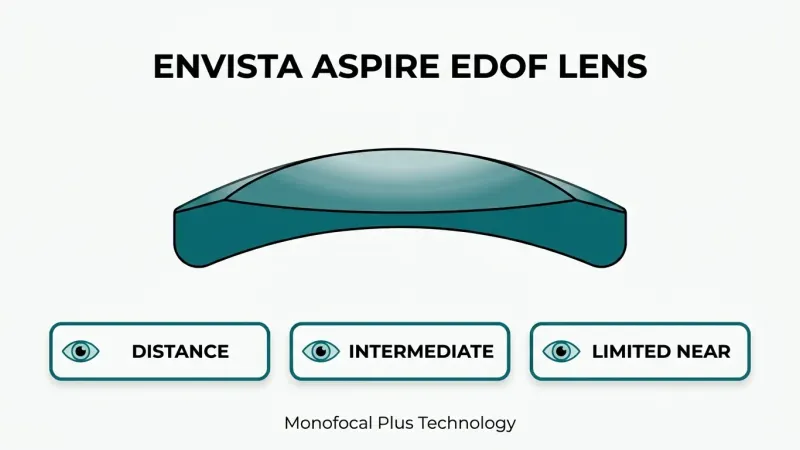
Monovision compares to extended depth of focus (EDOF) lenses as an approach that mimics the continuous range of vision EDOF designs provide, but achieves it through interocular defocus rather than lens optics. A mathematical model published by the European Society of Cataract and Refractive Surgeons identified that targeting -0.27 D for the distance eye and -1.17 D for the near eye yields the least defocus across a fixation range of 0.33 m to 6.0 m in pseudophakic patients, closely approximating the functional range EDOF lenses target. Unlike EDOF IOLs, however, mini-monovision does not require a premium lens and avoids the optical trade-offs inherent to diffractive or extended-optic designs.
How Does Mini-Monovision Compare to Blended Vision With Premium IOLs?
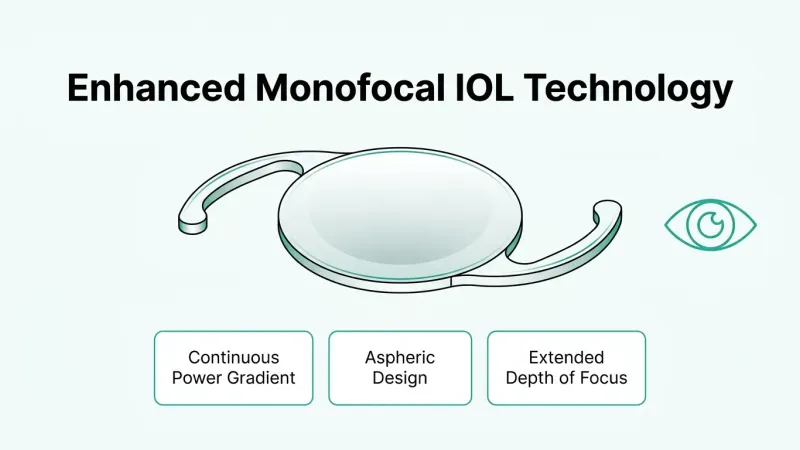
Mini-monovision compares to blended vision with premium IOLs as functionally similar strategies that are increasingly marketed under interchangeable terminology. According to the American Academy of Ophthalmology, search patterns show patients are growing more interested in “blended vision” as a consumer-facing term for mini-monovision strategies using aspheric or enhanced monofocal IOLs. In practice, blended vision often describes the same interocular defocus targets as mini-monovision, with the premium lens designation reflecting marketing positioning more than a distinct optical approach.
Understanding this distinction helps patients evaluate whether a premium-priced “blended vision” package offers measurable benefits beyond a standard mini-monovision plan with a quality monofocal IOL.
How Is the Dominant Eye Determined Before Monovision Surgery?
The dominant eye is determined before monovision surgery through a combination of sighting tests, sensory assessments, and a preoperative contact lens trial. Surgeons use these methods to identify which eye should receive distance correction and which should be targeted for near focus.
What Tests Are Used to Identify the Dominant Eye?
The tests used to identify the dominant eye include sighting-based methods, sensory tests, and clinical observation. The hole-in-card test is the most widely used sighting method: the patient extends both hands, forms a small opening, and centers a distant target through it while alternately closing each eye. The eye that keeps the target centered is the sighting-dominant eye. However, a 2023 study published in Translational Vision Science & Technology found that standard sensory and sighting dominance tests matched in only 55% of subjects, suggesting sighting tests alone may not reliably identify the optimal eye for distance correction in every patient.
Why Is Correct Dominant Eye Identification Important for Monovision?
Correct dominant eye identification is important for monovision because assigning distance correction to the wrong eye can increase the risk of neuroadaptation failure, visual discomfort, and poor functional outcomes. The dominant eye typically processes high-acuity distance information more efficiently, making it the natural candidate for distance targeting. Misidentification can result in symptoms such as asthenopia and blurred distance vision that prove difficult to reverse after surgery.
How Does a Contact Lens Trial Help Confirm Dominant Eye Selection?
A contact lens trial helps confirm dominant eye selection by simulating the planned monovision correction before any surgical commitment is made. According to guidance from Cataract & Refractive Surgery Today, a three-week contact lens trial is recommended as a preoperative screening tool to assess whether a patient can tolerate the anisometropia monovision requires. This trial period also gives surgeons additional observational data to verify that the planned dominant-eye assignment produces comfortable, functional vision for that individual patient.
Can You Trial Monovision Before Committing to Cataract Surgery?
Yes, you can trial monovision before committing to cataract surgery, and doing so is strongly recommended by most surgeons. A contact lens simulation allows patients to experience the anisometropia of monovision in real daily life before any irreversible surgical decision is made. The sections below cover how the trial works, what it reveals, and why its outcome matters.
How Is a Contact Lens Trial Used to Simulate Monovision?
A contact lens trial simulates monovision by temporarily correcting one eye for distance and the other for near, replicating the interocular defocus difference that an IOL strategy would create permanently. According to guidance from Drexel University School of Medicine, a three-week contact lens trial is the recommended minimum for screening candidates before surgery. This duration is long enough to expose real-world challenges, such as discomfort during night driving or difficulty with depth perception on stairs, that a brief in-office test would miss.
What Does a Monovision Trial Reveal About Patient Tolerance?
A monovision trial reveals whether a patient can tolerate the anisometropia required to achieve functional near and distance vision without optical aids. Candidates who adapt readily during the trial are strong surgical candidates. Those who experience persistent asthenopia, spatial disorientation, or significant visual discomfort are likely to struggle postoperatively. This screening step is particularly valuable because neuroadaptation after surgery may take several months, and identifying poor tolerance beforehand avoids a difficult recovery or, in rare cases, the need for lens exchange.
Can the Trial Help Determine the Correct Degree of Offset?
The trial can also help determine the correct degree of offset by exposing how much interocular power difference the patient comfortably accepts in practice. A patient who tolerates mild blur in the near eye but not stronger defocus may be a better candidate for mini-monovision, where the non-dominant eye typically targets only -0.50 D to -0.75 D, than for conventional monovision at -2.50 D or greater. Running the simulation at different correction levels gives the surgeon and patient objective, real-world data to guide target selection, making the pre-surgical lens planning discussion far more precise.
What Should You Expect During Recovery and Neuroadaptation?
Recovery from monovision cataract surgery involves both physical healing and a neuroadaptation period, during which the brain learns to prioritize each eye’s image. The two sections below cover how long adjustment typically takes and what options exist if adaptation is not successful.
How Long Does It Take the Brain to Adjust to Monovision?
The brain takes several months to fully adjust to monovision after cataract surgery. Neuroadaptation is the process by which the brain learns to suppress the blurred image from one eye depending on the viewing distance, drawing on the distance image from the dominant eye and the near image from the non-dominant eye to build functional vision across a range.
Early in recovery, some patients notice blur, mild visual fatigue, or reduced confidence with depth perception. These effects typically diminish as the brain consolidates its suppression response. According to Cataract and Refractive Surgery Today, postoperative adaptation may last for several months, and the expected dropout rate for LASIK monovision is approximately 5%, suggesting the large majority of patients do adapt successfully over time.
Mini-monovision, with its smaller interocular difference, generally shortens and eases this adjustment period compared to conventional monovision.
What Happens If You Cannot Tolerate Monovision After Surgery?
If you cannot tolerate monovision after surgery, several corrective options are available. Intolerance typically presents as persistent asthenopia, difficulty with depth perception, or significant visual discomfort that does not resolve with time.
In mild cases, a contact lens over the near eye can temporarily restore distance balance, allowing daily functioning while the surgical team assesses next steps. If intolerance persists, IOL exchange is a more definitive option. Notably, a Cochrane review found that zero patients in a monovision group required IOL exchange in the first year after surgery, compared to six in a multifocal IOL group, suggesting monovision carries a lower revision burden overall.
Choosing mini-monovision rather than conventional monovision is considered one of the most practical ways to reduce intolerance risk, as the smaller refractive gap is easier for the brain to reconcile.
How Should You Evaluate Lens Strategies With Your Surgeon?
Evaluating lens strategies requires combining surgeon expertise with your own informed expectations. The H3s below cover how surgeon-reviewed platforms support that process and what core takeaways should guide your final decision.
Can a Surgeon-Reviewed Educational Platform Help You Understand IOL Options?
Yes, a surgeon-reviewed educational platform can help you understand IOL options by translating clinical evidence into clear, accessible language before your consultation. Eye Surgery Today provides surgeon-reviewed educational resources covering monovision, mini-monovision, monofocal, and premium IOL strategies, helping patients arrive at surgical discussions with meaningful questions rather than uncertainty. Understanding the trade-offs between lens types before your appointment allows for a more productive, individualized conversation with your surgeon. This kind of pre-consultation education is often underestimated, but it directly shapes the quality of shared decision-making in the exam room.
What Are the Key Takeaways About Monovision and Mini-Monovision for Cataract Surgery?
The key takeaways about monovision and mini-monovision for cataract surgery center on realistic target-setting, candidate selection, and managing expectations for spectacle independence. The core lessons from this article include:
- Mini-monovision reduces spectacle dependence with a smaller interocular difference than conventional monovision, preserving better stereopsis and depth perception.
- Candidate selection is critical: ocular dominance testing, lifestyle priorities, and a pre-surgical contact lens trial all inform whether monovision is appropriate for a given patient.
- Photic phenomena are less common with monovision and mini-monovision strategies compared to multifocal IOLs, making them a practical alternative for light-sensitive patients.
- Refractive precision matters: according to a benchmark published in Eye (Nature), NHS cataract surgery targets a refractive outcome within 0.5 D in 55% of cases and within 1.0 D in 85% of cases, highlighting that small targeting errors can meaningfully affect monovision outcomes.
- No universal guideline exists for IOL type selection, so the decision between monovision, mini-monovision, and premium lenses remains a personalized, surgeon-guided process.
The right lens strategy balances your visual goals, tolerance for compromise, and the clinical judgment of your surgical team.