What Is Astigmatism and Why Should You Correct It During Cataract Surgery?
Astigmatism is a refractive error caused by an irregular curvature of the cornea or lens, preventing light from focusing on a single point and resulting in blurred or distorted vision at all distances. Cataract surgery offers a unique window to correct this condition because the eye is already open for lens replacement, making simultaneous treatment efficient and effective.
This guide covers how astigmatism affects vision, the diagnostic tools used to measure it before surgery, why cataract surgery is the optimal time to address it, the available correction methods, candidacy and risk considerations, what to expect before and after the procedure, and how surgeon-reviewed resources can support informed decision-making.
Astigmatism differs from nearsightedness and farsightedness because it stems from an asymmetrical optical surface rather than eye length, producing distortion at every distance and symptoms like eyestrain, headaches, and difficulty with night vision.
Preoperative measurement relies on corneal topography to map the corneal surface in three dimensions and optical biometry to calculate precise lens power; together, these tools distinguish between regular and irregular astigmatism and guide surgical planning.
Approximately 78% of cataract surgery patients present with at least 0.5 diopters of corneal astigmatism, and leaving it unaddressed may result in blurred vision and continued glasses dependence even after successful cataract removal.
Correction options include toric intraocular lenses, limbal relaxing incisions, and femtosecond laser-assisted techniques, each suited to different astigmatism levels and patient profiles.
Candidacy depends on astigmatism severity, corneal regularity, and the absence of conditions like zonular instability, while potential risks such as residual astigmatism and lens rotation can be minimized through careful preoperative planning and precise alignment.
What Is Astigmatism and How Does It Affect Your Vision?
Astigmatism is a refractive error caused by an irregular curvature of the eye, resulting in blurred or distorted vision at all distances. The sections below cover what causes it, how it differs from other refractive errors, and what symptoms to watch for.
What Causes Astigmatism in the Eye?
Astigmatism is caused by an imperfection in the curvature of the cornea or lens, preventing light from focusing correctly on the retina. Rather than having a smooth, spherical surface, the eye has an asymmetrical shape, similar to a football rather than a basketball, which causes incoming light rays to scatter across multiple focal points instead of one.
According to the Mayo Clinic, astigmatism is a common and generally treatable condition that can affect both distance and near vision.
How Does Astigmatism Differ from Nearsightedness or Farsightedness?
Astigmatism differs from myopia and hyperopia because it is caused by an asymmetrical curvature of the eye’s optics, rather than the eye being too long or too short. Myopia causes distant objects to blur because the eye is elongated; hyperopia causes near objects to blur because the eye is too short. Astigmatism, by contrast, distorts vision at all distances because the optical surface itself is uneven, creating multiple focal lines rather than a single focal point.
What Are the Common Symptoms of Astigmatism?
The common symptoms of astigmatism include blurred vision at both distance and near, eyestrain, headaches, and difficulty with night vision. According to StatPearls (NCBI Bookshelf), astigmatism accounts for approximately 13 percent of refractive errors in the human eye, with light rays failing to converge at a single focal point and instead forming focal lines across the retina.
These symptoms are often subtle and may go unrecognized for years, making routine eye examinations essential for early identification.
How Is Astigmatism Measured Before Cataract Surgery?
Accurate astigmatism measurement before cataract surgery relies on two primary tools: corneal topography and optical biometry. Together, they map the corneal surface and calculate precise IOL power, while also distinguishing between regular and irregular astigmatism.
What Is Corneal Topography and How Does It Map Astigmatism?
Corneal topography is a non-invasive diagnostic tool that creates a detailed, three-dimensional map of the corneal surface. According to EyeWiki (American Academy of Ophthalmology), it enables precise identification and quantification of both regular and irregular astigmatism, making it essential for surgical planning. By color-coding curvature data across the entire cornea, topography reveals the steep and flat meridians that define the axis and magnitude of astigmatism. This level of detail guides decisions about toric IOL selection, limbal relaxing incisions, and posterior corneal astigmatism compensation.
What Role Does Optical Biometry Play in Measuring Astigmatism?
Optical biometry plays a central role in measuring astigmatism by providing keratometry data used to calculate IOL power. Systems such as the IOLMaster average multiple readings from the central cornea to improve accuracy, which is critical for selecting the correct toric IOL cylinder power. According to EyeWiki (American Academy of Ophthalmology), these measurements are crucial for precise IOL power calculation in cataract surgery. When combined with corneal topography, optical biometry reduces the risk of residual astigmatism caused by measurement error.
What Is the Difference Between Regular and Irregular Astigmatism?
The difference between regular and irregular astigmatism lies in the orientation and uniformity of the corneal curvature. Regular astigmatism features principal meridians that are perpendicular to each other, producing a predictable, correctable refractive pattern. Irregular astigmatism, by contrast, features non-perpendicular meridians and an uneven corneal surface, often caused by trauma, keratoconus, or corneal scarring. According to Optometrists Clinic, this distinction is clinically significant because irregular astigmatism generally cannot be fully corrected with toric IOLs or standard incisional techniques. Identifying the type of astigmatism preoperatively is therefore one of the most important steps in surgical planning.
Why Is Cataract Surgery the Best Time to Correct Astigmatism?
Cataract surgery is the best time to correct astigmatism because the eye is already open for lens replacement, making simultaneous astigmatism correction efficient, cost-effective, and capable of significantly improving long-term visual outcomes. The following sections cover how uncorrected astigmatism limits results, the cost advantages of combined treatment, and how spectacle independence improves.
How Does Leaving Astigmatism Uncorrected Limit Cataract Surgery Results?
Leaving astigmatism uncorrected limits cataract surgery results by allowing blurred or distorted vision to persist even after a technically successful cataract removal, significantly reducing visual quality and patient satisfaction. According to Alcon, approximately 78% of patients presenting for cataract surgery have at least 0.5 diopters of corneal astigmatism, making this a widespread and addressable concern. Because the procedure already involves entering the eye and replacing the lens, cataract surgery provides a unique opportunity to use toric IOLs and achieve optimal refractive outcomes and spectacle independence, as noted in a review published in Clinical Ophthalmology. Treating astigmatism at the same time avoids the need for a separate corrective procedure later.
Why Does Correcting Astigmatism and Cataracts Together Reduce Overall Cost?
Correcting astigmatism and cataracts together reduces overall cost by eliminating the long-term expense of glasses and contact lenses that would otherwise remain necessary. A decision analytic model published in JAMA Ophthalmology found that toric IOLs reduce lifetime economic costs for patients with both conditions compared to conventional monofocal IOLs. While premium toric IOLs or laser-assisted procedures carry higher upfront out-of-pocket costs, the long-term reduction in spectacle dependence typically offsets the initial investment for most qualifying patients.
How Does Simultaneous Correction Reduce the Need for Glasses After Surgery?
Simultaneous correction reduces the need for glasses after surgery by addressing both the clouded natural lens and the underlying corneal shape irregularity in a single procedure. Systematic reviews and meta-analyses indicate that patients receiving toric IOLs during cataract surgery achieve significantly higher rates of spectacle independence for distance vision compared to those receiving non-toric monofocal IOLs, according to a review published in Graefe’s Archive for Clinical and Experimental Ophthalmology. From a patient outcomes perspective, combining both corrections during one surgery represents the most efficient path to functional, glasses-free distance vision.
What Are the Options for Correcting Astigmatism During Cataract Surgery?
The options for correcting astigmatism during cataract surgery include toric intraocular lenses, limbal relaxing incisions, and femtosecond laser-assisted astigmatic correction. Each approach suits different astigmatism levels and patient profiles, as the following sections explain.
Toric Intraocular Lenses
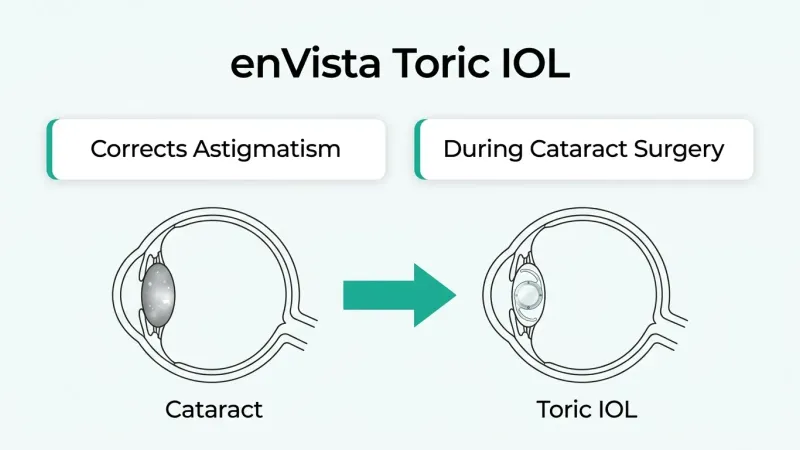
Toric intraocular lenses (toric IOLs) are specially designed implants that correct both the refractive error from cataract removal and pre-existing corneal astigmatism in a single procedure. Unlike standard IOLs, each toric lens has built-in cylinder power aligned to the eye’s steep corneal axis. According to a 2024 literature review published in the Taiwan Journal of Ophthalmology, zonular instability and posterior capsular dehiscence are absolute contraindications for toric IOLs, as a stable capsular bag-IOL complex is essential for rotational stability. Proper patient selection is critical: toric IOLs offer the most reliable astigmatism correction available within cataract surgery, making them the preferred first-line option for most eligible patients with regular astigmatism.
Limbal Relaxing Incisions
Limbal relaxing incisions (LRIs) are small arc-shaped cuts placed at the corneal periphery to flatten the steepest corneal meridian and reduce astigmatism. They are a practical, straightforward approach, particularly suited for low to moderate levels of astigmatism. According to a PMC study comparing techniques, femtosecond laser-assisted relaxing incisions (FLRIs) demonstrate better astigmatism correction than manual LRIs, with a higher reduction in mean manifest astigmatism and lower difference vectors at both 1 month and 1 year postoperatively. For patients who are not toric IOL candidates, LRIs remain a clinically valuable alternative.
Femtosecond Laser-Assisted Astigmatic Correction
Femtosecond laser-assisted astigmatic correction uses a precisely programmed laser to create corneal relaxing incisions with greater depth, length, and positional consistency than manual techniques allow. This precision translates directly into more predictable refractive outcomes, particularly for patients where accuracy is a priority. When combined with toric IOL implantation, femtosecond laser platforms can further refine surgical results. Understanding which correction method fits a patient’s astigmatism type and degree is an important step in preparing for cataract surgery.
Who Is a Good Candidate for Astigmatism Correction During Cataract Surgery?
Good candidacy for astigmatism correction during cataract surgery depends on astigmatism severity, corneal regularity, and the absence of conditions that compromise lens stability. The following sub-sections cover the key factors surgeons evaluate.
What Level of Astigmatism Warrants Correction During Surgery?
The level of astigmatism that warrants correction during surgery is generally 0.75 diopters (D) or more, as amounts of 0.50 D or less are not reliably predictable to correct. For lower levels, limbal relaxing incisions (LRIs) offer a practical, forgiving approach, according to a review published in ScienceDirect. For higher levels requiring a toric IOL, alignment precision becomes critical: each degree of rotational error reduces astigmatism correction by 3.3%, meaning even minor misalignment can leave meaningful residual astigmatism.
Can Patients with Irregular Astigmatism Still Benefit from Correction?
Patients with irregular astigmatism can benefit from correction in some cases, but standard toric IOLs are generally unsuitable for eyes affected by keratoconus or corneal scars, as complete refractive correction is unlikely, according to StatPearls (NIH). Some specific subtypes of irregular astigmatism may still respond to surgical intervention, but outcomes are less predictable. Residual astigmatism exceeding 0.5 D remains a common finding after toric IOL implantation, often linked to preoperative measurement errors or postoperative lens rotation, as noted in a systematic review published in Ophthalmology (Elsevier). Careful case selection is, in practice, the most important variable in achieving satisfactory outcomes for this patient group.
What Eye Conditions May Limit Candidacy for Astigmatism Correction?
The eye conditions that may limit candidacy for astigmatism correction include keratoconus, corneal scarring, zonular instability, and posterior capsular dehiscence. Zonular instability and posterior capsular dehiscence are absolute contraindications for toric IOLs because a stable capsular bag is essential for rotational stability. The National Eye Institute provides additional patient-accessible guidance on astigmatism and its management for those evaluating their options.
What Are the Potential Risks of Correcting Astigmatism During Cataract Surgery?
The potential risks of correcting astigmatism during cataract surgery include residual astigmatism, toric lens rotation, and suboptimal refractive outcomes. The following sections cover how often these risks occur, what causes them, and what options exist when correction falls short.
What Is Residual Astigmatism and How Often Does It Occur?
Residual astigmatism is the astigmatism that remains after surgical correction has been attempted. According to a systematic review published in Ophthalmology (Elsevier), residual astigmatism exceeding 0.5 diopters is a common outcome after toric IOL implantation, with a significant percentage of patients affected due to factors such as preoperative measurement errors or postoperative lens rotation. While toric IOLs represent a meaningful advance in refractive cataract surgery, no correction method eliminates this risk entirely. Careful preoperative planning and precise biometry measurements remain the most effective strategies for minimizing residual astigmatism.
Can a Toric Lens Rotate After Implantation?
Yes, a toric lens can rotate after implantation, and even small rotational errors carry meaningful visual consequences. According to BMC Ophthalmology, each degree of off-axis rotation results in a loss of up to 3.3% of the lens’s cylinder power, making precise alignment essential. Zonular instability and posterior capsular dehiscence are absolute contraindications for toric IOLs, as a stable capsular bag-IOL complex is required for rotational stability. Modern lens designs have improved this substantially: a study in the Journal of Clinical Medicine found that 88% of PODEYE TORIC IOLs remained within 5 degrees of the intended axis, with none rotating 10 degrees or more.
What Happens If Astigmatism Correction Does Not Achieve the Desired Outcome?
When astigmatism correction does not achieve the desired outcome, several management options are available depending on the cause and degree of the residual error. Common corrective pathways include:
- Toric IOL repositioning: If the lens has rotated, surgical realignment to the correct axis may restore the intended correction.
- Lens exchange: In cases of significant refractive error or an incorrect IOL power, replacing the implant may be considered.
- Enhancement procedures: Laser refractive surgery, such as LASIK or PRK, can address residual refractive error after the cornea has stabilized.
- Glasses or contact lenses: For mild residual astigmatism, updated spectacle correction remains a practical and low-risk solution.
Identifying the root cause, whether it is lens rotation, measurement error, or irregular corneal astigmatism, guides which option is most appropriate and should be evaluated by the treating surgeon.
What Should You Expect Before and After Astigmatism Correction with Cataract Surgery?
Preparation and recovery are two equally important phases of astigmatism correction during cataract surgery. The sections below cover what a thorough preoperative workup involves, what early recovery looks like, and how long vision takes to fully stabilize.
How Should You Prepare for Cataract Surgery with Astigmatism Correction?
Preparation for cataract surgery with astigmatism correction involves several preoperative steps designed to maximize accuracy and outcomes. A detailed workup typically includes visual acuity testing, slit-lamp examination, dilated funduscopy, and multiple biometry measurements using at least two different devices.
One particularly important step is preoperative axis marking. According to Review of Ophthalmology, toric IOL alignment marking is performed with the patient upright to prevent cyclotorsion errors that occur when the patient lies down during surgery. Skipping or rushing this step is one of the most underappreciated sources of postoperative residual astigmatism, making it worth discussing carefully with your surgical team beforehand.
What Does Recovery Look Like After Astigmatism Correction?
Recovery after astigmatism correction with cataract surgery follows a predictable pattern for most patients. Initial improvement in vision clarity may appear within the first few days, though some blurring, light sensitivity, and mild discomfort are common as the eye begins to heal.
Patients typically use prescribed antibiotic and anti-inflammatory eye drops for several weeks following surgery. Strenuous activity, swimming, and rubbing the eye should be avoided during this period. Follow-up appointments allow the surgeon to monitor lens position, healing progress, and early visual outcomes.
How Long Does It Take for Vision to Stabilize After Surgery?
Vision stabilization after astigmatism correction with cataract surgery typically takes four to eight weeks. According to Greenwich Eye, full recovery occurs over this period as corneal edema resolves and the eye heals completely.
Patients frequently ask how long stabilization takes, which reflects how central this timeline is to planning post-surgical life. For most, functional vision improves well before full stabilization, but final prescriptions for any residual correction should not be issued until the eye has fully settled, generally around the two-month mark.
With a clear picture of preparation and recovery timelines, patients are better positioned to set realistic expectations and plan confidently for surgery.
What Happens If Astigmatism Is Not Corrected During Cataract Surgery?
Leaving astigmatism unaddressed during cataract surgery can significantly undermine the visual outcome, even when the cataract itself is successfully removed. The sections below cover the visual consequences patients may experience and what options remain after the fact.
Uncorrected Astigmatism After Cataract Surgery Leads to Blurred, Distorted Vision
Uncorrected astigmatism after cataract surgery can leave patients with blurred or distorted vision, reducing visual quality and satisfaction even when the cataract is gone. According to Cataract & Refractive Surgery Today, this outcome is more common than many patients expect, since approximately 78% of cataract surgery candidates present with at least 0.5 diopters of corneal astigmatism. Ignoring a condition that prevalent virtually guarantees suboptimal results for a large portion of patients.
Patients May Still Need Glasses or Contact Lenses After Surgery
Patients who do not have astigmatism corrected during cataract surgery may still need glasses or contact lenses for functional vision after the procedure. Systematic reviews published in Graefe’s Archive for Clinical and Experimental Ophthalmology indicate that patients receiving toric IOLs achieve significantly higher rates of spectacle independence for distance vision compared to those receiving non-toric monofocal IOLs. Choosing a standard lens when astigmatism is present effectively trades one visual limitation for another.
Secondary Correction Remains Possible but Adds Cost and Recovery Time
Secondary correction after cataract surgery remains possible through options such as glasses, contact lenses, LASIK, or toric IOL repositioning. However, pursuing these corrections after the initial procedure introduces additional out-of-pocket costs and recovery periods that simultaneous correction would have avoided. Addressing astigmatism during the original surgery is, in most cases, the most efficient and cost-effective path to clear, spectacle-free vision.
How Can Surgeon-Reviewed Resources Help You Decide About Astigmatism Correction?
Surgeon-reviewed resources help you decide about astigmatism correction by providing clinically accurate, unbiased information that translates complex surgical decisions into clear, actionable guidance. The H3s below cover how Eye Surgery Today supports that process and the key takeaways from the evidence on correcting astigmatism during cataract surgery.
Can Eye Surgery Today Help You Understand Your Astigmatism Correction Options?
Yes, Eye Surgery Today can help you understand your astigmatism correction options through surgeon-reviewed educational content designed specifically for patients navigating these decisions. Resources from authoritative sources, including the National Eye Institute (NIH), confirm that access to comprehensive eye health information helps patients make more informed choices about astigmatism treatment. Eye Surgery Today bridges that gap by presenting this clinical evidence in clear, jargon-free language, covering options such as toric IOLs, limbal relaxing incisions, and femtosecond laser-assisted correction.
What Are the Key Takeaways About Correcting Astigmatism During Cataract Surgery?
The key takeaways about correcting astigmatism during cataract surgery center on outcomes, candidacy, and informed decision-making. According to a systematic review published in Graefe’s Archive for Clinical and Experimental Ophthalmology, patients receiving toric IOLs achieve significantly higher rates of spectacle independence for distance vision compared to those receiving non-toric monofocal IOLs. The core decisions worth understanding are:
- Correction is generally recommended for astigmatism at or above 0.75 diopters, as lower amounts are difficult to predict surgically.
- Toric IOLs offer the strongest evidence for spectacle independence, but require precise alignment and stable zonular anatomy.
- Limbal relaxing incisions and femtosecond laser-assisted techniques are effective alternatives for low to moderate astigmatism.
- Leaving astigmatism uncorrected at the time of cataract surgery may reduce overall visual quality even after a technically successful procedure.
- Out-of-pocket costs for premium correction options should be weighed against the long-term reduction in glasses dependence.
Understanding these factors before surgery gives patients the foundation to have a productive conversation with their surgical team about which approach best fits their visual goals.