Who Is the Right Patient for Multifocal Lens Implants?

A multifocal intraocular lens is an artificial lens implanted in the eye that provides focus at more than one distance simultaneously, potentially reducing or eliminating the need for glasses after cataract surgery or refractive lens exchange.

This guide covers how multifocal optics work and differ from monofocal lenses, the clinical and lifestyle factors that define strong candidacy, conditions that may disqualify patients, the diagnostic tests used to evaluate suitability, potential risks and benefits, and how realistic expectations influence long-term satisfaction.

Multifocal IOLs use diffractive or refractive optical structures to split light across multiple focal planes. Monofocal lenses focus at a single distance, preserving contrast sensitivity more reliably but leaving patients dependent on glasses for near tasks.

Strong candidacy depends on several intersecting factors. Patients with minimal astigmatism, healthy macular function, a stable tear film, and a genuine desire for spectacle independence tend to be the best fit. Pupil size, corneal regularity, and retinal integrity each play measurable roles in how effectively the lens performs.

Certain conditions may make multifocal lenses a poor choice. Progressive macular disease, advanced glaucoma, poorly controlled dry eye, and prior refractive surgery can each compromise optical outcomes or amplify visual disturbances such as halos and reduced contrast sensitivity.

Preoperative evaluation relies on corneal topography, OCT imaging, tear film analysis, and precise biometry to confirm that a patient’s ocular anatomy can support multifocal optics. These tests serve as the foundation for accurate lens selection.

While multifocal IOLs may offer greater spectacle independence, they can introduce optical side effects that resolve through neuroadaptation over weeks to months. Thorough pre-surgical counseling helps patients interpret early symptoms accurately and supports higher long-term satisfaction.

What Is a Multifocal Intraocular Lens?

A multifocal intraocular lens is an artificial lens implanted in the eye that provides focus at more than one distance simultaneously, reducing or eliminating the need for glasses after cataract surgery or refractive lens exchange. The sections below explain the optical mechanisms behind this technology and the market context shaping its adoption.

How Does a Multifocal IOL Work Optically?

A multifocal IOL works by dividing incoming light across multiple focal points, allowing the eye to focus at near, intermediate, and distance ranges without spectacles. According to a review published in the Journal of Clinical Medicine, ray optics, wavefront optics, and diffractive optics are the three fundamental optical principles that enable the multifocal mechanism in modern intraocular lenses. Diffractive designs use engineered surface rings to produce constructive interference at two or more focal points, creating a simultaneous vision effect on the retina. Refractive designs, by contrast, use concentric optical zones with varying curvatures to redirect light. Understanding which optical approach underlies a specific lens is clinically important, because each mechanism carries distinct trade-offs in contrast sensitivity and light distribution that directly influence patient selection.

What Types of Multifocal IOLs Are Available?

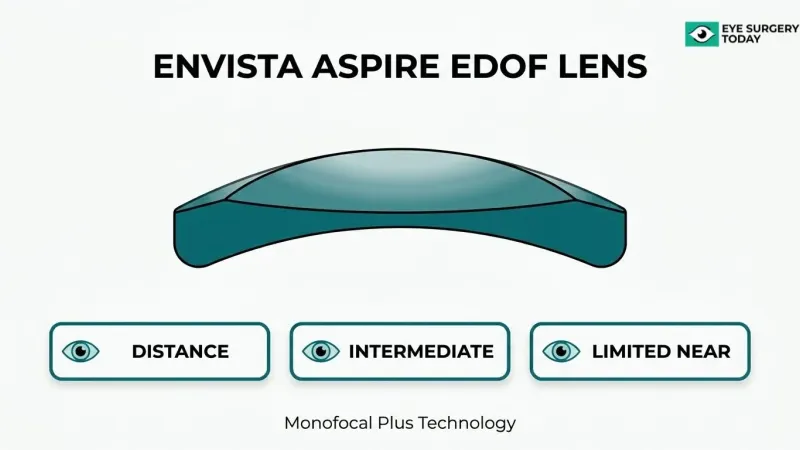
The main types of multifocal IOLs are bifocal, trifocal, and extended depth-of-focus (EDOF) designs. Bifocal lenses split light between two focal points, typically near and distance. Trifocal lenses add a third intermediate focal point, addressing tasks such as computer use. EDOF lenses extend the range of focus along a continuous corridor rather than discrete zones, which may reduce certain visual disturbances. Each category uses diffractive or refractive optics, or a hybrid of both, to achieve its intended focal range. The global intraocular lens market is projected to grow from US$4.46 billion in 2024 to US$7.16 billion by 2033, a compound annual growth rate of 5.41%, according to Yahoo Finance, reflecting the expanding clinical adoption of these premium lens categories.

How Do Multifocal Lenses Differ From Monofocal Lenses?

Multifocal lenses differ from monofocal lenses in how they distribute light: monofocal IOLs focus light at a single fixed point, while multifocal IOLs split light across multiple focal planes to support near, intermediate, and distance vision simultaneously. The sections below cover optical design distinctions, clinical classification standards, and the trade-offs patients should weigh.

How Do Their Optical Designs Compare?

Monofocal IOLs deliver sharp focus at one distance, typically set for distance, leaving patients dependent on reading glasses for near tasks. Multifocal IOLs, by contrast, divide incoming light among two or more focal points through diffractive or refractive optical structures, enabling a range of functional vision without spectacles. This simultaneous vision design is the defining mechanical difference between the two lens categories.

How Are They Classified Under Clinical Standards?

The criteria outlined by ANSI/AAO provide measurable guidelines to differentiate EDOF IOLs from monofocal IOLs, ensuring standardized categorization for clinical use, according to a 2024 report in the Journal of Cataract and Refractive Surgery. This framework matters clinically because it prevents misclassification during lens selection, particularly as EDOF designs occupy a functional space between true multifocal and monofocal performance. Standardized nomenclature helps surgeons match the right optical category to each patient’s visual demands.

What Are the Trade-Offs in Visual Quality?

Multifocal IOLs are associated with higher prevalence of halos or rings around lights and reduced contrast sensitivity compared to standard monofocal lenses, according to a review published in the Cochrane Database of Systematic Reviews. Monofocal lenses generally preserve contrast sensitivity more reliably, making them a safer choice for patients with already compromised visual function. For candidates prioritizing optical clarity over spectacle independence, this distinction is critical to informed consent.

What Makes Someone a Good Candidate for Multifocal Lenses?

Good multifocal lens candidacy depends on several intersecting factors, including lifestyle goals, ocular biometrics, corneal health, pupil dynamics, retinal integrity, and astigmatism severity.

Who May Benefit Most Based on Lifestyle and Visual Goals?

Patients who may benefit most from multifocal lenses are those with a strong desire to reduce or eliminate dependence on glasses after cataract surgery. Active individuals who regularly switch between near tasks, such as reading or device use, and distance activities tend to report the highest satisfaction. Patient motivation matters significantly because adaptation to simultaneous vision optics requires commitment.

Candidacy screening should also account for tolerance risk. According to a study published in Graefe’s Archive for Clinical and Experimental Ophthalmology, the most frequent reasons for early IOL explantation include IOL dislocation (32%), visual intolerance (26%), and opacification (20%). Patients who are perfectionistic about visual quality or have low tolerance for adaptation challenges are generally poor lifestyle candidates.

What Prescription Range Works Best for Multifocal Lenses?

The prescription range that works best for multifocal lenses includes patients with low to moderate refractive error and minimal irregular astigmatism. Eyes with highly predictable biometry and stable refraction are the strongest candidates, as accurate power calculation is essential for multifocal optics to perform as intended.

Financial readiness also influences candidacy practically. Multifocal IOLs are not covered by Medicare beyond the standard IOL allowance, requiring patients to pay the upgrade cost out of pocket, which can range from $3,500 to $7,000 per eye in 2025. Patients in the right prescription range who also understand the cost commitment tend to approach surgery with more realistic expectations, which supports better outcomes.

What Role Does Corneal Health Play in Candidacy?

Corneal health plays a critical role in multifocal lens candidacy because irregularities in corneal shape or surface quality can distort how light reaches the lens and is ultimately focused. Conditions such as keratoconus, significant corneal scarring, or untreated dry eye may undermine optical performance.

Preoperative evaluation for multifocal IOLs must include precise diagnostic testing such as corneal topography, OCT imaging of the macula, and detailed biometry to ensure accurate power calculations and ocular health. Corneal topography, in particular, identifies surface irregularities that could amplify the dysphotopsia associated with diffractive optics. Surgeons who skip thorough corneal assessment before premium IOL selection are taking on avoidable risk.

How Does Pupil Size Affect Multifocal Lens Performance?

Pupil size affects multifocal lens performance because diffractive optics rely on the relationship between the pupil diameter and the lens zones to distribute light correctly across focal points. Diffractive multifocal IOLs intentionally induce diffraction so that waves exiting the lens have constructive interference at two or more distinct focal points, creating a simultaneous vision effect on the retina. When pupil size falls outside the intended optical zone range, this constructive interference is disrupted.

According to Cataract and Refractive Surgery Today, Dr. Richard Tipperman prefers to place multifocal IOLs in patients who have less than 1.00 D of astigmatism, resting photopic pupils smaller than 3.6 mm, and a low level of angle kappa. Larger resting pupils, particularly in mesopic conditions, can increase the likelihood of halos and glare at night.

Why Does Retinal Health Matter for Multifocal Candidacy?

Retinal health matters for multifocal candidacy because multifocal optics reduce contrast sensitivity inherently, and any underlying macular dysfunction compounds this reduction in image quality. A retina that cannot process a crisp image will perform poorly even when the lens itself is optically sound.

Ideal candidates for multifocal IOLs should have a strong desire to be spectacle independence, excellent macular function, a healthy tear film, and normal aberrometry, according to guidance published in Cataract and Refractive Surgery Today. Subtle macular pathology that might be tolerable with a monofocal lens can become clinically significant with a multifocal IOL. Retinal evaluation, including OCT imaging, is therefore not optional in this decision.

How Does the Severity of Astigmatism Influence Eligibility?

The severity of astigmatism directly influences multifocal lens eligibility because uncorrected residual astigmatism degrades the simultaneous focal points that multifocal optics depend on. Even modest amounts of unaddressed cylinder can produce blurred or ghosted images at one or more focal distances, reducing overall satisfaction.

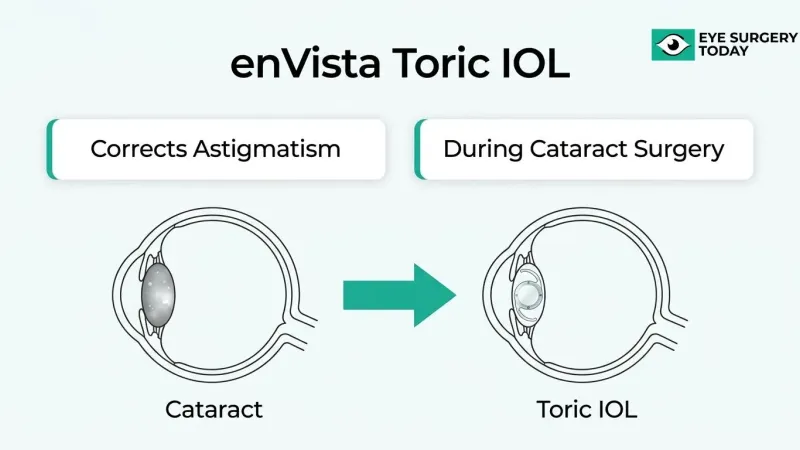
Patients with low astigmatism, generally below 1.00 D, are the strongest candidates. Those with moderate astigmatism may still qualify if a toric multifocal IOL is available and the corneal axis is regular and stable. High or irregular astigmatism, particularly from conditions such as keratoconus or post-refractive corneal ectasia, typically disqualifies patients from multifocal IOL implantation.

Who Should Avoid or Reconsider Multifocal Lenses?

Not every patient is a suitable candidate for multifocal IOLs. Several medical conditions and lifestyle factors may make monofocal or EDOF lenses a safer, more appropriate choice.

Why May Patients With Macular Degeneration Be Poor Candidates?

Patients with macular degeneration may be poor candidates because multifocal IOLs divide incoming light across multiple focal points, which can further compromise contrast sensitivity in eyes with already impaired macular function. According to the National Institutes of Health, multifocal IOLs are often discouraged in patients with or at risk of retinal disorders, including diabetic retinopathy and age-related macular degeneration, due to this potential contrast sensitivity loss. Conditions such as significant or progressive macular disease, advanced endothelial cell disease, poorly controlled ocular surface disease, and significant visual field defects all contribute to a high risk of an unsatisfactory outcome with multifocal IOLs. For these patients, a monofocal IOL typically preserves the best achievable visual quality.

Why Are Multifocal Lenses Risky for Patients With Glaucoma?

Multifocal lenses are risky for patients with glaucoma because the condition reduces contrast sensitivity and causes visual field defects that are incompatible with how multifocal optics distribute light. According to Cohen Eye Institute, advanced glaucoma is a contraindication for multifocal lenses, and such patients should instead consider EDOF or monofocal lenses for safer and more reliable outcomes. Even moderate glaucoma warrants careful evaluation before proceeding with a multifocal implant.

Why May Patients With Dry Eye Disease Face Challenges?

Patients with dry eye disease may face challenges with multifocal lenses because an unstable tear film degrades the optical clarity that multifocal optics require to function effectively. Multifocal IOLs rely on precise light distribution across multiple focal zones, and surface irregularities caused by poor tear film quality can amplify halos, glare, and blur. In many cases, optimizing dry eye treatment before surgery can improve candidacy, but severe or poorly controlled ocular surface disease may still represent a meaningful barrier to a satisfactory outcome.

Why Are Patients With Previous Refractive Surgery Evaluated Carefully?

Patients with previous refractive surgery are evaluated carefully because procedures such as LASIK, PRK, or radial keratotomy alter corneal curvature and optical zone geometry in ways that can make standard biometry calculations less reliable. Corneal shape changes from prior refractive surgery can introduce residual aberrations that interact unpredictably with multifocal optics, increasing the risk of dysphotopsia and reduced visual quality. Surgeons typically use advanced topography and adjusted power calculation formulas to reassess candidacy before recommending a multifocal IOL in these cases. The decision requires a careful, individualized evaluation rather than a blanket exclusion.

Why May Patients Who Drive at Night Have Concerns?

Patients who drive at night may have concerns because multifocal IOLs are associated with a higher prevalence of halos and rings around lights compared to monofocal lenses. These optical phenomena are most noticeable in low-light conditions, such as oncoming headlights or illuminated street signs, and can be distracting or disorienting while driving after dark. For patients whose occupational or lifestyle demands include frequent nighttime driving, this risk deserves serious discussion before choosing a multifocal implant. Neuroadaptation may reduce these symptoms over time, but they may persist in a subset of patients.

What Eye Tests and Evaluations Determine Candidacy?

Determining multifocal lens candidacy requires a structured series of diagnostic tests. The key evaluations include corneal topography, optical coherence tomography, tear film assessment, and biometry measurements.

How Does Corneal Topography Help Assess Suitability?

Corneal topography helps assess suitability by mapping the curvature and surface regularity of the cornea, revealing irregularities such as keratoconus or asymmetric astigmatism that may disqualify a patient from multifocal IOL implantation. Preoperative evaluation for multifocal IOLs must include precise diagnostic testing such as corneal topography to ensure accurate power calculations and ocular health, according to Azure Eye Center. A cornea with irregular curvature compromises the optics of a multifocal lens in ways that cannot be corrected postoperatively, making this mapping step one of the most consequential in the entire evaluation.

What Does Optical Coherence Tomography Reveal?

Optical coherence tomography (OCT) reveals the health of the retina and macula with cross-sectional imaging precision. According to London Cataract Centre, OCT helps surgeons determine whether lens replacement is appropriate by providing precise information about retinal health and identifying subtle macular dysfunction. Patients with early or subclinical macular changes may perform poorly with multifocal IOLs due to contrast sensitivity demands, and OCT is the only tool capable of detecting these changes before symptoms appear. For this reason, OCT findings often function as a decisive factor in lens selection.

Why Is a Tear Film Assessment Important Before Surgery?

A tear film assessment is important before surgery because an unstable tear film distorts the corneal surface, directly degrading the optical quality that multifocal IOLs depend on. Ideal candidates for multifocal IOLs should have a healthy tear film, according to Cataract and Refractive Surgery Today. Even mild dry eye disease can create variable wavefront measurements that misrepresent the true corneal profile, leading to inaccurate IOL power selection. Addressing tear film instability before surgery, rather than after, meaningfully reduces the risk of dissatisfied outcomes.

How Do Biometry Measurements Guide Lens Selection?

Biometry measurements guide lens selection by calculating the precise IOL power needed to achieve the patient’s target refraction, using axial length, keratometry, and anterior chamber depth. Accurate biometry is a foundational component of preoperative evaluation for multifocal IOLs, where even small errors in power calculation can amplify refractive misses and reduce spectacle independence. Modern optical biometers integrate multiple data inputs to minimize this margin of error, making them indispensable for premium lens planning.

What Are the Possible Risks and Side Effects of Multifocal Lenses?

The possible risks and side effects of multifocal lenses include visual disturbances, reduced contrast sensitivity, and, in rare cases, the need for lens removal. The sections below cover the most common complaints patients report, how dysphotopsia manifests, and what the data shows about lens exchange rates.

How Common Are Halos and Glare After Implantation?

Halos and glare are among the most frequently reported side effects after multifocal IOL implantation. According to a Cochrane Database of Systematic Reviews analysis, multifocal IOLs are associated with a higher prevalence of halos or rings around lights and reduced contrast sensitivity compared to standard monofocal lenses. These symptoms are typically most noticeable in low-light conditions, such as nighttime driving. For most patients, the brain gradually adapts to these optical effects over weeks to months, though a subset finds them persistently bothersome.

What Is Dysphotopsia and How May It Affect Vision?

Dysphotopsia is a category of unwanted visual phenomena, including halos, glare, starbursts, and arcs, that some patients experience after IOL implantation. In multifocal lenses specifically, it may affect vision by reducing functional contrast sensitivity and causing visual fatigue in demanding lighting environments. Positive dysphotopsia involves intrusive light streaks or rings, while negative dysphotopsia refers to a dark arc or shadow in the peripheral visual field. These effects tend to diminish with neuroadaptation, but patients with high visual demands should be counseled about realistic expectations before surgery.

How Often Do Patients Require a Lens Exchange?

Lens exchange following multifocal IOL implantation is uncommon but does occur. Reported explantation and exchange rates in randomized controlled trials range between 0.0% and 5.7%, with visual intolerance being a primary driver of early revision, according to a study published in Value in Health. Separately, data from Graefe’s Archive for Clinical and Experimental Ophthalmology identifies the most frequent reasons for IOL explantation overall as dislocation (32%), visual intolerance (26%), and opacification (20%). The American Academy of Ophthalmology Journal notes that optimal IOL selection requires a complex, objective assessment of patient-specific characteristics, underscoring why thorough preoperative screening remains the most effective strategy for reducing exchange rates.

What Are the Potential Benefits of Multifocal Lenses?

The potential benefits of multifocal lenses center on two outcomes: reduced dependence on glasses and a broader functional range of vision. The following sections cover how each of these advantages may apply after cataract surgery.

How May Multifocal Lenses Reduce Dependence on Glasses?

Multifocal lenses may reduce dependence on glasses by providing corrected vision at multiple distances within a single implanted lens. According to a review published in PubMed (National Library of Medicine), multifocal IOLs result in better uncorrected near vision and greater spectacle independence compared to monofocal IOLs, although they may introduce more optical compromises. For patients whose primary goal is to minimize daily reliance on reading glasses or distance correction, this trade-off is often worth evaluating carefully with a surgeon.

What Range of Vision Can Multifocal Lenses Potentially Provide?

The range of vision multifocal lenses can potentially provide spans near, intermediate, and distance focal points. According to the Asia-Pacific Journal of Ophthalmology, multifocal IOLs address post-surgical presbyopia by accomplishing near and intermediate spectacle-independent vision using optical technologies that divide light among different optical planes through either diffractive or refractive approaches. Research published in Scientific Reports also suggests that peripheral piston modulation in diffractive multifocal lenses may improve distance vision quality by optimizing light propagation. That said, explantation rates in randomized controlled trials range between 0.0% and 5.7%, underscoring that not every patient tolerates the multifocal visual experience equally.

What Should Patients Expect During Recovery and Neuroadaptation?

Recovery from multifocal IOL implantation involves both physical healing and a neurological adjustment period as the brain learns to interpret simultaneous focal inputs. The sub-sections below cover the neuroadaptation timeline, common visual disturbances, and long-term satisfaction data.

What Is the Neuroadaptation Timeline After Multifocal IOL Surgery?

The neuroadaptation timeline after multifocal IOL surgery is a gradual process during which the visual cortex recalibrates to process simultaneous focal images. According to a study published in BMC Ophthalmology, significantly increased functional amplitude of low-frequency fluctuation values in the visual cortex were detected one week after surgery, returning to baseline at three and six months. This suggests active neural reorganization continues for several months post-implantation.

Most patients notice progressive improvement in visual clarity and comfort within the first four to twelve weeks, though full adaptation can extend to six months or beyond for some individuals.

What Visual Symptoms Are Common in the Early Recovery Period?

Common visual symptoms during early multifocal IOL recovery include halos around lights, glare, and mild contrast sensitivity reduction. These disturbances are closely related to the diffractive optical design, which divides light across multiple focal points simultaneously.

For most patients, these symptoms diminish as neuroadaptation advances. However, a small proportion may experience persistent intolerance. According to data published in Value in Health, lens explantation rates in randomized controlled trials range from 0.0% to 5.7%, with visual intolerance cited as a primary reason for early revision.

How Does Long-Term Patient Satisfaction Compare to Initial Concerns?

Long-term patient satisfaction with multifocal IOLs is generally high despite early-phase visual disturbances. Surveys indicate more than 70% of premium IOL recipients report they would choose the same lens again, even knowing it involved out-of-pocket costs.

This satisfaction trajectory reflects how effectively neuroadaptation resolves initial optical side effects for the majority of well-selected candidates. In clinical terms, patient selection quality directly predicts satisfaction outcomes, making thorough preoperative counseling as important as any surgical technique.

Understanding recovery and neuroadaptation helps set expectations that are both honest and encouraging for appropriate candidates.

How Do Realistic Expectations Affect Multifocal Lens Satisfaction?

Realistic expectations affect multifocal lens satisfaction by shaping how patients interpret optical side effects, such as halos and reduced contrast sensitivity, during and after neuroadaptation. The subsections below cover how pre-surgical counseling and patient psychology influence outcomes.

Why Does Pre-Surgical Counseling Matter for Satisfaction?

Pre-surgical counseling matters for satisfaction because patients who understand the trade-offs of multifocal lenses are significantly less likely to report dissatisfaction after surgery. Multifocal IOLs distribute light across multiple focal points, which means some reduction in contrast sensitivity is an inherent optical property, not a surgical error. When this is explained clearly before the procedure, patients are better prepared to allow time for neuroadaptation rather than interpreting early visual disturbances as permanent problems. According to a survey reported by Eye Associates of South Texas, more than 70% of patients said they would choose a premium IOL again, even with the associated out-of-pocket costs, suggesting that informed patients generally remain satisfied over the long term. Setting honest, specific expectations before surgery may be among the most protective factors against post-operative disappointment.

How Does Patient Psychology Influence Visual Outcomes?

Patient psychology influences visual outcomes because perception of visual quality is shaped not only by optical performance but also by how closely results align with what the patient anticipated. Patients with perfectionist tendencies or those who require high-contrast vision for professional tasks, such as graphic designers or surgeons, may find the inherent optical compromises of multifocal IOLs disruptive even when objective measurements show good results. Conversely, patients who enter surgery understanding that some night-time halos are expected often rate those same symptoms as acceptable. Screening for psychological readiness and discussing lifestyle demands before implantation gives surgeons important information for matching lens type to patient personality, making this step as clinically relevant as biometry or corneal topography.

How Can You Make an Informed Decision About Multifocal Lenses?

Making an informed decision about multifocal lenses requires understanding both clinical evidence and your personal visual goals. The following sections cover what Eye Surgery Today offers and the core takeaways from multifocal lens candidacy.

Can Eye Surgery Today Help You Understand Your Lens Options?

Yes, Eye Surgery Today can help you understand your lens options through surgeon-reviewed educational content designed to translate complex clinical information into clear, actionable guidance. Choosing between multifocal, EDOF, and monofocal IOLs is not straightforward. According to a review published in JAMA Ophthalmology, trifocal IOLs and bifocal diffractive IOLs achieve the greatest improvement in uncorrected near visual acuity among presbyopia-correcting cataract surgery options. Yet clinical performance is only one part of the equation. North America led the intraocular lens market in 2025, accounting for 41.76% of global revenue, reflecting how widely cataract surgery decisions are being made today. Eye Surgery Today provides the unbiased, evidence-based context patients need to approach those decisions with confidence.

What Are the Key Takeaways About Multifocal Lens Candidacy?

The key takeaways about multifocal lens candidacy center on matching the right lens to the right patient based on ocular health, lifestyle, and realistic expectations. Strong candidates typically have minimal astigmatism, healthy macular function, a stable tear film, and a genuine desire for spectacle independence. Contraindications such as advanced glaucoma, macular degeneration, and poorly controlled dry eye disease significantly increase the risk of dissatisfaction. Preoperative testing, including corneal topography, OCT imaging, and biometry, is essential before any lens decision. Cost is also a practical factor, since premium IOL upgrades are not covered by Medicare. Understanding candidacy criteria before surgery is the single most important step toward a successful outcome.


Skip to content