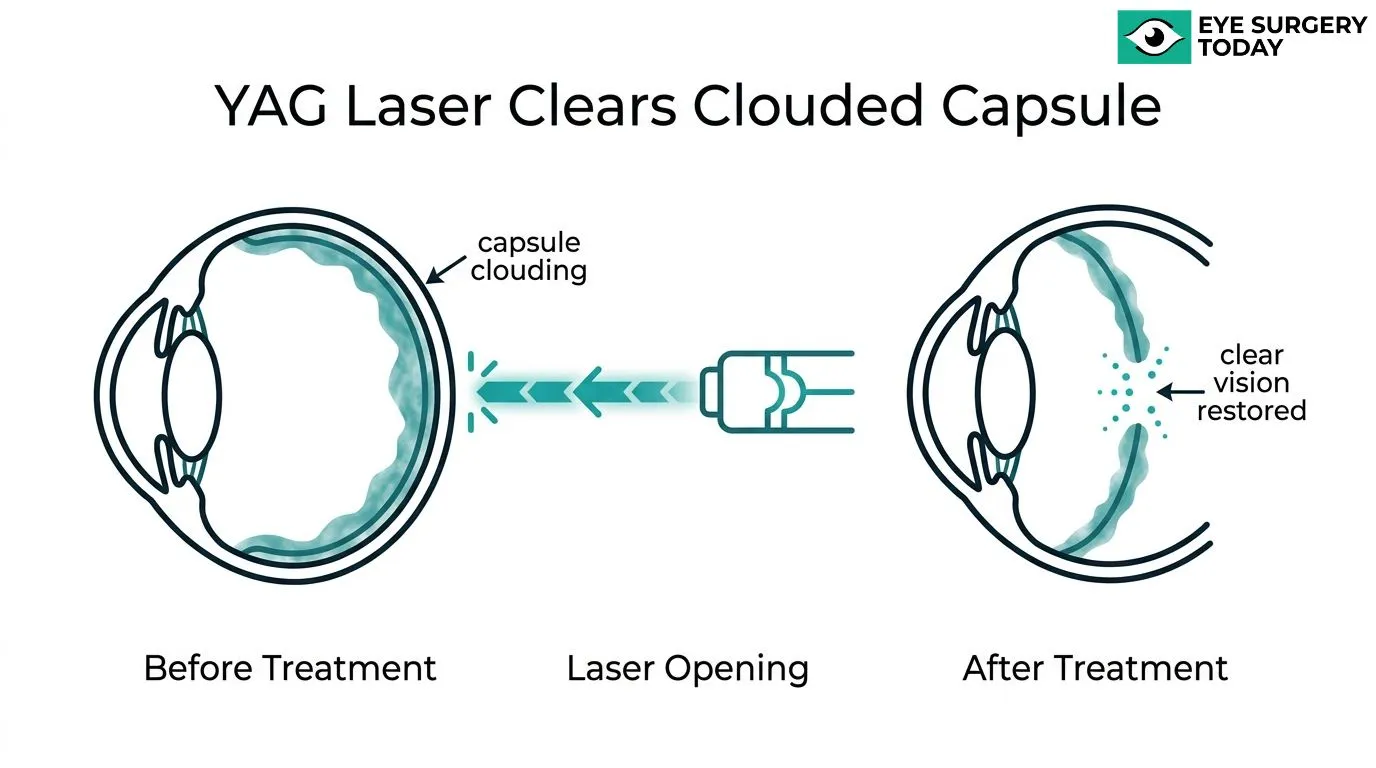
YAG laser capsulotomy is a brief, non-invasive outpatient procedure that uses focused laser energy to open a clouded membrane behind the intraocular lens implant placed during cataract surgery. The clouding, called posterior capsule opacification (PCO), is not a new cataract; it results from residual lens cells that gradually migrate and proliferate on the capsule membrane after the original surgery.
This guide covers the causes and symptoms of PCO, when and how to discuss YAG capsulotomy with your eye doctor, what the procedure involves and who may be a good candidate, the potential risks and effectiveness of treatment, and how surgeon-reviewed resources can support your decision.
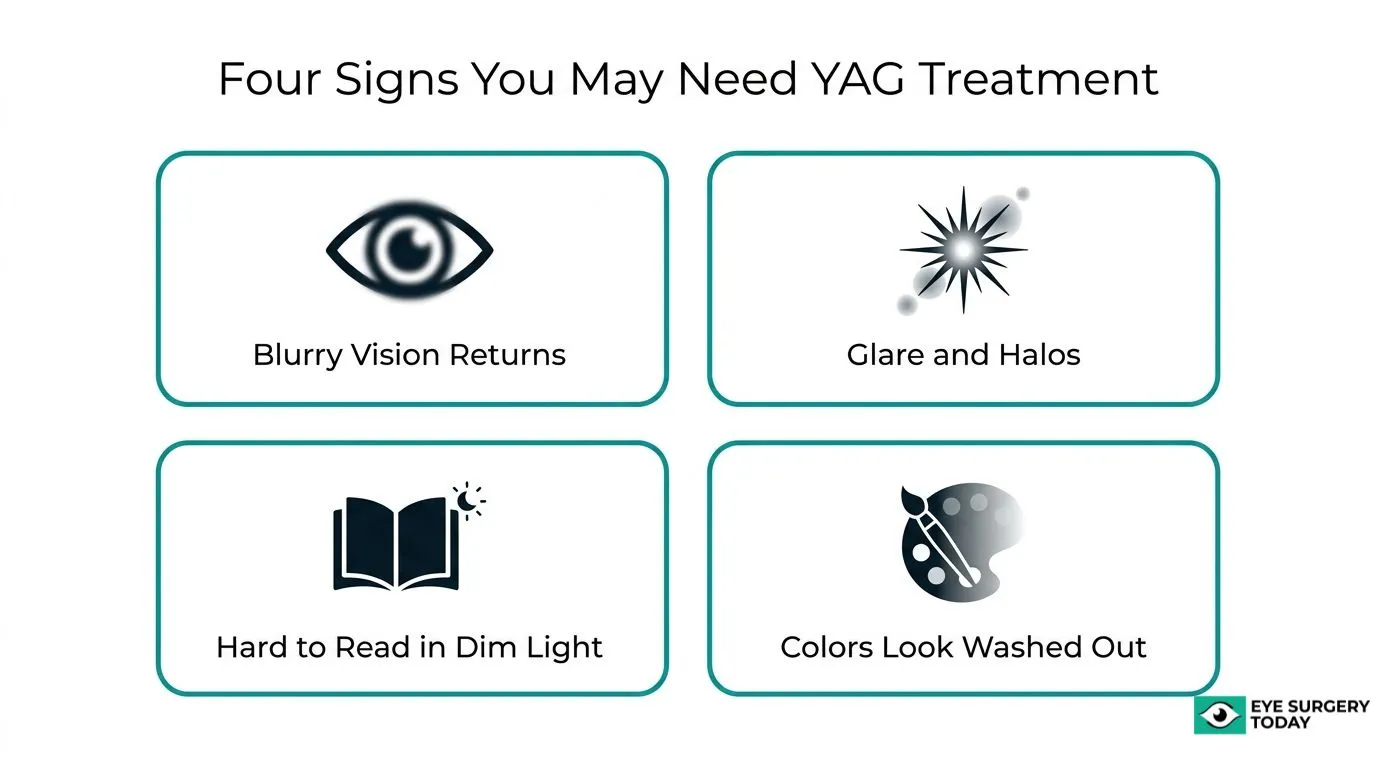
PCO can develop as early as three months after cataract surgery or surface years later, and common symptoms include progressive blurriness, glare or halos around lights, difficulty reading in low light, and fading color perception. Recognizing these patterns early may help patients seek timely evaluation rather than assuming their vision changes are permanent.
The decision to proceed with YAG capsulotomy depends on whether PCO is measurably impairing daily activities and whether conditions such as active macular edema or corneal disease have been ruled out or stabilized. Patients with co-existing conditions like macular degeneration may still be eligible, though visual improvement can be limited by the underlying retinal damage.
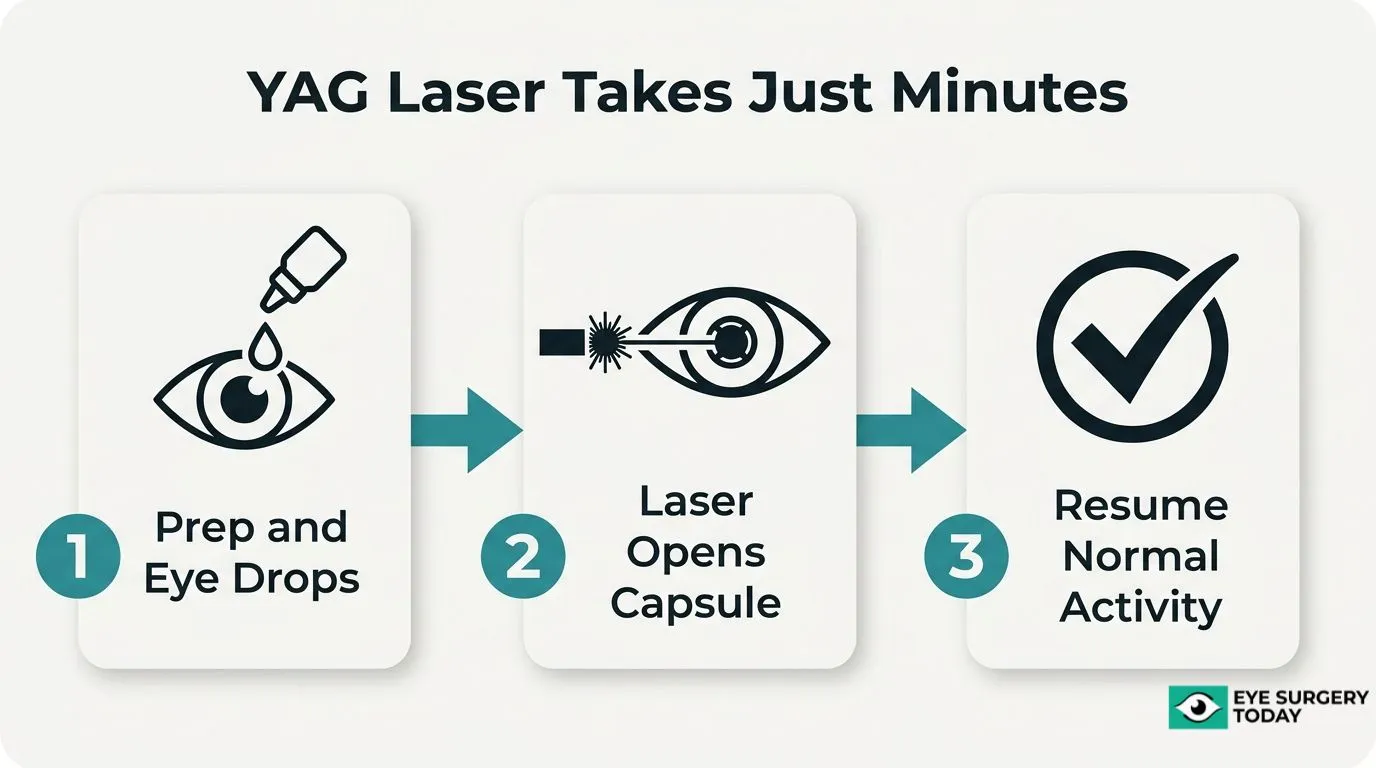
The procedure itself typically takes only minutes, requires no incisions, and most patients resume normal activities the same day. Complications such as elevated eye pressure or retinal detachment are uncommon but warrant awareness during follow-up.
Preparing specific questions for your ophthalmologist, covering your personal candidacy, timing, and risk factors, is one of the most practical steps toward making a confident, well-informed decision.
What Is YAG Laser Capsulotomy?
YAG laser capsulotomy is a non-invasive outpatient procedure that uses a focused laser beam to restore clear vision after cataract surgery. The sections below explain how the procedure works, what the “YAG” name means, and what visual improvement patients can realistically expect.
How Does YAG Laser Capsulotomy Work?
YAG laser capsulotomy works by directing precise pulses of laser energy at the clouded membrane behind the intraocular lens, creating an opening that restores a clear visual pathway. According to the American Academy of Ophthalmology, Nd:YAG laser posterior capsulotomy introduced a technique for closed-eye, effective, and relatively safe opening of the opacified posterior capsule, establishing it as the standard of care following extracapsular cataract extraction. For a typical capsule, energy settings of 1 to 2 mJ per pulse are usually sufficient to rupture the membrane. The procedure does not require incisions, making it fundamentally different from the original cataract surgery.
What Does “YAG” Stand For?
“YAG” stands for Yttrium Aluminum Garnet, the neodymium-doped crystal used to generate the laser’s focused beam of energy. The full clinical name is Nd:YAG laser, where “Nd” refers to neodymium, the element embedded in the crystal to produce the specific wavelength needed to precisely rupture the posterior capsule without damaging surrounding ocular structures.
What Visual Improvement Can You Expect From YAG Capsulotomy?
YAG capsulotomy can produce meaningful, rapid improvements in visual clarity for most patients. A study published via PubMed found that median visual acuity improved from 20/60 before the procedure to 20/25 afterward, representing a substantial functional gain. Results are typically noticeable within 24 hours as floaters from the disrupted membrane gradually settle. The degree of improvement depends on whether other underlying conditions, such as macular disease, are also present.
Why Might You Need YAG Laser After Cataract Surgery?
After cataract surgery, some patients experience a gradual return of cloudy or hazy vision caused by a condition called posterior capsule opacification (PCO). The following sections explain what PCO is and how it differs from a new cataract.
What Is Posterior Capsule Opacification?
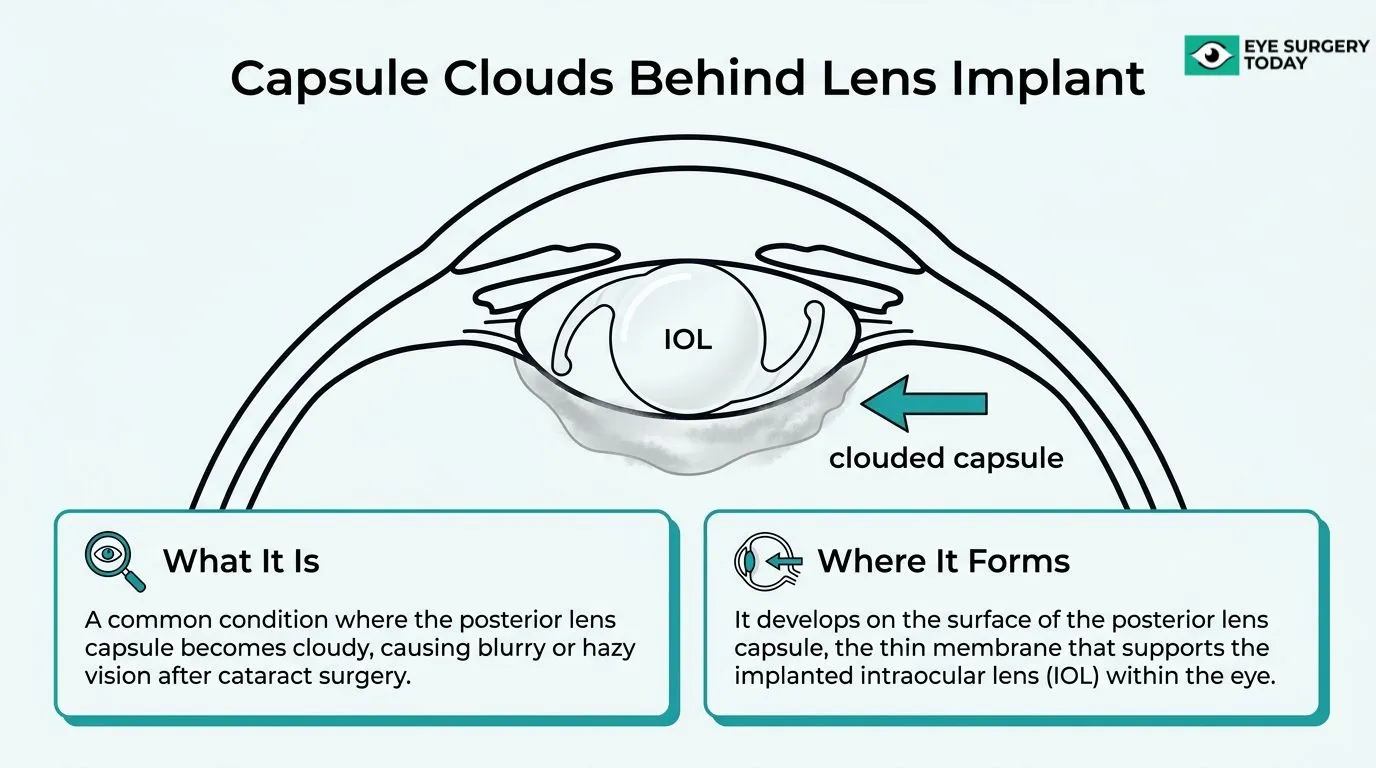
Posterior capsule opacification is a clouding of the thin membrane that holds the intraocular lens (IOL) in place after cataract surgery. According to the American Academy of Ophthalmology, PCO occurs when residual lens epithelial cells form opaque secondary membranes through active proliferation, transformation into fibroblasts with contractile elements, and collagen deposition. The membrane sits behind the IOL, which is why the condition is sometimes described using the posterior capsule as a reference point. Because the clouding develops gradually, patients may not notice the change immediately, making routine post-surgical follow-up appointments particularly valuable for early detection.
How Does Posterior Capsule Opacification Differ From a New Cataract?
Posterior capsule opacification differs from a new cataract in both cause and location. A natural cataract forms when proteins inside the eye’s original crystalline lens clump and cloud over time, whereas PCO results from residual lens epithelial cells (LECs) that migrate and proliferate on the capsule membrane left behind after surgery. Though PCO is commonly called a “secondary cataract” or “after-cataract,” no new lens is clouding; the artificial IOL remains clear. Importantly, unlike a natural cataract, PCO can be resolved quickly: Nd:YAG laser posterior capsulotomy has become the standard of care for opening the opacified capsule through a closed-eye, non-invasive approach.
What Symptoms May Suggest You Need YAG Capsulotomy?
The symptoms that may suggest you need YAG capsulotomy are visual changes that develop after cataract surgery and progressively interfere with daily activities. The following H3s cover the four most common symptom patterns: increasing blurriness, glare or halos, difficulty in low light, and fading color perception.
What Does Increasing Blurriness After Cataract Surgery Mean?
Increasing blurriness after cataract surgery may indicate posterior capsule opacification (PCO), also called a secondary cataract, where the capsule holding your lens implant gradually clouds over. According to research published in the Journal of Cataract & Refractive Surgery, this blurring can develop at any point following surgery and tends to worsen progressively without treatment. Unlike the gradual decline before your original cataract surgery, PCO-related blur often feels like your previously clear post-surgical vision is slowly being reversed. If corrective lenses no longer sharpen your sight, PCO is a likely cause worth discussing with your ophthalmologist.
What Does Glare or Halo Around Lights Indicate?
Glare or halos around lights may indicate that PCO is scattering incoming light before it reaches the retina clearly. This symptom is particularly noticeable at night, around headlights, or in brightly lit environments. According to Bedfordshire Hospitals NHS Trust, blurred vision and glare are among the most common symptoms of PCO and can emerge weeks, months, or even years after cataract surgery. For patients with multifocal IOLs, existing halos can intensify significantly as the capsule opacifies, making this symptom especially disruptive.
What Does Difficulty Reading or Seeing in Low Light Suggest?
Difficulty reading or seeing in low light may suggest that PCO is reducing the contrast sensitivity your visual system needs in dim conditions. Low-light and near-vision tasks, such as reading menus or driving at dusk, depend heavily on optical clarity. When the posterior capsule clouds over, it reduces the amount of usable light reaching the retina, making these tasks disproportionately harder than distance vision. If reading glasses and adequate lighting no longer compensate, PCO-related contrast loss is a plausible explanation that warrants an eye examination.
When Should Fading Color Vision Concern You?
Fading color vision should concern you when colors appear washed out, yellowed, or less vivid than they did shortly after cataract surgery. A yellowing or dimming of color perception can signal progressive capsule clouding, since a thickening posterior capsule filters and distorts the light spectrum reaching the retina. Clinical guidelines recommend that Nd:YAG laser posterior capsulotomy should only be performed when PCO measurably impairs vision-related activities, according to Healthy Blue North Carolina clinical guidelines. Color fading that affects daily tasks, such as distinguishing clothing colors or reading digital screens, meets that functional threshold and warrants a prompt consultation.
When Is the Right Time to Ask Your Doctor About YAG?
The right time to ask your doctor about YAG depends on when symptoms appear and how much they affect your daily vision. The H3s below cover early-onset symptoms, how long to wait before acting, and what to do if vision changes surface years later.
How Soon After Cataract Surgery Can Symptoms Appear?
Symptoms can appear sooner than most patients expect. According to Review of Ophthalmology, early-onset posterior capsule opacification (PCO) can develop as soon as three months following cataract surgery, potentially causing significant light glare and visual symptoms if left untreated.
If you notice blurred vision or glare within the first few months after cataract surgery, mention it at your next follow-up rather than assuming the eye is still settling. Early reporting gives your surgeon the chance to monitor progression before it meaningfully impacts your quality of life.
How Long Should You Wait Before Considering YAG?
There is no fixed waiting period before considering YAG capsulotomy. The decision depends on whether PCO is measurably affecting your vision-related activities, not on a predetermined timeline.
Most ophthalmologists prefer to confirm that the IOL has fully stabilized and that any post-surgical inflammation has resolved before proceeding. If your symptoms are mild and stable, a period of observation is reasonable. If vision is meaningfully impaired, bring it up with your surgeon promptly rather than waiting for a scheduled review.
What If Symptoms Appear Years After Cataract Surgery?
Symptoms appearing years after cataract surgery are a recognized pattern of PCO. According to Bedfordshire Hospitals NHS Trust, blurred vision and glare from posterior capsule opacification can occur weeks, months, or years after cataract surgery.
Late-onset symptoms are just as treatable as early ones. YAG capsulotomy remains effective regardless of how long PCO has been developing, so a delayed presentation is not a barrier to treatment. If your vision has gradually worsened since surgery, scheduling an eye examination is the appropriate next step.
Who Is a Good Candidate for YAG Capsulotomy?
Good candidacy for YAG capsulotomy depends on both the presence of vision-impairing PCO and the absence of conditions that increase procedural risk. The following sub-sections cover qualifying eye conditions and contraindications.
What Eye Conditions May Affect Your Eligibility?
The eye conditions that may affect your eligibility for YAG capsulotomy include posterior capsule opacification that impairs daily activities, pre-existing glaucoma, a history of retinal vein occlusion, and prior anti-VEGF therapy. According to a Clinical Ophthalmology study, risk factors significantly associated with increased PCO development include primary open angle glaucoma (OR = 6.53), retinal vein occlusion (OR = 8.42), and a history of anti-VEGF therapy (OR = 3.22). Patients with macular degeneration may also be eligible, though visual improvement is often limited by pre-existing macular damage. Clinical guidelines further specify that the procedure should only be performed when PCO measurably interferes with vision-related activities or the management of other ocular diseases.
Who May Not Be a Suitable Candidate for YAG?
Patients who may not be suitable candidates for YAG capsulotomy include those with active cystoid macular edema (CME), certain corneal conditions that prevent accurate laser focusing, and poorly controlled intraocular pressure. According to Review of Ophthalmology, active CME is a relative contraindication and should be stable or resolved before the procedure is scheduled. Patients with significant corneal opacities may also be excluded, since the laser cannot focus precisely through a compromised cornea. In these cases, deferring the procedure until underlying conditions are stabilized is generally the safer clinical approach.
What Should You Expect During a YAG Laser Procedure?
A YAG laser procedure is a short, outpatient treatment that uses focused energy from Neodymium-doped Yttrium Aluminum Garnet crystals to open the clouded posterior capsule. The sections below cover preparation steps, what occurs during treatment, and what recovery involves.
How Should You Prepare for YAG Capsulotomy?
Preparation for YAG capsulotomy typically involves a pre-procedure eye exam to confirm the diagnosis and rule out contraindications. Active cystoid macular edema (CME) and certain corneal conditions that interfere with laser focusing are relative contraindications, so both should be evaluated and resolved before scheduling. Your eye care provider may dilate your pupils on the day of the procedure and will review your current medications. Arranging a ride home is generally advisable, as dilating drops can affect vision temporarily.
What Happens During the YAG Laser Treatment?
The YAG laser treatment uses brief, precisely aimed pulses to create an opening in the opacified posterior capsule. The session typically lasts only a few minutes and requires no incisions. To reduce a known procedural risk, clinical research published in PubMed found that one drop of 1% apraclonidine administered one hour before the procedure is effective in preventing the post-laser rise in intraocular pressure (IOP). Patients usually remain seated at a slit lamp, and mild flashing sensations may be noticed during the laser pulses.
What Does Recovery After YAG Capsulotomy Look Like?
Recovery after YAG capsulotomy is generally brief, with most patients resuming normal activities the same day. Some floaters are common in the first few days as the capsule tissue settles. Post-procedure care often includes topical anti-inflammatory drops for one to two weeks to manage inflammation. According to a study published in the Journal of Cataract and Refractive Surgery examining over 700 cases, the 90-day risk of retinal tear following the procedure was 0.21%, making serious complications uncommon but worth monitoring for. Prompt reporting of sudden vision changes, new flashes, or a curtain-like obstruction to your eye care provider remains the most important post-procedure step.
What Are the Potential Risks of YAG Capsulotomy?
The potential risks of YAG capsulotomy include retinal detachment, elevated intraocular pressure, and lens implant damage. These complications are uncommon, but understanding each one helps patients have informed conversations with their eye care provider.
How Common Is Retinal Detachment After YAG?
Retinal detachment after YAG capsulotomy is rare but recognized. According to a study published in PubMed, the incidence of retinal detachment following Nd:YAG laser capsulotomy was 0.82%, with a mean interval of 13.5 months between the procedure and the detachment. Because the onset can be delayed by more than a year, patients should remain alert to warning signs such as sudden floaters, flashes of light, or a curtain-like shadow in their vision well beyond the immediate recovery period.
Can YAG Capsulotomy Cause Increased Eye Pressure?
Yes, YAG capsulotomy can cause a temporary increase in eye pressure. According to the American Academy of Ophthalmology, intraocular pressure typically peaks at 3 to 4 hours following Nd:YAG laser capsulotomy and may remain elevated at 24 hours. For most patients this spike resolves without intervention, though those with pre-existing glaucoma or ocular hypertension warrant closer monitoring after the procedure.
What Is the Risk of Lens Implant Displacement After YAG?
The risk of lens implant displacement after YAG capsulotomy is low, but IOL pitting or marking can occur, particularly when there is minimal separation between the posterior capsule and the intraocular lens. To reduce this risk, surgeons direct the laser energy posterior to the capsule into the anterior vitreous rather than at the IOL surface. Proper technique substantially limits the chance of lens damage, making this complication uncommon in experienced hands.
How Effective Is YAG Capsulotomy at Restoring Vision?
YAG capsulotomy is highly effective at restoring vision impaired by posterior capsule opacification, with most patients experiencing a meaningful improvement in visual clarity shortly after the procedure. However, the degree of recovery depends on whether any underlying eye conditions are limiting vision independently of the PCO.
According to Blue Fin Vision, while YAG capsulotomy can be performed in patients with macular degeneration, the visual improvement is often limited by the pre-existing macular damage. This means that patients with concurrent retinal or macular conditions may experience only partial recovery, even after a technically successful procedure.
For patients with no other contributing eye disease, outcomes are generally strong. Visual acuity improvements are typically noticeable within days, and the capsulotomy itself takes only minutes to perform. That said, realistic expectations matter: if reduced vision stems from both PCO and an unrelated condition such as macular degeneration or glaucoma, the procedure addresses only the capsule-related component.
From a practical standpoint, a thorough pre-procedure evaluation is the most important factor in predicting how much vision a patient will recover. Identifying any co-existing ocular disease before proceeding helps set accurate expectations and avoids attributing a limited result solely to the YAG treatment itself.
What Questions Should You Bring to Your Eye Doctor About YAG?
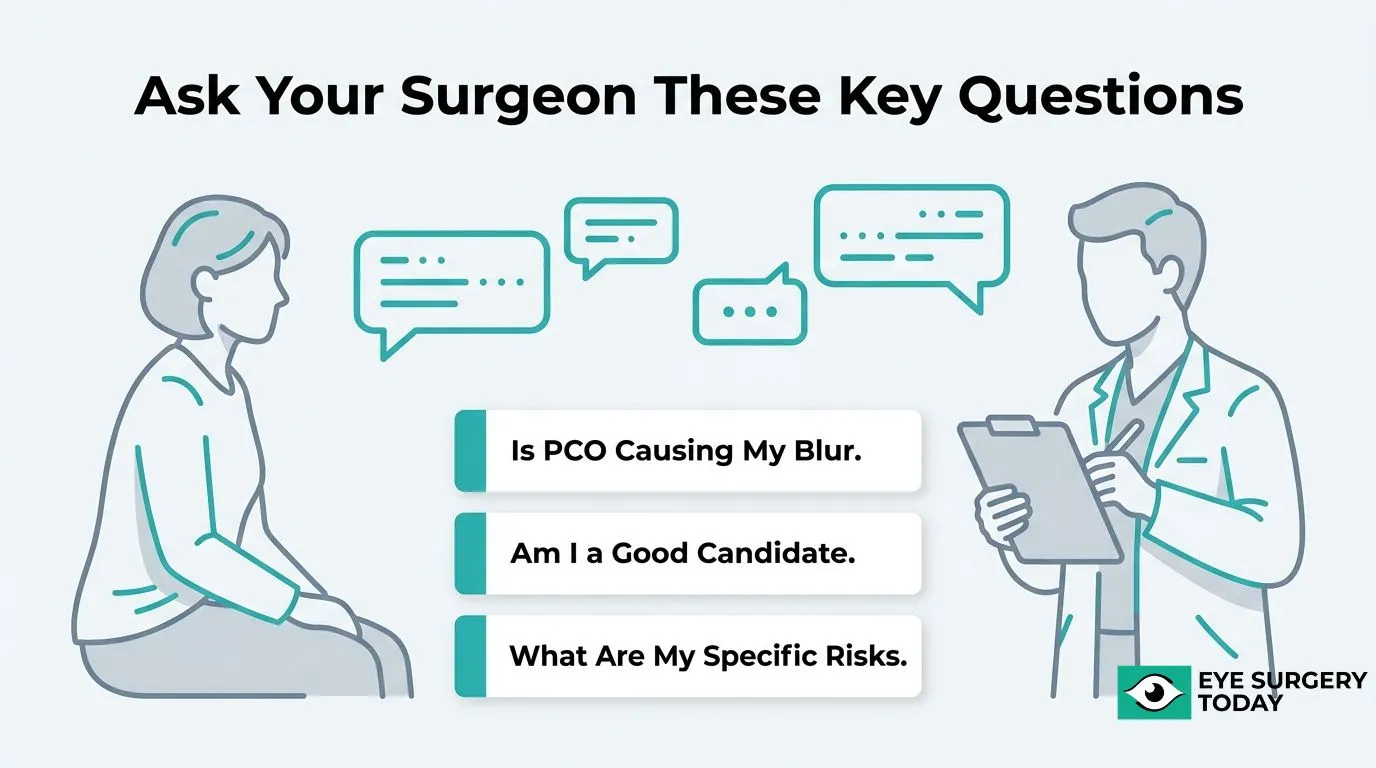
The questions to bring to your eye doctor about YAG cover your personal candidacy, procedure timing, risks, and what to expect after treatment. Preparing specific questions helps you leave the appointment with a clear, actionable plan.
Being thorough during your consultation can also reveal whether other conditions, such as macular edema or elevated eye pressure, might affect your eligibility or timing. The right questions ensure your doctor can assess your situation accurately and recommend the safest path forward.
Consider asking your eye doctor the following questions before pursuing YAG capsulotomy:
- Is my blurred vision caused by PCO, or could another condition explain my symptoms?
- Am I a suitable candidate for YAG capsulotomy given my current eye health?
- Do I have any contraindications, such as active macular edema or corneal issues, that would delay the procedure?
- How large should the capsulotomy opening be for my specific lens implant?
- What is the risk of elevated eye pressure after the procedure, and how will it be monitored?
- What are the signs of retinal detachment I should watch for in the weeks following treatment?
- Will I need anti-inflammatory eye drops after the procedure, and for how long?
- How soon after the procedure can I expect my vision to improve?
- Are there any factors in my history, such as prior retinal conditions or glaucoma, that increase my risk?
- Could waiting longer to treat my PCO cause any additional harm to my vision?
According to the American Academy of Ophthalmology, common patient questions also include whether a posterior capsulotomy can be performed more than once and what the realistic risks of retinal detachment are, both of which are worth discussing directly with your surgeon.
Asking about your specific IOL type is often overlooked but genuinely matters. The proximity between the posterior capsule and the lens implant varies by IOL design, which directly influences how the laser is aimed and what risks are most relevant to your case.
How Can Educational Resources Help You Decide About YAG?
Deciding whether to ask about YAG capsulotomy requires reliable, clinically grounded information. Eye Surgery Today provides surgeon-reviewed resources and key takeaways to help patients navigate that decision with confidence.
Can Eye Surgery Today Help You Understand YAG Capsulotomy?
Eye Surgery Today can help you understand YAG capsulotomy by providing surgeon-reviewed educational content designed to translate complex ophthalmic concepts into clear, accessible guidance. The platform was built to bridge the gap between clinical expertise and patient understanding, covering topics such as posterior capsule opacification, procedural expectations, candidacy criteria, and risk profiles. Rather than offering diagnostic advice, Eye Surgery Today empowers patients to recognize their symptoms, formulate informed questions, and enter conversations with their eye doctor prepared and confident.
What Are the Key Takeaways About YAG After Cataract Surgery?
The key takeaways about YAG after cataract surgery center on recognition, timing, and informed decision-making. Understanding this topic means knowing when to act and what to expect:
- Blurred vision, glare, or reduced contrast returning after cataract surgery may indicate posterior capsule opacification and warrant a prompt eye exam.
- PCO can develop as early as three months after cataract surgery, so symptoms should not be dismissed as normal healing.
- YAG capsulotomy is a well-established outpatient procedure with a strong safety profile, though risks such as transient intraocular pressure elevation exist.
- Candidacy depends on clinical factors, including the severity of visual impairment and the absence of contraindications such as active macular edema.
- Surgeon-reviewed resources like those at Eye Surgery Today help patients ask the right questions before their appointment.