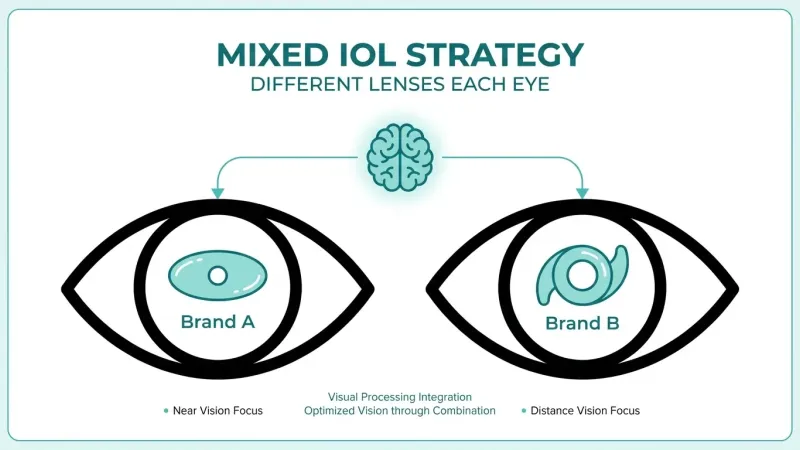
Monovision is a vision correction strategy for presbyopia that focuses one eye for distance and the other for near, allowing the brain to integrate both images through a process called neuroadaptation.
This guide covers how monovision works and what it feels like, the correction methods available, potential benefits and risks, candidacy and contraindications, comparisons with multifocal and EDOF lenses, trial protocols, reversibility options, and surgeon discussion points for cataract surgery planning.
Neuroadaptation is the brain’s ability to suppress blur from one eye while using clear input from the other; approximately 73% of patients adapt successfully, while roughly 27% experience neuroadaptation failure. Satisfaction rates following LASIK monovision reach 85.4% in published retrospective data.
Monovision can be achieved through contact lenses, LASIK, or intraocular lens implantation during cataract surgery. Contact lenses offer a reversible trial option, LASIK permanently reshapes the cornea, and pseudophakic monovision uses programmed refractive differences calculated from biometry during lens replacement.
Potential benefits include reduced spectacle dependence and a simpler optical design that avoids the dysphotopsias associated with multifocal lenses. However, monovision may degrade stereopsis, create intermediate vision gaps, and affect night driving for a small percentage of patients.
Candidacy depends on lifestyle demands, ocular anatomy, and willingness to accept trade-offs. Contraindications include significant corneal astigmatism, ocular deviation, and strong ocular dominance. A sustained contact lens trial before surgery is widely recommended to assess neuroadaptation potential under real-world conditions.
Both LASIK and IOL-based monovision can be reversed if dissatisfaction persists, and thorough preoperative counseling with your surgeon helps set realistic expectations before any permanent correction is pursued.
What Is Monovision and How Does It Work?
Monovision is a vision correction strategy for presbyopia where one eye is focused for distance and the other for near vision. The sections below cover how ocular dominance is determined and what patients typically experience during adaptation.
How Is the Dominant Eye Determined for Monovision?
The dominant eye in monovision is determined using sighting tests, sensory tests, or both, though these methods do not always agree. The most common approach is the “hole-in-the-card” sighting test, where a patient looks at a distant target through a small opening held at arm’s length. According to a study published in Translational Vision Science & Technology, standard sensory and sighting dominance tests matched in only 55% of subjects, suggesting that sighting dominance may reflect a motor habit rather than a fixed physiological property relevant to monovision planning.
In surgical planning, the clinical convention is straightforward: surgeons typically target the dominant eye for emmetropia and the nondominant eye for a refractive offset of no more than 0.75 D in mini-monovision cases. Given the discordance between test types, relying solely on one dominance method carries real risk for misassignment.
What Does Vision Feel Like With Monovision?
Vision with monovision feels initially unequal, as one eye sees distance clearly while the other handles near tasks, but most patients adapt through neuroadaptation. Neuroadaptation is the brain’s process of suppressing the blurred image from one eye and integrating clear images from both to produce functional vision across distances.
During the adaptation period, some patients notice reduced depth perception and mild blur when switching between near and far targets. Across studies, the mean success rate for monovision is approximately 73%, implying that roughly 27% of patients experience neuroadaptation failure. According to a retrospective review published in Clinical Ophthalmology, 85.4% of patients reported satisfaction after monovision LASIK, with near acuity reaching 20/40 or better in 88.9% of those with recorded postoperative readings.
Understanding how neuroadaptation shapes the monovision experience helps set realistic expectations before committing to any correction modality.
What Are the Different Types of Monovision Correction?
The types of monovision correction are contact lens monovision, LASIK monovision, and monovision achieved through cataract surgery with intraocular lenses (IOLs). Each method applies the same core principle — one eye corrected for distance, the other for near — but differs in reversibility, precision, and the clinical context in which it is used.
Contact Lens Monovision
Contact lens monovision is the most accessible and reversible form of monovision correction, making it the standard starting point before any surgical option is considered. One contact lens corrects the dominant eye for distance, while a near-powered lens is placed in the nondominant eye. According to a study published in the Transactions of the American Ophthalmological Society, a +1.50 D add power in the nondominant eye provided the optimal balance of near and distance vision in emmetropic presbyopes, as measured by patient questionnaires and visual function tests. Because contact lens monovision carries no permanent commitment, it serves as the ideal trial modality for patients assessing their neuroadaptation potential before pursuing surgery.
LASIK Monovision
LASIK monovision corrects presbyopia by permanently reshaping the cornea of each eye to different focal targets. The dominant eye is lasered for clear distance vision, and the nondominant eye is treated for near focus. A retrospective review of 294 patients published in Clinical Ophthalmology found that 85.4% reported being satisfied or very satisfied following monovision LASIK, with near acuity improving to 20/40 or better in 88.9% of patients with recorded postoperative near reading data. LASIK monovision suits patients who have already tolerated contact lens monovision and prefer a glasses-free lifestyle without undergoing intraocular surgery.
Monovision With Cataract Surgery and IOLs
Monovision with cataract surgery and IOLs is a type of monovision correction where surgeons implant intraocular lenses of different powers during lens replacement surgery to target separate focal distances in each eye. Pseudophakic monovision, as described in the Indian Journal of Ophthalmology, corrects postoperative presbyopia through programmed refractive error calculated from biometry measurements. In the mini-monovision approach, surgeons typically target the dominant eye for emmetropia and the nondominant eye for a refractive difference of no more than 0.75 D, according to the American Academy of Ophthalmology. This makes it a well-tolerated option for cataract patients who want reduced spectacle dependence without the dysphotopsia risks associated with multifocal IOLs.
What Are the Potential Benefits of Monovision?
The potential benefits of monovision include reduced dependence on reading glasses, a simpler optical design compared to multifocal lenses, and preserved functional distance vision. The sections below explore each of these advantages in clinical terms.
How May Monovision Reduce Dependence on Reading Glasses?
Monovision may reduce dependence on reading glasses by correcting one eye for near vision, enabling spectacle independence for many daily activities. Spectacle independence is the ability to perform routine tasks, such as reading, cooking, and using a phone, without glasses. According to the Indian Journal of Ophthalmology, surgeons select patients who have a strong desire to be free of glasses and who fully understand monovision’s potential drawbacks, including reduced stereopsis and contrast sensitivity. Appropriate patient selection is foundational to achieving this benefit, since candidates who underestimate the trade-offs are less likely to remain satisfied long-term.
How Does Monovision Provide a Simpler Lens Option Than Multifocals?
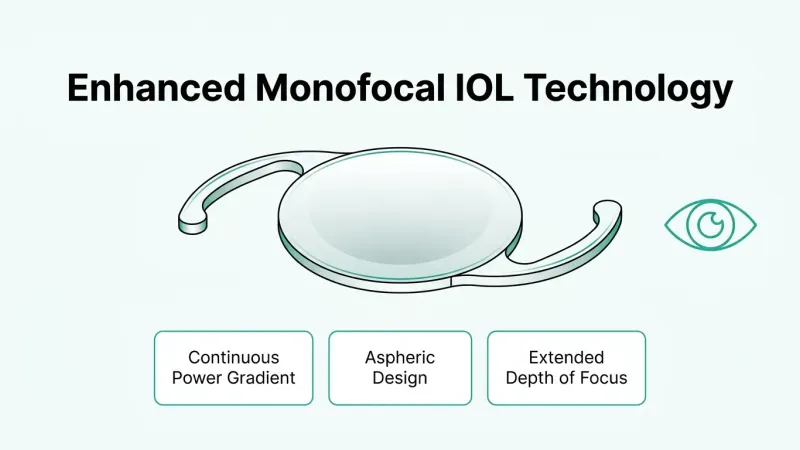
Monovision provides a simpler lens option than multifocals by using standard monofocal optics in each eye rather than complex refractive or diffractive designs. Multifocal IOLs are intraocular lenses engineered to split incoming light across multiple focal points for distance, intermediate, and near vision. Extended depth of focus (EDOF) lenses extend that range continuously, primarily enhancing intermediate vision. Both designs introduce optical complexity that can increase the risk of dysphotopsias such as glare and halos. Monovision sidesteps these optical trade-offs by relying on cortical neuroadaptation rather than lens engineering to integrate the two focal zones.
How Can Monovision Preserve Functional Distance Vision?
Monovision can preserve functional distance vision because the dominant eye is typically corrected for distance, keeping distance acuity intact while the nondominant eye handles near tasks. According to a study published in Eye and Vision, neuroadaptation allows the brain to suppress the blurred image from the near eye and integrate clear input from both eyes, achieving functional vision across distances. An alternative arrangement, cross monovision, assigns near correction to the dominant eye instead, though this is less common in clinical practice. A study published in Cornea reported that the enhancement rate to convert the near eye to full distance correction after LASIK monovision was 8.8%, indicating that the large majority of patients retain their distance-dominant setup without modification.
What Are the Possible Drawbacks and Risks of Monovision?
The possible drawbacks and risks of monovision include reduced depth perception, intermediate vision gaps, neuroadaptation failure, and night driving difficulty. The sections below cover each risk with clinical context to help you weigh them clearly.
How Might Monovision Affect Depth Perception?
Monovision may affect depth perception by degrading stereopsis, the visual system’s ability to perceive the world in three dimensions. According to a study published in Investigative Ophthalmology & Visual Science, monovision has been confirmed to increase stereoacuity thresholds and disrupt fine disparity processing, the precise depth discrimination mechanism that relies on both eyes receiving similar images. Because each eye is focused at a different distance, the visual system cannot process the subtle binocular cues that stereopsis depends on. For most daily activities, this reduction is manageable, but tasks requiring precise spatial judgment — such as parking a car or pouring liquids accurately — may feel less intuitive during adaptation.
Can Monovision Cause Visual Compromise at Intermediate Distances?
Monovision can cause visual compromise at intermediate distances because the correction intentionally focuses one eye for distance and the other for near, leaving the middle range, roughly arm’s length to several feet, without a dedicated focal point. Computer screens, dashboards, and supermarket shelves typically fall within this zone. Patients often notice that intermediate clarity requires greater neural effort, particularly before neuroadaptation is established. Modified or mini-monovision strategies, which use smaller prescription differences between eyes, are specifically designed to reduce this intermediate gap, making them worth discussing with your surgeon if screen-based work is central to your daily routine.
What Happens if Your Brain Cannot Adapt to Monovision?
Neuroadaptation failure occurs when the brain cannot successfully suppress the blurred image from one eye and integrate clear signals from both eyes into functional vision. According to a study published in Ophthalmology, the mean success rate for monovision across multiple studies is approximately 73%, implying a neuroadaptation failure rate of around 27%. When adaptation fails, patients may experience persistent blur, difficulty concentrating visually, or headaches. In many cases, failure can be identified early through a contact lens trial before any surgical commitment is made, which is precisely why pre-surgical trials are so strongly recommended by ophthalmologists.
How May Monovision Impact Night Driving or Low-Light Vision?
Monovision may impact night driving or low-light vision because reduced binocular summation under dim conditions can make it harder to detect contrast and judge speed and distance. A study of pseudophakic mini-monovision published in the Journal of Cataract & Refractive Surgery found that 73% of patients reported low difficulty scores for driving at night, though reading and night driving were the activities where spectacle use was most frequently reported. Separately, clinical data indicate that approximately 7% of monovision patients required glasses specifically for night driving. For most patients this is manageable, but those who drive frequently after dark should weigh this risk carefully during surgical planning.
Who Is a Good Candidate for Monovision?
Good monovision candidates share three qualities: a strong desire for spectacle independence, realistic expectations about trade-offs, and the visual anatomy to support neuroadaptation. The following H3s cover lifestyle suitability, contact lens trial predictors, and medical contraindications.
Is Monovision Suitable for People With Active Lifestyles?
Monovision is suitable for people with active lifestyles in many cases, though the fit depends on which activities dominate daily life. According to the Indian Journal of Ophthalmology, patient selection is crucial because visual functions including stereopsis, contrast sensitivity, and visual fields may be reduced after monovision correction. Activities that rely heavily on fine depth perception, such as racket sports, cycling on uneven terrain, or precision construction work, may be more affected than everyday tasks like walking, driving, or light exercise. Candidates who primarily need freedom from reading glasses for work and casual activities tend to adapt well. In clinical practice, it is generally recommended that surgeons assess each patient’s occupational and recreational demands before proceeding.
Does Prior Contact Lens Monovision Success Predict Surgical Success?
Prior contact lens monovision success does predict surgical success to a meaningful degree. According to Clinical Ophthalmology, a preoperative contact lens trial is widely recommended: in one LASIK monovision study, 57.5% of 294 patients trialed monovision with contact lenses before surgery. Patients who tolerate the interocular blur and sustain comfort through daily activities during a contact lens trial demonstrate that their visual cortex can neuroadapt, which is the primary determinant of long-term satisfaction. However, contact lens trial success rates of 59% to 67% (Ophthalmic and Physiological Optics) indicate that a meaningful proportion of patients will not adapt even at the trial stage, making the trial an important screening tool rather than a guarantee of surgical outcomes.
Who Should Avoid Monovision Correction?
People who should avoid monovision correction include those with specific anatomical, motor, or perceptual conditions that impair neuroadaptation. According to the Indian Journal of Ophthalmology, established contraindications include:
- Significant corneal astigmatism greater than 1.50 D, which can reduce optical clarity and compound the visual mismatch between eyes.
- Ocular deviation, such as strabismus or exophoria exceeding 10.0 prism diopters, which interferes with binocular fusion.
- Strong ocular dominance, where one eye so clearly overpowers the other that the brain struggles to integrate competing focal inputs.
Patients who depend on precise stereoscopic depth perception professionally, such as surgeons, pilots, or heavy machinery operators, should also approach monovision cautiously. For these individuals, alternative presbyopia corrections such as multifocal IOLs or EDOF lenses may be worth exploring with a qualified eye care provider.
How Does Monovision Compare to Multifocal and Extended Depth IOLs?
Monovision, bilateral multifocal IOLs (bMFIOLs), and extended depth of focus (EDOF) lenses each offer distinct trade-offs in spectacle independence, visual quality, and side effect profiles. The sections below compare these options across visual acuity outcomes and dysphotopsia risk.
How Does Visual Quality Differ Between Monovision and Multifocal IOLs?
Visual quality between monovision and multifocal IOLs differs most clearly in dysphotopsia risk rather than raw acuity. A network meta-analysis published in Eye (London) found no statistically significant difference between monovision and bilateral multifocal IOLs for binocular unadjusted distance visual acuity or binocular unadjusted near visual acuity. However, bMFIOLs were more likely to achieve complete spectacle independence (Relative Risk = 2.06, 95% CI = 1.34 to 3.15, p = 0.002).
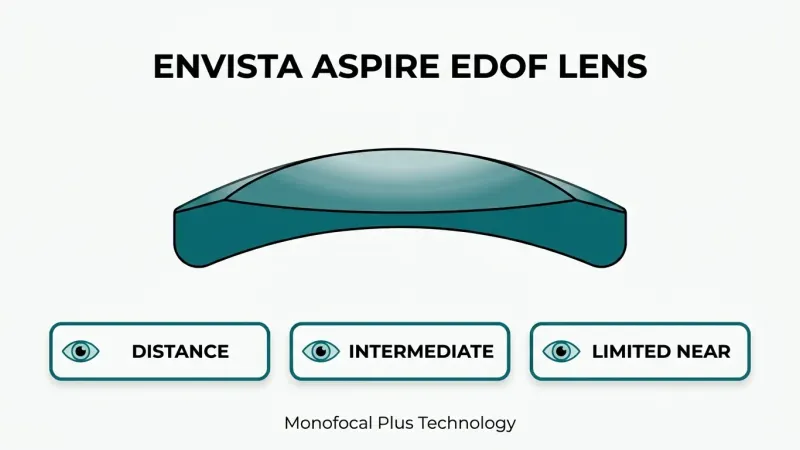
EDOF IOLs offer a middle path: they are designed to reduce dysphotopsias commonly associated with refractive or diffractive multifocal IOLs while maintaining visual quality and extending the functional range of vision without correction.
For patients sensitive to glare and halos, monovision may be the more comfortable long-term choice. Multifocal IOLs deliver stronger spectacle independence, but that benefit comes with a higher dysphotopsia burden that not all patients tolerate equally well.
How Do Side Effect Profiles Compare Between Monovision and Premium Lenses?
The side effect profiles of monovision and premium lenses differ primarily in the type and frequency of visual disturbances. According to the same network meta-analysis in Eye (London), monovision resulted in significantly less glare than bilateral multifocal IOLs (Relative Risk = 0.343, 95% CI = 0.181 to 0.651, p = 0.001). Multifocal IOLs are more frequently associated with dysphotopsias such as halos, starbursts, and glare, particularly in low-light conditions.
Key side effect differences include:
- Monovision: Reduced stereopsis, potential intermediate vision gap, lower glare risk.
- Multifocal IOLs: Higher spectacle independence but elevated dysphotopsia rates.
- EDOF IOLs: Reduced dysphotopsia compared to multifocals, with improved intermediate and distance vision.
When glare sensitivity is a priority, monovision or EDOF lenses are generally better-tolerated options than diffractive multifocal designs.
What Is a Monovision Trial and Why Is It Recommended?
A monovision trial is a pre-surgical simulation that lets patients experience real-world monovision before committing to a permanent procedure. The two H3s below cover how long a trial typically runs and what to assess during it.
How Long Does a Contact Lens Monovision Trial Usually Last?
A contact lens monovision trial should last long enough for the brain to demonstrate meaningful neuroadaptation under real-world conditions. According to the Journal of Cataract & Refractive Surgery, a sustained trial is advantageous specifically because it exposes patients to images of varying contrast at different distances and in different lighting conditions, which a brief in-office simulation cannot replicate. A short test lasting only minutes is rarely sufficient; clinicians generally favor a trial of at least several weeks to allow functional neuroadaptation to either establish itself or fail clearly. This duration gives both patient and surgeon reliable signal before any irreversible surgical step is taken.
What Should You Evaluate During a Monovision Trial?
The key things to evaluate during a monovision trial include comfort with near vision tasks, clarity at distance, performance in low-light environments, and any sense of visual imbalance or suppression difficulty. Patients should test activities such as reading fine print, driving at night, using a computer at intermediate distances, and navigating stairs, where depth perception demands are highest. Preoperative planning guidelines recommend that patients experience monovision in real-world situations rather than controlled clinical conditions alone. If discomfort, persistent blurring, or difficulty with depth-dependent tasks remains after adequate adaptation time, surgical monovision may not be the right fit.
Can Monovision Be Reversed if You Are Unsatisfied?
Monovision can be reversed if you are unsatisfied, though the process and feasibility differ depending on whether the correction was achieved through LASIK or intraocular lens implantation. The following sections cover reversal via LASIK enhancement and IOL exchange after cataract surgery.
How Is LASIK Monovision Reversed?
LASIK monovision is reversed by performing an enhancement procedure that converts the near-corrected eye back to full distance correction. According to a study published in Cornea, the enhancement rate to eliminate monovision by converting the near eye to full distance was 8.8%, while 3.2% of patients required additional monovision induction. A separate American Academy of Ophthalmology report found that while 28% of LASIK monovision patients underwent enhancement for general refractive reasons, only 7% specifically requested reversal to eliminate the monovision effect. These figures suggest that the majority of patients adapt successfully, but a clear surgical path exists for those who do not.
Can a Monovision IOL Be Exchanged After Cataract Surgery?
Yes, a monovision IOL can be exchanged after cataract surgery, though this is a more complex undertaking than a LASIK enhancement. IOL exchange is technically more involved and carries greater surgical risk than laser retreatment, so it is generally considered when non-surgical strategies have been exhausted. Research published in Eye and Vision found that 80% of dissatisfied patients experiencing neuroadaptation failure after multifocal IOL implantation were successfully managed by exchanging the lens for one with a different optical profile, indicating that lens exchange can be an effective solution for persistent dissatisfaction.
What Questions Should You Ask Your Eye Surgeon About Monovision?
The questions you should ask your eye surgeon about monovision cover your candidacy, realistic visual outcomes, trial options, and what happens if the correction does not work for you. Asking the right questions before any procedure helps set accurate expectations and guides a more personalized treatment plan.
Am I a Good Candidate for Monovision Based on My Eye Health and Lifestyle?
A strong candidacy question addresses both ocular health and daily visual demands together. Your surgeon should evaluate whether conditions such as significant corneal astigmatism (greater than 1.50 D), strabismus, or strong ocular dominance may contraindicate monovision, as these factors can hinder successful neuroadaptation. According to the Indian Journal of Ophthalmology, surgeons should select patients who desire spectacle independence and fully understand monovision’s design and its potential drawbacks, including reduced stereopsis and contrast sensitivity. Your occupation, hobbies, and driving habits are equally relevant, as activities requiring precise depth perception may be affected.
Should I Complete a Contact Lens Trial Before Committing to Surgery?
A contact lens monovision trial is strongly recommended before any surgical procedure. A sustained contact lens trial allows you to assess neuroadaptation and experience real-world images at varying distances and lighting conditions, according to the Journal of Cataract and Refractive Surgery. Ask your surgeon how long the trial should last and what specific visual tasks you should test, such as reading, computer work, and night driving, to evaluate whether the correction suits your daily life.
What Are My Options if Monovision Does Not Work for Me?
Your reversal options if monovision does not work depend on which correction method was used. For LASIK monovision, ask about the enhancement process; data published by the American Academy of Ophthalmology shows that only 7% of LASIK monovision patients specifically requested reversal to eliminate the monovision effect. For IOL-based monovision after cataract surgery, ask whether a lens exchange is feasible and what that process involves. Understanding the exit strategy before proceeding helps you make a fully informed decision.
How Will Monovision Affect My Binocular Vision and Orthoptic Function?
Monovision may cause a pre-existing binocular vision anomaly to decompensate, which is why pre-fitting screening should include an assessment of orthoptic function, as noted in Ophthalmic and Physiological Optics. Ask your surgeon whether a formal orthoptic evaluation is part of their preoperative workup. This question is particularly important if you have any history of eye muscle imbalance or suppression, since monovision places deliberate and sustained demands on binocular integration that can expose latent issues.
What Diagnostic Tests Will You Use to Determine My Dominant Eye?
Ocular dominance testing is a foundational step in monovision planning, but the method used matters. Standard sighting and sensory dominance tests agree in only 55% of subjects, according to research published in Translational Vision Science and Technology, suggesting that the common “hole-in-the-card” test alone may be insufficient. Ask your surgeon which dominance testing method they use and whether they supplement sighting tests with sensory dominance assessments to improve planning accuracy. A more thorough evaluation at this stage may meaningfully improve your outcome.
How Can You Explore Monovision During Cataract Surgery Planning?
Exploring monovision during cataract surgery planning involves preoperative education, diagnostic testing, and candid surgeon counseling. The H3s below cover IOL education and the key takeaways from this article to help you make an informed decision.
Can Surgeon-Reviewed IOL Education Help You Decide on Monovision?
Yes, surgeon-reviewed IOL education can help you decide on monovision by giving you a clear, evidence-based framework before your consultation. According to a CRSToday surgical planning report, thorough preoperative planning is essential to achieve excellent outcomes in refractive cataract surgery, including proper diagnostic testing and counseling to help set realistic patient expectations.
During planning, your surgeon will likely assess ocular dominance, biometry measurements, and orthoptic function. Patients should be informed that monovision may cause a binocular vision anomaly to decompensate, and pre-fitting screening should include an assessment of orthoptic balance. Reviewing surgeon-curated educational resources before your appointment helps you ask sharper questions and evaluate whether monovision, mini-monovision, or a premium IOL alternative better fits your lifestyle.
What Are the Key Takeaways About Monovision Pros, Cons, and Candidacy?
The key takeaways about monovision pros, cons, and candidacy are:
- What it does: Monovision corrects one eye for distance and the other for near, reducing dependence on reading glasses after cataract surgery.
- Who benefits most: Patients with a strong desire for spectacle independence who understand the trade-offs, including reduced stereopsis and possible contrast sensitivity changes, are the strongest candidates.
- Trial first: A contact lens monovision trial before surgery lets your brain begin neuroadaptation and helps predict whether you will tolerate the correction long-term.
- Risks to weigh: Neuroadaptation may not succeed in roughly 27% of cases, and a minority of patients may need glasses for night driving.
- Reversibility: Enhancement options exist for both LASIK and IOL-based monovision, though surgical revision carries its own considerations.
- Alternatives exist: Multifocal IOLs offer greater spectacle independence for some patients, while EDOF lenses may suit those sensitive to glare and halos.
Eye Surgery Today provides surgeon-reviewed educational resources to help you enter your cataract surgery consultation prepared, informed, and confident in the questions you ask.