Enhancement after cataract surgery is any additional procedure performed after the initial operation to improve visual outcomes for patients with residual refractive error or posterior capsule opacification. It is a secondary refinement, not a correction of a surgical failure, and multiple effective options exist depending on the specific cause of imperfect vision.
This guide covers the clinical reasons enhancement may be needed, the types of procedures available, candidacy and risk factors, expected results and recovery, and how enhancement differs from the original surgery in purpose and cost.
Residual refractive error, persistent astigmatism, suboptimal IOL power, and posterior capsule opacification are the most common reasons patients pursue enhancement. Approximately 64% of eyes achieve a residual error within ±0.50D after cataract surgery, meaning a meaningful portion may benefit from further correction.
Available procedures range from laser-based options like LASIK and PRK to intraocular approaches such as IOL exchange, piggyback IOL implantation, and YAG laser capsulotomy. Each targets a different source of residual error, and selection depends on the individual’s anatomy and lens type.
Candidacy requires stable refraction, adequate corneal thickness, and absence of disqualifying conditions such as uncontrolled glaucoma or autoimmune disease. Surgeons typically recommend waiting at least three months after the initial surgery before considering enhancement.
Risks vary by procedure type and may include corneal scarring, flap complications, or retinal detachment with intraocular options. Recovery is generally shorter than the original surgery, with most patients noticing improvement within 24 to 48 hours and full stabilization occurring over four to eight weeks.
Most elective refractive enhancements are not covered by Medicare or standard insurance, making out-of-pocket planning an essential part of the decision process.
What Is Enhancement After Cataract Surgery?
Enhancement after cataract surgery is any additional procedure performed after the initial operation to improve visual outcomes, typically for patients with residual refractive error or posterior capsule opacification. The sections below explain the clinical definition, the most common reasons enhancements are needed, and how they differ from the original surgery.
Defining Enhancement in the Context of Cataract Surgery
Enhancement in the context of cataract surgery refers to a secondary intervention designed to correct vision that remains imperfect after the primary procedure. While cataract surgery removes a clouded natural lens and replaces it with an intraocular lens (IOL), achieving a precise refractive target is not always guaranteed on the first attempt.
Several factors can contribute to a suboptimal outcome, including:
- Errors in pre-surgical biometry measurements
- Variation in postoperative IOL orientation
- Manufacturing inaccuracies in the implanted lens
- Uncorrected residual astigmatism from corneal irregularity or toric IOL rotational divergence
According to research published in the Expert Review of Ophthalmology (via PMC), these are the primary sources of residual refractive error following cataract surgery. Enhancements are the clinical response to these outcomes, targeting myopia, hyperopia, or astigmatism that persists after the eye has healed.
How Enhancement Differs From the Original Cataract Surgery
Enhancement after cataract surgery differs from the original procedure in both purpose and technique. The original cataract surgery addresses a clouded lens to restore basic visual clarity, while an enhancement specifically targets residual refractive errors to reduce or eliminate dependence on glasses or contact lenses.
Common enhancement approaches include:
- Laser procedures such as LASIK or PRK, which reshape the cornea
- Intraocular procedures such as IOL exchange or piggyback IOL implantation, which address the implanted lens directly
- YAG laser capsulotomy, performed when posterior capsule opacification clouds the back of the lens capsule
Understanding this distinction matters because the candidacy criteria, risks, and recovery timelines differ considerably between the two types of surgery. Enhancement is an elective refinement of an already-successful cataract removal, not a correction of a surgical error.
Why Might You Need Enhancement After Cataract Surgery?
You might need enhancement after cataract surgery for several reasons, including residual refractive error, suboptimal IOL power, persistent astigmatism, or posterior capsule opacification. The sub-sections below explore each of these scenarios in detail.
What If You Still Have Blurry Vision After Cataract Surgery?
Blurry vision after cataract surgery may indicate that the eye has not yet achieved its target refractive outcome. As patient demand for spectacle-free results continues to grow, precise refractive outcomes have become central to surgical success, according to CRSToday. Persistent blur does not always mean something went wrong; in some cases, the prescription remains in flux during early healing. According to Liberty Laser Eye, an unstable or changing prescription is a common disqualifier for laser enhancement, as the eye must first reach full refractive stabilization before a touch-up is considered. Patients may also experience fogginess or blurry vision for the first one to three days following any subsequent enhancement procedure, as noted by Precision Vision London.
What If You Experience Residual Refractive Error?
Residual refractive error is a common finding after cataract surgery, caused by factors such as biometry errors, IOL orientation variation, manufacturing inaccuracies, and uncorrected corneal astigmatism. According to data published on ResearchGate, approximately 64% of evaluated eyes had a residual refractive error within ±0.50D following cataract surgery. Refractive stabilization following phacoemulsification occurred by day 28 in 98.8% of eyes and in 100% by day 60, according to PMC research, which directly informs the minimum waiting period before any enhancement is performed. In clinical practice, even small uncorrected errors can meaningfully affect quality of vision, particularly for patients with premium IOLs expecting near-independence from glasses.
What If Your IOL Power Was Not Optimal?
Suboptimal IOL power may result in residual myopia, hyperopia, or mixed astigmatism that glasses alone cannot comfortably address long-term. Errors in pre-operative biometry measurements or unexpected shifts in IOL position within the capsular bag are among the primary contributors. When residual refractive error is traced directly to an IOL power mismatch, an enhancement procedure, whether laser-based or intraocular, may be recommended to bring vision closer to the intended target.
What If You Develop Posterior Capsule Opacification?
Posterior capsule opacification (PCO) is a condition in which the membrane behind the IOL becomes cloudy after cataract surgery, causing a gradual return of blurred or hazy vision. According to a study published in PubMed, the overall incidence of PCO following implantation of the CNA0T monofocal lens was 3.7% at one year, with 1.9% of eyes undergoing YAG capsulotomy. YAG laser capsulotomy is the standard treatment for PCO and is typically a quick, non-invasive outpatient procedure.
What If Astigmatism Persists After Cataract Surgery?
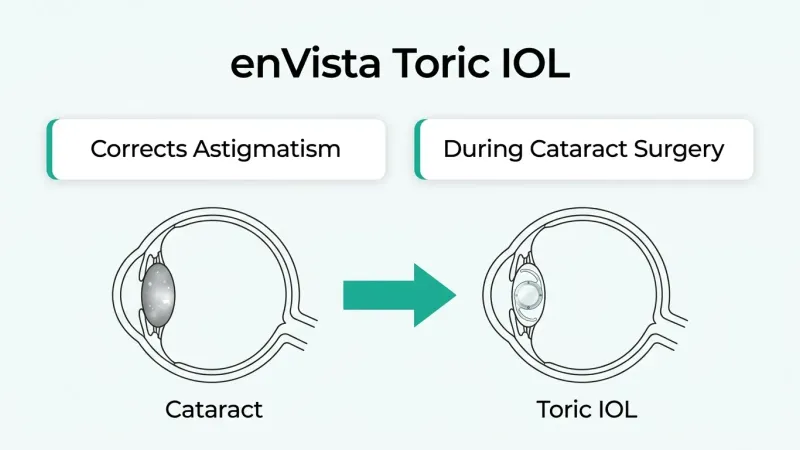
Persistent astigmatism after cataract surgery may require a targeted enhancement to restore clear, undistorted vision. According to a Cochrane Library review, patients receiving a toric IOL are likely to experience a small improvement in visual acuity at six months or more compared to those receiving limbal relaxing incisions, with a higher probability of achieving residual astigmatism within 0.5D. Pre-operative corneal astigmatism of ≥1.5D affects approximately 15% to 22% of cataract surgery candidates, according to PMC, making this a clinically significant source of post-operative dissatisfaction when not adequately corrected at the time of primary surgery.
What Are the Types of Enhancement Procedures After Cataract Surgery?
The types of enhancement procedures after cataract surgery include laser-based corrections, intraocular lens modifications, and targeted capsule treatments. The following sections cover LASIK, PRK, IOL exchange, piggyback IOL implantation, YAG laser capsulotomy, and limbal relaxing incisions.
LASIK Enhancement
LASIK enhancement is a laser procedure that reshapes the cornea to correct residual refractive error remaining after cataract surgery. According to a study published in the Journal of Cataract and Refractive Surgery, 67% of LASIK patients achieved 20/20 vision or better, compared to 43% of PRK patients, making LASIK generally the more predictable laser option for pseudophakic ametropia. Laser vision correction is broadly considered more effective for managing residual refractive error than intraocular procedures such as IOL exchange.
PRK Enhancement
PRK enhancement reshapes the corneal surface without creating a flap, making it a suitable alternative when LASIK is contraindicated. For patients with multifocal IOLs, PRK may be preferred over LASIK because the LASIK flap interface carries a theoretical risk of disrupting the optical pathway and increasing dysphotopsia. While PRK produces slightly lower rates of 20/20 outcomes than LASIK, it remains a clinically sound option for carefully selected candidates.
IOL Exchange
IOL exchange is a surgical procedure that removes the original implanted lens and replaces it with a new intraocular lens of corrected power. Placement within the capsular bag is preferred when possible due to its superior safety profile, though the procedure carries risks such as zonular dialysis or retinal detachment. It is typically most effective when performed within the first three months after the initial implantation, before the capsule has fully fibrosed around the original lens.
Piggyback IOL Implantation
Piggyback IOL implantation is a procedure in which a second intraocular lens is placed over the existing IOL to correct residual refractive error, particularly myopia or hyperopia. According to a systematic review published in the Journal of Refractive Surgery, the overall complication rate for piggyback IOL implantation was 11.3%, though it remains a highly effective correction method. It is generally considered when IOL exchange poses greater surgical risk.
YAG Laser Capsulotomy
YAG laser capsulotomy is a non-invasive procedure that uses a focused laser pulse to create an opening in the clouded posterior lens capsule, restoring light transmission to the retina. It is the standard treatment for posterior capsule opacification (PCO), a common secondary complication that can develop months to years after cataract surgery. The procedure is performed in an outpatient setting and typically takes only a few minutes.
Limbal Relaxing Incisions
Limbal relaxing incisions (LRIs) are small, arc-shaped cuts placed at the peripheral cornea to reduce residual astigmatism by relaxing corneal curvature. Evidence from the Cochrane Library suggests that toric IOLs offer a higher likelihood of achieving residual astigmatism within 0.5 D compared to LRIs, indicating LRIs may be the less precise option for moderate-to-high astigmatism correction. They remain useful for mild cases or when laser treatment is not available.
Who Is a Good Candidate for Enhancement After Cataract Surgery?
Good candidates for enhancement after cataract surgery are patients with stable refractive error, adequate corneal thickness, and no disqualifying ocular or systemic conditions. The following H3s cover the specific eye health criteria required, the recommended waiting period, and conditions that may rule out enhancement.
What Eye Health Criteria Must Be Met for Enhancement?
The eye health criteria for enhancement include a stable refraction, sufficient corneal thickness for laser procedures, and healthy ocular surface. Candidates should have no significant dry eye, uncontrolled glaucoma, or active retinal disease. For laser-based options such as LASIK or PRK, the corneal profile must support the planned ablation depth without compromising the residual stromal bed. Patients with multifocal IOLs require particularly careful evaluation, as optical pathway integrity is essential for maintaining post-enhancement quality of vision.
How Long After Cataract Surgery Should You Wait?
The recommended waiting period after cataract surgery before pursuing enhancement is typically at least three months. A PMC study found that refractive error stabilization following phacoemulsification occurred by day 28 in 98.8% of eyes, reaching 100% by day 60, which establishes the physiological basis for this timeline. According to Dr. Kathryn M. Hatch, writing in CRSToday, waiting approximately three months allows for healing, improvement, and refractive stabilization before laser enhancement is considered. In practice, a stable refraction across two consecutive measurements is the most reliable indicator that the eye is ready, regardless of how many weeks have passed.
Are There Conditions That May Disqualify You?
Several conditions may disqualify a patient from enhancement after cataract surgery. An unstable or changing prescription is a common disqualifier, as it indicates the eye has not reached refractive stabilization. According to NVISION Eye Centers, additional contraindications include large pupils, thin corneas, and certain autoimmune conditions such as lupus, which can interfere with healing. Ocular conditions such as dry eye, glaucoma, and retinal disease may also exclude a patient or require extra precautions before proceeding. Discussing your full medical history with a specialist is the most reliable way to confirm eligibility.
What Are the Possible Risks of Enhancement After Cataract Surgery?
The possible risks of enhancement after cataract surgery vary by procedure type but can include interface complications, structural eye damage, and long-term visual changes. The sections below cover surgical complications specific to LASIK enhancement, risks tied to IOL exchange, and how these procedures may affect long-term eye health.
What Surgical Complications May Occur With LASIK Enhancement?
Surgical complications that may occur with LASIK enhancement include flap necrosis, permanent corneal scarring, and varying degrees of visual acuity loss. Despite these risks, LASIK generally offers more predictable outcomes than PRK for post-cataract patients. According to a study published in the Journal of Cataract & Refractive Surgery, 67% of LASIK patients achieved 20/20 or better uncorrected distance visual acuity compared to 43% of PRK patients.
However, for patients with multifocal IOLs, PRK may be the safer choice. There is a theoretical risk that the LASIK flap interface could disrupt the optical pathway and increase dysphotopsia in these patients. Choosing between the two procedures depends heavily on IOL type and individual corneal anatomy.
What Risks Are Associated With IOL Exchange?
The risks associated with IOL exchange include zonular dialysis and retinal detachment, both of which are serious surgical complications. IOL exchange within the capsular bag is preferred over other secondary IOL options when possible due to its superior safety profile, according to a review published in Clinical Ophthalmology. Still, the procedure carries meaningful intraoperative risk, particularly when the capsule has begun to fibrosis after the initial implantation.
Can Enhancement Procedures Affect Long-Term Eye Health?
Yes, enhancement procedures can affect long-term eye health, particularly when complications arise during or after surgery. Corneal scarring from LASIK flap complications may cause permanent refractive irregularities. IOL exchange carries a low but real risk of retinal detachment, which can threaten long-term vision. Careful candidate selection and timing are the most important factors in minimizing these risks, making a thorough pre-operative evaluation essential before proceeding with any enhancement.
What Results Can Enhancement After Cataract Surgery Provide?
Enhancement after cataract surgery can meaningfully reduce residual refractive errors, including nearsightedness, farsightedness, and astigmatism. The following sections outline what patients can realistically expect for each refractive condition.
How Much Can Enhancement Improve Residual Nearsightedness?
Enhancement can improve residual nearsightedness by reshaping the corneal surface or adjusting the eye’s refractive power to reduce myopic error remaining after cataract surgery. Timing plays an important role in how effective these corrections are. According to Dr. Kathryn M. Hatch, writing in CRSToday, surgeons often wait approximately three months after cataract surgery before considering a laser enhancement, allowing adequate time for healing, improvement, and refractive stabilization. Attempting correction too early risks treating a prescription that has not yet settled, which can compromise the accuracy of the outcome.
How Much Can Enhancement Improve Residual Farsightedness?
Enhancement can improve residual farsightedness by correcting hyperopic refractive error that persists after intraocular lens implantation. Laser procedures such as LASIK and PRK are the most commonly used options for pseudophakic hyperopia, as they offer more predictable outcomes than intraocular revision surgery for most eligible patients. The degree of correction achievable depends on the amount of remaining hyperopia, corneal thickness, and whether the patient meets candidacy criteria for laser treatment.
How Much Can Enhancement Improve Residual Astigmatism?
Enhancement can improve residual astigmatism by correcting irregular corneal curvature or rotational displacement of a toric IOL that was not fully addressed during the initial procedure. Laser vision correction is generally considered the most effective approach for managing mild to moderate pseudophakic astigmatism. For patients who received a toric IOL, repositioning or exchanging the lens may also be an option if rotation is the primary cause. The extent of improvement depends on the source and severity of the remaining astigmatic error.
What Should You Expect During Recovery From Enhancement?
Recovery from enhancement after cataract surgery is generally shorter and less intensive than the original cataract surgery, but the timeline and experience vary depending on the procedure type. The sections below cover early symptoms, healing milestones, and how long full stabilization typically takes.
What Happens in the First Few Days After Enhancement?
The first few days after enhancement commonly involve mild discomfort, fogginess, or blurry vision as the eye begins to heal. According to Precision Vision London, these symptoms typically resolve within 1 to 3 days following a refractive lens enhancement procedure. Light sensitivity and mild tearing are also common during this window. These early symptoms are a normal part of the healing response and do not indicate a complication in most cases.
How Long Until Vision Stabilizes After Enhancement?
Vision after enhancement may stabilize gradually over several weeks rather than immediately. Most patients notice significant visual improvement within the first 24 to 48 hours after a laser enhancement procedure, though full healing and stabilization can take four to eight weeks, according to Brooks Eye. Patients should avoid rubbing the eye, strenuous activity, and swimming during this period to protect the healing tissue and support optimal outcomes.
What Visual Goals Does Enhancement Target During Recovery?
Enhancement procedures target residual refractive errors, such as myopia, hyperopia, and astigmatism, to reduce dependence on glasses after cataract surgery. Unlike the original cataract procedure, which addresses lens clarity, enhancements refine the focusing power of the eye. Understanding this distinction helps patients set realistic expectations: the goal is not to redo the surgery, but to fine-tune the result. Staying aligned with your surgeon’s follow-up schedule is the most reliable way to monitor progress during recovery.
How Does Enhancement Differ From the Original Cataract Surgery?
Enhancement after cataract surgery differs from the original procedure in both purpose and coverage. Cataract surgery removes a cloudy lens to restore clarity; enhancement targets residual refractive errors such as myopia, hyperopia, or astigmatism to reduce dependence on glasses. The sections below compare their goals, insurance treatment, and cost implications.
Purpose: Restoring Clarity vs. Refining Focus
The purpose of cataract surgery is to remove a cloudy natural lens and replace it with an intraocular lens (IOL), restoring functional vision. Enhancement, by contrast, specifically targets residual refractive error remaining after that initial procedure. Because enhancement addresses a refractive outcome rather than a disease, it is generally classified as elective rather than medically necessary, which carries significant implications for coverage and cost.
Insurance and Medicare Coverage Differences
Medicare covers cataract surgery and standard prosthetic lenses, but does not cover advanced technology lenses or elective refractive enhancements such as LASIK, according to AARP. This distinction means most patients pay out-of-pocket for laser-based enhancements even when the original surgery was fully covered. Medically necessary procedures, such as YAG capsulotomy for posterior capsule opacification, may retain coverage, making it essential to confirm the specific enhancement type with your insurer before proceeding.
Out-of-Pocket Cost Considerations
Out-of-pocket costs for enhancements are a frequently overlooked gap in patient planning. Because elective refractive enhancements are excluded from Medicare and most standard insurance plans, patients absorb the full cost. This financial exposure is notably distinct from the original surgery experience, where most medically necessary components are reimbursed. Discussing the realistic likelihood of needing an enhancement before the initial surgery can help patients budget appropriately and avoid unexpected expenses.
How Can You Make an Informed Decision About Enhancement?
Making an informed decision about enhancement starts with understanding your options, candidacy, and realistic outcomes. The following sections cover how surgeon-reviewed resources can support that process and the key takeaways every patient should know.
Can Surgeon-Reviewed Resources Help You Understand Enhancement?
Surgeon-reviewed resources can help you understand enhancement by translating complex clinical information into clear, actionable guidance. For a procedure as nuanced as post-cataract enhancement, the gap between what patients know and what they need to know can directly affect their outcomes. Resources developed under surgical oversight help patients ask better questions, recognize valid candidacy criteria, and weigh procedure options with realistic expectations. Eye Surgery Today provides surgeon-reviewed educational content designed to support exactly this kind of informed decision-making, covering topics from residual refractive error to IOL selection.
What Are the Key Takeaways About Enhancement After Cataract Surgery?
The key takeaways about enhancement after cataract surgery are that it is a well-defined secondary procedure, not a failure of the original surgery, and that multiple effective options exist depending on the cause of residual visual impairment. Enhancement refers to any additional procedure performed after initial cataract surgery to improve visual outcomes, typically targeting residual refractive error or posterior capsule opacification.
The most important decisions involve:
- Waiting for refractive stabilization before pursuing any enhancement, generally at least three months post-surgery.
- Matching the procedure to the cause: laser correction for residual myopia, hyperopia, or astigmatism; YAG capsulotomy for PCO; IOL exchange or piggyback IOL for significant power errors.
- Confirming candidacy: corneal thickness, ocular health, and absence of disqualifying conditions all determine eligibility.
- Understanding coverage: elective refractive enhancements are typically not covered by Medicare or standard insurance, making out-of-pocket planning essential.
Patients who approach enhancement with accurate expectations and surgeon-reviewed information are best positioned to achieve the visual outcomes they are looking for.