Monovision vs Multifocal Lenses (Which Is Better?)
Monovision is a vision correction strategy that sets each eye to a different focal distance, while multifocal intraocular lenses (IOLs) split light into multiple focal points within a single implant to provide near, intermediate, and distance vision simultaneously.
This guide covers how each approach works and the lens types available, the potential benefits and visual trade-offs of both strategies, candidacy screening and real-world performance comparisons, cost and insurance considerations, and the surgical journey from preoperative assessment through recovery.
Monovision relies on the brain suppressing the blurred image from the non-dominant eye, and it comes in traditional, mini, and modified variants that offer differing levels of binocular function. Multifocal IOLs use diffractive, refractive, or extended depth of focus optics to create simultaneous focal points, and bilateral multifocal implants may be associated with significantly higher rates of complete spectacle independence compared to monovision.
Each strategy carries distinct trade-offs. Monovision may reduce stereopsis and leave intermediate distances like computer screens underserved, while multifocal lenses may increase the likelihood of halos, glare, and reduced contrast sensitivity, particularly in low-light conditions. Candidacy for either option depends on ocular surface health, macular status, lifestyle priorities, and personal tolerance for a neuroadaptation period.
Insurance coverage also differs: Medicare may cover standard monofocal lens implantation during cataract surgery, but the presbyopia-correcting function of premium multifocal IOLs is generally an out-of-pocket expense. A contact lens monovision trial before permanent surgery can help clarify individual tolerance, and a thorough consultation with your surgeon remains the most reliable path to matching the right lens strategy to your specific visual goals.
How do monovision and multifocal lenses work differently to correct vision?
Monovision and multifocal lenses take fundamentally different approaches to solving the same problem: restoring clear vision at multiple distances after the eye’s natural focusing ability is lost. The sections below cover how each strategy works, what multifocal IOLs offer in terms of spectacle independence, and how the brain adjusts to each approach.
What is monovision and how does it change the way your eyes focus?
Monovision changes the way your eyes focus by deliberately correcting each eye for a different focal distance, rather than giving both eyes identical correction. Typically, the dominant eye is set for distance vision and the non-dominant eye is corrected for near vision. The brain then learns to favor whichever eye is more useful for a given task.
Modified monovision extends this concept further. According to a 2023 double-masked prospective comparative study published in the Indian Journal of Ophthalmology, modified monovision may involve fitting the dominant eye with single-vision distance correction while fitting the other eye with a multifocal design, or using multifocal lenses of differing add powers in each eye to optimize both near and distance performance.
The trade-off is that some degree of binocular overlap is sacrificed, which is why a contact lens trial before any permanent procedure is strongly advisable.
What are multifocal IOLs and how do they provide vision at multiple distances?
Multifocal IOLs provide vision at multiple distances by dividing incoming light into two or more simultaneous focal points within a single lens. Rather than dedicating each eye to one distance, a single multifocal implant handles near, intermediate, and distance vision concurrently.
The FDA granted the first U.S. approval for a multifocal IOL in 1997, according to a 2014 FDA workshop report from the Division of Ophthalmic and Ear, Nose and Throat Devices. Since then, the technology has evolved considerably.
This simultaneous-focus design offers a meaningful independence advantage. A 2024 systematic review and network meta-analysis published in Eye (Lond), covering 32 studies and 3,082 patients at the National University of Singapore, found that bilateral multifocal IOLs were more than twice as likely as monovision to achieve complete spectacle independence (RR = 2.06, 95% CI = 1.34 to 3.15, p = 0.002). For patients whose primary goal is freedom from glasses across all distances, this is a clinically significant distinction.
How does your brain adapt differently to monovision versus multifocal lenses?
The brain adapts differently to monovision versus multifocal lenses primarily because the two strategies make different demands on neural processing. With monovision, the brain must learn to suppress the out-of-focus image from the non-dominant eye, a process called interocular suppression that typically develops over days to weeks. With multifocal IOLs, the brain faces a different challenge: learning to select the appropriate focal image from several simultaneous signals arriving through one lens.
No direct head-to-head neuroadaptation timeline data comparing the two strategies is currently available from authoritative sources. What is well established clinically is that neither approach is instantaneous. Patients considering either option should expect an adjustment period and discuss realistic adaptation timelines with their surgeon before making a final decision.
What are the main types of monovision and multifocal lens options?
The main types of monovision and multifocal lens options span a spectrum from simple distance/near splits to advanced premium implants. The sub-sections below cover monovision variants, multifocal IOL optics, and how premium multifocal lenses differ from standard monofocal implants.
What are the types of monovision (traditional monovision, mini-monovision, modified monovision)?
The types of monovision are traditional monovision, mini-monovision, and modified monovision, each defined by how much inter-eye correction difference is applied.
- Traditional monovision sets the dominant eye for clear distance vision and the non-dominant eye for near, using a relatively large inter-eye power difference.
- Mini-monovision uses a smaller power gap, preserving more binocular function while still reducing near-glasses dependence.
- Modified monovision fits the dominant eye with single-vision distance correction and the non-dominant eye with a multifocal design, or pairs a low-add multifocal in the dominant eye with a high-add multifocal in the other eye to optimize both distance and near vision, according to a 2023 prospective study published in the Indian Journal of Ophthalmology.
Modified monovision offers the most flexibility, making it a strong option for patients who cannot tolerate the blur associated with traditional approaches.
What are the main types of multifocal IOLs (diffractive, refractive, extended depth of focus)?
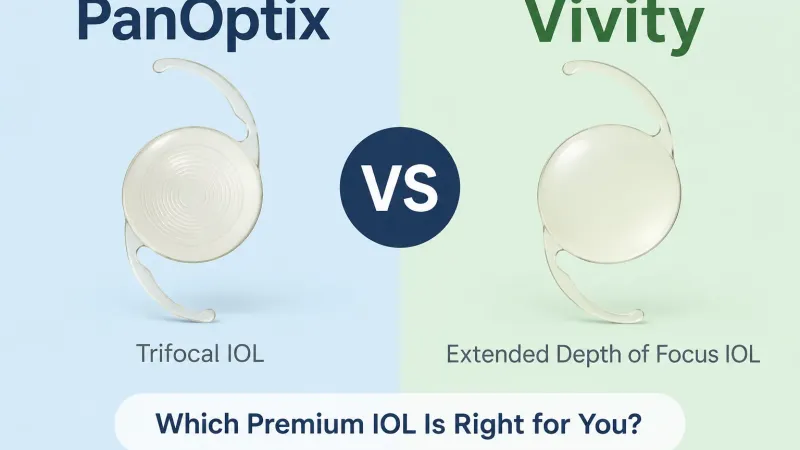
The main types of multifocal IOLs are diffractive, refractive, and extended depth of focus (EDOF) designs, each producing multiple focal points through different optical mechanisms.
According to a 2020 literature review in Graefe’s Archive for Clinical and Experimental Ophthalmology (247 articles; University of Warmia and Mazury and University of Helsinki):
- Diffractive IOLs generate multifocality through light interference using a series of annular concentric grooves less than 1 micron deep, engraved on the lens surface using echelette technology.
- Refractive IOLs achieve multiple foci through light refraction across zone-based lens surfaces, governed by Snell’s law.
- EDOF IOLs elongate the focal range rather than creating discrete near and distance peaks, providing a continuous corridor of vision with fewer dysphotopsias.
How do premium multifocal IOLs differ from standard monofocal lenses?
Premium multifocal IOLs differ from standard monofocal lenses in their ability to provide functional vision at more than one distance, at a measurably higher cost and quality-of-life benefit. A 2019 cost-effectiveness analysis using a Markov model at the Shiley Eye Institute and University of California San Diego found that multifocal IOLs were associated with a 0.71 QALY increase at an additional cost of $3,415 compared with monofocal IOLs, yielding an incremental cost-effectiveness ratio of $4,805 per QALY. Monofocal lenses, by contrast, provide sharp vision at only one fixed distance, typically requiring patients to wear glasses for near or intermediate tasks. The trade-off is real: premium multifocals carry a higher risk of dysphotopsias such as halos and glare, which monofocals largely avoid.
Understanding these lens categories helps patients and surgeons match optical design to lifestyle priorities.
What are the potential benefits of choosing monovision?
Monovision may offer meaningful advantages for patients seeking reduced dependence on glasses after cataract or refractive lens surgery. The sections below cover how monovision can affect reading glass use, distance vision quality, and daily tasks involving depth perception.
How may monovision reduce dependence on reading glasses?
Monovision may reduce dependence on reading glasses by correcting one eye for near vision and the other for distance, allowing the brain to select the appropriate image for each task. The near-corrected eye handles close work such as reading menus, labels, and text messages, while the distance eye remains clear for driving and general viewing. This division of focal responsibilities removes the constant need to reach for glasses during routine activities, which many patients find genuinely liberating in daily life.
How does monovision typically affect distance vision quality?
Monovision typically preserves good distance vision in the dominant eye while introducing some degree of compromise in binocular sharpness. According to a 2007 review by Bruce J. W. Evans at the Neville Chappell Research Clinic, Institute of Optometry, London, published in Ophthalmic and Physiological Optics, the success rate of monovision in adapted contact lens wearers is 59 to 67%, with main limitations including difficulty suppressing the blurred image when driving at night and reduced stereopsis. Patients considering monovision should weigh these trade-offs carefully, particularly if night driving is a frequent activity.
How might monovision influence depth perception and everyday tasks?
Monovision may influence depth perception because the brain receives two images of slightly different clarity, which can reduce stereoacuity. Most everyday tasks, such as cooking, using a smartphone, or navigating familiar environments, rely primarily on monocular depth cues and are generally manageable. More demanding spatial tasks, such as catching fast-moving objects or judging precise distances, may feel subtly less accurate. For many adapted patients, this reduction is minor enough that it does not interfere meaningfully with daily function.
What are the potential benefits of choosing multifocal lenses?
Multifocal lenses may offer meaningful advantages for patients who want clear vision across multiple distances after cataract surgery. The following sections cover near and intermediate vision improvement, spectacle independence, and quality-of-life outcomes.
How may multifocal IOLs improve near and intermediate vision after cataract surgery?
Multifocal IOLs may improve near and intermediate vision by distributing incoming light across two or more focal points, allowing the eye to focus at varying distances simultaneously. For patients prioritizing intermediate visual acuity specifically, the 2024 European Society of Cataract and Refractive Surgeons guidelines note that EDF IOLs or pseudophakic monovision may deliver good intermediate vision with significantly less dysphotopsia than traditional multifocal IOLs. This makes lens selection a nuanced decision: patients seeking strong near and intermediate performance across all distances may benefit most from a full multifocal design, while those primarily concerned with intermediate tasks may find EDF options more comfortable.
How can multifocal lenses reduce the need for glasses across different distances?
Multifocal lenses can reduce the need for glasses by providing simultaneous correction for near, intermediate, and distance vision in a single implanted lens. A 2024 systematic review and network meta-analysis published in Eye (National University of Singapore), including 32 studies and 3,082 patients, found that bilateral multifocal IOLs were more than twice as likely to achieve complete spectacle independence compared to monovision (RR = 2.06, 95% CI 1.34 to 3.15). For patients whose primary goal is to minimize reliance on glasses, this represents a clinically meaningful advantage.
How do multifocal lenses impact quality of life and daily activities?
Multifocal lenses may positively impact quality of life by enabling patients to read, use digital devices, and drive without switching between pairs of glasses. Reduced spectacle dependence across daily tasks, such as cooking, reading, and screen use, can support greater independence and convenience. That said, some patients experience visual phenomena like halos or glare, particularly in low-light conditions, which may affect satisfaction and should be discussed thoroughly with a surgeon before choosing this lens type.
What are the possible risks, side effects, and visual trade‑offs with monovision?
Monovision carries real trade‑offs that vary by individual tolerance. The subsections below cover how depth perception is affected, which visual symptoms are most commonly reported, and what reversal options are available if the outcome does not suit you.
How can monovision affect depth perception and 3D vision?
Monovision can affect depth perception and 3D vision by reducing stereopsis, the binocular cue the brain uses to judge distance. Because each eye is corrected for a different focal range, the two eyes no longer receive matching sharp images simultaneously, which weakens stereoscopic acuity. According to a 2007 review by Bruce J. W. Evans at the Neville Chappell Research Clinic, Institute of Optometry London, stereopsis is measurably impaired in monovision, though most patients do not consciously notice this in daily life. Tasks such as judging kerb heights, pouring liquids, or catching objects may feel subtly less precise, particularly in the early adaptation period. For most people, the brain compensates through other depth cues such as perspective and motion parallax, making the real‑world impact manageable. Still, patients with occupations requiring precise depth judgment should weigh this trade‑off carefully with their surgeon.
What visual symptoms or discomfort might occur with monovision?
The visual symptoms that may occur with monovision include blurred image suppression difficulties, reduced night‑driving clarity, and insufficient vision at intermediate distances such as computer screens. The same 2007 Evans review noted that the success rate of monovision in adapted contact lens wearers is only 59 to 67 percent, with night‑driving blur and the absence of a comfortable intermediate focal point cited as the main limitations. Some patients also report mild eyestrain or headaches during the adaptation period as the brain learns to alternate between the two eyes. Intermediate‑distance tasks are a particularly underestimated challenge: the dominant eye optimized for distance and the near eye optimized for reading can both leave a computer screen in a soft blur.
How reversible is monovision if you are unhappy with the outcome?
Reversibility depends on which monovision method was used. For contact lens monovision, the outcome is fully reversible: simply stop wearing the lenses. For LASIK‑based monovision, the correction can often be adjusted with an enhancement procedure, though this adds cost and carries the typical LASIK re‑treatment considerations. For pseudophakic monovision achieved through IOL implantation during cataract surgery, reversal is considerably more complex, as lens exchange carries surgical risk. This is why the American Academy of Ophthalmology recommends trialing monovision with contact lenses before committing to any permanent surgical correction, giving patients a low‑risk way to assess personal tolerance before an irreversible step.
What are the possible risks, side effects, and visual trade‑offs with multifocal lenses?
The possible risks, side effects, and visual trade‑offs with multifocal lenses include glare, halos, reduced contrast sensitivity, and night-vision disturbances. The sections below examine each trade‑off in detail, including how often enhancement procedures may be needed.
What types of glare, halos, or night-vision issues can multifocal lenses cause?
The types of glare, halos, and night-vision issues that multifocal lenses can cause are well-documented in clinical literature. A 2016 Cochrane systematic review of 20 trials and 2,230 people found that adverse subjective visual phenomena were more prevalent and more troublesome with multifocal IOLs compared with monofocals, with a relative risk for halos of 3.58 (95% CI 1.99 to 6.46) and for glare of 1.41 (95% CI 1.03 to 1.93). These effects stem from the lens splitting incoming light across multiple focal points simultaneously. For most patients, symptoms are mild and diminish as the brain adapts, but individuals who drive frequently at night or work in dim environments may find them more disruptive.
How might contrast sensitivity be affected by multifocal IOLs?
Contrast sensitivity may be reduced in patients who receive multifocal IOLs. According to a 2021 American Academy of Ophthalmology evidence review of 34 studies, all patients who received multifocal and EDOF lenses showed decreased contrast sensitivity and reported more visual phenomena compared with control participants who received monofocal lenses. Lower contrast sensitivity can affect the ability to distinguish fine details in low-light conditions, such as reading in dim rooms or recognizing faces at dusk. Patients with pre-existing retinal conditions or corneal irregularities may experience this effect more acutely, making thorough preoperative screening essential.
How often do patients need enhancement procedures after multifocal IOL implantation?
No standardized, head-to-head enhancement-rate data for multifocal IOLs versus monovision was identified in reviewed authoritative sources, so a precise figure cannot be cited. Enhancement procedures such as LASIK or lens exchange may be considered when residual refractive error reduces the benefit of the multifocal design. Careful preoperative biometry and lens power selection reduce the likelihood of needing secondary intervention. Understanding the full risk profile, from dysphotopsia to contrast loss, helps set realistic expectations before choosing a multifocal lens.
Who may be a good candidate for monovision?
Good monovision candidates share several common traits: they have presbyopia or early cataracts, realistic expectations about visual trade-offs, and lifestyle needs that align with what monovision reliably delivers. The sections below examine how age, vision type, daily activities, and pre-surgical trials shape candidacy.
How do age and type of vision problem influence candidacy for monovision?
Age and type of vision problem influence monovision candidacy primarily through the presence of presbyopia, the age-related loss of near focusing ability that typically begins in the mid-40s. Monovision is designed to compensate for presbyopia by setting one eye for distance and the other for near, making it most relevant for patients in this age group and older. People with mild myopia in their non-dominant eye may adapt more readily, since that eye is already accustomed to near-focus priority. Patients with significant astigmatism or irregular corneas may require additional correction before monovision becomes viable. Your surgeon will assess your refractive profile to determine which monovision approach, traditional, mini, or modified, suits your specific prescription.
How do occupation, hobbies, and driving needs affect suitability for monovision?
Occupation, hobbies, and driving needs affect monovision suitability because this approach involves deliberate interocular blur, which may not suit every daily demand. Patients should discuss their visual requirements honestly with their surgeon, particularly around:
- Precision near tasks: such as detailed hand-work, surgery, or fine art, where reduced binocular summation may matter.
- Night driving: where suppressing the blurred image in low contrast can be more difficult.
- Intermediate-distance work: such as computer use, which monovision does not always address well without a supplementary near correction.
- Active sports: where depth perception accuracy may be a practical concern.
No universally evidence-based occupation-specific prohibition list exists in current authoritative sources, so individual discussion with your surgeon remains the appropriate path.
Why is a contact lens monovision trial important before permanent surgery?
A contact lens monovision trial is important because it lets you experience the actual visual result before committing to an irreversible lens implant. The American Academy of Ophthalmology advises patients to try monovision contacts before cataract surgery to determine whether monovision works for them. This trial reveals whether your brain can suppress the blurred eye comfortably in real daily conditions, including reading, driving, and screen use. Given that monovision success rates in adapted contact lens wearers range from 59 to 67% according to a 2007 review by Bruce J. W. Evans in Ophthalmic and Physiological Optics, a trial period provides genuinely meaningful information about your individual likelihood of satisfaction before a permanent decision is made.
Who may be a good candidate for multifocal lenses?
Good multifocal IOL candidacy depends on ocular health, lifestyle expectations, and psychological tolerance for a neuroadaptation period. The following H3s cover the three key screening dimensions surgeons evaluate before recommending a multifocal implant.
How do eye health conditions (like dry eye, macular disease, astigmatism) impact suitability for multifocal IOLs?
Eye health conditions impact suitability for multifocal IOLs significantly, because the optics of these lenses tolerate less ocular surface or retinal compromise than monofocal designs. Active or poorly controlled dry eye disease is a particular concern. More than 90% of ASCRS Clinical Survey respondents felt that mild-to-moderate dry eye disease impacts patient satisfaction in cataract and refractive surgery. Macular disease, significant epiretinal membrane, and unmanaged astigmatism can degrade image quality at each focal point, amplifying the contrast sensitivity losses already inherent to diffractive multifocal designs. Surgeons typically require a stable, healthy ocular surface and a clear macular profile before proceeding. Patients with corneal irregularities or significant astigmatism may need toric correction incorporated into the lens or a preliminary corneal procedure to optimize outcomes.
How do lifestyle priorities and expectations shape candidacy for multifocal lenses?
Lifestyle priorities shape candidacy for multifocal lenses because the technology is designed for patients whose primary goal is broad spectacle independence across near, intermediate, and distance tasks. Ideal candidates typically want to read menus, use a smartphone, work at a computer, and drive without reaching for glasses. Those who prioritize absolute optical precision in a single zone, such as a professional photographer who demands peak contrast for fine detail, may find that a monofocal or monovision strategy better aligns with their needs. Patients should enter surgery with realistic expectations: multifocal lenses redistribute light across focal points, which involves trade-offs in contrast and the possibility of halos or glare, especially at night.
Why is personality and tolerance for visual imperfections important with multifocal IOLs?
Personality and tolerance for visual imperfections are important with multifocal IOLs because the brain requires a neuroadaptation period before fully integrating the multiple focal images these lenses produce. A 2021 prospective controlled clinical trial at Zhongshan Ophthalmic Center, Sun Yat-sen University, found that visual cortex activity in multifocal IOL patients decreased at one week postoperatively, recovered to baseline by three months, and then exceeded preoperative levels at six months, indicating a measurable cortical adjustment process. Patients who are highly sensitive to visual disturbances, or who become anxious when results are not immediately perfect, may find this adaptation window stressful. Conversely, motivated, patient individuals who can tolerate transient imperfections during recovery tend to achieve the highest satisfaction with multifocal implants in the long term.
How do cost, insurance coverage, and long‑term value compare between monovision and multifocal lenses?
Cost and insurance coverage differ meaningfully between monovision and multifocal IOL strategies. The sections below cover upfront cost considerations, Medicare and insurance rules, and how to weigh long-term spectacle savings against higher initial investment.
How do upfront costs differ between monovision strategies and multifocal IOLs?
Upfront costs differ between monovision and multifocal IOL strategies, but no universally published patient price exists across providers. Monovision using standard monofocal lenses generally carries a lower out-of-pocket premium than bilateral multifocal IOL implantation, since multifocal lenses are classified as presbyopia-correcting premium devices and attract additional fees beyond the base surgical cost. However, authoritative non-commercial sources do not provide a standardized price comparison, and costs vary by surgeon, facility, and region. Patients should request itemized quotes that separate the surgical fee from the lens upgrade charge before making a financial commitment.
How does insurance typically cover monofocal versus multifocal IOLs?
Insurance coverage differs substantially between monofocal and multifocal IOLs. Medicare Part B may cover cataract surgery that implants conventional intraocular lenses, but according to CMS Ruling 05-01 (2005), the presbyopia-correcting functionality of a multifocal IOL does not fall within the Medicare benefit category and is not covered; additionally, any extra provider or physician services required specifically to insert or monitor a presbyopia-correcting IOL are also excluded. This means patients choosing multifocal lenses typically pay the lens upgrade cost entirely out of pocket, regardless of their Medicare or supplemental plan status.
How should you weigh long‑term spectacle costs and value when choosing between options?
Long-term spectacle costs and value should be weighed by comparing the higher upfront investment in multifocal IOLs against the cumulative cost of ongoing eyewear. A 2019 cost-effectiveness analysis at the Shiley Eye Institute, University of California San Diego, using a Markov model found that multifocal IOLs were associated with a 0.71 quality-adjusted life-year gain at an incremental cost of $3,415 over monofocal IOLs, yielding an incremental cost-effectiveness ratio of $4,805 per QALY. For patients who are strong multifocal candidates, this ratio compares favorably to many accepted healthcare interventions. Monovision may represent a lower upfront cost, but patients who still require reading glasses offset some of that advantage over time. Discussing both the short-term financial commitment and your expected glasses use with your surgeon helps clarify which option offers the better personal value.
How do monovision and multifocal lenses compare for specific everyday situations?
Monovision and multifocal lenses perform differently depending on the visual task. The three H3 sections below address night driving, computer use, and distance vision sharpness.
Which option may be better if you drive frequently at night?
Monovision may be the better option for frequent night drivers, though it carries its own limitations in low-light conditions. According to a 2007 review by Bruce J. W. Evans at the Neville Chappell Research Clinic, Institute of Optometry, London, a main limitation of monovision is difficulty suppressing the blurred image when driving at night. Multifocal lenses may introduce additional concerns: a 2016 Cochrane systematic review of 20 trials and 2,230 people found that halos were 3.58 times more likely with multifocal IOLs than with monofocals. For night drivers, neither option is perfect, but multifocal lenses carry a higher documented risk of disruptive light phenomena.
Which option may be better if you do a lot of computer and intermediate‑distance work?
Monovision may be a weaker option for heavy computer users, because it lacks a dedicated intermediate focal point. The same 2007 Evans review identifies the need for a third focal length, such as computer screens at intermediate distance, as a primary limitation of monovision. The 2024 European Society of Cataract and Refractive Surgeons guidelines recommend EDOF IOLs or pseudophakic monovision for patients who desire good intermediate visual acuity, with significantly less dysphotopsia than standard multifocal IOLs. For consistent screen-distance clarity, an EDOF or trifocal lens may serve computer-intensive patients better than traditional monovision.
Which option may be better if you prioritize the sharpest possible distance vision?
The option that may be better for sharpest distance vision is monovision, specifically its dominant eye, which is corrected purely for distance. Multifocal IOLs split incoming light across multiple foci, and a 2021 AAO Ophthalmic Technology Assessment covering 34 studies found that all patients receiving multifocal and EDOF lenses showed decreased contrast sensitivity compared with monofocal controls. This optical trade-off means that while multifocal lenses deliver broader range, they can slightly reduce the crispness of peak distance acuity. Patients whose work or lifestyle depends on high-contrast distance vision, such as pilots or avid golfers, are often better served by a distance-dominant monovision or monofocal approach.
What should you expect before, during, and after cataract surgery or lens surgery when choosing these options?
Before, during, and after cataract or lens replacement surgery, the experience varies depending on whether you choose monovision or a multifocal IOL. The key phases cover pre-surgery assessment, the surgical procedure itself, and your recovery and adaptation period.
What pre-surgery assessments are needed to decide between monovision and multifocal IOLs?
The pre-surgery assessments needed include corneal topography, biometry, dominant eye testing, dry eye evaluation, and a structured discussion of your visual goals and lifestyle. Ocular surface health is particularly important: according to an ASCRS Clinical Survey, more than 90% of respondents felt that mild-to-moderate dry eye disease impacts patient satisfaction in cataract and refractive surgery. Surgeons also typically assess pupil size, macular health, and contrast sensitivity, as these directly influence which lens type is appropriate. For monovision candidates, a contact lens trial is often completed before any surgical commitment.
What happens during cataract or lens replacement surgery with each lens choice?
Cataract or lens replacement surgery follows the same core procedure regardless of lens type: phacoemulsification removes the natural lens, and the chosen IOL is implanted into the capsular bag. The lens selection, however, affects both the surgical planning and post-operative experience. A 2024 online survey of 30 UK refractive surgeons published in BMC Ophthalmology found EDoF lenses were the most popular choice (30%), followed by monofocals and trifocals (20% each), with better overall visual outcomes cited most for EDoF and fewer unwanted symptoms for monofocals. Notably, a 2016 Cochrane systematic review of 20 trials and 2,230 people found multifocal IOLs carried a significantly higher risk of halos (RR 3.58) and glare (RR 1.41) compared to monofocals. Medicare Part B may cover conventional IOL implantation, but premium presbyopia-correcting lenses typically involve out-of-pocket costs.
What can you expect in terms of recovery, adaptation, and follow-up for each option?
Recovery and adaptation timelines differ meaningfully between monovision and multifocal IOLs. With monovision, most patients adapt within weeks as the brain suppresses interocular blur, though some never fully adjust. Multifocal IOL recipients often experience a longer neuroadaptation window, with visual fluctuations particularly noticeable in low-light environments during the first weeks. The 2024 ESCRS Recommendations for Cataract Surgery note that EDoF IOLs and pseudophakic monovision produce significantly less dysphotopsia than multifocal IOLs, making the recovery experience generally smoother for those options. Follow-up visits typically occur at one day, one week, and one month post-surgery, with additional appointments if visual symptoms persist. Understanding these differences before surgery helps set realistic expectations and supports better long-term satisfaction.
How should you discuss monovision vs multifocal lenses with your eye surgeon?
Discussing monovision vs multifocal lenses with your eye surgeon involves three core areas: asking the right questions, communicating your visual priorities clearly, and assessing your surgeon’s hands-on experience with premium IOLs.
What key questions should you ask your surgeon about monovision and multifocal IOLs?
The key questions to ask your surgeon about monovision and multifocal IOLs cover candidacy, realistic outcomes, and the tradeoffs specific to your eyes. Useful questions include:
- Am I a good candidate for multifocal IOLs, or does my eye health (such as dry eye or astigmatism) favor monovision?
- What are the realistic chances I will need glasses after each option?
- How likely am I to experience glare, halos, or reduced contrast sensitivity with a multifocal lens?
- Would you recommend a contact lens monovision trial before committing to a permanent strategy?
- What happens if I am unhappy with the result, and what revision options are available?
Asking about specific tradeoffs rather than general outcomes gives you the most actionable information to compare both strategies for your situation.
How can you clearly explain your visual goals and lifestyle needs to your surgeon?
You can clearly explain your visual goals by describing the specific tasks and distances that matter most to you daily, such as driving at night, reading without glasses, or using a computer for extended hours. Rather than stating a general preference, tell your surgeon:
- Which activities you perform most frequently and at what distance
- How important complete spectacle independence is to you versus optical quality
- Whether you are comfortable with an adaptation period
- Your tolerance for visual phenomena like halos or reduced sharpness in low light
The more concrete your descriptions, the better your surgeon can match a lens strategy to your real-world priorities.
How can you evaluate your surgeon’s experience and outcomes with premium IOLs?
You can evaluate your surgeon’s experience with premium IOLs by asking direct, outcome-focused questions during your consultation. Specifically, ask:
- How many monovision and multifocal IOL procedures do you perform annually?
- What percentage of your multifocal patients report significant glare or halos?
- What is your rate of spectacle independence for each lens strategy?
- Do you offer a standardized pre-surgical assessment for ocular surface health before implantation?
A surgeon with strong premium IOL experience will answer these questions with specific data rather than generalities. According to a 2024 survey of 30 UK refractive surgeons published in BMC Ophthalmology, lens preferences varied considerably based on patient outcomes priorities, reinforcing that surgeon-specific experience and outcomes data are meaningful factors in your choice.
How should you approach monovision vs multifocal lens decisions with Eye Surgery Today?
Eye Surgery Today provides surgeon-reviewed guides designed to help you compare monovision and multifocal lens options clearly and confidently. The H3s below explain how those resources support safer decisions and recap the key lessons from this article.
How can Eye Surgery Today’s surgeon-reviewed guides help you compare monovision and multifocal options safely?
Eye Surgery Today’s surgeon-reviewed guides help you compare monovision and multifocal options safely by translating complex clinical evidence into clear, accessible language free from medical jargon. Each guide reflects evidence-based content reviewed by internationally recognized ophthalmologists, covering candidacy factors, visual trade-offs, and cost considerations relevant to both lens strategies.
Rather than replacing a surgeon consultation, Eye Surgery Today’s resources prepare you to have a more informed, productive conversation with your own eye care team. Understanding the difference between spectacle independence rates, dysphotopsia risks, and neuroadaptation timelines before your appointment means you can ask sharper questions and evaluate answers more critically. For patients navigating a decision this significant, arriving informed is one of the most practical advantages available.
What are the key takeaways about monovision vs multifocal lenses we covered?
The key takeaways about monovision vs multifocal lenses from this article are:
- Spectacle independence: A 2024 network meta-analysis in Eye (Lond.) found bilateral multifocal IOLs were more than twice as likely to achieve complete spectacle independence compared to monovision (RR = 2.06).
- Night vision and dysphotopsia: Multifocal lenses carry a meaningfully higher risk of halos and glare; the 2024 ESCRS guidelines recommend pseudophakic monovision or EDF IOLs for patients prioritizing fewer visual disturbances.
- Trial before commitment: The American Academy of Ophthalmology recommends trialing monovision contact lenses before permanent surgery to assess personal tolerance.
- Cost and coverage: Medicare does not cover the presbyopia-correcting function of premium IOLs, making out-of-pocket costs a real factor in the multifocal decision.
- Candidacy is individual: Ocular health, lifestyle priorities, and tolerance for visual adaptation all influence which strategy suits each patient best.
No single lens option is universally superior; the right choice depends on your specific visual goals, eye health, and daily demands.