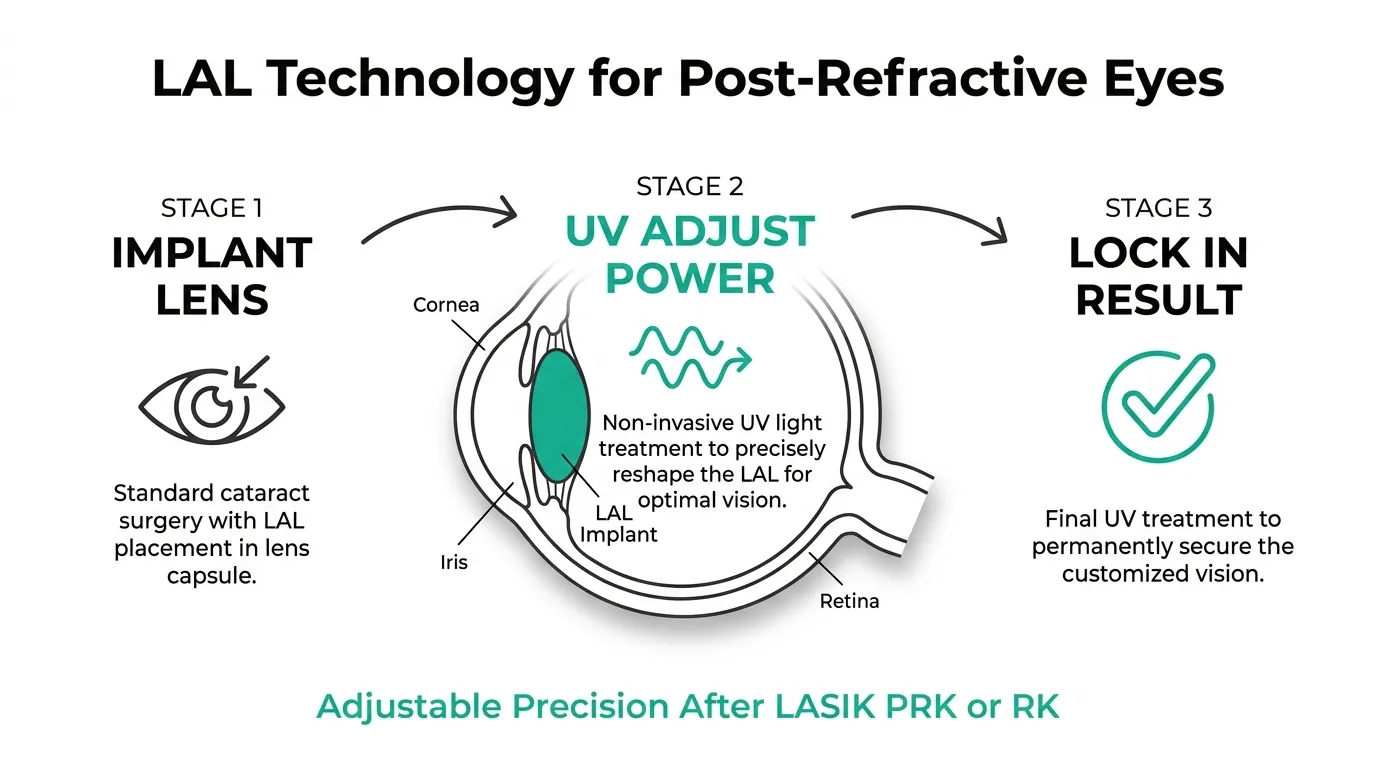
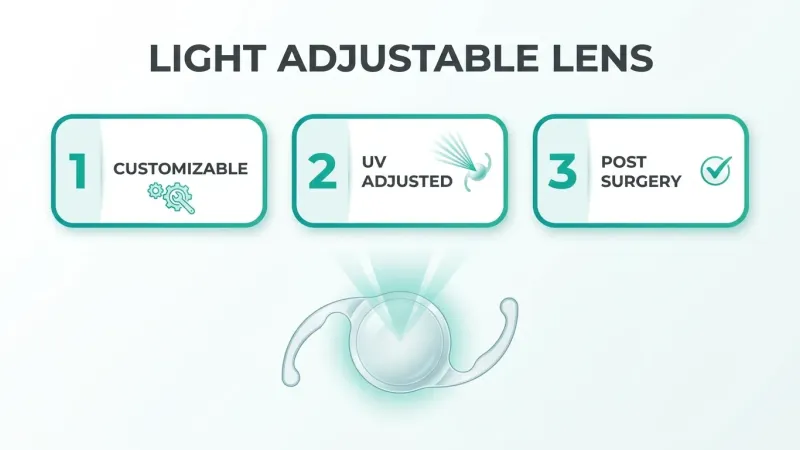
A light adjustable lens (LAL) is a photoreactive silicone intraocular lens whose power can be modified after cataract surgery using targeted UV light, then permanently stabilized through a lock-in treatment. For eyes with prior LASIK, PRK, or RK, this postoperative adjustability addresses a core problem: altered corneal geometry makes standard IOL power calculations inherently less reliable, and fixed lenses cannot be corrected once implanted.
This guide covers how the LAL works in surgically altered eyes, why each type of prior refractive procedure complicates cataract surgery planning, the specific benefits and recognized limits of LALs for post-LASIK, post-PRK, and post-RK patients, candidacy and contraindication factors, published refractive outcomes, risks tied to UV adjustment and lock-in, and practical considerations including the step-by-step process, IOL comparisons, cost structure, and surgeon selection.
Prior LASIK and PRK flatten the central cornea, causing standard formulas to misread curvature; published data show that even the best-performing formulas place fewer than half of post-myopic eyes within ±0.25 D of target with a fixed lens. RK adds further complexity through diurnal refractive fluctuation and progressive hyperopic shift, with long-term studies documenting shifts of 1.00 D or more in over 40% of patients.
Post-implantation LAL adjustments may substantially narrow that accuracy gap. Published case series report 86% of post-LASIK and post-PRK eyes reaching ±0.50 D of target, and 88% of post-RK eyes achieving that same threshold after adjustment. Blended-vision strategies using LALs have also shown strong near and distance results.
Candidacy requires stable corneal health, absence of macular disease, and consistent compliance with UV-protective eyewear throughout the adjustment window. Eyes with significant irregular astigmatism or higher-order aberrations may not fully benefit, because the LAL corrects sphere and cylinder but does not address corneal irregularity itself.
How Do Light Adjustable Lenses Work in Post-Refractive Eyes?
Light adjustable lenses work by using UV light to reshape the implanted lens after cataract surgery, allowing power corrections that account for the unique biometric challenges of previously operated corneas. The following sections explain the lens design, the UV adjustment process, and why the lock-in step is especially critical for post-refractive patients.
What Is a Light Adjustable Lens and How Is It Different From Standard IOLs?
A light adjustable lens is a posterior chamber, photoreactive silicone intraocular lens that can be modified after implantation, unlike standard IOLs whose power is permanently fixed at the time of surgery. According to the FDA’s Summary of Safety and Effectiveness Data (2017), the RxSight LAL is a UV-absorbing, three-piece, foldable lens implanted in the capsular bag following phacoemulsification, and its power is changed post-operatively through spatially profiled UV light exposure delivered by the Light Delivery Device (LDD).
Standard IOLs require surgeons to commit to a single power before the eye has fully healed. For post-refractive patients, whose corneas already carry altered curvatures and unpredictable effective lens positions, that fixed commitment carries a higher risk of missing the refractive target entirely.
How Does the UV Light Adjustment Process Change the IOL Power After Surgery?
The UV light adjustment process changes IOL power by triggering photopolymerization of macromer molecules within the lens, which redistributes lens material to alter curvature and refraction. A 2004 study published in the Transactions of the American Ophthalmological Society (Calhoun Vision, Inc., University of California, San Francisco, and California Institute of Technology) found that upon irradiation with 365-nm light, macromers in the unirradiated lens regions diffuse along the resulting concentration gradient into the photopolymerized zone to reestablish thermodynamic equilibrium, producing a controlled shape change.
This matters greatly in post-refractive eyes. A 2026 narrative review from the Department of Ophthalmology, Shenzhen Eye Hospital, Southern Medical University, noted that altered corneal morphology after procedures such as RK creates challenges including irregular corneal astigmatism, shifting anterior-to-posterior curvature ratios, and diurnal refractive fluctuations that standard pre-operative IOL calculations struggle to anticipate. The ability to measure actual post-healing refraction and then adjust the LAL directly compensates for these prediction gaps.
Why Is the “Lock-In” Step Important for Patients With Prior LASIK, PRK, or RK?
The lock-in step is important because it permanently stabilizes the adjusted lens power, protecting the achieved refraction from any subsequent unintended UV exposure. Without lock-in, ambient sunlight could trigger further uncontrolled macromer polymerization and unpredictably shift the correction that was dialed in during the adjustment sessions.
For patients with prior LASIK, PRK, or RK, this protection is especially significant. These corneas are less predictable from the outset, meaning surgeons and patients invest multiple adjustment visits to reach a precise refractive target. An unstable lens before lock-in could undo that work entirely. The FDA notes that UV exposure before lock-in may necessitate explantation of the LAL. The AAO’s 2023 Refractive Surgery Preferred Practice Pattern reinforces that individual clinical judgment governs every step of care, underscoring the importance of completing the full adjustment-and-lock-in protocol before any UV precautions are relaxed.
Completing lock-in marks the point where the customized correction is secured, and the patient can transition to normal activity without UV-protective eyewear restrictions.
Why Are Post-Refractive Eyes Challenging for Standard Cataract Surgery and IOLs?
Post-refractive eyes present unique measurement and calculation challenges that make standard IOL selection unreliable. The following sections explain how prior LASIK, PRK, and RK each distort the corneal data surgeons depend on for accurate lens power planning.
How does prior LASIK affect IOL power calculations for cataract surgery?
Prior LASIK affects IOL power calculations by altering the corneal shape in ways that standard formulas were not designed to interpret. Myopic LASIK flattens the central cornea, causing conventional keratometry to underestimate true corneal power and shift the predicted refraction toward hyperopia after cataract surgery.
Specialized tools exist to address this. The American Society of Cataract and Refractive Surgery (ASCRS) Post-Refractive IOL Calculator is designed to serve as an adjunct tool to assist physicians in selecting the appropriate IOL power for these patients. Even with advanced formulas, residual error remains a real concern. A 2024 peer-reviewed study in the Journal of Cataract and Refractive Surgery noted that while the Light Adjustable Lens offers postoperative adjustability and superior refractive outcomes in post-refractive patients, it does not account for or minimize preexisting higher-order aberrations (HOAs) from prior corneal surgery, making thorough preoperative evaluation essential.
How does prior PRK change the corneal shape and impact IOL accuracy?
Prior PRK changes the corneal shape through surface ablation, removing epithelial and stromal tissue to reduce refractive error. Like LASIK, this flattens the central cornea in myopic cases, causing standard IOL formulas to misread curvature and introduce systematic prediction error.
Because PRK heals from the surface inward, corneal topography after PRK can show subtle irregularities that compound formula inaccuracies. A 2002 clinical study in JAMA Ophthalmology, involving researchers from the Academic Medical Center, University of Amsterdam and affiliated institutions, found that even with adjusted calculation methods, only about 70% of post-PRK eyes achieved a predicted refraction within 1.00 D of the actual result. That leaves a meaningful percentage of patients with residual refractive error that a fixed IOL cannot correct after implantation.
Why do prior RK incisions make cataract surgery planning more complex?
Prior RK incisions make cataract surgery planning more complex because the radial cuts fundamentally alter the relationship between anterior and posterior corneal curvatures, making standard biometry unreliable. According to a 2026 narrative review published in Frontiers in Medicine (Department of Ophthalmology, Shenzhen Eye Hospital, Southern Medical University), the altered corneal morphology after RK creates challenges including irregular corneal astigmatism, difficulty predicting effective lens position, and diurnal fluctuation of refraction.
That diurnal instability is particularly problematic: the cornea’s power shifts throughout the day, meaning a single preoperative measurement may not represent the eye’s true refractive state. This variability introduces unpredictability that fixed IOLs cannot compensate for once implanted. Standard cataract surgery recovery also expects relative corneal stability; as the National Eye Institute notes, most patients are completely healed within 8 weeks, but in post-RK eyes, baseline instability predates surgery and persists independently of healing.
Why May Light Adjustable Lenses Be Especially Beneficial After LASIK?
LASIK changes the corneal curvature in ways that can mislead standard IOL power formulas, making refractive surprises more likely with fixed-power lenses. The headings below explain how corneal alterations raise calculation risk, how LAL adjustments address monovision complexity, and where the lens has recognized limits.
How do corneal changes from LASIK increase refractive surprise risk with fixed IOLs?
Corneal changes from LASIK increase refractive surprise risk with fixed IOLs by altering the curvature and refractive index relationships that standard formulas rely on. When LASIK flattens or steepens the central cornea, keratometry-based calculations can produce significant prediction errors. A 2002 clinical study published in JAMA Ophthalmology found that even with the best available post-PRK correction method, only 70% of eyes landed within 1.0 D of target using SRK/T, Holladay 1, or Hoffer Q formulas. The LAL addresses this directly: if the initial IOL power estimate is off, postoperative UV adjustments can correct residual sphere or cylinder without additional surgery. For patients who already accepted visual uncertainty once with LASIK, having a correctable implant represents a meaningful safety net.
How can LAL adjustments fine-tune vision for patients with previous LASIK monovision?
LAL adjustments can fine-tune vision for patients with previous LASIK monovision by allowing surgeons to trial and then lock in each eye’s refraction independently after cataract surgery. Patients who previously used LASIK monovision often have one eye corrected for distance and the other for near, making their neuroadaptation and preferred balance well-established. A 2024 retrospective study published in Scientific Reports, conducted across Keio University Hospital and Hayashi Eye Hospital in Japan, found that the EVO PK formula yielded the most accurate IOL power calculation in eyes with previous myopic LASIK surgery, though residual error remained. The LAL’s postoperative adjustability allows the surgeon to honor each eye’s individualized target precisely, preserving a monovision balance the patient has already adapted to.
Can LALs help address residual higher-order aberrations after LASIK?
LALs can help improve sphere and cylinder outcomes after LASIK but cannot address residual higher-order aberrations (HOAs) introduced by prior corneal surgery. According to a 2024 peer-reviewed post-refractive outcomes study published in the Journal of Cataract and Refractive Surgery, the LAL does not account for or minimize preexisting HOAs present in the cornea from prior corneal refractive surgery, making preoperative evaluation of irregular astigmatism and HOAs essential before proceeding. The lens’s adjustability corrects lower-order refractive error effectively, but patients with significant corneal irregularity from LASIK should understand that night vision symptoms or contrast sensitivity limitations tied to HOAs may persist. Thorough corneal topography and wavefront analysis before surgery help set realistic expectations.
Why May Light Adjustable Lenses Be Especially Beneficial After PRK?
Light adjustable lenses may be especially beneficial after PRK because surface ablation creates corneal geometry that reduces the reliability of standard IOL formulas. The sections below cover how PRK affects calculation accuracy, how LAL adjustments may address uneven healing, and how the technology may help PRK patients reduce glasses dependence after cataract surgery.
How does surface ablation from PRK affect standard IOL calculation formulas?
Surface ablation from PRK affects standard IOL calculation formulas by flattening the central cornea in a way that causes most traditional keratometry-based formulas to underestimate corneal power, which can produce a hyperopic refractive surprise after cataract surgery. PRK removes corneal tissue directly from the epithelial surface, altering the anterior-to-posterior curvature relationship that standard formulas assume is intact. A 2002 clinical study published in JAMA Ophthalmology found that even with the best-performing adjusted calculation method, only 70% of post-PRK eyes landed within 1.00 D of the intended refraction using SRK/T, Holladay 1, or Hoffer Q. That margin of error is clinically meaningful, and it illustrates why a fixed IOL carries real risk in this population. The LAL’s post-implantation adjustability converts a potentially permanent refractive surprise into a correctable one.
Can LAL adjustments compensate for irregular or asymmetric corneal healing after PRK?
LAL adjustments can partially compensate for the refractive consequences of irregular or asymmetric corneal healing after PRK, though they do not correct corneal irregularity itself. PRK healing varies between patients and even between the two eyes of the same patient, sometimes producing residual sphere or cylinder that was not predicted before surgery. The LAL’s UV-driven power modification addresses these spherical and cylindrical residuals after the eye has stabilized. However, it is important to understand the limit: a 2024 peer-reviewed study published in the Journal of Cataract and Refractive Surgery confirmed that the LAL does not account for or minimize preexisting higher-order aberrations arising from prior corneal refractive surgery, making thorough preoperative corneal mapping essential before selecting this lens. In practical terms, the LAL is well-suited for correcting measurable sphere and astigmatism errors after PRK, but irregular astigmatism beyond its adjustment range requires careful candidacy evaluation.
How might LALs help PRK patients aiming to reduce or eliminate glasses after cataract surgery?
LALs may help PRK patients reduce or eliminate glasses after cataract surgery by allowing the treating surgeon to measure actual post-healing refraction and fine-tune lens power before permanently locking in the result. According to the U.S. Food and Drug Administration’s 2017 regulatory approval, the RxSight LAL adjustment process begins 17 to 21 days after implantation, with three or four light treatments delivered over one to two weeks, each session lasting approximately 40 to 150 seconds depending on the correction needed. This measured, iterative approach is particularly valuable for PRK patients because their corneas have already undergone tissue removal, making pre-surgical prediction inherently less reliable than in virgin eyes. The FDA also notes the device is intended for patients with corneal astigmatism who do not have macular disease, which describes many PRK candidates presenting for cataract surgery later in life. For PRK patients motivated to minimize spectacle dependence, the LAL’s ability to fine-tune power based on real-world visual results after healing represents a meaningful clinical advantage over fixed-power alternatives.
Why May Light Adjustable Lenses Be Especially Beneficial After RK?
Light adjustable lenses may be especially beneficial after RK because RK creates corneal instability, diurnal fluctuation, and progressive hyperopic shift that make fixed IOL power selection particularly unreliable. The H3s below cover how RK incisions disrupt IOL predictions, how LALs may address hyperopic shifts, and what special surgical considerations apply.
How do RK incisions and diurnal vision fluctuations affect IOL predictions?
RK incisions affect IOL predictions by altering the relationship between anterior and posterior corneal curvatures, complicating effective lens position estimates, and introducing diurnal refractive fluctuation. According to a 2026 narrative review in Frontiers in Medicine (Shenzhen Eye Hospital, Southern Medical University), altered corneal morphology after RK creates challenges including irregular corneal astigmatism and diurnal fluctuation of refraction. Separately, a BMC Ophthalmology review (2024) found that visual variation throughout the day is most likely associated with immature wound architecture and corneal stromal edema adjacent to radial incisions, with the cornea flattening overnight and gradually recovering thickness through the day. Because any fixed IOL power is selected at a single point in time, the cornea’s shifting shape may mean that the chosen power is accurate only part of the day. Post-operative adjustability makes LALs particularly well suited to this scenario.
Can LALs help manage hyperopic shifts and instability common after RK?
LALs may help manage the hyperopic shift and refractive instability that frequently follow RK. The PERK study, as reviewed in the American Academy of Ophthalmology’s EyeWiki (updated January 30, 2026), found that 43% of post-RK patients developed a hyperopic shift of at least 1.00 D within 10 years, with patients averaging a +0.21 D/year shift in the first two years alone. A mean diurnal myopic fluctuation of 0.31 ± 0.58 D from morning to evening was also documented. Because the LAL’s power can be refined after implantation, surgeons have the opportunity to target and adjust for residual refractive error once the eye has stabilized post-cataract surgery, rather than locking in a potentially inaccurate power at the time of implant. A 2025 retrospective consecutive case series at Creighton University School of Medicine and Vance Thompson Vision (94 eyes, 77 patients) found that 98% of post-RK eyes were within ±1.00 D of target and 88% were within ±0.50 D, suggesting strong outcomes when adjustability is applied.
What special considerations apply when using LALs in eyes with many or deep RK cuts?
Special considerations for LALs in eyes with many or deep RK cuts center on pre-existing higher-order aberrations (HOAs) and irregular astigmatism. A 2024 peer-reviewed study in the Journal of Cataract and Refractive Surgery noted that while the LAL offers postoperative adjustability for spherical and cylindrical power, it does not account for or minimize pre-existing HOAs from prior corneal refractive surgery. Eyes with a higher number of RK incisions or deeper cuts tend to have more irregular corneal topography, which the LAL cannot correct. Surgeons should therefore evaluate corneal irregularity and HOA burden thoroughly before recommending a LAL in heavily incised RK eyes. In cases where irregularity is significant, realistic expectations about the limits of adjustability are essential.
Who Is Typically a Good Candidate for a Light Adjustable Lens After LASIK, PRK, or RK?
Good candidates for a light adjustable lens after LASIK, PRK, or RK share several traits: strong motivation to reduce glasses dependence, corneal stability, and no disqualifying ocular conditions. The following H3s cover vision goals and lifestyle fit, corneal health requirements, and the role of age and overall eye health.
What Vision Goals and Lifestyle Factors Support Choosing a LAL in Post-Refractive Eyes?
Vision goals and lifestyle factors that support choosing a LAL in post-refractive eyes include a strong desire for spectacle independence, tolerance for multiple postoperative clinic visits, and consistent use of UV-protective glasses throughout the adjustment period. The FDA notes that patients must wear UV-protective eyewear from the time of cataract surgery until all light treatments are complete. Patients who cannot commit to that schedule or UV protection protocol are less suitable candidates. Lifestyle-wise, people with outdoor occupations or high ambient UV exposure need to be especially diligent. The European Society of Cataract and Refractive Surgeons’ 2024 evidence-based guideline states that target refraction selection should reflect shared decision-making between patient and ophthalmologist, factoring in individual expectations. In post-refractive eyes particularly, the ability to fine-tune the outcome after implantation makes the LAL a strong match for patients with precise visual goals.
How Do Corneal Health and Stability Affect Candidacy for LAL After Prior Surgery?
Corneal health and stability directly affect LAL candidacy by determining whether postoperative adjustments can achieve a reliable refractive outcome. A 2024 peer-reviewed study published in the Journal of Cataract and Refractive Surgery noted that although the LAL offers postoperative adjustability, it does not correct preexisting higher-order aberrations from prior corneal refractive surgery, making thorough evaluation of irregular astigmatism essential before proceeding. Patients with moderate-to-severe corneal irregularity, active ectasia, or significant scarring may not achieve the precision the LAL adjustment process is designed to deliver. Corneal stability is equally important: a recently fluctuating refraction, such as ongoing diurnal variation in a post-RK eye, may compromise the accuracy of both the initial IOL power calculation and the adjustment targets.
How Do Age, Overall Eye Health, and Other Conditions Influence LAL Eligibility?
Age and overall eye health influence LAL eligibility primarily through the presence of conditions that contraindicate UV-based treatment or compromise postoperative cooperation. According to EyeWiki (American Academy of Ophthalmology, updated April 6, 2026), the LAL should not be used in patients with pre-existing macular disease, a prior history of herpes eye infection, intake of medications that increase UV sensitivity (such as Tamoxifen), nystagmus, or demonstrated poor compliance with postoperative schedules and UV protective eyewear. The FDA also states that the device is intended for patients without macular disease. Older patients are common LAL candidates given the typical age of cataract onset, but any concurrent retinal or macular condition must be ruled out. Overall systemic health factors matter only insofar as medications may increase photosensitivity or impair wound healing.
In Which Post-Refractive Situations Might a Light Adjustable Lens Not Be Recommended?
A light adjustable lens may not be recommended when corneal integrity, retinal health, or ocular surface stability cannot support reliable adjustment outcomes. The following three situations cover the most clinically relevant contraindication scenarios.
When Can Corneal Scarring, Ectasia, or Irregular Astigmatism Limit LAL Usefulness?
Corneal scarring, ectasia, or irregular astigmatism can limit LAL usefulness because the lens adjusts spherical and cylindrical power but cannot correct pre-existing higher-order aberrations (HOAs) in the cornea itself. According to a 2024 peer-reviewed post-refractive outcomes study published in the Journal of Cataract and Refractive Surgery, the LAL does not account for or minimize preexisting HOAs from prior corneal refractive surgery, making thorough preoperative evaluation of irregular astigmatism critical. When scarring or ectasia is significant, the visual benefit of post-implant power refinement may be substantially reduced regardless of how precisely the lens is dialed in.
How Can Retinal or Macular Disease Impact the Decision to Use a LAL?
Retinal or macular disease can impact the LAL decision because the FDA’s intended-use designation explicitly excludes patients with macular disease, and the LAL’s UV-based adjustment process carries a risk of UV-induced retinal damage that may potentially cause vision loss. Per the 2017 FDA Summary of Safety and Effectiveness Data, LAL-specific risks include UV-induced retinal damage from the Light Delivery Device. Eyes with active or progressive retinal pathology face compounded risk, and the anticipated visual gain from adjustability may be limited by underlying retinal dysfunction.
When Might Dry Eye or Ocular Surface Disease Reduce the Benefit of a LAL?
Dry eye or ocular surface disease may reduce the LAL’s benefit when surface instability produces inconsistent refractions between adjustment visits, making it difficult to reach a stable, accurate endpoint. Unstable tear film can cause fluctuating visual acuity measurements that undermine the precision the LAL is designed to deliver. In practice, optimizing the ocular surface before pursuing LAL implantation is an important step that surgeons should address proactively, as even moderate untreated dry eye can erode the refractive accuracy that makes the LAL valuable for post-refractive eyes.
What Are the Potential Vision Outcomes With Light Adjustable Lenses in Post-Refractive Patients?
The potential vision outcomes with light adjustable lenses in post-refractive patients are notably strong, with published case series showing high rates of refractive accuracy across LASIK, PRK, and RK populations. The following sections cover glasses independence, monovision strategies, and outcome stability.
How Often Do LALs Reduce Dependence on Glasses in LASIK or PRK Eyes?
LALs can significantly reduce glasses dependence in post-LASIK and post-PRK eyes by allowing postoperative power refinement after the cornea’s altered geometry has already influenced the initial IOL calculation. According to a 2024 retrospective consecutive case series at Vance Thompson Vision (76 eyes from 70 patients), 86% of eyes achieved a refractive outcome within ±0.50 D of target, and 66% were within ±0.25 D. Hitting those tight targets in surgically altered corneas is precisely what makes the LAL’s adjustability so clinically meaningful: refractive surprise can be corrected rather than accepted.
Can LALs Help Achieve Customized Monovision or Blended Vision in Post-Refractive Patients?
LALs can help achieve customized monovision or blended vision in post-refractive patients, extending their functional range beyond distance correction alone. A 2024 peer-reviewed review published in Current Opinion in Ophthalmology (Shiley Eye Institute, University of California San Diego, and Keimyung University School of Medicine) found that an adjustable blended-vision strategy using LALs delivered distance vision of 20/20 and near vision of J2 in 96% of patients. For post-refractive patients who had prior monovision with contact lenses or LASIK, the LAL’s titratability allows surgeons to recreate or refine that same binocular balance with precision unavailable in fixed-power lenses.
How Stable Are LAL Outcomes Over Time in Eyes With Prior Refractive Surgery?
LAL outcomes in eyes with prior refractive surgery appear stable within available follow-up data, though long-term evidence is still emerging. In post-RK eyes specifically, a 2025 retrospective consecutive case series at Creighton University School of Medicine and Vance Thompson Vision (94 eyes from 77 patients) reported that 98% of eyes were within ±1.00 D, 88% within ±0.50 D, and 69% within ±0.25 D of the preoperative refractive target. These figures compare favorably with historical fixed-IOL benchmarks in post-refractive populations. Longer-term studies are still needed to characterize stability beyond the postoperative adjustment window, and patients should discuss current evidence limits with their surgeon.
What Are the Possible Risks and Complications of Light Adjustable Lenses in Post-Refractive Eyes?
The possible risks and complications of light adjustable lenses in post-refractive eyes span general cataract surgery risks, LAL-specific hazards tied to UV exposure and lock-in, and additional concerns unique to eyes with prior LASIK, PRK, or RK. Each category is covered in the sub-sections below.
What Are the General Risks of Cataract Surgery With a LAL Compared to Standard IOLs?
The general risks of cataract surgery with a LAL are largely the same as those with standard IOLs, since the implantation procedure itself is equivalent. According to NHS cataract-surgery patient guidance (reviewed March 6, 2025), the operation typically takes 20 to 45 minutes and requires pre-surgical eye measurement by a specialist. Standard risks include infection, inflammation, posterior capsule opacification, and residual refractive error. Where the LAL differs from a fixed-power IOL is in what happens after implantation: the power remains adjustable until locked in, introducing a window of vulnerability that standard lenses do not have.
What LAL-Specific Risks Relate to UV Exposure, Adjustments, or Lock-In?
The LAL-specific risks relate directly to the UV light adjustment and lock-in process. According to the FDA’s Summary of Safety and Effectiveness Data (2017), these include:
- Unpredicted vision change from unprotected sunlight exposure before lock-in, which may require LAL explantation.
- Transient or permanent erythropsia (red-tinted vision) and color vision anomaly from Light Delivery Device UV treatments.
- Corneal abrasions from the contact lens used during adjustment and lock-in sessions.
- UV-induced retinal damage, which may potentially cause vision loss.
Strict daily use of UV-protective eyeglasses from surgery through final lock-in is therefore not optional. From a clinical standpoint, patient compliance with UV protection is one of the most controllable risk factors in this process, and poor adherence is among the more serious avoidable complications.
Are There Additional Risks for Patients With Previous LASIK, PRK, or RK?
There are additional risks for patients with previous LASIK, PRK, or RK, primarily stemming from how prior surgery alters corneal structure and complicates refractive targeting. A 2024 study published in the Journal of Cataract and Refractive Surgery noted explicitly that while the LAL offers postoperative adjustability, it does not account for or minimize preexisting higher-order aberrations (HOAs) from prior corneal refractive surgery. If significant irregular astigmatism or HOAs are present, LAL adjustments may improve sphere and cylinder but leave residual optical imperfections that reduce functional vision quality. Post-RK eyes face the added complexity of diurnal refractive fluctuation, which can affect how consistently the lens settles during the adjustment window. A thorough preoperative evaluation of corneal regularity and HOA burden is essential before committing to a LAL in any post-refractive eye.
How Does the Light Adjustable Lens Process Work Step-by-Step for Someone With Prior LASIK, PRK, or RK?
The Light Adjustable Lens process works through four sequential stages: comprehensive preoperative testing, surgical implantation, postoperative UV light adjustments, and a final lock-in treatment. Each stage is adapted to account for the corneal changes introduced by prior LASIK, PRK, or RK.
What Preoperative Tests Are Needed for Post-Refractive Patients Considering a LAL?
The preoperative tests needed for post-refractive patients include corneal topography, biometry, manifest refraction, and review of all prior surgical records. Surgeons use this data to select the most accurate IOL power formula for the altered corneal shape left by LASIK, PRK, or RK. For RK patients specifically, diurnal refraction testing is particularly important, as readings taken only in the morning may not reflect afternoon corneal behavior. This level of diagnostic depth is what separates a well-planned LAL case from one that still ends in glasses dependence.
What Should Patients Expect During Cataract Surgery When a LAL Is Implanted?
Cataract surgery with a LAL follows standard phacoemulsification, where the clouded natural lens is removed and the LAL is placed in the capsular bag. What differs for post-refractive patients is the target refraction decision. According to the 2024 European Society of Cataract and Refractive Surgeons evidence-based guideline, the selection of a specific target refraction depends on the IOL chosen and the patient’s preferences, with the final decision made jointly by patient and ophthalmologist. For RK patients, the PERK study (reviewed by EyeWiki, American Academy of Ophthalmology, January 2026) showed that 43% of post-RK eyes develop a hyperopic shift of at least 1.00 D over 10 years, a long-term drift that surgeons should factor into the initial LAL target.
How Many Postoperative Light Treatments Are Usually Needed and Over What Timeline?
Patients typically receive three or four light treatments over one to two weeks, beginning 17 to 21 days after surgery. According to the FDA’s 2017 regulatory announcement, each session using the Light Delivery Device lasts approximately 40 to 150 seconds depending on the magnitude of adjustment required. Throughout this period, patients must wear UV-protective eyeglasses at all times outdoors to prevent unintended photopolymerization of the lens material before the planned lock-in.
What Happens During the Final Lock-in and What Vision Changes Are Expected Afterward?
The final lock-in stabilizes the LAL’s power permanently. According to the FDA’s 2017 Summary of Safety and Effectiveness Data, a subsequent lock-in UV exposure is delivered to the implanted LAL to stabilize the lens power, preventing any further refractive change. After lock-in, UV-protective glasses are no longer required. Most patients notice that their vision remains stable from this point forward, though full healing from cataract surgery generally takes up to eight weeks. For post-refractive patients, the lock-in represents the definitive close of a process designed to compensate for the prediction errors that fixed IOLs cannot correct after the fact.
How Do Light Adjustable Lenses Compare With Other IOL Options for Post-Refractive Eyes?
LALs compare favorably with fixed-power IOLs for post-refractive eyes because postoperative adjustability can correct residual refractive error that standard formulas miss. The H3s below examine accuracy versus monofocal and toric IOLs, suitability versus multifocal and EDOF lenses, and when a fixed IOL may still be the right choice.
How does LAL accuracy compare with monofocal and toric IOLs after LASIK or PRK?
LAL accuracy compares favorably with fixed monofocal and toric IOLs after LASIK or PRK, primarily because the adjustment window catches refractive surprises that even advanced formulas cannot fully prevent. With a fixed monofocal, the best available formulas for post-myopic LASIK eyes still place fewer than half of eyes within ±0.25 D of target. According to a 2022 retrospective series at the Cole Eye Institute, Cleveland Clinic, the Barrett True-K formula achieved the lowest mean absolute error (0.36 D), with only 44.8% of post-myopic eyes landing within ±0.25 D. By contrast, a 2024 retrospective series from Vance Thompson Vision reported that 66% of post-LASIK/PRK eyes implanted with a LAL were within ±0.25 D and 86% within ±0.50 D of target, after adjustments were made. Toric IOLs correct cylinder at implantation but offer no post-implantation refinement; any residual astigmatism is fixed. The LAL’s adjustability is a meaningful clinical advantage in populations where formula-based predictions are inherently less reliable.
How does a LAL compare with multifocal or extended depth-of-focus IOLs in post-refractive eyes?
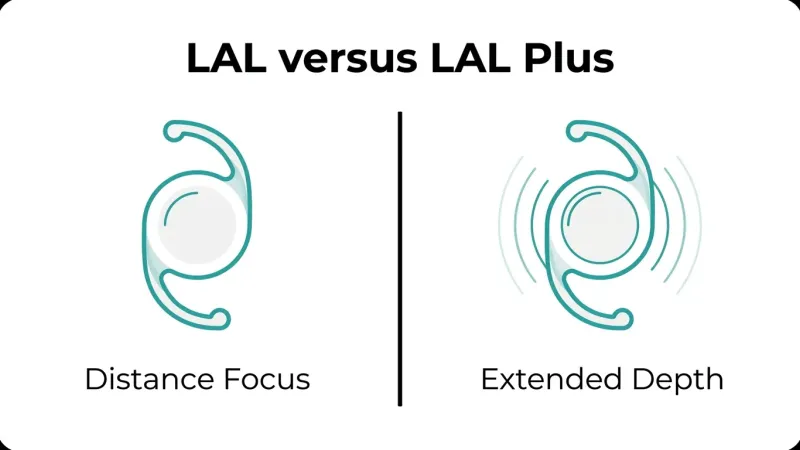
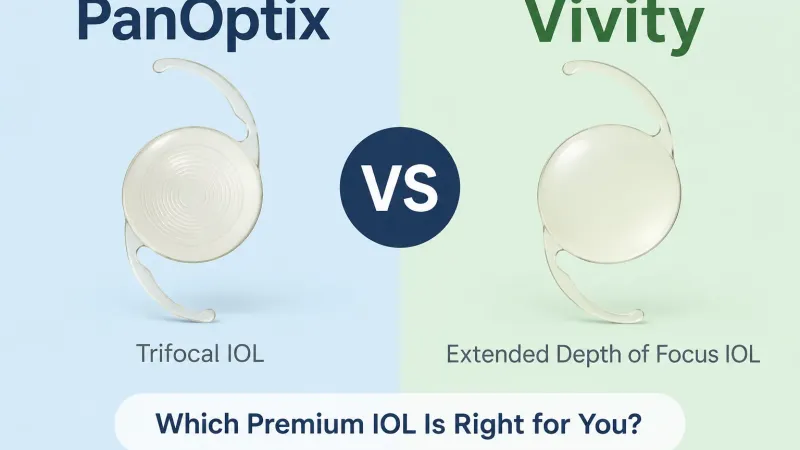
A LAL compares differently with multifocal and extended depth-of-focus (EDOF) IOLs for post-refractive eyes, and the distinction matters clinically. Multifocal IOLs split incoming light to create near and distance focal points, but pre-existing higher-order aberrations (HOAs) from prior LASIK, PRK, or RK amplify the halos and contrast loss those designs inherently produce. The American Academy of Ophthalmology notes that extended depth-of-focus lenses or the LAL may be better choices for patients with prior LASIK, depending on the degree of corneal alteration. A LAL functions as a monofocal platform, avoiding the dysphotopsias associated with multifocal optics, while still enabling customized monovision or blended vision after implantation. Surgeons experienced in post-refractive cases often find this combination of optical simplicity and post-implantation flexibility more manageable than multifocal optics on a cornea already carrying elevated HOAs.
When might surgeons still recommend a high-quality monofocal or toric IOL instead of a LAL?
Surgeons may still recommend a monofocal or toric IOL instead of a LAL in several specific situations:
- Patient compliance limitations: The LAL requires strict UV-protective eyewear from surgery through lock-in and multiple postoperative treatment visits; patients unable to follow this schedule are better served by a fixed IOL.
- Contraindicated medical history: Pre-existing macular disease, prior herpes eye infection, UV-sensitizing medications such as Tamoxifen, or nystagmus each rule out the LAL per American Academy of Ophthalmology EyeWiki guidance.
- Access or cost constraints: Where the additional cost of the LAL and multiple Light Delivery Device sessions is prohibitive and no adjustment flexibility is required, a well-selected premium monofocal or toric IOL remains a sound option.
- Surgeons with limited LAL experience: Optimal outcomes with the LAL in post-refractive eyes depend on surgeon familiarity with the adjustment protocol; in that context, a high-quality fixed IOL may deliver more predictable results.
A fixed IOL is not an inferior fallback; it can be the most appropriate choice when patient factors or clinical circumstances preclude the LAL workflow.
What Practical Considerations Should Post-Refractive Patients Know Before Choosing a Light Adjustable Lens?
Post-refractive patients considering a LAL should understand three practical realities: UV protection requirements during the adjustment window, the clinic visit commitment for light treatments, and how costs compare with other premium IOL options.
How strict are UV protection and lifestyle restrictions during the adjustment period?
UV protection restrictions during the adjustment period are strict and non-negotiable. According to the FDA, patients must wear special UV-protective eyeglasses continuously from the time of cataract surgery through the completion of all light treatments. This requirement exists because any uncontrolled UV exposure before lock-in can trigger an unintended power change, potentially requiring lens explantation. Outdoor activities, driving, and time near windows all require these glasses. For post-refractive patients who are accustomed to glasses-free living, this temporary restriction can feel significant, but it is a fixed, time-limited requirement rather than a permanent lifestyle change.
How much clinic time and how many visits are typically required for LAL adjustments?
The clinic time required for LAL adjustments typically spans three to four light treatment sessions delivered over one to two weeks, starting 17 to 21 days after surgery. Each individual session lasts approximately 40 to 150 seconds, depending on the adjustment magnitude needed. That means total chair time for the treatment phase is brief, but patients must plan for multiple return visits within a defined window. Post-refractive patients with more complex corrections may require adjustments closer to the upper end of that range. Scheduling flexibility during this three- to four-week post-implant window is an important practical factor when choosing a LAL.
How do costs and insurance coverage for LALs compare with other premium IOL options?
The costs and insurance coverage for LALs follow the same framework that applies to all premium IOLs. Medicare covers the underlying cataract surgery, meaning patients pay 20% of the Medicare-approved amount after the Part B deductible for the procedure itself. However, the premium IOL upgrade, including the LAL’s adjustability feature and associated light treatments, is an out-of-pocket patient expense. According to a CMS ruling, beneficiaries pay the difference between the cost of a premium lens and a conventional IOL, plus associated physician fees for the premium function. The 2024 European Society of Cataract and Refractive Surgeons guidelines note that IOL target selection should reflect a shared decision between patient and ophthalmologist, weighing both clinical fit and individual expectations. For post-refractive patients, the LAL’s ability to correct residual error after implantation may reduce the likelihood of needing enhancement procedures, which is a cost consideration worth discussing with your surgeon.
What Questions Should You Ask Your Surgeon About Light Adjustable Lenses After LASIK, PRK, or RK?
The questions you ask your surgeon about light adjustable lenses after LASIK, PRK, or RK can meaningfully shape your outcome. According to the American Academy of Ophthalmology (March 2024), IOL selection in post-refractive eyes should account for both the extent of prior surgery and your specific visual goals. The H3s below cover surgeon experience, comparable outcomes, and backup strategies.
How Experienced Is Your Surgeon With LALs in Post-Refractive Eyes Like Yours?
Your surgeon’s experience with LALs in post-refractive eyes is one of the most important factors to assess before proceeding. Post-LASIK, post-PRK, and post-RK corneas each present distinct biometric challenges that require familiarity beyond routine cataract surgery. Ask directly how many LAL cases the surgeon has performed in eyes with your specific prior procedure, and whether they routinely use post-refractive IOL calculation tools to guide power selection.
What Outcomes Has Your Surgeon Seen in Patients With Similar Prior Procedures?
The outcomes your surgeon has seen in patients with similar prior procedures give you a realistic benchmark for your own expectations. Ask for procedure-specific results, such as what percentage of their post-LASIK or post-RK patients achieved the target refraction within ±0.50 D after LAL adjustment. Surgeons with a robust post-refractive caseload can speak to realistic ranges rather than generalized figures, which is far more useful when weighing your decision.
What Alternative Strategies Will Be Used if You Are Not a Candidate for a LAL?
The alternative strategies that will be used if you are not a candidate for a LAL depend on your corneal profile, health history, and visual goals. Extended depth-of-focus lenses and toric monofocal IOLs are common alternatives, though each carries its own limitations in eyes with altered corneal geometry. A surgeon prepared for this scenario should outline a clear backup plan before your procedure date, not after a candidacy issue arises intraoperatively.
How Should You Approach Light Adjustable Lens Decisions With Surgeon-Reviewed Education From Eye Surgery Today?
Approaching light adjustable lens decisions well requires understanding both your candidacy and your contraindications before any surgeon conversation. The H3s below cover how Eye Surgery Today’s surgeon-reviewed education supports that process and what the most actionable takeaways are for post-refractive patients.
How can Eye Surgery Today’s cataract and IOL education help you compare LAL with other options?
Eye Surgery Today’s cataract and IOL education can help you compare the LAL with other options by translating surgeon-level clinical reasoning into clear, accessible language. Post-refractive eyes involve complex variables: altered corneal shape, unpredictable IOL power calculations, and higher refractive surprise risk. Understanding those variables before meeting your surgeon means you can ask sharper questions, weigh trade-offs between LAL, toric, monofocal, and extended depth-of-focus lenses, and arrive at a shared decision grounded in your actual visual goals. Eye Surgery Today’s content is surgeon-reviewed, which means the clinical accuracy behind every comparison reflects real-world surgical insight, not marketing material.
What are the key takeaways about light adjustable lenses in post-refractive eyes and why might they be ideal for you?
The key takeaways about light adjustable lenses in post-refractive eyes center on adjustability, candidacy, and realistic expectations. Post-refractive corneas introduce calculation errors that fixed IOLs cannot correct after implantation; the LAL’s post-surgical UV adjustment addresses exactly that gap. Candidacy matters just as much as technology. According to a 2026 review by EyeWiki (American Academy of Ophthalmology), LAL is not appropriate for patients with pre-existing macular disease, a prior history of herpes eye infection, medications that increase UV sensitivity (such as Tamoxifen), nystagmus, or those unable to comply with UV protection and follow-up schedules. If you clear those considerations, the LAL’s adjustability makes it one of the most clinically rational choices available for eyes with a history of LASIK, PRK, or RK.