RxSight UV-protective glasses are specially designed eyewear that blocks ultraviolet light from reaching the Light Adjustable Lens (LAL) after cataract surgery, preventing unintended changes to the implant before it is permanently locked in. Because the LAL remains photosensitive until the final lock-in treatment, uncontrolled UV exposure can permanently distort the lens and may cause blurred vision that cannot be corrected afterward.
This guide covers how the glasses work and why strict compliance matters, how long you may need to wear them, what can happen if you slip up, daily wear and care practices, candidacy considerations, risks of UV exposure, how these glasses compare to regular eyewear, what to expect throughout the treatment timeline, and how patient education supports success.
The RxSight LAL is the first FDA-approved implanted lens whose shape can be adjusted after surgery using a clinical UV light source, with patients typically receiving three or four office-based treatments over one to two weeks. That same UV sensitivity makes the lens vulnerable to ambient light from windows, sunlight, and reflected surfaces during the adjustment period.
Wear duration varies by patient. Published case series report a mean final lock-in time of roughly 41 days, with ranges spanning 24 to 90 days depending on the number of adjustments needed. Glasses are required during all waking hours, both indoors and outdoors, from surgery day through 24 hours after the last lock-in session.
Even brief unprotected exposure may lead totrigger irreversible refractive changes, and repeated lapses can compromise the surgeon’s ability to reach the intended vision target. Symptoms to watch for after a lapse include blurred vision, increased glare, and a reddish tint known as erythropsia.
RxSight’s glasses are rigorously tested for LAL-specific protection, and the company states it cannot guarantee equivalent shielding from third-party UV eyewear. Structured follow-up visits, written instructions, and caregiver support can all help patients maintain consistent compliance throughout the protocol.
What Are RxSight UV-Protective Glasses and How Do They Work?
RxSight UV-protective glasses are specially designed eyeglasses that block ultraviolet light to prevent unintended changes to the Light Adjustable Lens (LAL) between cataract surgery and the completion of light treatments. The sections below explain the lens technology, the role of UV protection in the adjustment process, and what the glasses actually do at a clinical level.
What Is the RxSight Light Adjustable Lens?
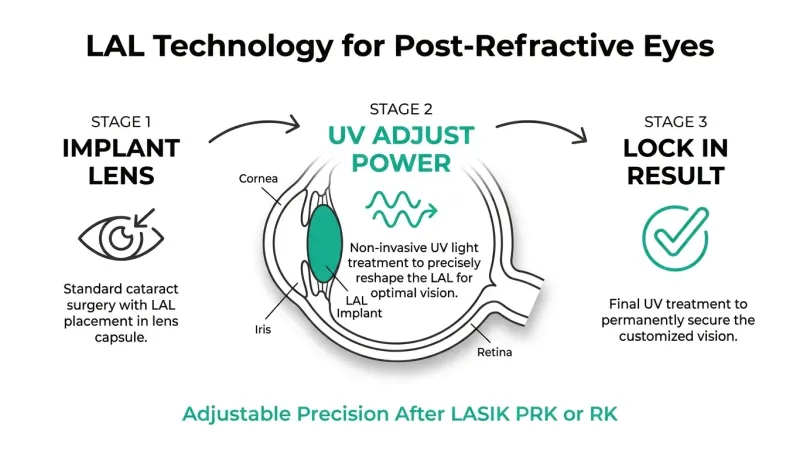
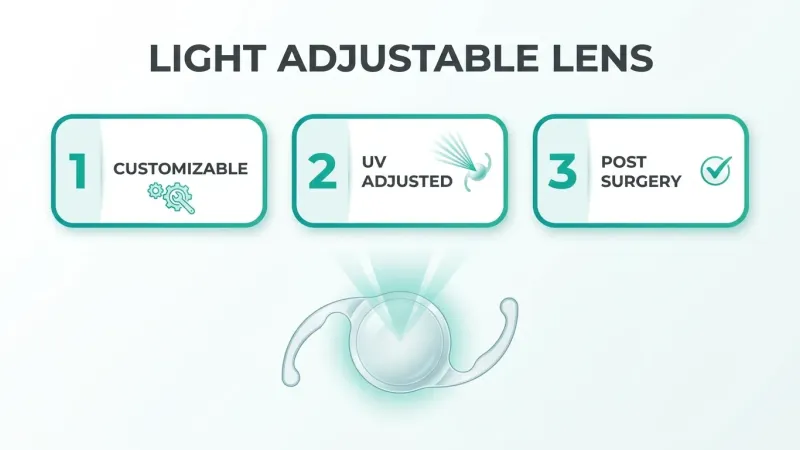
The RxSight Light Adjustable Lens is an intraocular lens whose shape and focusing characteristics can be changed after implantation using an office-based UV light source called the Light Delivery Device (LDD). The FDA approved the RxSight LAL and LDD on November 22, 2017, making it the first implanted lens that could be adjusted post-surgically to improve vision without additional procedures. Patients typically receive three or four light treatments over one to two weeks, with each session lasting approximately 40 to 150 seconds. This post-implantation adjustability is what makes UV protection so critical: the same UV sensitivity that allows precise correction also makes the lens vulnerable to ambient UV exposure.
How Do RxSight UV-Protective Glasses Block Harmful UV Light?
RxSight UV-protective glasses work by filtering out UV wavelengths that would otherwise trigger unintended photochemical changes in the LAL material. According to RxSight, the glasses are rigorously tested specifically for LAL protection, and the company cannot guarantee that another brand’s UV-blocking product provides equivalent protection. Unlike standard sunglasses worn for general comfort, these glasses serve a precise clinical function: preserving the lens in its unadjusted state until each scheduled treatment. Substituting non-approved eyewear introduces an unquantified risk that could compromise the entire adjustment process.
Why Is UV Protection Specific to the LAL Different From General UV Eye Safety?
UV protection for the LAL is different from general UV eye safety because ambient UV exposure before lock-in can permanently distort the lens, producing blurred vision that cannot be corrected with glasses, contact lenses, or additional light treatments. The FDA-hosted RxSight patient information brochure notes that the long-term effect on vision from UV exposure causing erythropsia after LDD treatment has not been fully determined. General UV eyewear protects healthy eye tissue from cumulative damage over years; RxSight UV glasses protect a photosensitive implant during a narrow, defined treatment window. This distinction matters because patients who underestimate the difference may assume any dark or UV-labeled lens is sufficient, when clinical-grade protection is what the protocol requires.
Why Do You Need UV-Protective Glasses After RxSight Light Adjustable Lens Surgery?
UV-protective glasses are essential after RxSight Light Adjustable Lens surgery because the implanted lens remains photosensitive until it is permanently locked in. The sections below explain what unprotected UV exposure does to the LAL, how protection supports your target vision, and how strictly compliance must be followed.
How Does UV Light Affect the Light Adjustable Lens If It Is Not Protected?
UV light affects the Light Adjustable Lens by triggering unintended photochemical changes in the lens material before your surgeon has finished making precision adjustments. The LAL is designed to respond to controlled UV light delivered through the Light Delivery Device. When ambient UV reaches it first, those changes occur outside of a clinical setting and cannot be reversed.
According to the National Eye Institute, UV light penetrates eye tissues more easily than visible light, and prolonged UV exposure modifies lens proteins in ways that can worsen eyesight. In the context of the LAL, uncontrolled exposure can shift the lens’s shape and focusing characteristics away from your intended refractive target, potentially resulting in blurred vision that cannot be corrected with glasses afterward.
How Can UV-Protective Glasses Help You Achieve Your Target Vision Safely?
UV-protective glasses help you achieve your target vision by shielding the LAL from uncontrolled UV exposure between each planned adjustment session, preserving the lens in its intended photosensitive state. This matters because the adjustment window is an active clinical tool, not just a recovery period.
According to the American Academy of Ophthalmology, Dr. Michael Greenwood of Vance Thompson Vision noted that “the surgeon has three opportunities to adjust the LAL before locking it in,” allowing the target to be refined if a patient’s visual preferences change. Each of those opportunities depends on the lens remaining unaffected by stray UV between visits. Consistent glasses wear keeps that option open and protects the accuracy of each subsequent treatment session.
How Strictly Do You Need to Follow the UV-Protection Instructions?
You need to follow UV-protection instructions without exception throughout the entire adjustment period. RxSight states that its UV-protective glasses should be worn both indoors and outdoors during all waking hours, as UV light can reach the eyes through windows, reflected surfaces, and indoor lighting sources, not only direct sunlight.
The FDA-hosted RxSight patient brochure confirms that failure to comply can distort the LAL and cause blurred vision that cannot be corrected with glasses. This is a one-way consequence: once unintended UV exposure alters the lens material, the change is permanent. Treating compliance as optional or situational creates a risk with no corrective fallback.
How Long Do You Need to Wear RxSight UV-Protective Glasses After Surgery?
The duration of UV-protective glasses wear depends on your treatment timeline, the number of light adjustments performed, and your surgeon’s protocol. The three H3 sections below cover typical wear duration, how treatment scheduling affects that timeline, and how your lifestyle may influence it.
How Long Do Most Patients Need UV Protection Between Surgery and Final Lock-In?
Most patients need UV protection from the day of cataract surgery through at least 24 hours after the final lock-in treatment. Because the Light Adjustable Lens remains photosensitive until lock-in is complete, that window can vary considerably between individuals. According to a retrospective case series published in PubMed Central (National Library of Medicine) involving 33 patients and 34 eyes with prior LASIK and/or PRK, the mean final lock-in time was 41.1 days after surgery, with a range of 24 to 90 days. For most patients, this translates to roughly four to six weeks of continuous wear, though some may require glasses for three months or longer depending on how their adjustment schedule unfolds.
How Does the Number and Timing of RxSight Light Treatments Affect Wear Time?
The number and timing of RxSight light treatments directly determines how long UV-protective glasses are required. Patients who need only the minimum adjustments and respond quickly to each treatment will reach lock-in sooner, shortening the protection period. Those who require additional refractive refinements before lock-in will extend the timeline, since the lens remains adjustable and vulnerable between every session. Each additional treatment session adds days to weeks before the final lock-in can be performed, meaning total wear time is not fixed at surgery but evolves based on your refractive response.
How Might Your Individual Activities and UV Exposure Change the Recommended Duration?
Your individual activities and UV exposure habits do not shorten the required wear duration, but they can significantly raise the risk of accidental lens alteration if glasses are removed. Patients who work outdoors, live in high-altitude or high-UV-index environments, or frequently drive face greater ambient UV exposure than those with predominantly indoor lifestyles. In these situations, surgeons may counsel extra vigilance, such as never stepping outside without glasses even briefly, and may factor UV exposure risk into scheduling adjustment appointments. Consistent daily compliance remains the standard expectation regardless of lifestyle, since the lens responds to UV exposure at any intensity during the photosensitive period.
What Happens If You Forget or Slip Up Wearing Your RxSight UV Glasses?
Forgetting your RxSight UV glasses, even briefly, can affect the Light Adjustable Lens before it is locked in. The H3 sections below cover brief accidental lapses, repeated non-compliance, warning symptoms, and when to contact your surgeon.
What If You Accidentally Go Outside Without UV Glasses for a Few Minutes?
A brief accidental lapse without UV glasses may trigger unintended changes to the Light Adjustable Lens, because the lens reacts to ambient UV light before the final lock-in treatment. According to the FDA-hosted RxSight Patient Information Brochure, failure to wear the protective glasses can distort the LAL and cause blurred vision that cannot be corrected with glasses afterward. The severity of any unintended change depends on UV intensity, duration, and how close you are to a scheduled adjustment session. A few minutes in direct midday sun carries more risk than a brief step into shaded outdoor light, though neither is advisable. If any accidental exposure occurs, inform your surgeon at your next appointment, regardless of how brief it seemed.
What If You Repeatedly Remove the Glasses or Do Not Follow UV Restrictions?
Repeated failure to follow UV restrictions may compromise your vision outcome in ways that cannot be reversed. The FDA-hosted RxSight Patient Information Brochure states that uncontrolled UV exposure can distort the LAL and result in blurred vision that glasses cannot correct, and that the long-term effect on vision from UV-related erythropsia after Light Delivery Device treatment has not been determined. Each exposure adds cumulative, uncontrolledunpredictable refractive changes to the lens material before lock-in. Consistent non-compliance may also make it impossible for your surgeon to achieve a precise adjustment target, potentially eliminating the primary benefit of choosing a Light Adjustable Lens. This makes adherence one of the most consequential patient responsibilities in the entire RxSight protocol.
What Signs or Vision Changes Should You Watch For After a UV-Protection Lapse?
The signs to watch for after a UV-protection lapse include blurred or hazy vision, unexpected changes in clarity at distance or near, increased glare or halos, and any new color distortion. The FDA-hosted RxSight patient brochure specifically identifies erythropsia, a reddish tint to vision, as a possible effect of UV exposure after Light Delivery Device treatment. These symptoms may indicate that ambient UV light has begun altering the lens material in an unintended way. Not all lapses produce immediately noticeable symptoms, which makes them especially difficult to self-assess. Any new or worsening visual symptom after a known or suspected UV exposure warrants prompt documentation and reporting to your surgeon.
When Should You Call Your Surgeon If You Think You Had Unprotected UV Exposure?
You should call your surgeon the same day if you suspect significant unprotected UV exposure, particularly if it occurred close to a scheduled light adjustment or if you notice any new visual symptoms afterward. Time-sensitive communication matters here: your surgeon may need to reassess your lens status before proceeding with a planned adjustment session, since treating a lens that has already been inadvertently altered can compound refractive error rather than correct it. Even if the exposure seemed minor, a quick call allows your care team to document the event and monitor for downstream changes. When in doubt, contact the office rather than waiting until your next routine appointment.
How Should You Use and Care for RxSight UV-Protective Glasses Day to Day?
Daily use of RxSight UV-protective glasses requires consistent habits around when to wear them, when you can safely remove them, and how to keep them functioning properly. The following H3s cover indoor versus outdoor wear, activity-specific exceptions, lens combinations, and proper cleaning and storage.
When Do You Need to Wear the Glasses Indoors Versus Outdoors?
You need to wear RxSight UV-protective glasses both indoors and outdoors during all waking hours. According to RxSight’s official guidance, the glasses must be worn in all settings throughout the day, not just in direct sunlight. Indoor UV sources such as windows, skylights, and fluorescent lighting can still expose the Light Adjustable Lens to enough UV energy to alter its prescription before lock-in. Wearing them consistently indoors is just as critical as wearing them outside.
Can You Ever Take the Glasses Off for Showering, Sleeping, or Screen Time?
Yes, you can take the glasses off for showering and sleeping, as these activities occur with eyes closed or in controlled low-UV environments. The FDA-hosted RxSight patient brochure specifies that UV-blocking glasses must be worn during all waking hours, which means they are not required during sleep. Showering with eyes closed also poses minimal risk. However, screen time while awake does require the glasses, since ambient light in the room, not the screen itself, remains a UV exposure variable.
How Can You Combine Prescription Lenses, Sunglasses, or Contacts With UV Glasses Safely?
You can combine prescription lenses, sunglasses, or contacts with UV glasses safely by wearing the RxSight UV-protective glasses over or in place of other eyewear, but only if they remain the outermost barrier. RxSight states that it cannot guarantee another company’s UV-blocking product offers the same protection as its own tested glasses. This makes substituting personal sunglasses or prescription frames risky during the adjustment period. Contact lenses worn underneath the UV glasses are generally acceptable, but your surgeon’s specific guidance should always take precedence.
How Should You Clean, Store, and Avoid Damaging Your RxSight UV Glasses?
You should clean RxSight UV glasses by gently rinsing them with lukewarm water and gentle soap, then drying them carefully. RxSight’s cleaning instructions recommend this method to preserve the lens coating that provides UV protection. Avoid abrasive cloths, harsh solvents, or paper towels, as these can scratch or degrade the protective coating. When not in use, store the glasses in their provided case to prevent scratches or bending of the frames that could compromise the fit and protective seal around the eyes.
Who Is a Good Candidate for RxSight Light Adjustable Lens and Its UV-Protection Protocol?
Good candidates for the RxSight Light Adjustable Lens are adults seeking precise, customizable vision correction after cataract surgery who can commit to the full UV-protection protocol. The following H3 sections address how age, lifestyle, coexisting eye conditions, and occupational factors each shape candidacy.
How Do Age, Lifestyle, and Sun Exposure Habits Affect Candidacy?
Age, lifestyle, and sun exposure habits affect candidacy by determining whether a patient can realistically maintain strict UV compliance throughout the adjustment period. Adults with stable refractions who spend significant time outdoors, in high-UV environments, or who travel frequently to sunny regions face a higher compliance burden. The FDA-approved protocol requires UV-protective glasses during all waking hours from surgery through 24 hours after the final lock-in treatment, meaning patients whose daily routines involve prolonged outdoor exposure must be especially committed. Patients who are highly motivated and detail-oriented tend to be the strongest candidates, as the protocol demands consistent, uninterrupted wear regardless of setting.
How Do Other Eye Conditions Influence Whether RxSight LAL Is Appropriate?
Other eye conditions influence whether RxSight LAL is appropriate by affecting both surgical eligibility and the reliability of light-based adjustments. Conditions such as corneal irregularities, macular degeneration, glaucoma, or diabetic retinopathy may limit the precision achievable with the adjustment process or compromise final visual outcomes. Prior refractive surgery, such as LASIK or PRK, does not necessarily disqualify a patient. According to a retrospective case series published in PubMed Central, 82.4% of eyes with prior LASIK or PRK achieved 20/20 or better vision following LAL adjustment, suggesting suitability extends to post-refractive patients when carefully selected. Your surgeon will evaluate each condition individually before recommending the RxSight system.
What Should You Discuss With Your Surgeon If You Work Outdoors or Travel Frequently?
Patients who work outdoors or travel frequently should discuss UV exposure risk, schedule flexibility, and compliance strategies with their surgeon before committing to the RxSight LAL protocol. Key topics to raise include:
- Daily UV exposure duration: How many hours per day you spend in direct sunlight and whether wraparound RxSight glasses will provide sufficient protection in your work environment.
- Travel timing: Whether planned trips to high-UV locations (such as tropical destinations or high-altitude areas) can be scheduled after lock-in is complete.
- Light treatment scheduling: Whether your travel calendar allows you to attend the required three to four in-office light treatment sessions within the 1 to 2 week adjustment window.
- Compliance documentation: What your surgical team recommends if you cannot avoid occupational UV exposure during the adjustment period.
The American Medical Association states that informed consent requires physicians to present the burdens, risks, and expected benefits of a procedure so patients can make a voluntary, independent decision. For outdoor workers and frequent travelers, that conversation must directly address whether the UV compliance demands are practical given their lifestyle.
What Are the Possible Risks and Complications Related to UV Exposure With RxSight Lenses?
The possible risks and complications related to UV exposure with RxSight lenses include permanent refractive changes, compromised light treatment outcomes, and increased dependence on corrective eyewear. Each risk stems from uncontrolled UV light altering the photosensitive material of the Light Adjustable Lens before it is locked in.
What Vision Distortions or Refractive Changes Can Uncontrolled UV Exposure Cause?
The vision distortions uncontrolled UV exposure can cause include blurred vision and unintended refractive changes to the Light Adjustable Lens. According to the FDA-hosted RxSight Patient Information Brochure, failure to wear UV-blocking glasses can distort the LAL and cause blurred vision that cannot be corrected with glasses afterward. Because the lens material responds to UV light whether that light comes from the clinical Light Delivery Device or ambient sunlight, any unplanned exposure shifts the lens’s focusing characteristics outside the intended target. This type of outcome is particularly concerning because it may be irreversible, leaving the patient with permanently suboptimal vision.
How Might Unprotected UV Exposure Affect the Safety of Subsequent Light Treatments?
Unprotected UV exposure may compromise the accuracy and safety of subsequent scheduled light treatments. If ambient UV has already altered portions of the lens material before a planned adjustment session, the surgeon’s ability to precisely calibrate the remaining photosensitive zones is reduced. The lens may respond unpredictably to the clinical UV dose, making it harder to reach the intended refractive target. In practice, this unpredictability raises the risk that a planned treatment delivers an outcome outside the desired correction range.
Can Incorrect UV Protection Lead to the Need for Additional Procedures or Glasses?
Yes, incorrect UV protection can lead to the need for additional procedures or glasses after RxSight LAL surgery. The FDA patient brochure explicitly states that UV-induced distortion of the LAL can result in blurred vision that glasses cannot correct, meaning some patients may require further surgical intervention. Beyond that, the brochure notes that the long-term effect of UV exposure causing erythropsia following Light Delivery Device treatment has not been fully determined. From a clinical standpoint, the stakes of non-compliance are unusually high compared to standard IOLs, since the LAL’s adjustability is also its vulnerability before lock-in is complete.
How Do RxSight UV-Protective Glasses Compare to Regular UV-Blocking Eyewear?
RxSight UV-protective glasses are purpose-built for the Light Adjustable Lens protocol, making them functionally different from standard UV eyewear. The sections below compare their design, substitution risks, and compatibility with specialty lens types.
How Do RxSight UV Glasses Differ From Standard Sunglasses or Prescription Glasses?
RxSight UV glasses differ from standard sunglasses or prescription glasses in both their purpose and the consequences of bypassing them. Standard sunglasses protect the natural eye from chronic UV damage, such as cataracts, pterygium, and ocular cancers, as noted by the World Health Organization’s recommendation of wraparound frames providing 99–100% UV-A and UV-B protection. RxSight glasses, by contrast, shield an implanted photoreactive lens that can still be altered by ambient UV after surgery.
According to the FDA’s RxSight Patient Information Brochure, unprotected UV exposure can permanently distort the LAL’s shape and focusing characteristics, causing blurred vision that cannot be corrected with glasses afterward. That irreversibility is what separates these glasses from any general UV-blocking product; they are a clinical requirement, not a comfort accessory.
Can You Substitute Your Own Sunglasses for the Supplied RxSight UV Glasses?
No, you cannot substitute your own sunglasses for the supplied RxSight UV glasses. RxSight states that its UV-protective glasses are rigorously tested for protection of the Light Adjustable Lens specifically, and that it cannot guarantee another company’s UV-blocking product provides the same level of protection. Even high-quality wraparound sunglasses rated for UV400 are designed for general ocular protection, not for blocking the precise wavelengths and exposure levels that could alter a photoreactive IOL. Using an unapproved substitute introduces uncertainty that is not worth the risk given the stakes of an irreversible refractive outcome.
How Do RxSight Glasses Work With Photochromic or Blue-Light-Filtering Lenses?
RxSight glasses work independently of photochromic or blue-light-filtering lenses, and the two are not interchangeable. Photochromic lenses darken reactively in outdoor light but do not provide consistent, calibrated UV blocking at the level required to protect the LAL during the adjustment period. Blue-light-filtering lenses target a different part of the spectrum entirely and offer no meaningful UV protection for the LAL. Patients who normally wear photochromic or blue-light glasses should wear their RxSight UV-protective glasses over or instead of those lenses during all waking hours, following the FDA-documented protocol until 24 hours after the final lock-in treatment.
What Should You Expect Before, During, and After RxSight LAL and UV-Glasses Use?
The RxSight Light Adjustable Lens experience follows a structured sequence: pre-surgery counseling, surgery day, a series of light adjustment sessions, and final lock-in. Each phase carries specific UV-protection responsibilities that directly determine your visual outcome.
What Pre-Surgery Counseling Should You Receive About UV Protection?
Pre-surgery counseling about UV protection should cover the full scope of the UV-glasses protocol, including when to start wearing them, how long they are required, and what happens if the rules are not followed.
According to the American Medical Association’s Code of Medical Ethics, informed consent requires physicians to present the nature and purpose of interventions, their burdens and risks, expected benefits, and the option of forgoing treatment, and to document the patient’s decision in the medical record. For RxSight patients, this means your surgeon should explain that unprotected UV exposure can permanently distort the LAL in ways that glasses cannot correct. Ask your surgeon directly what the UV compliance requirements are and confirm you receive written instructions before leaving the office.
What Will Happen on Surgery Day and When Do You Start Wearing UV Glasses?
UV glasses wear begins on surgery day, immediately after the LAL is implanted. The lens is UV-reactive from the moment it enters your eye, so protection cannot be delayed.
Your care team will provide the RxSight UV-protective glasses before you leave the surgical facility. You should expect to wear them continuously during all waking hours from that point forward. Your surgeon will schedule your first light adjustment visit approximately 17 to 21 days after surgery, once initial healing is complete.
What Can You Expect During Light Adjustment Sessions and Final Lock-In?
Light adjustment sessions are brief, office-based treatments in which a UV light source called the Light Delivery Device reshapes the LAL to refine your vision. Each treatment lasts approximately 40 to 150 seconds, and most patients receive three or four sessions over one to two weeks.
After your refractive adjustments are complete, two final lock-in treatments are performed to stabilize the lens permanently. UV-glasses compliance is mandatory throughout this entire period. You must continue wearing the glasses until 24 hours after the final lock-in treatment, as specified in the FDA-reviewed RxSight patient brochure.
How Does Life Change Once UV-Protection Restrictions Are Finally Lifted?
Life after UV-protection restrictions are lifted means you can return to normal eyewear habits, including standard sunglasses, prescription glasses, or no glasses at all based on your achieved vision.
Most patients find the transition straightforward. Your surgeon will confirm the exact end date based on your lock-in treatment timeline. From that point, the LAL is permanently stable and no longer reacts to UV light, so ordinary UV precautions adequate for the general population apply. This milestone typically represents the end of a 5-to-10-week protocol and the beginning of enjoying your adjusted vision result long-term.
How Can Patient Education and Follow-Up Help You Succeed With RxSight UV Protection?
Patient education and follow-up help you succeed with RxSight UV protection by reinforcing compliance habits, catching early problems, and ensuring your Light Adjustable Lens achieves its intended refractive target. The H3s below cover written tools and reminders, follow-up visit frequency, and caregiver support strategies.
How Can Written Instructions, Apps, or Reminders Help You Avoid UV Mistakes?
Written instructions, apps, and reminders help you avoid UV mistakes by turning an unfamiliar daily requirement into a consistent routine. RxSight specifies that UV-protective glasses must be worn both indoors and outdoors during all waking hours, a rule easy to forget without structured prompts. Practical tools that support compliance include:
- Printed instruction sheets reviewed at discharge with highlighted wear rules
- Smartphone alarm reminders set for morning wear, meal breaks, and bedtime removal
- Calendar apps tracking each light adjustment appointment and the expected lock-in date
- Pill-organizer-style visual checklists placed on bathroom mirrors or nightstands
According to a 2022 retrospective observational case series published on PubMed, 97.2% of emmetropic-goal eyes achieved 20/20 or better vision, suggesting that structured protocols supporting consistent protection can contribute to excellent refractive outcomes.
How Often Should You See Your Eye Surgeon While You Are Still Wearing UV Glasses?
Follow-up visit frequency while wearing UV glasses depends on your individual light treatment schedule. Patients typically attend three to four light treatment sessions over one to two weeks after the initial post-surgical healing period, with each visit also serving as a compliance check. Surgeons use these appointments to assess refractive progress, confirm the lens is responding as intended, and address any questions about wearing habits before proceeding to the next adjustment or final lock-in.
Missing or delaying appointments can disrupt the treatment sequence, so building the full schedule into your calendar from surgery day forward is strongly advisable.
How Can You Involve Family or Caregivers to Support Your UV-Protection Plan?
Family members and caregivers can support your UV-protection plan by serving as daily accountability partners. Practical involvement strategies include:
- Reminding you to put on glasses before leaving any room with sunlight exposure
- Keeping a spare pair of UV glasses accessible in the car, bedroom, or common areas
- Confirming glasses are worn correctly before driving or outdoor activities
- Accompanying you to light adjustment appointments to reinforce care instructions from the surgeon
Caregiver involvement is especially valuable in the first days after surgery, when fatigue or post-operative discomfort may reduce a patient’s own vigilance. Informed support at home meaningfully extends the education patients receive in the clinical setting.
How Should You Approach RxSight UV-Protective Glasses and Light Adjustable Lens Decisions With Eye Surgery Today?
Approaching RxSight UV-protective glasses and Light Adjustable Lens decisions requires understanding the FDA-approved protocol, compliance requirements, and realistic outcomes. The two H3 sections below address how surgeon-reviewed guidance supports your decision and what the most critical takeaways are.
How Can Eye Surgery Today’s Surgeon-Reviewed Guides Help You Decide if RxSight and Its UV Protocol Are Right for You?
Eye Surgery Today’s surgeon-reviewed guides help you decide by translating the clinical details of the RxSight protocol into clear, actionable patient education. The FDA approved the RxSight Light Adjustable Lens on November 22, 2017, following a study of 600 patients, and the protocol requires UV-protective glasses from cataract surgery through the end of all light treatments. That commitment spans weeks, involves three or four office sessions, and carries real consequences if not followed. Understanding the scope of that obligation before surgery is what separates a confident decision from a regretted one. Eye Surgery Today’s guides present the protocol’s requirements, the compliance expectations, and the clinical evidence in language that does not require a medical background to act on.
What Are the Key Takeaways About RxSight UV-Protective Glasses, How Long You Need Them, and What Happens If You Slip Up?
The key takeaways about RxSight UV-protective glasses are that they are non-negotiable, time-limited, and lens-specific. RxSight states that the glasses must be worn both indoors and outdoors during all waking hours, and the company cannot guarantee that third-party UV products offer equivalent protection. The treatment window typically spans 1 to 2 weeks of light sessions beginning 17 to 21 days after surgery. According to a retrospective chart review published in the Journal of Refractive Surgery, 97% of treated eyes landed within ±0.50 diopters of target and the mean patient satisfaction score was 8.8 out of 10, with no adverse events. Those outcomes depend directly on wearing the prescribed glasses correctly throughout the entire protocol.