The Light Adjustable Lens (LAL) is a photoreactive intraocular lens implanted during cataract surgery whose refractive power can be fine-tuned after the eye heals using targeted UV light from a Light Delivery Device. The LAL+ is a newer model, approved by the FDA in March 2023 as a design modification of the original, featuring a modified aspheric anterior surface intended to broaden depth of focus.
This guide covers how the two lenses compare in optical design and materials, what to expect from the adjustment process and clinical outcomes, candidacy and decision-making factors, potential benefits and risks, and the cost and insurance landscape.
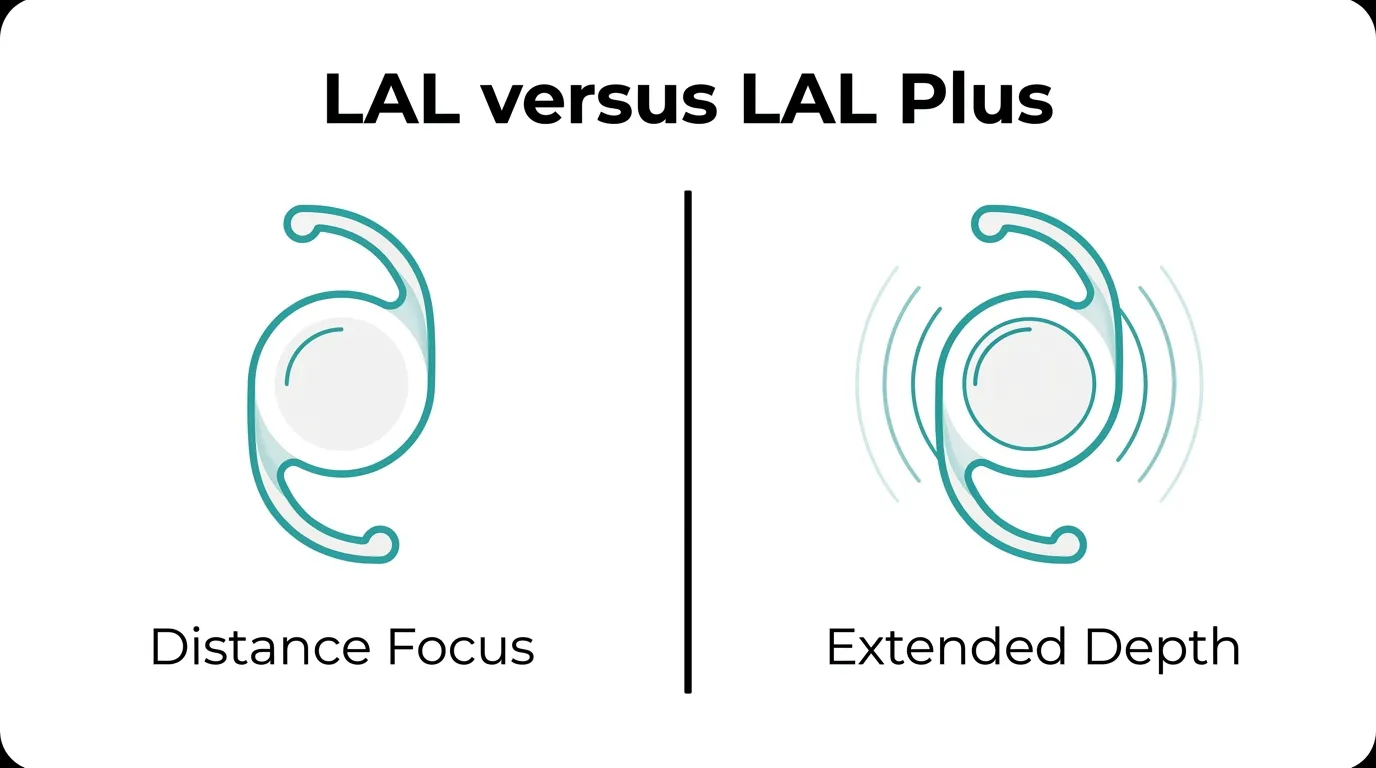
Both lenses share the same UV-reactive silicone platform, but the LAL+ introduces an extended-depth-of-focus optical geometry while the standard LAL targets primarily distance correction. The LAL+ is specifically indicated for patients with pre-existing corneal astigmatism of 0.75 diopters or greater.
Published comparative data suggest that distance acuity may be similar between the two lenses, while LAL+ may improve near visual performance for a larger proportion of patients. Neither lens guarantees spectacle independence, and individual results depend on anatomy and adjustment precision.
The adjustment protocol, UV-protective eyewear requirements, and lock-in process are clinically equivalent across both models. Both are classified as premium IOLs with out-of-pocket costs not covered by Medicare.
Candidacy, risks, lifestyle alignment, and long-term value all factor into the choice, and the decision should always be individualized through consultation with a qualified surgeon.
How Do the Standard LAL and the LAL Plus IOL Compare Overall?
The standard LAL and the LAL Plus IOL are both UV-adjustable intraocular lenses made by RxSight, but they differ in optical design, indicated patient profile, and the range of vision they may provide after cataract surgery. The sections below cover clinical outcomes, design differences, adjustment protocols, candidacy, costs, and how to choose between them.
What Exactly Is the Standard Light Adjustable Lens (LAL) and How Does It Work?
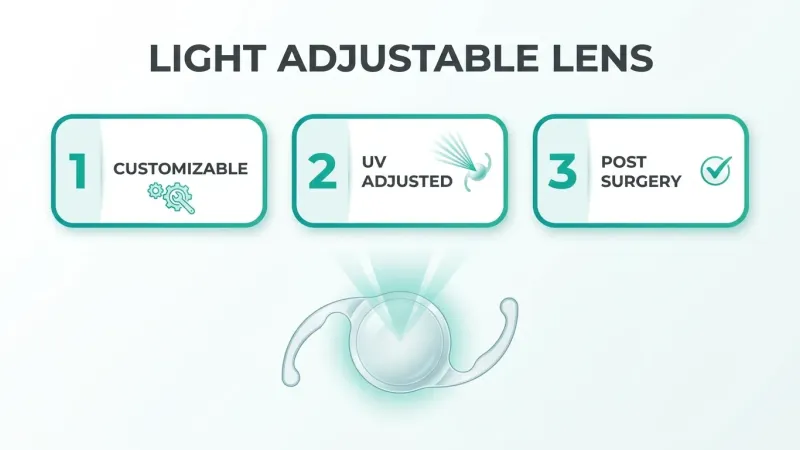
The standard Light Adjustable Lens (LAL) is a photoreactive intraocular lens implanted during cataract surgery that allows a surgeon to adjust its refractive power after the eye has healed, using focused UV light. The sections below cover its origins, how the adjustment mechanism works, and the FDA-approved treatment protocol.
What Is the Origin and Science Behind the Standard LAL?
The standard Light Adjustable Lens originated in 1997, when Danial Schwartz, M.D. from the University of California, San Francisco, and Robert Grubbs, Chemistry Professor at the California Institute of Technology jointly developed a lens whose three-dimensional structure could be altered non-invasively with the application of light energy, according to EyeWiki from the American Academy of Ophthalmology. The lens is made from a photoreactive silicone material containing UV-sensitive macromers embedded throughout its structure. When UV light from the Light Delivery Device (LDD) is applied in a precise spatial pattern, these macromers polymerize and migrate, physically changing the lens curvature and therefore its optical power. This polymerization process enables corrections for myopia, hyperopia, and astigmatism in approximately 0.25 diopter increments.
How Does the Light Delivery Device Adjust the LAL After Surgery?
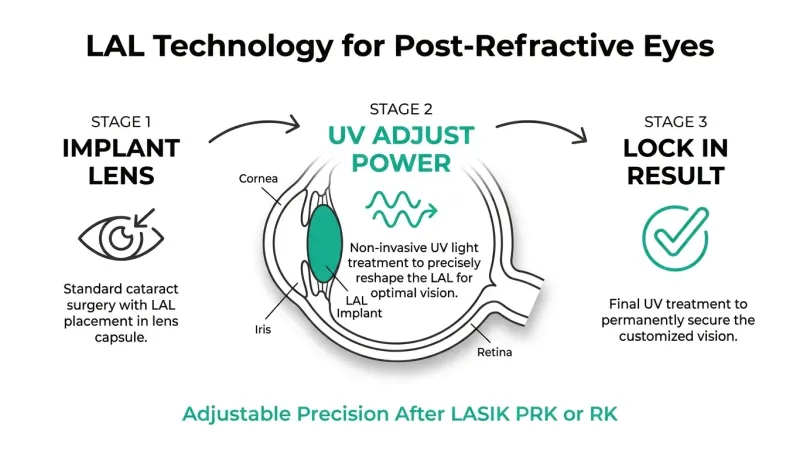
The Light Delivery Device adjusts the LAL by projecting calibrated UV light onto specific zones of the implanted lens, triggering localized polymerization that reshapes its optical surface. The surgeon programs the LDD based on the patient’s residual refractive error measured after healing, allowing a targeted correction without any additional surgical procedure. Once the desired power is reached, a final lock-in treatment polymerizes all remaining unactivated macromers, stabilizing the lens permanently so that subsequent ambient UV exposure cannot alter it further.
What Is the FDA-Approved Treatment Protocol for the Standard LAL?
The FDA-approved protocol for the standard LAL begins UV light treatments 17 to 21 days after surgery, with patients receiving three or four adjustment sessions over one to two weeks, each lasting approximately 40 to 150 seconds depending on the degree of correction needed, as confirmed in the FDA’s original approval announcement for the RxSight Light Adjustable Lens and Light Delivery Device. Because the lens remains UV-sensitive between sessions, patients must wear UV-protective eyewear continuously until all lock-in treatments are complete. This post-operative adjustability makes the LAL fundamentally different from conventional fixed-power intraocular lenses, where any residual refractive error can only be addressed by additional surgery or glasses. For patients who want the precision of measuring real-world vision outcomes before finalizing their lens power, this protocol represents a meaningful clinical advantage.
What Is the Light Adjustable Lens Plus (LAL+) and What Is New About It?
The Light Adjustable Lens Plus (LAL+) is an updated intraocular lens model developed by RxSight that builds on the original Light Adjustable Lens technology, adding a modified optical design intended to broaden the range of clear vision after cataract surgery. The sections below cover its FDA approval status, how its optics differ from the standard LAL, and what its clinical indication specifically targets.
What Is the LAL+ and How Did It Receive FDA Approval?
The LAL+ is a next-generation photoadjustable IOL approved by the FDA as a level A modification of the original LAL. According to the FDA Premarket Approval Database, RxSight received approval for the LAL+ model under PMA supplement S024 (PMA number P160055) on March 31, 2023, with the modification reason recorded as a change in design, components, specifications, or material. Like the original LAL, it is implanted in the capsular bag during phacoemulsification and its refractive power is fine-tuned after surgery using the Light Delivery Device. The 2023 approval date means the LAL+ is the more recent of the two devices, making it worth understanding before choosing between them.
What Is the Clinical Indication for the LAL+?
The clinical indication for the LAL+ specifically targets patients with pre-existing corneal astigmatism of 0.75 diopters or greater. According to Health Canada’s regulatory decision summary, the LAL+ and Light Delivery Device System is indicated for reducing residual astigmatism to improve uncorrected visual acuity following phacoemulsification and primary implantation in the capsular bag, in adult patients without pre-existing macular disease. The indication also states that the system reduces the likelihood of clinically significant residual spherical refractive errors. This explicit astigmatism threshold is a meaningful distinction from the broader standard LAL labeling.
What Is New About the LAL+ Optical Design?
The LAL+ introduces a modified aspheric anterior surface compared with the standard LAL, which is designed to slightly extend the depth of focus and provide a broader range of functional vision. While both lenses use RxSight’s photoreactive silicone macromer material that responds to UV light delivered by the Light Delivery Device, the LAL+ optical geometry reshapes the central lens power profile to reduce the dependence on a single focal point. This design change is what distinguishes the LAL+ from a straightforward monofocal photoadjustable IOL, positioning it closer to an extended-depth-of-focus lens concept, though it is not classified as a trifocal IOL.
How Do LAL and LAL+ Differ in Design, Materials, and Optics?
The LAL and LAL+ share the same photoreactive silicone platform but differ in lens geometry and optical goals. The sections below cover optical design differences, vision range, and UV-reactive material properties.
How Does the Optical Design of LAL vs LAL+ Differ?
The optical design of LAL vs LAL+ differs primarily in anterior surface geometry. The standard LAL uses a conventional aspheric design focused on correcting spherical refractive error and astigmatism. The LAL+ incorporates a modified aspheric anterior surface engineered to broaden depth of focus while preserving distance vision.
According to the FDA Premarket Approval Database, the LAL+ was approved on March 31, 2023, under PMA supplement S024 with modification reason listed as “Change Design/Components/Specifications/Material,” confirming the redesign was a formal regulatory-level change, not a minor refinement.
This surface redesign is what makes LAL+ functionally distinct from its predecessor, not just an incremental material update.
How Does LAL+ Change the Range of Clear Vision Compared With LAL?
LAL+ changes the range of clear vision by broadening depth of focus beyond what the standard LAL provides. The standard LAL primarily targets distance correction and astigmatism reduction. The LAL+ is engineered to extend usable focus through intermediate distances, reducing spectacle dependence across a wider range of daily tasks.
No authoritative source in the available research establishes that either lens guarantees spectacle independence or eliminates the need for reading glasses. Patients should discuss realistic visual goals with their surgeon before choosing between the two designs.
How Do Material or UV-Reactive Properties Differ Between LAL and LAL+?
The material and UV-reactive properties of LAL and LAL+ are fundamentally the same: both are manufactured from photoreactive silicone containing a UV-sensitive macromer that migrates and polymerizes under targeted UV light delivery. Both lenses require the RxSight Light Delivery Device for post-implant adjustment, and both require UV-protective eyewear until the lock-in treatment is complete.
The distinction lies in how the lens curvature responds to adjustment protocols, not in the base photochemical material itself. Because the underlying UV-reactive mechanism is shared, the post-surgical protection and lock-in requirements are clinically equivalent between the two models.
How Do the Adjustment Process and Treatment Schedule Differ Between LAL and LAL+?
The adjustment process for both LAL and LAL+ follows the same foundational model: light treatments delivered by the Light Delivery Device after surgery, followed by lock-in sessions. The sub-sections below cover session counts, timing to lock-in, and UV protection requirements.
How Many Light Adjustment Sessions Are Usually Needed With LAL vs LAL+?
The number of light adjustment sessions needed with LAL vs LAL+ is typically three to four treatments for each lens, delivered over one to two weeks following surgery. According to the FDA, each treatment lasts approximately 40 to 150 seconds depending on the correction required. No authoritative evidence establishes a distinct session count specific to LAL+ that differs from the standard LAL protocol; the treating surgeon determines the precise number based on individual refractive results.
Accuracy across both platforms is well supported. Reporting on LAL outcomes, Dr. Neuhann, medical director at Marienplatz Eye Clinic in Munich, noted through the European Society of Cataract and Refractive Surgeons that achieved refraction fell within 0.5 D of the intended target in 95% of eyes. In practice, the flexibility to fine-tune over multiple sessions is one of the most clinically valuable features of this technology.
Does the Time From Surgery to Final “Lock-In” Differ Between LAL and LAL+?
The time from surgery to final lock-in does not appear to differ substantially between LAL and LAL+ based on currently available evidence. For the standard LAL, the FDA confirmed that the Light Delivery Device begins treatments 17 to 21 days after surgery, with adjustments completed over one to two weeks before lock-in sessions conclude the process. No separately published protocol has established a distinct lock-in timeline unique to LAL+, and timing may be individualized by the surgeon depending on how quickly the eye stabilizes and the patient’s refractive target is achieved.
Do LAL and LAL+ Require Different UV-Blocking Glasses or Protection Routines?
LAL and LAL+ do not require different UV-blocking glasses; both lenses use photoreactive silicone material that responds to UV light, making consistent UV-protective eyewear essential from implantation until after lock-in is complete. Wearing the prescribed UV-blocking glasses outdoors and in any environment with significant UV exposure protects the unadjusted lens from unintended optical changes before treatment is finalized. This requirement applies equally to both models and is a non-negotiable element of the post-operative routine for either lens.
How Do Vision Outcomes With LAL vs LAL+ Typically Compare?
Vision outcomes with LAL vs LAL+ are broadly similar for distance acuity but differ meaningfully for near vision range and refractive precision. The sections below cover distance and intermediate results, close-up reading vision, and residual spectacle dependence.
How May Distance and Intermediate Vision Results Differ With LAL vs LAL+?
Distance and intermediate vision results with LAL vs LAL+ are clinically comparable, though published data show a slight edge for each lens in different measures. According to a study published in the Journal of Cataract and Refractive Surgery, 92.0% of LAL patients and 89.0% of LAL+ patients achieved binocular uncorrected distance visual acuity of 20/20 or better after adjustment. LAL+ showed a higher rate of eyes within 0.50 D of target spherical equivalent (93.5% vs 91.1%), suggesting marginally better refractive accuracy at distance. For intermediate tasks such as computer use, LAL+ is designed with a modified aspheric anterior surface intended to broaden the functional depth of focus beyond what the standard monofocal LAL provides.
How May Close-Up or Reading Vision Differ Between LAL and LAL+?
Close-up or reading vision differences between LAL and LAL+ reflect the lenses’ fundamentally different optical designs. The standard LAL is a monofocal lens; near vision typically requires spectacles unless monovision or blended vision is targeted during adjustment. LAL+ is designed to extend depth of focus, which may improve near and intermediate acuity compared with the standard LAL. However, no authoritative source in the available research establishes that either lens guarantees spectacle independence or eliminates the need for reading glasses. Patients considering either lens should discuss realistic near-vision expectations with their surgeon before surgery.
How Often Do Patients Still Need Glasses After LAL Compared With LAL+?
Spectacle dependence rates after LAL vs LAL+ are not yet definitively established by large head-to-head trials, but available comparative data offer useful reference points. In the Journal of Cataract and Refractive Surgery study, 86.0% of LAL patients and 93.0% of LAL+ patients achieved binocular uncorrected best focus visual acuity of J1 or better at 100% contrast, suggesting LAL+ may reduce residual reading glass dependence for a larger proportion of patients. The FDA-approved LAL protocol involves three or four UV light treatments to fine-tune lens power after surgery, giving both lens versions a post-implantation refractive advantage over conventional fixed IOLs. In practice, individual outcomes depend on pre-existing astigmatism, target refraction strategy, and how precisely the adjustment and lock-in process is executed.
Who May Be a Good Candidate for LAL vs LAL+?
Candidacy for standard LAL versus LAL+ depends on several intersecting factors. The H3s below cover who may suit each lens, how lifestyle and visual goals shape the choice, and which eye conditions may favor or exclude either option.
Who may benefit most from standard LAL instead of LAL+?
Patients who may benefit most from standard LAL are those whose primary goal is precise distance vision correction without a strong need for expanded intermediate or near focus. If a patient has minimal corneal astigmatism and mainly wants accurate spherical power refinement after cataract surgery, the standard LAL may address that goal effectively.
No published source in current research establishes a universal treatment-count or lock-in schedule for LAL+ that is distinct from the standard LAL protocol, meaning the choice between them may ultimately rest on the surgeon’s clinical judgment and the patient’s specific refractive profile.
Who may be better suited to LAL+ than the standard LAL?
Patients who may be better suited to LAL+ than the standard LAL are those with pre-existing corneal astigmatism of 0.75 diopters or greater who also want a broader functional range of vision after cataract surgery. The LAL+ is specifically indicated for reducing residual astigmatism while also reducing the likelihood of clinically significant residual spherical refractive errors, according to regulatory labeling reviewed by Health Canada.
Adults without pre-existing macular disease who value both astigmatism correction and expanded depth of focus are the core profile this lens was designed to serve.
How do age, lifestyle, and visual priorities affect LAL vs LAL+ choice?
Age, lifestyle, and visual priorities affect LAL vs LAL+ choice by shaping which visual distances matter most day to day. Consider how these factors may influence the decision:
- Active adults or working-age patients who regularly use computers, smartphones, or read printed material may place greater weight on intermediate and near visual performance.
- Patients who drive frequently or prioritize outdoor activities may favor predictable, sharp distance vision with minimal dysphotopsia risk.
- Older patients or those with presbyopia-related demands may benefit from discussing whether LAL+ can reduce reliance on reading glasses, while understanding that neither lens guarantees spectacle independence.
- Patients with a history of prior corneal refractive surgery, such as LASIK or PRK, may represent a more complex refractive profile requiring individualized discussion with their surgeon.
Visual priorities should drive the conversation, not lens marketing alone.
Are there eye conditions that favor LAL or LAL+ or rule either one out?
Several eye conditions may favor one lens over the other or may disqualify a patient from either option. Based on available regulatory and clinical evidence:
- Pre-existing macular disease is a contraindication for LAL+, as its indication explicitly requires no pre-existing macular disease.
- Corneal astigmatism of 0.75 D or greater is a stated indication criterion for LAL+, making it the more fitting choice when significant astigmatism correction is needed.
- Prior corneal refractive surgery (LASIK, PRK, RK) does not automatically exclude LAL candidacy; a ClinicalTrials.gov-registered RxSight study enrolled 105 eyes with prior corneal refractive surgery to evaluate LAL safety and effectiveness in that population.
- Conditions affecting the macula or retina generally warrant careful surgical evaluation before either adjustable lens is considered.
A surgeon-reviewed assessment of each patient’s ocular health remains the essential step before any IOL selection.
What Are the Potential Benefits of LAL+ Compared With the Standard LAL?
The potential benefits of LAL+ compared with the standard LAL center on three areas: a broader range of spectacle independence, more precise astigmatism correction, and the possibility of improved quality of vision. Each is explored in the H3 sections below.
How Can LAL+ Potentially Offer a Wider Range of Spectacle Independence?
LAL+ can potentially offer a wider range of spectacle independence through its modified aspheric anterior surface design, which may extend depth of focus beyond what the standard LAL achieves. While the standard LAL primarily targets distance vision correction, LAL+ is designed to reduce both residual astigmatism and residual spherical refractive error, broadening the range of clear vision across distances. According to a comparative study published in the Journal of Cataract and Refractive Surgery via PubMed Central, 93% of LAL+ patients achieved binocular uncorrected best focus visual acuity of J1 or better at 100% contrast, compared with 86% for standard LAL patients. No source in this research establishes that either lens guarantees full spectacle independence, and patients should discuss realistic expectations with their surgeon.
How Might LAL+ Improve Fine-Tuning for Astigmatism Compared With LAL?
LAL+ may improve fine-tuning for astigmatism because it is specifically indicated for patients with pre-existing corneal astigmatism of 0.75 diopters or greater, a criterion not shared by the standard LAL. The LAL+ system is designed to reduce residual cylindrical refractive error with the same post-operative UV light adjustment process, but with an optical platform better suited to addressing higher astigmatic corrections. This targeted indication makes LAL+ the more clinically appropriate choice for patients whose cataract surgery outcome would otherwise be compromised by uncorrected corneal astigmatism. From a practical standpoint, reducing residual astigmatism is one of the most meaningful levers for improving uncorrected visual acuity after cataract surgery.
How Could LAL+ Affect Quality-of-Vision Issues Like Halos, Glare, or Contrast?
LAL+ could affect quality-of-vision issues such as halos, glare, and contrast sensitivity through its modified aspheric optic, which may influence how the lens handles peripheral light rays. However, no head-to-head evidence was located comparing LAL and LAL+ rates of halos, glare, starbursts, or validated patient-reported dysphotopsia outcomes using standardized instruments. Without that comparative data, any claim that LAL+ meaningfully reduces or increases these symptoms relative to the standard LAL cannot be supported. Patients with concerns about dysphotopsia should raise them directly with their surgeon, as individual corneal profiles and neuroadaptation play a significant role in how these visual phenomena are experienced.
What Are the Possible Risks, Side Effects, or Downsides of LAL and LAL+?
The possible risks, side effects, and downsides of LAL and LAL+ span standard cataract surgery complications, lens-specific UV-protection requirements, and some additional trade-offs that may apply more to LAL+. The subsections below address shared risks, LAL+-specific considerations, and the critical role of UV light control.
What side effects or risks are shared by both LAL and LAL+?
The side effects and risks shared by both LAL and LAL+ are largely those common to any cataract surgery and intraocular lens implantation. These include:
- Vision loss that does not resolve with time
- Persistent eye pain unresponsive to standard pain relief
- Severe redness of the eye
- Floaters, flashes of light, or new dark spots in the visual field
According to the National Eye Institute (NIH), patients should contact their eye doctor immediately if any of these warning signs appear after surgery. Beyond standard surgical risks, both lenses require patients to wear UV-protective eyewear continuously until lock-in is complete, as uncontrolled UV exposure can alter the photoreactive silicone macromer and produce unintended refractive changes.
Are there any risks or trade‑offs that may be higher with LAL+?
The risks or trade-offs that may be higher with LAL+ are primarily related to its modified optical design and patient expectations around near and intermediate vision. Because LAL+ is designed to broaden depth of focus, some patients may have expectations about reading or intermediate vision that the lens cannot reliably fulfill for every individual.
Clinically, no long-term, multi-year peer-reviewed comparative safety or refractive-stability dataset specific to LAL+ has been located, meaning the extended safety profile remains less established than that of the standard LAL. Additionally, no head-to-head evidence currently exists comparing LAL+ and standard LAL on rates of halos, glare, or validated dysphotopsia outcomes, so patients should discuss these uncertainties with their surgeon before implantation.
How important is UV light exposure control for safety with LAL and LAL+?
UV light exposure control is critically important for the safety and effectiveness of both LAL and LAL+, as uncontrolled UV exposure before lock-in can inadvertently alter the lens’s refractive power and compromise the adjustment outcome. Both lenses are made from UV-reactive photosensitive silicone material; any ambient UV light reaching the eye before the lock-in treatment is complete can trigger unintended polymerization.
A ClinicalTrials.gov study (NCT03660865, National Library of Medicine) enrolling 105 patients evaluated LAL safety and effectiveness specifically in eyes with prior corneal refractive surgery, underscoring how closely safety is monitored in complex cases. Patients must wear UV-protective eyewear at all times outdoors, and even indoors near UV-emitting light sources, until the treating surgeon confirms lock-in is complete. This requirement is non-negotiable and represents one of the most distinctive lifestyle commitments of the LAL and LAL+ experience compared with standard IOLs.
How Do Costs and Insurance Coverage Compare for LAL vs LAL+?
Both LAL and LAL+ are classified as premium intraocular lenses, meaning patients pay an out-of-pocket surcharge beyond what Medicare or standard insurance covers. The H3s below cover typical cost differences, Medicare and insurance treatment, and long-term value considerations.
How do typical out-of-pocket costs differ between LAL and LAL+?
Typical out-of-pocket costs for both LAL and LAL+ include a premium-lens surcharge added to the standard cataract surgery fee. No authoritative national price list for either lens has been published, so specific dollar ranges cannot be stated reliably. What research does confirm is the relative cost-effectiveness of the LAL technology: a study published in Investigative Ophthalmology & Visual Science found that cataract surgery with LAL produced an incremental cost of $8,431 over monofocal IOL, yielding an incremental cost-effectiveness ratio of $10,072 per quality-adjusted life year, well below the standard $50,000/QALY willingness-to-pay threshold. LAL+ may carry a modestly higher surcharge than standard LAL given its expanded optical design, but patients should ask their surgeon’s practice for current pricing, as fees vary by facility and region.
How do insurance and Medicare usually treat LAL and LAL+ upgrades?
Insurance and Medicare treat both LAL and LAL+ as premium lens upgrades, with the additional costs falling to the patient. According to the American Academy of Ophthalmology, the LAL is billed under V code V2787 alongside the standard cataract CPT code, and the premium-lens portion is not covered by Medicare. Medicare Part B does cover one pair of standard eyeglasses or contact lenses after cataract surgery that implants any intraocular lens, but that benefit does not offset the premium surcharge. A CMS ruling also addresses payment for astigmatism-correcting IOLs following cataract surgery, reinforcing that the astigmatism-correction upgrade remains an out-of-pocket expense. Commercial insurer policies vary and no complete insurer-by-insurer coverage map exists in published sources, so patients should verify benefits directly with their plan.
What long-term value considerations matter when choosing LAL vs LAL+?
Long-term value considerations for LAL versus LAL+ center on spectacle dependence, the precision of the post-surgical adjustment, and the cost of corrective lenses over time. Because both lenses allow UV light-based fine-tuning after implantation, patients can achieve a refractive outcome that may reduce reliance on glasses for distance tasks, potentially offsetting the upfront surcharge through fewer prescription lens purchases over years. LAL+ adds the ability to broaden depth of focus, which may also reduce intermediate and near spectacle use for suitable patients, adding further long-term value. Neither lens guarantees spectacle independence, and outcomes depend on individual anatomy and healing. From a value standpoint, the higher upfront cost of a premium adjustable lens is most justifiable for patients who place a strong priority on reducing glasses dependence across multiple distances and who are willing to commit to the full post-operative adjustment schedule.
What Should You Expect Before, During, and After Surgery With LAL vs LAL+?
The surgical experience with LAL and LAL+ follows the same standard cataract surgery framework, with key differences emerging in pre-operative workup, day-of counseling, and the post-operative adjustment schedule. The sections below cover what to expect at each stage.
How does pre‑operative testing differ, if at all, for LAL vs LAL+?
Pre-operative testing for LAL vs LAL+ differs primarily in the emphasis on astigmatism measurement. Both lenses require standard biometry and corneal topography to calculate IOL power. For LAL+, surgeons may place greater weight on precise corneal astigmatism mapping, since the lens is specifically indicated for patients with pre-existing corneal astigmatism of 0.75 diopters or greater. Macular health evaluation is also essential for both lenses, as active macular disease is a contraindication for each. In practice, the testing equipment used is largely the same; the difference is in how the data informs the choice between the two lenses.
What is the cataract surgery day experience like with either lens?
The cataract surgery day experience with either the LAL or LAL+ is largely identical to standard phacoemulsification cataract surgery. The natural clouded lens is removed, and the photoadjustable IOL is implanted in the capsular bag. Patients should be counseled before surgery that vision outcomes are not fully determined on the day of implantation. As Professor Sumitra Khandelwal, MD, of Baylor College of Medicine noted in a 2024 EyeWorld report by the American Society of Cataract and Refractive Surgery, patients need to understand they may not get the near vision they expect, and that locking in the lens in a timely manner is important for optimal results. UV-protective eyewear must be worn immediately following surgery and continued until all adjustments and the final lock-in treatment are complete.
What is recovery and follow‑up like with LAL compared with LAL+?
Recovery and follow-up with LAL compared with LAL+ are structurally similar, as both require a post-operative adjustment phase using the Light Delivery Device before the lens power is permanently locked in. For both lenses, light adjustment treatments begin approximately 17 to 21 days after surgery, with sessions each lasting roughly 40 to 150 seconds depending on the correction needed. The critical recovery distinction is that LAL+ patients are typically those managing more significant astigmatism correction alongside spherical refinement, which may make the adjustment planning more involved. No large randomized head-to-head trial comparing LAL+ recovery against standard LAL recovery has been published, so individual timelines should be discussed with your surgeon. Throughout the follow-up period, strict UV-protective eyewear compliance remains essential for both lens types to prevent unintended photopolymerization before lock-in is complete.
How Should You Decide Between LAL and LAL+ With Your Surgeon?
Deciding between LAL and LAL+ requires an honest conversation with your surgeon about your refractive profile, visual priorities, and daily life demands. The following H3s cover the key questions to raise, how lifestyle shapes the choice, and how to account for future eye changes.
What Questions Should You Ask Your Surgeon About LAL vs LAL+?
The questions you should ask your surgeon about LAL vs LAL+ include your astigmatism level, your dominant visual tasks, and which lens design aligns with your refractive target. Because no universally endorsed patient-selection algorithm specific to LAL+ currently exists in published guidelines from bodies such as the AAO or ASCRS, your surgeon’s clinical judgment carries significant weight. Useful questions to bring to your consultation include:
- Does my pre-existing corneal astigmatism meet the threshold where LAL+ is indicated?
- What is my target refraction, and which lens gives the surgeon more room to fine-tune it?
- How many adjustment sessions should I realistically plan for?
- What is your practice’s experience with LAL compared with LAL+?
- What outcomes are realistic for me, given my eye measurements?
Framing these questions around your specific measurements rather than general preferences tends to produce the most clinically useful answers.
How Can You Match LAL or LAL+ to Your Work, Hobbies, and Daily Tasks?
Matching LAL or LAL+ to your work, hobbies, and daily tasks starts with identifying which visual distances matter most to you across a typical day. Consider the following when discussing options with your surgeon:
- Distance-dominant tasks (driving, sports, lectures): Standard LAL may deliver strong uncorrected distance acuity for many patients.
- Mixed-distance tasks (computer work, cooking, reading labels): LAL+ may offer a broader functional range, depending on how adjustment targets are set.
- Near-critical tasks (detailed reading, fine craftwork): Neither lens guarantees reading-glass independence, so discuss realistic near-vision expectations openly.
- UV exposure demands: Both lenses require UV-protective eyewear during the adjustment period, which may affect outdoor work or hobbies.
Patients whose daily life spans multiple visual distances may benefit most from an extended discussion about how adjustment targets can be customized to their routine.
How Should You Think About Future Eye Changes When Choosing LAL vs LAL+?
Future eye changes worth discussing with your surgeon when choosing between LAL and LAL+ include the likelihood of residual refractive drift, the potential need for reading glasses as presbyopia progresses, and the stability of any corneal conditions. Once the lock-in treatment is complete, the lens power is fixed and cannot be re-adjusted. Conditions such as posterior capsule opacification can develop after surgery in either lens type and may affect vision quality over time, requiring separate treatment. Patients with a history of prior corneal refractive surgery, such as LASIK or PRK, should discuss how that history may influence refractive predictability during the adjustment phase. Thinking through how your visual needs may shift over the next decade is a practical step that helps your surgeon recommend the most appropriate adjustment strategy before lock-in occurs.
How Can Eye Surgery Today Help You Understand LAL vs LAL+ and Your Vision Options?
Eye Surgery Today provides surgeon-reviewed educational guides to help patients compare the Light Adjustable Lens and Light Adjustable Lens Plus before making any decisions. The H3s below outline what Eye Surgery Today offers and summarize the core takeaways from this article.
How Can Eye Surgery Today’s Surgeon-Reviewed Guides Help You Compare LAL and LAL+?
Eye Surgery Today’s surgeon-reviewed guides help you compare LAL and LAL+ by translating clinical evidence, regulatory records, and specialist insight into clear, accessible language. Choosing between a photoadjustable IOL optimized for distance and one designed to broaden depth of focus involves nuanced trade-offs across optical design, candidate criteria, cost, and recovery. Eye Surgery Today covers each of these dimensions without medical jargon, so you can arrive at a conversation with your surgeon already informed. The National Eye Institute advises patients to contact their eye doctor immediately if they experience vision loss, persistent pain, very red eyes, or new floaters after cataract surgery, and Eye Surgery Today’s guides reinforce that kind of safety awareness alongside the technical comparison content.
What Are the Key Takeaways About LAL vs LAL+ and the Differences in the Light Adjustable Lens Plus We Covered?
The key takeaways about LAL vs LAL+ are:
- Origin: The Light Adjustable Lens technology was developed in 1997 by Dr. Daniel Schwartz at the University of California, San Francisco and Dr. Robert Grubbs at Caltech, producing a photosensitive silicone IOL whose refractive power can be altered non-invasively with UV light (EyeWiki, American Academy of Ophthalmology).
- Regulatory status: The FDA approved the LAL+ as a level A modification of the original LAL under PMA supplement S024 on March 31, 2023, confirming a design change in components, specifications, and materials.
- Core distinction: The LAL targets distance refractive accuracy; the LAL+ adds an extended-depth-of-focus profile, with a specific indication for patients with pre-existing corneal astigmatism of 0.75 diopters or greater.
- Cost and coverage: Both lenses are billed using V code V2787 and classified as premium IOLs; the additional out-of-pocket cost is not covered by Medicare, according to the American Academy of Ophthalmology.
- Decision guidance: Candidate selection, treatment schedule, and lock-in timing should always be individualized with a qualified surgeon based on your corneal measurements, lifestyle priorities, and refractive goals.
Understanding these distinctions gives you a solid foundation for a productive consultation about which light-adjustable intraocular lens may suit your vision needs.