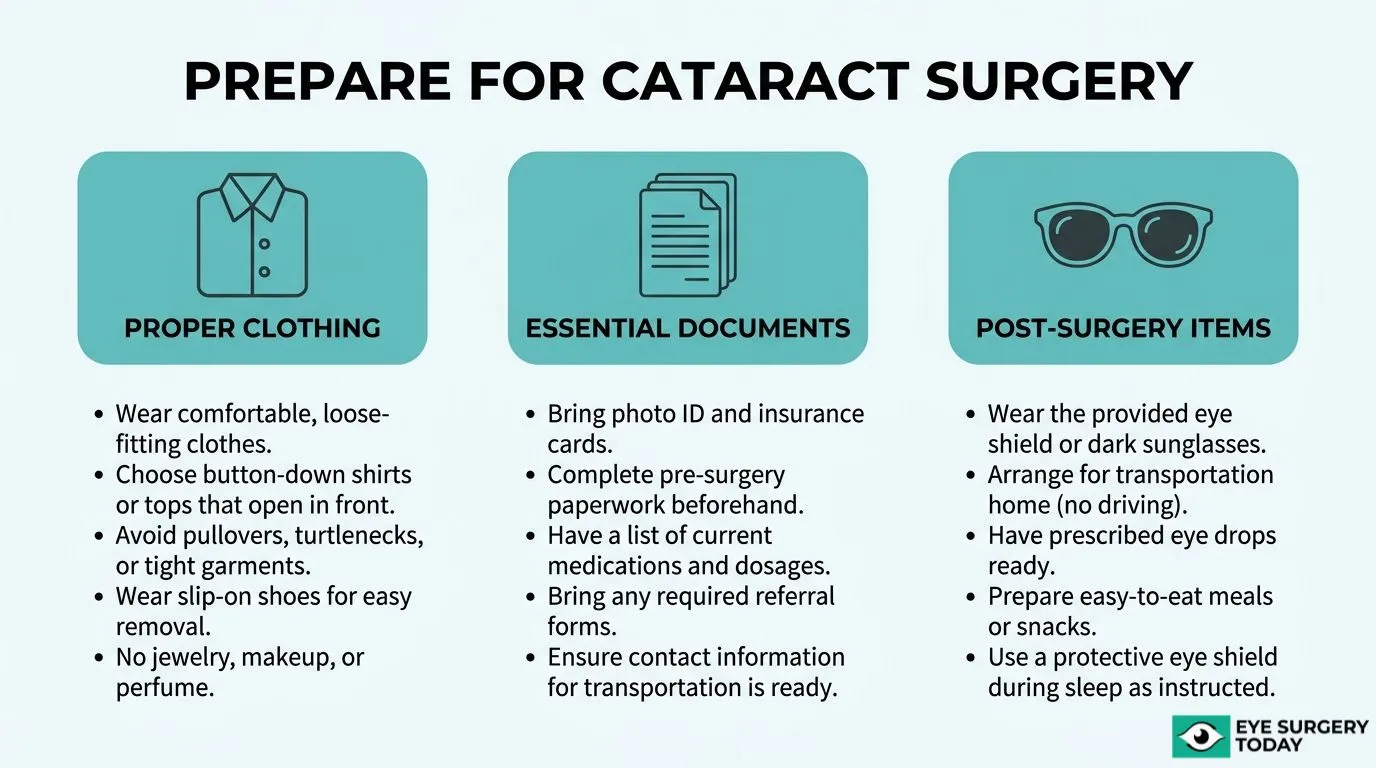
Cataract surgery is a brief outpatient procedure that removes the eye’s clouded natural lens and replaces it with a clear artificial intraocular lens (IOL). What you wear and bring to the surgery center can directly affect your comfort, clinical safety, and check-in efficiency.
This guide covers clothing and accessory guidelines, essential items to bring and leave behind, the clinical reasoning behind surgery center dress codes, post-operative comfort on the ride home, and night-before preparation.
Clothing choices matter because medical staff need unobstructed arm access for blood pressure monitoring and IV placement. A short-sleeved, button-down shirt is widely recommended, while makeup, perfume, and jewelry should be avoided to maintain a sterile surgical field and reduce infection risk.
Bringing the right documents and items, including photo ID, insurance cards, a signed consent form, a current medication list, and wraparound sunglasses, helps prevent check-in delays and supports a smoother post-operative transition.
Surgery centers enforce these guidelines for specific clinical reasons: reducing microbial contamination near the eye, enabling efficient vital sign monitoring, and supporting operational flow that keeps procedures on schedule.
Planning the night before, from laying out appropriate clothing to packing your bag, can reduce morning stress on a day when you may also be managing fasting requirements and pre-operative eye drops. A designated driver is a firm requirement, as driving is typically restricted for at least 24 hours following the procedure.
What Should You Wear to Cataract Surgery?
What you wear to cataract surgery affects how smoothly your procedure goes, from monitoring access to post-operative comfort. The following sections cover the best shirt type, footwear, clothing fit, jewelry rules, and cosmetics restrictions.
What Type of Shirt or Top Is Best for Cataract Surgery?
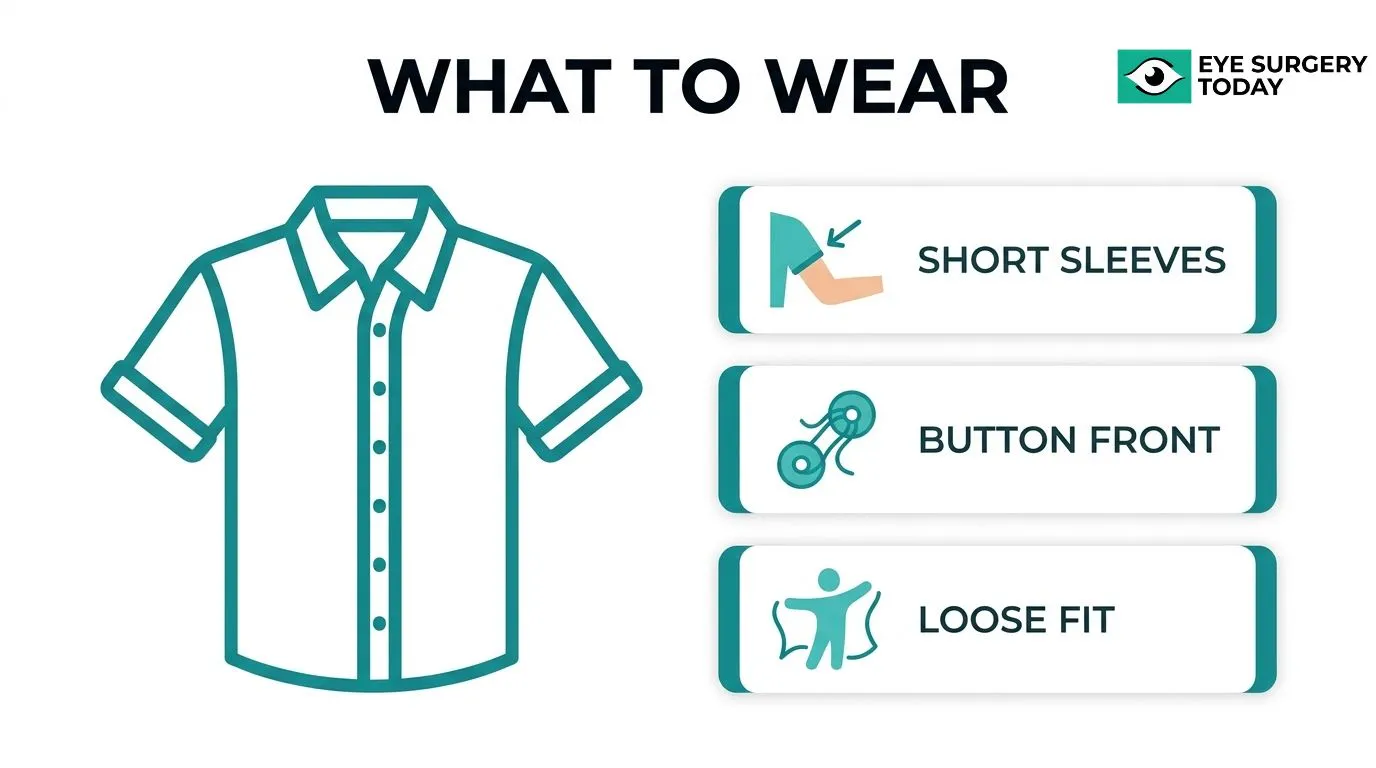
The best shirt for cataract surgery is a short-sleeved button-down top. Short sleeves give medical staff unobstructed access to your arm for blood pressure monitoring and intravenous sedation if needed. A button-front design means you won’t need to pull anything over your head after surgery, when your eye may be patched or sensitive. According to Lyons Eye Care, short-sleeved shirts are specifically recommended to allow staff to monitor vital signs and administer medications without delay.
What Shoes Should You Wear to Your Cataract Surgery Appointment?
The shoes you wear to your cataract surgery appointment should be flat, closed-toe, and easy to slip on and off. Sedation can temporarily affect your balance and coordination after the procedure, making heeled or open-toe footwear a fall risk. Shoes with simple fastenings, such as slip-ons or Velcro straps, are practical because bending to tie laces may be uncomfortable post-procedure. Stable, non-slip soles offer the most support when walking from the surgical suite to your waiting ride.
Should You Wear Loose or Tight Clothing to Cataract Surgery?
You should wear loose-fitting clothing to cataract surgery. According to the Eye Surgery Center of Arizona, loose, comfortable clothing, particularly a button-down shirt, allows easy access for blood pressure and heart monitoring and eliminates the need to pull tight garments over your head after surgery. Tight necklines, turtlenecks, and fitted sleeves can obstruct monitoring equipment and cause unnecessary discomfort during what is already an unfamiliar experience.
Can You Wear Jewelry or Accessories to Cataract Surgery?
No, you cannot wear jewelry or accessories to cataract surgery. All hand and arm jewelry must be removed before invasive surgical procedures, as it increases the microbial load around the surgical field and compromises the sterile environment required during the operation, according to Alberta Health Services guidelines. Leave rings, bracelets, and watches at home rather than removing them at the center, where items are more easily misplaced.
Can You Wear Makeup or Perfume to Cataract Surgery?
No, you cannot wear makeup or perfume to cataract surgery. Patients are advised to refrain from wearing makeup, lotions, perfumes, and hair products on the day of surgery to maintain a clean surgical field and minimize infection risks. This restriction is especially important around the eye area, where even trace residue from cosmetics may increase the risk of postoperative complications. Arriving with a clean, product-free face is one of the simplest steps you can take to protect your surgical outcome.
What Should You Bring to the Cataract Surgery Center?
What you should bring to the cataract surgery center includes your identification, insurance cards, medications, eyewear, and a few personal comfort items. The H3s below cover each category in detail.
What Documents and Identification Should You Bring?
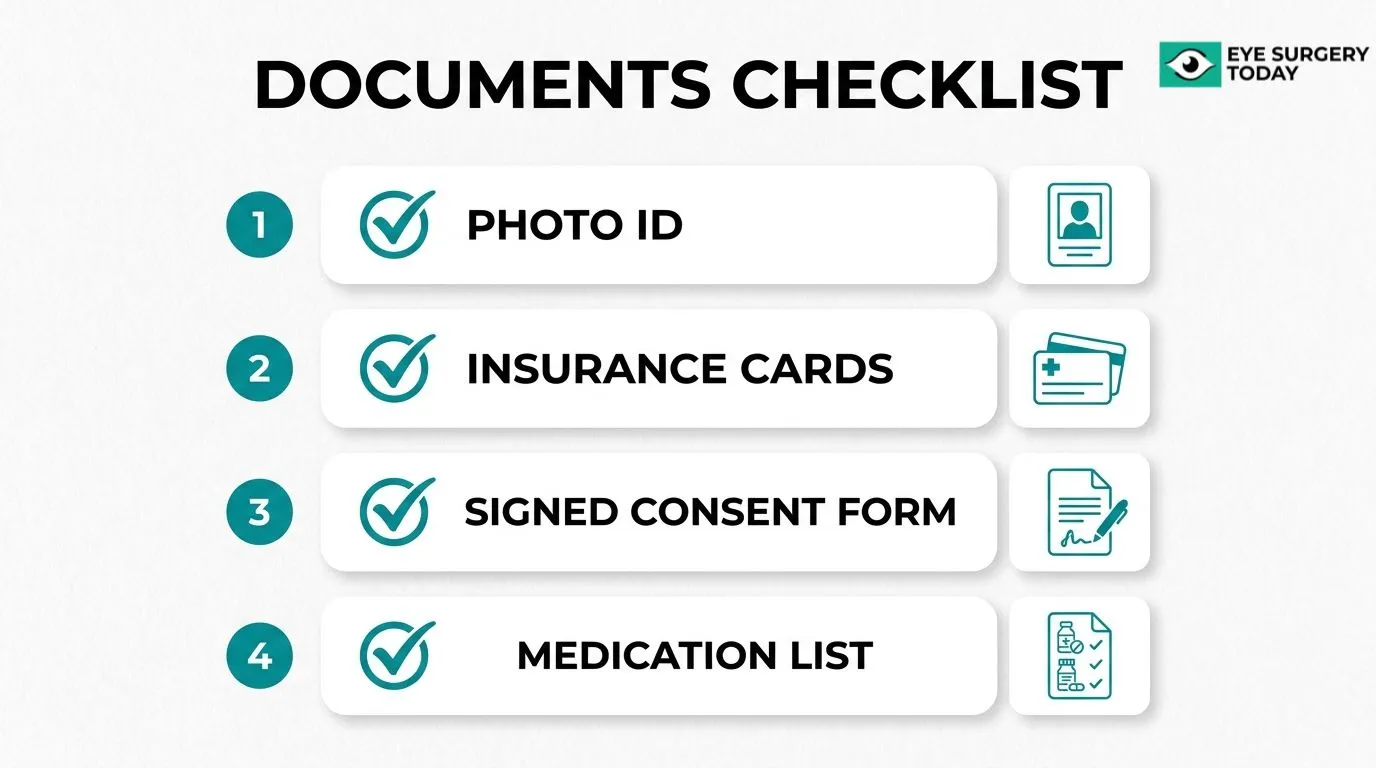
The documents and identification you should bring include a valid photo ID, your insurance cards, a signed consent form, and a current medication list. According to a pre-operative checklist published by Cleveland Clinic, these four items are standard requirements on the day of the procedure. Missing even one can delay your check-in and, in some cases, result in a postponed surgery. From a practical standpoint, keeping these items together in a single folder the night before is one of the simplest ways to avoid a stressful morning.
What Medications Should You Bring on Surgery Day?
The medications you should bring on surgery day are all current prescription and over-the-counter drugs, including any pre-operative eye drops your surgeon prescribed. Staff will review the list to screen for interactions or contraindications, such as alpha-blockers, which can cause Intraoperative Floppy Iris Syndrome. Bring the actual bottles where possible, since label information helps clinical staff confirm dosages quickly.
Should You Bring Your Glasses or Contact Lenses?
Yes, you should bring your glasses to the cataract surgery center, but you should not wear contact lenses on surgery day. Your glasses will be useful before and after the procedure, particularly while your vision stabilizes during recovery. Contact lenses alter the shape of the cornea and can interfere with pre-operative measurements, so most surgeons ask patients to stop wearing them several days before the appointment.
Should You Bring Sunglasses for After Cataract Surgery?
Yes, you should bring sunglasses for after cataract surgery. According to the Michigan Eye Institute, patients are advised to wear sunglasses for at least one week following surgery to manage light sensitivity, which can persist for up to four weeks due to pupil dilation from the procedure. Wrap-around or oversized frames offer the best coverage. Driving is also typically restricted for a minimum of 24 hours post-surgery, so a companion will be managing the ride home while you wear them.
Do You Need to Bring a Blanket or Pillow for Comfort?
A blanket or pillow is not required, but bringing a small, familiar comfort item is reasonable for patients who experience anxiety in clinical settings. Most cataract surgery centers provide blankets on request, and the procedure itself is brief, typically lasting between 20 and 45 minutes. If temperature sensitivity or neck discomfort is a concern for you, a thin travel pillow can make the wait more manageable without creating any clinical issues.
What Should You Leave at Home on Cataract Surgery Day?
Leaving certain items at home on cataract surgery day reduces security risks and keeps the clinical environment safe. The two most important categories to consider are valuables and personal electronics.
Why Should You Leave Valuables at Home?
Valuables such as jewelry, watches, and cash should be left at home on cataract surgery day. Beyond the practical risk of loss, jewelry poses a direct clinical concern: Alberta Health Services guidelines specify that all hand and arm jewelry must be removed before invasive surgical procedures to reduce microbial load and maintain a sterile field. Rings, bracelets, and similar items can harbor bacteria that increase infection risk during an eye procedure performed in a controlled sterile environment. Leaving them home entirely is simpler and safer than removing them on-site.
Should You Leave Your Phone in the Car During Surgery?
Your phone is best left in the car during cataract surgery, though it is reasonable to have it with you in the waiting area beforehand. The surgical suite is a restricted, sterile environment where personal devices are not permitted. More practically, the procedure typically lasts between 20 and 45 minutes, according to the NHS, and you will be under sedation for much of that time, making your phone inaccessible regardless. Having a trusted companion hold it, or locking it in the car, prevents any concern about loss or distraction during the procedure.
Why Do Cataract Surgery Centers Have Clothing Guidelines?
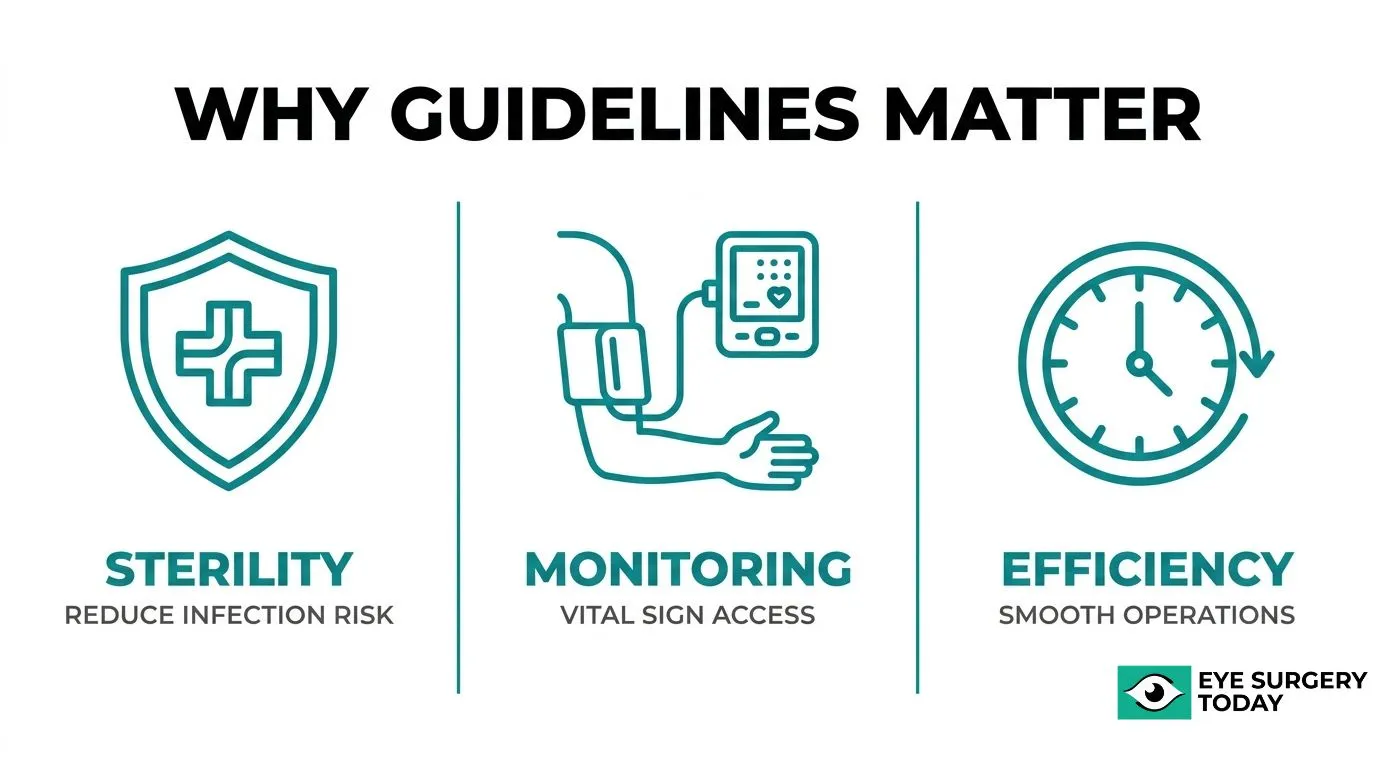
Cataract surgery centers have clothing guidelines to protect patient safety, maintain a sterile surgical environment, and allow medical staff to monitor and treat patients efficiently throughout the procedure.
Sterility and Infection Prevention
Clothing guidelines exist primarily to reduce infection risk during cataract surgery. Cosmetics, lotions, and perfumes introduce microbial contaminants near the surgical field, while jewelry on the hands and arms elevates the microbial load and compromises sterile technique. According to Alberta Health Services’ surgical aseptic technique guidance, all hand and arm jewelry must be removed before invasive surgical procedures to maintain a sterile environment and prevent infection. Given that infectious endophthalmitis, a severe intraocular infection, occurs at an estimated rate of 1.3 per 1,000 cataract surgeries, eliminating controllable contamination sources is clinically significant.
Clinical Access and Monitoring Requirements
Short-sleeved shirts and button-down tops serve a direct clinical function during cataract surgery. Medical staff require unobstructed access to the arms to monitor blood pressure, measure vital signs, and administer intravenous sedation or medications. According to Lyons Eye Care’s pre-surgical preparation guidelines, short sleeves allow staff to perform these tasks without delays. Button-down fronts also prevent patients from pulling clothing over their heads after the procedure, avoiding accidental contact with the treated eye.
Operational Efficiency and Patient Safety
Standardized clothing guidelines support the operational flow of ambulatory surgery centers. Patients who arrive wearing restricted items, such as pullover tops or heavy jewelry, require additional preparation time that delays surgical schedules. Implementing consistent patient education around what to wear reduces same-day complications and supports efficient surgical throughput. From a patient safety standpoint, comfortable, loose-fitting attire also reduces physical stress on the day of a procedure where sedation and post-operative sensitivity are expected.
What Should You Wear After Cataract Surgery on the Ride Home?
After cataract surgery, you should wear the same comfortable, loose clothing you arrived in, plus a pair of wraparound sunglasses to manage light sensitivity on the way home.
The sections below cover eye protection and clothing comfort for the ride home.

What Eye Protection Should You Wear on the Ride Home?
The eye protection you should wear on the ride home is a pair of dark, wraparound sunglasses. According to the Michigan Eye Institute, patients are advised to wear sunglasses for at least one week following surgery to manage light sensitivity, which can persist for up to four weeks due to pupil dilation from the procedure. Bright daylight or oncoming headlights can cause significant discomfort during this window, making wraparound styles particularly effective at blocking light from multiple angles. Your surgery center may also send you home with a protective eye shield, which should remain in place if instructed.
What Clothing Is Most Comfortable for the Ride Home?
The clothing most comfortable for the ride home is the same loose, button-front outfit worn to the appointment. Since you will not need to change after the procedure, arriving in the right clothing eliminates any discomfort caused by pulling fabric over your head near the treated eye. A soft, zip-up layer is also worth bringing, as surgery centers tend to keep temperatures cool and post-procedure rest benefits from added warmth.
With the right eye protection and comfortable clothing ready, the ride home becomes a simple, low-stress part of your recovery.
Do You Need Someone to Drive You Home After Cataract Surgery?
Yes, you need someone to drive you home after cataract surgery. Driving is typically restricted for a minimum of 24 hours post-surgery due to residual sedation effects and the use of a protective eye shield, with full confidence in driving often returning within one to two weeks.
Arranging a trusted driver before your surgery date is not optional; it is a firm requirement most surgery centers enforce before admitting you for the procedure. Beyond the immediate restriction, the long-term vision benefits are significant. A 2018 study published in JAMA Ophthalmology, involving 560,000 patients, found that cataract surgery was associated with a 9% reduction in the risk of serious traffic crashes for drivers in the subsequent year. That outcome, however, depends on allowing proper recovery first. Attempting to drive too soon, while vision is still stabilizing and sedation lingers, undermines both your safety and your surgical results. Plan for a responsible adult to accompany you, and confirm this arrangement the day before your procedure.
How Should You Prepare the Night Before Cataract Surgery?
Preparing the night before cataract surgery reduces morning stress and helps ensure a smooth check-in. The two key steps are selecting the right clothing and packing your bag with everything the center will need.
What Clothing Should You Lay Out the Night Before?
The clothing you should lay out the night before cataract surgery includes a short-sleeved, button-down shirt and flat, closed-toe shoes. A button-down front eliminates the need to pull anything over your head after surgery, which matters when your eye is covered by a protective shield. Short sleeves give medical staff unobstructed access to your arm for blood pressure monitoring and any IV line placement. Comfortable, loose-fitting trousers or elastic-waist bottoms complete the outfit. Avoid anything with tight necklines, zippers near the face, or layers that complicate undressing. Setting these items out the evening before removes one decision from a morning when most patients are already managing fasting instructions and pre-operative eye drops.
What Items Should You Pack in Your Bag Ahead of Time?
The items you should pack in your bag ahead of time include photo identification, insurance cards, a signed consent form, and a current medication list. According to the Cleveland Clinic, patients must bring all four of these documents to the surgery center on the day of the procedure. Beyond paperwork, pack any prescribed pre-operative eye drops, a pair of wraparound sunglasses for post-surgery light sensitivity, and your regular glasses if you wear them. Leave jewelry, large amounts of cash, and unnecessary valuables at home. A systematic review published on PubMed also noted that aspirin can increase the likelihood of subconjunctival bleeding before cataract surgery, so confirm with your surgeon the night before which medications to take or pause.
How Can Surgeon-Reviewed Resources Help You Prepare for Cataract Surgery?
Surgeon-reviewed resources help you prepare for cataract surgery by translating clinical protocols into clear, actionable guidance covering what to expect, what to wear, and what to bring.
Can Eye Surgery Today Help You Understand What to Expect on Surgery Day?
Yes, Eye Surgery Today can help you understand what to expect on surgery day by providing surgeon-reviewed content covering pre-operative protocols, medication timing, and post-operative restrictions.
Pre-operative eye drops, including antibiotic and anti-inflammatory agents, are commonly prescribed starting two to three days before surgery to reduce infection risk and post-operative swelling. Driving is typically restricted for a minimum of 24 hours post-surgery due to residual sedation and the use of a protective eye shield, with full driving confidence often returning within one to two weeks. Well-prepared patients also reduce delays at the surgery center, as inadequate preparation is a leading cause of operating room inefficiency.
Eye Surgery Today consolidates these clinical expectations into straightforward, jargon-free guidance, so patients arrive ready and confident rather than uncertain.
What Are the Key Takeaways About What to Wear and Bring to Cataract Surgery?
The key takeaways about what to wear and bring to cataract surgery center on comfort, access, and documentation.
- Wear a loose-fitting, button-down shirt with short sleeves for easy vital sign monitoring and IV access.
- Leave makeup, perfume, lotions, and jewelry at home to maintain a clean surgical field.
- Bring photo ID, insurance cards, a signed consent form, and a current medication list.
- Arrange a responsible adult driver, as driving is prohibited for at least 24 hours post-procedure.
- Pack a pair of sunglasses to manage light sensitivity on the ride home.
According to the American Academy of Ophthalmology, arriving prepared with the right clothing, documentation, and support reduces procedural friction and supports a smoother recovery. Eye Surgery Today’s surgeon-reviewed resources bring all of these guidelines together in one accessible place, helping patients walk in informed and walk out confidently.