The human eye focuses light through a coordinated optical system where the cornea, crystalline lens, and pupil work together to bend and direct incoming light rays onto the retina. This guide covers the anatomy of focusing structures, the light pathway from cornea to photoreceptor, the accommodation mechanism, refraction physics, common refractive errors, age-related changes, and surgical correction options.
The cornea contributes approximately 65% to 75% of the eye’s total refractive power, while the crystalline lens fine-tunes focus by dynamically changing shape through ciliary muscle action. The pupil regulates optical clarity by controlling how much light enters the system.
Light passes through four transparent media before reaching the retina, where photoreceptors convert the focused image into electrical signals through a biochemical cascade called phototransduction. Each interface bends light by a predictable amount governed by Snell’s law.
Accommodation allows the lens to shift between near and distance focus by increasing its optical power from roughly 20 diopters to 33 diopters. This capacity declines with age as the lens stiffens, eventually producing presbyopia.
When structural irregularities prevent light from converging precisely on the retina, refractive errors such as myopia, hyperopia, astigmatism, and presbyopia may result. Globally, billions of people are affected by these conditions across all age groups.
Age-related changes include both loss of accommodation and lens clouding from cataracts. Surgical options, including corneal reshaping and intraocular lens implantation, may help restore clear focus when the eye’s natural system can no longer maintain precise light alignment.
What Are the Main Parts of the Eye That Focus Light?
The main parts of the eye that focus light are the cornea, lens, and pupil, each playing a distinct role in directing incoming light onto the retina. Together, these structures refract and regulate light so that a clear image can form. The sections below explain how each component contributes to sharp, accurate vision.
How Does the Cornea Bend Light?
The cornea bends light by exploiting the difference in refractive index between air and ocular tissue, a relationship governed by Snell’s law (ni × sin(i) = nr × sin(r)), which calculates the precise path light takes through the cornea, aqueous humor, lens, and vitreous humor. According to StatPearls (NCBI/NIH), the cornea is responsible for approximately 65% to 75% of the eye’s total refractive power. Its anterior surface contributes roughly 48 to 49 diopters, while the posterior surface offsets this with a negative power of around -5.8 to -6 diopters, producing a net corneal power of approximately 43 diopters. Because the cornea performs the majority of this optical work before light even reaches the lens, its curvature and clarity are critical to overall vision quality.
How Does the Lens Fine-Tune Focus?
The lens fine-tunes focus by changing its curvature in response to signals from the ciliary muscle, a process called accommodation. When the ciliary muscle contracts, tension on the zonular fibers decreases, allowing the elastic lens capsule to round out and increase optical power for near objects. According to the American Academy of Ophthalmology, the crystalline lens can temporarily increase its optical power from approximately 20 diopters to 33 diopters in the fully accommodated state. This dynamic range is what allows the eye to shift seamlessly between near and distant targets, compensating for whatever fixed power the cornea cannot adjust.
What Role Does the Pupil Play in Focusing Light?
The pupil plays an important role in focusing light by controlling the diameter of the light beam that enters the eye, which directly affects optical clarity and aberration. According to the American Academy of Ophthalmology, for pupil diameters up to 3 mm, the emmetropic eye remains close to the diffraction limit and is well-corrected, but optical aberrations increase significantly beyond this size. In bright light, a smaller pupil increases depth of focus and reduces peripheral aberrations. In dim conditions, the larger pupil admits more light but at the cost of image sharpness, particularly in eyes with pre-existing optical irregularities.
How Does Light Travel Through the Eye to Create an Image?
Light travels through the eye in a precise sequence, passing through several transparent structures before reaching the retina. The following sections explain each stage of that pathway, from the first point of entry at the cornea’s surface to the biochemical moment when photoreceptors convert light into a neural signal.
What Is the Path Light Takes From the Cornea to the Retina?
The path light takes from the cornea to the retina moves through four distinct optical media: the cornea, the aqueous humor, the crystalline lens, and the vitreous humor. As light enters each medium, its speed changes according to that medium’s refractive index, bending the light rays toward a common focal point on the retina. According to Snell’s law (ni × sin(i) = nr × sin(r)), this bending at each interface is mathematically predictable, allowing clinicians to calculate exactly where light will converge inside the eye.
How Do the Aqueous and Vitreous Humors Transmit Light?
The aqueous humor and vitreous humor transmit light by remaining optically transparent and maintaining stable refractive indices that support undistorted ray passage. The vitreous humor, a transparent jelly-like substance, carries a refractive index of approximately 1.336, which allows light exiting the lens to reach the retinal surface without scattering or distortion. Any degradation in transparency, such as from floaters or posterior segment changes, can reduce the optical clarity of this final transmission stage.
How Do Photoreceptors Convert Light Into a Neural Signal?
Photoreceptors convert light into a neural signal through phototransduction, a biochemical cascade triggered when light causes the photoisomerization of 11-cis retinal to all-trans retinal within the protein rhodopsin. According to research published by PMC-NIH, this structural change initiates a cascade that closes cGMP-gated ion channels in the photoreceptor outer segments, generating an electrical signal that travels via the optic nerve to the visual cortex. This moment marks the transition from optical physics to visual perception, where a focused image becomes something the brain can interpret.
What Is Accommodation and How Does the Eye Shift Focus?
Accommodation is the eye’s ability to dynamically shift focus between near and distant objects by changing the shape of the crystalline lens. The two H3 sections below explain how this mechanism works for close-up and far-away targets.
How Does the Eye Focus on Near Objects?
The eye focuses on near objects through a process called accommodation, where the ciliary muscle contracts to reduce tension on the zonular fibers. This allows the elastic lens capsule to reshape, increasing lens curvature and optical power. According to the American Academy of Ophthalmology, the crystalline lens can temporarily increase its optical power from approximately 20 D to 33 D in the fully accommodated state. That 13 D increase is what allows sharp reading vision without any external correction.
How Does the Eye Focus on Distant Objects?
The eye focuses on distant objects by relaxing the ciliary muscle, which increases zonular fiber tension and flattens the crystalline lens. In this relaxed state, the lens returns to its lower baseline power of approximately 20 D, reducing total optical power and shifting the focal point back to the retina for far targets. No active muscular effort is required to maintain distance focus in a healthy, emmetropic eye, making distance vision the eye’s natural resting state.
What Is Refraction and Why Does It Matter for Clear Vision?
- Instructions: Define refraction in the context of eye optics. Explain why precise refraction at each optical surface is necessary for a focused image on the retina. Cover the physics of light bending (Snell’s law), the role of the cornea as the primary refracting surface, and how the vitreous humor transmits light to the retina. Use accessible language appropriate for patients, while embedding technical accuracy.
- Entities: refraction, Snell’s law, cornea, crystalline lens, vitreous humor, retina, refractive index, diopters, optical power
- Triples: refraction → determines → where light focuses on the retina | cornea → contributes → ~40 D of optical power | Snell’s law → governs → light bending at each optical interface | vitreous humor → transmits → light from lens to retina
- Priority: depth
- Competitor Coverage: moderate — most competitors define refraction but few explain Snell’s law or vitreous humor’s role
- Discourse: foundational definition section — establish the physics before discussing errors and corrections
- Research:
- Stat: Snell’s law, defined as ni x sin(i) = nr x sin(r), is the fundamental principle used to calculate the path and focal point of light beams as they pass through the cornea, aqueous humor, lens, and vitreous humor. Source: Docteur Damien Gatinel (Refraction Physics)
- Stat: The cornea is responsible for approximately 65% to 75% of the eye’s total refraction, protecting the eye from outside infiltrates and ultraviolet radiation. Source: StatPearls – NCBI – NIH
- Stat: The relaxed human eye has an approximate total optical power of 60 diopters (D), with the cornea contributing about 40 D (approximately two-thirds of the total power) and the crystalline lens providing the remaining 20 D. Source: American Academy of Ophthalmology
- Stat: The vitreous humor is a transparent jelly-like substance with a refractive index of approximately 1.336, which is crucial for the undistorted transmission of light from the lens to the retina. Source: Journal of Ocular Biology, Diseases, and Informatics
Refraction is the bending of light as it passes from one transparent medium into another with a different density. In the eye, precise refraction at each optical surface determines whether incoming light converges exactly on the retina, producing a sharp image.
The sub-sections below cover the governing physics of light bending, the cornea’s dominant refracting role, and how the vitreous humor carries light to the retina without distortion.
The Physics of Light Bending: Snell’s Law
Snell’s law governs the bending of light at every optical interface inside the eye. Defined as ni × sin(i) = nr × sin(r), it calculates the angle at which a light ray changes direction when moving between two media with different refractive indices, such as air, the tear film, the cornea, the aqueous humor, the crystalline lens, and the vitreous humor. Each transition point bends light by a specific, predictable amount. When these bending angles accumulate correctly across all surfaces, light converges precisely on the retina. Any deviation, whether from an irregular corneal surface or an axial length mismatch, shifts the focal point away from the retina and blurs vision.
Why the Cornea Is the Eye’s Primary Refracting Surface
The cornea is the eye’s dominant refracting surface, contributing approximately 65% to 75% of the eye’s total refraction, according to StatPearls (NCBI/NIH). In a relaxed eye with roughly 60 diopters of total optical power, the cornea alone accounts for about 40 D, with the crystalline lens supplying the remaining 20 D, as reported by the American Academy of Ophthalmology. This disproportionate contribution exists because the air-to-cornea interface creates the steepest change in refractive index encountered anywhere in the optical system. Subtle changes in corneal curvature, thickness, or regularity therefore have an outsized effect on overall focus quality, which is why corneal measurement is central to refractive surgery planning.
How the Vitreous Humor Supports Clear Image Transmission
The vitreous humor transmits focused light from the crystalline lens to the retina. It is a transparent, gel-like substance with a refractive index of approximately 1.336, a value close enough to water that it introduces minimal additional bending while still maintaining the structural shape of the posterior eye. Because the vitreous is largely optically inert, light arriving from the lens reaches the photoreceptors with its focal geometry intact. Any loss of vitreous transparency, through floaters, hemorrhage, or degeneration, can scatter this light and degrade image clarity before it ever reaches the retina. Maintaining vitreous health is therefore an underappreciated factor in sustaining sharp vision.
What Happens When the Eye Cannot Focus Light Correctly?
When the eye cannot focus light correctly, the result is a refractive error: a condition where light fails to converge precisely on the retina. The four main refractive errors are nearsightedness, farsightedness, astigmatism, and presbyopia.
What Causes Nearsightedness?
Nearsightedness, or myopia, occurs when the eye focuses light in front of the retina rather than on it, making distant objects appear blurry. This typically happens because the eyeball is too long or the cornea is too steeply curved. According to Frontiers in Public Health, an estimated 4.758 billion individuals worldwide will experience myopia by 2050, with 938 million of those affected by high myopia. Myopia is particularly prevalent in younger populations, reflecting both genetic and environmental contributors. The scale of this projection makes myopia one of the most significant public health challenges in vision care today.
What Causes Farsightedness?
Farsightedness, or hyperopia, occurs when light focuses behind the retina rather than directly on it, causing difficulty with near vision. This usually results from an eyeball that is too short or a cornea with insufficient curvature. Mild hyperopia can be self-corrected by the lens through accommodation, though this becomes progressively harder with age.
What Causes Astigmatism?
Astigmatism occurs when the cornea or lens has an irregular curvature, causing light to focus at multiple points rather than one precise location on the retina. This produces blurred or distorted vision at all distances. A clinical study published by SAERA recorded astigmatism prevalence at 62.1% in one refractive error cohort, making it the most common refractive condition identified in that population.
What Causes Presbyopia?
Presbyopia is the age-related loss of the eye’s ability to focus on near objects, caused by progressive stiffening of the crystalline lens. According to Cataract and Refractive Surgery Today, more than 1.8 billion individuals worldwide currently live with presbyopia, and 96% of patients aged 40 to 55 report symptoms. Unlike other refractive errors driven by structural shape, presbyopia results from reduced lens elasticity rather than corneal or axial abnormality. It is the one refractive condition that affects virtually everyone who lives long enough.
How Does Aging Affect the Way the Eye Focuses Light?
Aging affects the way the eye focuses light primarily through two processes: the progressive stiffening of the crystalline lens and the gradual loss of ciliary muscle efficiency. The sections below cover how lens rigidity causes presbyopia and how age-related lens clouding leads to cataracts.
How Does Lens Stiffening Lead to Presbyopia?
Lens stiffening leads to presbyopia by reducing the eye’s ability to change shape and shift focus between near and far distances. The crystalline lens grows less elastic with age, and even when the ciliary muscle contracts, it can no longer increase lens curvature enough to bring close objects into focus.
According to longitudinal research published in Ophthalmic and Physiological Optics, the amplitude of accommodation declines at approximately 0.3 diopters per year until complete presbyopia is reached. More than 1.8 billion people worldwide currently live with presbyopia, and surveys show that 96% of patients aged 40 to 55 report symptoms related to the condition, according to Cataract and Refractive Surgery Today.
Presbyopia is often underestimated as a simple nuisance, but its impact on quality of life, reading, and screen use makes it one of the most functionally significant age-related visual changes a patient will experience.
How Do Cataracts Affect Light Focusing in Older Eyes?
Cataracts affect light focusing by clouding the crystalline lens, scattering incoming light rather than transmitting it cleanly to the retina. As proteins within the lens degrade and aggregate over time, the lens loses its transparency and its ability to refract light precisely onto the fovea.
The result is progressive blurring, glare sensitivity, and reduced contrast, particularly in low-light conditions. Unlike presbyopia, which affects accommodation, cataracts compromise the optical clarity of the lens itself, making sharp focus impossible regardless of how well the ciliary muscle functions.
Understanding how lens clouding disrupts light transmission helps clarify why surgical intervention, rather than corrective lenses alone, is ultimately required to restore clear vision.
How Can Eye Surgery Help When the Eye No Longer Focuses Light Properly?
Eye surgery can help by replacing or reshaping the eye’s focusing structures to restore precise light alignment on the retina. The sections below cover cataract surgery with advanced lens options and key takeaways from how the eye focuses light.
Can Cataract Surgery and Advanced Lens Options Restore Clear Focus?
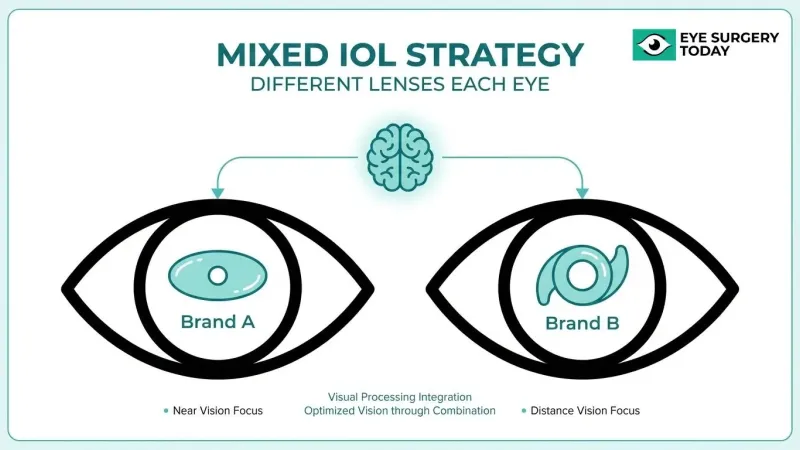
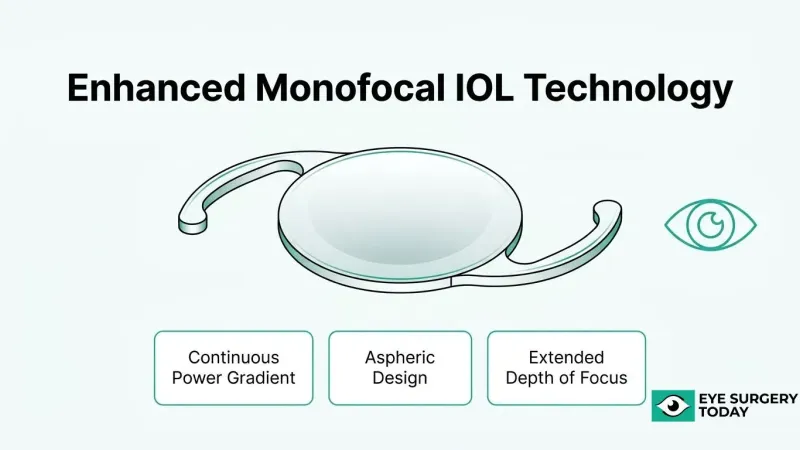
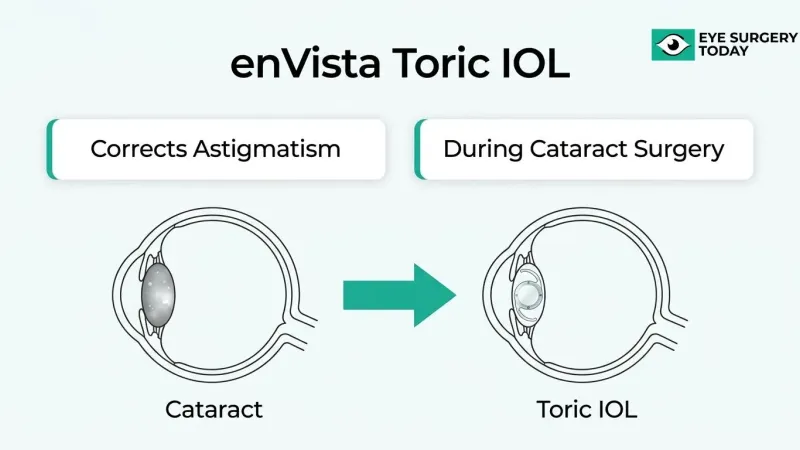
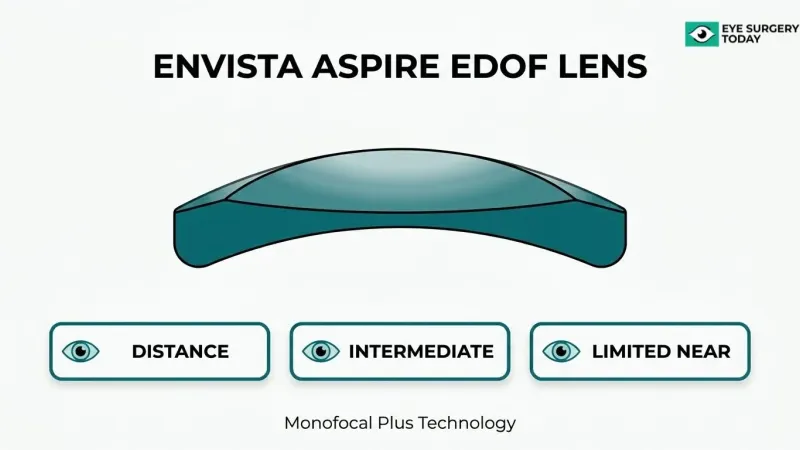
Yes, cataract surgery and advanced lens options can restore clear focus by replacing the clouded natural lens with an intraocular lens (IOL) matched to the patient’s refractive needs. According to a study published in Graefe’s Archive for Clinical and Experimental Ophthalmology, multifocal IOLs achieved significantly higher rates of spectacle independence compared to monofocal lenses after cataract surgery, though patient satisfaction can vary based on intermediate vision quality. Monofocal lenses target a single focal distance, while multifocal and extended depth-of-focus designs aim to restore a broader range of vision. As board-certified ophthalmologist Joobin Khadamy, MD, notes, accurate measurement of corneal power is essential for precise IOL calculations and successful refractive outcomes.
What Are the Key Takeaways About How the Eye Focuses Light?
The key takeaways about how the eye focuses light are that clear vision depends on the coordinated optical function of the cornea, crystalline lens, and retina working together. The cornea provides the majority of the eye’s refractive power, while the lens fine-tunes focus through accommodation. When any part of this system fails, whether through refractive error, lens clouding, or age-related stiffening, the resulting blur is often correctable through surgery. Understanding these mechanisms helps patients make more confident, informed decisions about their vision care options.