What Are Your Cataract Lens Options: Monofocal vs Multifocal vs EDOF?
Cataract lens options refer to the types of intraocular lenses (IOLs) implanted during cataract surgery to replace the eye’s clouded natural lens, with each design offering a different approach to restoring vision at specific distances.
This guide covers how each lens type works, the visual performance trade-offs between them, the role of astigmatism in lens selection, cost and insurance considerations, and how to prepare for an informed conversation with your surgeon.
Monofocal IOLs provide sharp vision at a single focal point, typically set for distance, and tend to produce the fewest visual disturbances under low-light conditions. Most patients with monofocal lenses still rely on reading glasses for near tasks, though their optical predictability may make them well suited for patients with pre-existing eye conditions or sensitivity to glare.
Multifocal IOLs use multiple corrective zones to support vision at near, intermediate, and far distances, which can reduce dependence on glasses across a broader range of activities. However, the diffractive ring design that enables this versatility is also associated with a higher likelihood of halos and glare, and the brain may require several months of neural adaptation to process the multiple focal images effectively.
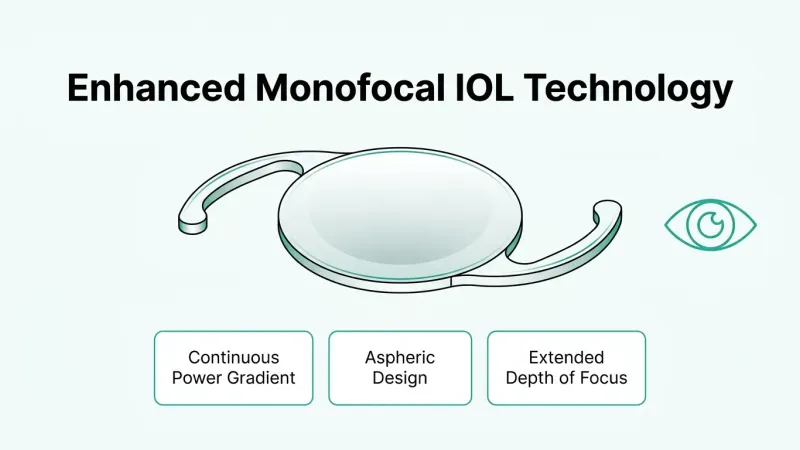
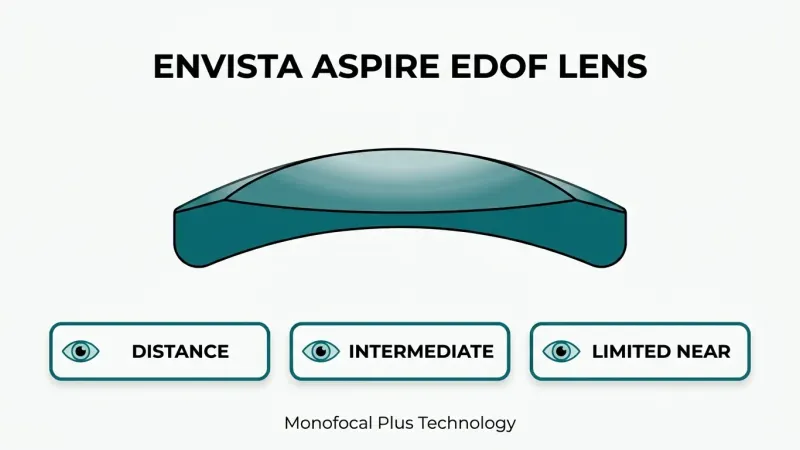
EDOF lenses stretch a single corrective zone to create a continuous range of distance and intermediate vision, producing fewer photic side effects than multifocal designs while offering more functional range than standard monofocals. Near vision at close reading distances remains their primary limitation, and reading glasses are often still needed for fine print.
Toric IOL designs can be combined with monofocal, multifocal, or EDOF platforms to correct corneal astigmatism, broadening candidacy for patients who might otherwise be left with residual blur. Medicare and most private insurers cover conventional monofocal implants as medically necessary, while premium lens upgrades typically require an additional out-of-pocket investment per eye.
What Is an Intraocular Lens and Why Does It Matter?
An intraocular lens (IOL) is an artificial lens surgically implanted inside the eye to replace the natural crystalline lens after it is removed during cataract surgery. It matters because, without a replacement lens, the eye loses its ability to focus light onto the retina, leaving vision blurred or severely impaired.
The specific IOL selected determines not just whether a patient can see clearly, but at which distances and under which lighting conditions. According to Cleveland Clinic, IOLs restore the eye’s focusing function and are a permanent, low-maintenance solution that eliminates the need for thick corrective glasses in most patients. The type chosen, whether monofocal, multifocal, or EDOF, shapes the entire visual experience after surgery.
Photic phenomena such as starbursts and dysphotopsia are reported at higher prevalence in patients with certain IOL designs, and in some cases can lead to IOL exchange if neural adaptation does not occur, according to EyeWiki. This underscores why IOL selection is one of the most consequential decisions in the cataract surgery process.
The sections below explore each major lens category, how they differ in optical design, and what those differences mean for real-world vision after surgery.
What Are the Main Types of Cataract Lens Implants?
The main types of cataract lens implants are monofocal, multifocal, extended depth of focus (EDOF), and toric lenses. The following sections explain how each design works and who it may suit best.
Monofocal Lenses
Monofocal lenses are intraocular lenses that provide sharp vision at a single fixed focal point, typically set for distance, intermediate, or near. According to StatPearls (NCBI), standard monofocal IOLs are indicated for the visual correction of aphakia after extracapsular cataract extraction. Because they correct only one distance, most patients still require reading glasses or distance glasses after surgery. For individuals who prioritize visual quality over spectacle independence, a monofocal lens is often the most straightforward and predictable choice.
Multifocal Lenses
Multifocal lenses are IOLs that contain multiple corrective zones, allowing the eye to focus at both near and far distances. According to the American Academy of Ophthalmology, these corrective zones function similarly to bifocal or trifocal eyeglasses, with some designs also covering intermediate distances. The brain selects the appropriate focal zone depending on the viewing task. This design can reduce dependence on glasses across a broader range of activities, though it does introduce a greater potential for photic side effects such as halos and glare.
Extended Depth of Focus (EDOF) Lenses
Extended depth of focus (EDOF) lenses are IOLs that use a single elongated corrective zone to provide a continuous range of vision across distance and intermediate focal points. According to the American Academy of Ophthalmology, this stretched zone differs fundamentally from the discrete focal zones used in multifocal designs. Rather than splitting light into separate focal points, EDOF lenses extend the depth of the focal range. A 2026 systematic review and meta-analysis published in Cureus found no significant clinical difference between enhanced monofocal and EDOF IOLs for distance visual acuity, suggesting EDOF lenses may appeal most to patients seeking intermediate-range improvement with fewer photic disturbances than multifocal lenses.
Toric Lenses
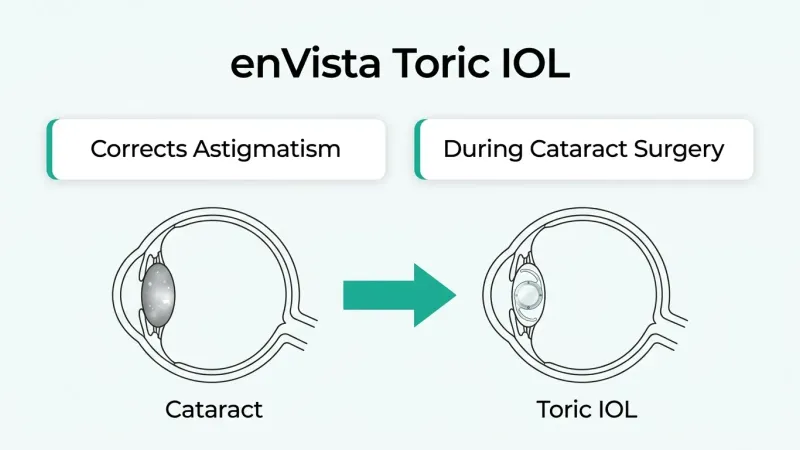
Toric lenses are IOLs with built-in astigmatism correction, and they are available in monofocal, multifocal, and EDOF designs. According to the American Academy of Ophthalmology, toric IOLs incorporate extra correction to address corneal astigmatism that would otherwise remain uncorrected after standard cataract surgery. Understanding which of these four lens types may suit a specific patient depends on factors like lifestyle, ocular health, and refractive goals.
How Do Monofocal Lenses Work for Cataract Surgery?
Monofocal lenses work by replacing the eye’s clouded natural lens with an artificial intraocular lens (IOL) set to a single fixed focal point. The following sections cover the range of vision monofocal lenses correct, which patients may benefit most, and where their limitations lie.
What Range of Vision Do Monofocal Lenses Correct?
The range of vision monofocal lenses correct is limited to one distance: near, intermediate, or far. According to StatPearls (NCBI), standard monofocal IOLs are indicated for aphakia correction after extracapsular cataract extraction, providing sharp vision at only that preset focal point. Most surgeons target distance vision, leaving patients to use reading glasses for near tasks. A 2026 meta-analysis published in the Cureus Journal of Medical Science found no significant clinical difference between enhanced monofocal and EDOF IOLs for distance acuity (mean difference: -0.01 logMAR), though multifocal IOLs deliver significantly better uncorrected near vision and higher spectacle independence overall.
Who May Benefit Most from a Monofocal Lens?
Patients who may benefit most from a monofocal lens include those with pre-existing ocular conditions, sensitivity to visual disturbances, or straightforward lifestyle needs. Halos and glare are the most common visual side effects reported after multifocal IOL surgery, according to a PMC review, making monofocal lenses a safer choice for patients who drive frequently at night or require reliable contrast sensitivity. The WHO also recognizes phacoemulsification-based IOL implantation as among the most cost-effective healthcare interventions globally, and the predictable optical performance of monofocal lenses supports that value in appropriate candidates. For patients prioritizing visual quality over spectacle independence, monofocal IOLs remain a clinically sound choice.
What Are the Potential Limitations of Monofocal Lenses?
The potential limitations of monofocal lenses center on their inability to provide vision across multiple distances. Because pseudophakia with a monofocal IOL corrects only one focal point, patients typically depend on reading glasses or bifocals for tasks outside their set range. Additionally, posterior capsule opacification (PCO) is a recognized late complication of cataract surgery, though EyeWiki notes that hydrophobic acrylic IOLs carry lower PCO rates than hydrophilic acrylic or silicone materials due to superior capsular adhesion. A refractive surprise, where postoperative vision deviates from the intended target, is also possible if biometry measurements are imprecise before surgery.
How Do Multifocal Lenses Work for Cataract Surgery?
Multifocal lenses work by dividing incoming light across multiple focal zones, allowing vision at more than one distance after cataract surgery. The sections below cover how these lenses deliver near and distance vision, who may be a suitable candidate, and what side effects to expect.
How Do Multifocal Lenses Provide Near and Distance Vision?
Multifocal IOLs provide near and distance vision by using several corrective zones built into the lens, similar in principle to bifocal or trifocal eyeglasses, according to the American Academy of Ophthalmology. Unlike monofocal lenses, which have a single focal point, each zone targets a different focal distance, and the brain selects the appropriate image for the task at hand. This neurological adjustment process, called neural adaptation, can take several months as the brain learns to process multiple simultaneous images. A Bayesian network meta-analysis published in JAMA Ophthalmology found no statistically significant differences in distance visual acuity between multifocal and monofocal IOLs, though near and intermediate performance varied by lens type. Neural adaptation is often underestimated in patient counseling, yet it is central to long-term satisfaction with multifocal IOLs.
Who May Be a Good Candidate for Multifocal Lenses?
A good candidate for multifocal lenses is typically someone who prioritizes spectacle independence for both near and distance tasks and has no significant pre-existing ocular pathology. According to Ophthalmology Management (2025), preoperative macular OCT is recommended for all premium IOL candidates to screen for subtle pathologies such as epiretinal membranes, which could compromise the final visual outcome. Conditions like advanced glaucoma or macular degeneration may disqualify a patient, as these already reduce contrast sensitivity. Lifestyle factors, including night driving frequency and the need for fine detail work, should also be assessed before proceeding.
What Visual Side Effects Can Multifocal Lenses Cause?
The visual side effects multifocal lenses can cause include halos, glare, starbursts, and dysphotopsia, all of which result from the diffractive rings splitting light across multiple focal points. According to PMC (PubMed Central), halos and glare are the most commonly reported visual impairments following multifocal IOL implantation. In some patients, photic phenomena persist and may lead to IOL exchange if neural adaptation does not occur. Patients with corneal astigmatism of 1.0D or greater may also face compounded visual disturbance unless astigmatism is addressed, as clinical guidelines from the European Society of Cataract and Refractive Surgeons recommend toric IOL consideration at that threshold. Thorough preoperative counseling on these risks is essential for realistic expectations and postoperative satisfaction.
How Do EDOF Lenses Work for Cataract Surgery?
EDOF lenses work by using a single elongated corrective zone to produce a continuous focal range, rather than splitting light into discrete focal points. The sections below cover how EDOF differs from multifocal designs, which patients may be well suited to this technology, and where its limitations lie.
How Does Extended Depth of Focus Differ from Multifocal?
Extended depth of focus differs from multifocal IOLs primarily in how each lens distributes light. Multifocal IOLs use multiple diffractive rings to create two or three distinct focal zones, requiring the brain to select between them. EDOF IOLs stretch a single focal zone across a continuous range, prioritizing distance and intermediate vision without the same degree of light splitting.
That optical difference has meaningful consequences for side effects. According to EyeWiki (American Academy of Ophthalmology), photic phenomena such as starbursts and dysphotopsia are reported at higher prevalence rates in multifocal IOL patients and can sometimes lead to IOL exchange when neural adaptation does not occur. EDOF designs tend to produce fewer of these disturbances, making them a more tolerable option for patients who are sensitive to glare or spend significant time driving at night.
Who May Benefit Most from an EDOF Lens?
Patients who may benefit most from an EDOF lens include those who prioritize quality of vision and reduced photic side effects over full spectacle independence. Strong candidates typically share several characteristics:
- Active computer users or professionals who rely on intermediate-distance tasks throughout the day.
- Night drivers concerned about halos and glare associated with multifocal designs.
- Patients with mild contrast sensitivity concerns who are not ideal multifocal candidates but still want reduced dependence on distance glasses.
- Individuals with realistic expectations who accept that reading glasses may still be needed for fine near tasks.
Patient selection remains the single most important factor in achieving a satisfying outcome with any premium IOL, and EDOF is no exception.
What Are the Potential Limitations of EDOF Lenses?
The potential limitations of EDOF lenses center on near vision and full spectacle independence. Because the elongated focal zone emphasizes distance and intermediate ranges, many EDOF patients still require reading glasses for small print or extended near tasks. Key limitations include:
- Near vision at typical reading distances (40 cm) is generally weaker than with trifocal or bifocal multifocal IOLs.
- Some degree of halos or mild glare can still occur, particularly in low-light conditions, even if at lower rates than with multifocal designs.
- Patients with significant pre-existing ocular pathologies, such as advanced glaucoma or macular degeneration, are generally not recommended for EDOF lenses, as these conditions already reduce contrast sensitivity.
Understanding these trade-offs before surgery helps patients choose the lens that best fits their daily visual demands.
How Does Vision Quality Compare Across Lens Types?
Vision quality varies meaningfully across monofocal, multifocal, and EDOF IOLs, with each lens type offering distinct trade-offs across distance, intermediate, near, and low-light performance. The sections below break down how each focal range compares.
How Does Distance Vision Compare Across Lens Options?
Distance vision compares favorably across all three lens categories, with monofocal, EDOF, and multifocal IOLs all capable of delivering strong uncorrected distance acuity. A 2026 meta-analysis published in the Cureus Journal of Medical Science found no significant clinical difference between enhanced monofocal and EDOF IOLs for distance visual acuity, with a mean difference of just -0.01 logMAR. A Bayesian network meta-analysis in JAMA Ophthalmology similarly found no statistically significant distance acuity differences between multifocal and monofocal IOLs. For patients whose primary goal is sharp distance vision, lens type matters less than other clinical factors.
How Does Intermediate Vision Compare Across Lens Options?
Intermediate vision compares most favorably for EDOF IOLs, which are specifically engineered to extend the focal range through a single elongated corrective zone. According to a meta-analysis of defocus curves published on PubMed Central, EDOF IOLs provide a superior range of intermediate vision compared to standard monofocal lenses while maintaining better contrast sensitivity than traditional multifocal designs. Monofocal lenses offer little usable intermediate vision without spectacle correction, while multifocal lenses vary by design. For patients who rely heavily on screens or mid-range tasks, EDOF represents a clinically sound choice.
How Does Near Vision Compare Across Lens Options?
Near vision compares most strongly for multifocal IOLs, which distribute light across multiple focal zones to support reading and close-up tasks without glasses. Systematic reviews published via NCBI indicate that multifocal IOLs generally result in significantly better uncorrected near vision and higher rates of spectacle independence compared to monofocal IOLs. EDOF lenses provide limited near focus, and monofocal lenses set to distance correction typically require reading glasses for near tasks. Patients who prioritize reading independence should weigh this advantage carefully against multifocal side-effect profiles.
How Do Night Vision and Glare Compare Across Lens Options?
Night vision and glare compare least favorably for multifocal IOLs, where diffractive ring technology splits incoming light and increases the likelihood of halos, starbursts, and dysphotopsia. Clinical data published in MDPI Healthcare shows that overall quality of vision is significantly higher in monofocal IOL groups compared to EDOF and bifocal groups, primarily due to fewer reported visual disturbances under low-light conditions. EDOF lenses occupy a middle ground, producing fewer photic phenomena than multifocals while offering broader coverage than standard monofocals. For patients who frequently drive at night, monofocal or carefully selected EDOF lenses tend to produce more predictable low-light outcomes.
What Role Does Astigmatism Play in Choosing a Lens?
Astigmatism plays a significant role in cataract lens selection because uncorrected corneal astigmatism can blur vision even after a successful cataract procedure. For patients with measurable astigmatism, a toric IOL may be the most appropriate option. According to ESCRS clinical guidelines, toric IOLs are recommended for any patient with corneal astigmatism of 1.0 diopters or greater to optimize uncorrected distance visual acuity.
Toric IOLs are engineered with precise meridional correction aligned to the axis of the patient’s astigmatism. Surgical accuracy during implantation is critical: research published in PMC found that every 1 degree of rotational misalignment results in a loss of approximately 3% of the lens’s astigmatic corrective power. A 10-degree rotation, therefore, eliminates roughly 30% of the correction intended. This makes precise intraoperative alignment and stable postoperative lens positioning essential to a good outcome.
Toric designs are available in both monofocal and premium (multifocal or EDOF) platforms, meaning astigmatic patients are not automatically excluded from presbyopia-correcting options. In practice, astigmatism should be evaluated and addressed proactively during lens planning, not treated as secondary to the choice between focal designs.
How Much Do Different Cataract Lenses Cost?
Cataract lens costs vary significantly by type, ranging from largely covered by insurance to several thousand dollars per eye out of pocket. The sections below cover monofocal, multifocal, and EDOF pricing, plus what Medicare and private insurance typically do and do not pay.
What May a Monofocal Lens Cost Out of Pocket?
Monofocal lens costs out of pocket are generally the lowest of all IOL types, because Medicare and most private insurance plans treat the standard monofocal as the medically necessary baseline. According to Medicare.gov, Medicare Part B covers 80% of the Medicare-approved amount for cataract surgery with a conventional monofocal IOL after the annual deductible is met. Patients with supplemental (Medigap) coverage may owe little to nothing for the lens itself, though facility fees and anesthesia costs can still apply. Reading glasses are typically still needed for near tasks after a standard monofocal implant.
What May a Multifocal Lens Cost Out of Pocket?
The multifocal lens out-of-pocket cost typically ranges from $2,000 to $4,000 per eye above what insurance covers. This premium reflects both the lens cost and the specialized pre-operative biometry and surgical planning required for accurate placement. Because insurance classifies multifocal IOLs as elective upgrades rather than medically necessary implants, patients pay the difference themselves. For both eyes, this can represent a total additional investment of $4,000 to $8,000, making it important to clarify the full fee schedule with your surgical center before deciding.
What May an EDOF Lens Cost Out of Pocket?
The EDOF lens out-of-pocket cost falls in the same general range as multifocal lenses: approximately $2,000 to $4,000 per eye above the standard insurance-covered amount. Like multifocal IOLs, EDOF lenses are classified as premium upgrades, so insurers and Medicare cover only the monofocal baseline. The remaining balance, which includes the advanced lens technology and the added precision measurement and planning it requires, is billed directly to the patient. Costs can vary by practice, geographic region, and whether a toric version of the EDOF lens is chosen.
Does Insurance or Medicare Cover Premium Lens Upgrades?
Insurance and Medicare do not cover premium lens upgrades. According to Medicare.gov, Medicare Part B covers 80% of the approved amount for cataract surgery using a conventional monofocal IOL after the annual deductible, but does not cover the additional cost of multifocal, EDOF, or toric IOL upgrades. Medicare does cover one pair of eyeglasses or one set of contact lenses after each cataract surgery; however, patients who choose a premium IOL specifically to reduce their dependence on glasses remain responsible for any remaining vision correction costs. Private insurance policies generally follow the same framework. From a patient planning perspective, understanding this coverage boundary early is one of the most practical steps in IOL decision-making, as the cost difference between lens types can be substantial.
What Risks or Complications Can Occur with Any IOL?
The risks and complications that can occur with any IOL include posterior capsule opacification, photic phenomena such as halos and glare, and toric lens rotation. These complications vary in frequency and severity depending on lens type and patient factors.
Posterior Capsule Opacification
Posterior capsule opacification (PCO) is a common late complication of cataract surgery, occurring when residual lens epithelial cells migrate and cloud the capsule behind the IOL. According to EyeWiki (American Academy of Ophthalmology), PCO rates are lower with hydrophobic acrylic IOLs than with hydrophilic acrylic or silicone materials, due to better capsular adhesion. When PCO does develop, it is typically treated with a quick in-office laser procedure called a YAG capsulotomy, which restores clarity without additional surgery.
Halos, Glare, and Photic Phenomena
Halos and glare are the most common visual impairments reported after multifocal IOL surgery, arising from diffractive rings that split light into multiple focal points, as documented in a PMC review. Photic phenomena such as starbursts and dysphotopsia occur at higher prevalence in multifocal IOL patients and can sometimes lead to IOL exchange if neural adaptation does not occur. Monofocal lenses carry a meaningfully lower risk of these disturbances, making lens type selection critical for patients who frequently drive at night.
Toric IOL Rotation and Decentration
Toric IOL rotation is a known risk that can significantly reduce the effectiveness of astigmatism correction. According to a PMC study, every 1 degree of rotation results in a loss of approximately 3% of the lens’s astigmatic corrective power. A 30-degree rotation effectively eliminates all correction. Surgical marking, modern capsular tension management, and postoperative monitoring help minimize this risk, though it remains an important consideration when discussing toric lens candidacy with a surgeon.
What Should You Ask Your Surgeon Before Choosing a Lens?
The questions you should ask your surgeon before choosing a lens cover your lifestyle priorities, ocular health status, cost expectations, and tolerance for visual side effects. Asking the right questions transforms a complex clinical decision into a clear, personalized choice.
What Questions Address Your Vision Goals and Lifestyle?
The questions that address your vision goals and lifestyle help your surgeon match an IOL to how you actually use your eyes every day. According to Ophthalmology Management, successful IOL selection requires a thorough assessment of lifestyle factors, including night driving frequency, digital device use, and professional requirements for fine detail work.
Key questions to ask your surgeon include:
- How important is reading without glasses to your daily routine?
- Do you drive frequently at night, where glare and halos may be disruptive?
- Does your work require high-contrast, fine detail vision?
- Are you comfortable wearing glasses for some tasks if it means fewer optical side effects?
Your answers directly narrow the IOL category most likely to satisfy your expectations after surgery.
What Questions Address Your Eye Health and Candidacy?
The questions that address your eye health and candidacy determine whether premium lenses are appropriate for your specific anatomy. Preoperative macular OCT is recommended for all premium IOL candidates to screen for subtle pathologies such as epiretinal membranes, which can compromise the final visual outcome of a multifocal lens.
Ask your surgeon:
- Do I have any corneal astigmatism that would require a toric IOL?
- Are there any retinal or macular conditions that rule out a multifocal or EDOF design?
- What does my biometry show about which lens power is most accurate for my eye?
- Am I at higher risk for posterior capsule opacification?
These candidacy questions are often the most clinically decisive, and patients who skip them risk choosing a lens their eye anatomy cannot support effectively.
What Questions Address Cost and Insurance Coverage?
The questions that address cost and insurance coverage clarify what you will pay out of pocket before any financial commitments are made. Premium IOL upgrades, including multifocal, EDOF, and toric designs, typically cost $2,000 to $4,000 per eye beyond what Medicare or standard insurance reimburses.
Ask your surgeon’s billing team:
- Which portion of this surgery does Medicare or my insurance cover?
- What is the exact out-of-pocket upgrade cost for the premium lens recommended for me?
- Are payment plans or financing available for the difference?
- If I need an enhancement procedure later, is that included in the quoted cost?
Understanding the cost structure upfront prevents unexpected financial surprises after your procedure is scheduled.
What Questions Address Surgical Experience with Your Recommended Lens?
The questions that address surgical experience with your recommended lens help you gauge whether your surgeon routinely implants the specific IOL being proposed. As Dr. Elizabeth Yeu, MD, notes, patient selection is critical when deciding whether to use an EDOF or multifocal IOL, and establishing a connection early can help build trust and make patients receptive to discussing their treatment options (American Academy of Ophthalmology).
Ask directly:
- How many of this specific lens have you implanted?
- What is your rate of patients who achieve spectacle independence with this design?
- What is your protocol if I experience persistent halos or glare after the procedure?
- Would you personally recommend this lens for someone with my profile?
Surgeon experience with a specific IOL platform matters as much as the lens technology itself, making these questions essential before finalizing your decision.
How Can Surgeon-Reviewed Resources Help You Choose?
Surgeon-reviewed resources help you choose by translating complex clinical evidence into clear, actionable guidance. The H3s below cover how Eye Surgery Today supports IOL decision-making and what the key takeaways from this article are.
Can Eye Surgery Today Help You Understand Your IOL Options?
Eye Surgery Today can help you understand your IOL options through surgeon-reviewed educational content designed specifically for patients navigating cataract surgery decisions. Choosing between monofocal, multifocal, and EDOF lenses is rarely straightforward, and the right resource makes that conversation with your surgeon more productive. As Dr. Elizabeth Yeu, MD, notes: “Patient selection is critical when deciding whether to use an EDOF or multifocal IOL… establishing a connection early can help build trust and make patients receptive to discussion of their treatment options.” Eye Surgery Today bridges that gap by presenting balanced, evidence-based information free from medical jargon.
What Are the Key Takeaways About Monofocal vs Multifocal vs EDOF Lenses?
The key takeaways about monofocal vs multifocal vs EDOF lenses are:
- Monofocal lenses deliver the sharpest vision at one distance with the fewest visual disturbances, making them the most predictable option.
- Multifocal lenses offer the greatest spectacle independence but carry a higher risk of halos and glare; according to a systematic review published in Nature Scientific Reports, trifocal IOLs are 32% more likely to generate a halo effect compared to other lens types.
- EDOF lenses provide a continuous range of distance and intermediate vision with better contrast sensitivity than traditional multifocals, though near vision often still requires reading glasses.
- Premium lenses (multifocal and EDOF) are generally not recommended for patients with advanced glaucoma or macular degeneration, as these conditions already reduce contrast sensitivity.
Matching the right lens to your lifestyle, ocular health, and visual priorities is the most important decision in cataract surgery.