Pre-operative anxiety before cataract surgery is a common emotional and physiological response that affects a significant proportion of patients scheduled for lens replacement. Fears related to vision loss, pain, and the procedure itself can trigger measurable stress responses in the body.
This guide covers the causes and symptoms of cataract surgery anxiety, practical mental techniques for managing pre-operative stress, understanding the surgical process, breathing and relaxation methods, when to seek medical support for severe anxiety, pre-surgery preparation mistakes to avoid, and how mindset may influence recovery outcomes.
Cataract surgery anxiety is driven by fear of the unknown, concerns about pain, and worry over potential vision loss. These fears can produce physical symptoms such as elevated heart rate, muscle tension, and hyperventilation, which may compound emotional distress.
We walk through seven evidence-supported mental tips, including deep breathing with the 4-7-8 method, positive visualization of successful outcomes, cognitive restructuring of fear-based thoughts, and open communication with your surgical team. Each technique targets a different aspect of the anxiety response.
Understanding what actually happens during the procedure, from preparation through sedation, can replace imagined worst-case scenarios with accurate expectations. Modern cataract surgery is brief, minimally invasive, and performed with carefully calibrated comfort measures.
Breathing and relaxation techniques such as diaphragmatic breathing and progressive muscle relaxation offer accessible, equipment-free tools patients can use in the waiting area on surgery day.
We also cover when anxiety warrants a conversation with your surgeon about prescription support or sedation options, and how your psychological state before surgery may influence pain perception, healing, and overall satisfaction with results.
Why Do Patients Feel Anxious Before Cataract Surgery?
Pre-surgery anxiety before cataract surgery is common and well-documented. The sections below cover the physical symptoms anxiety produces, the fear-of-the-unknown factors that drive it, and how past medical experiences can intensify pre-operative stress.
What Physical Symptoms Does Pre-Surgery Anxiety Cause?
The physical symptoms of pre-surgery anxiety include tachycardia, hypertension, hyperventilation, hyperthermia, muscle tension, and sweating, alongside psychological reactions such as acute panic attacks. According to a 2021 review published in Dove Medical Press (Obuchowska et al.), the most common source of that anxiety is fear of losing vision entirely, cited by 54 to 55% of patients, followed by fear of pain during the operation at 41%, concern over surgical outcomes at 36%, and fear of the procedure itself at 29 to 33%. These are not abstract worries; they translate directly into measurable physiological stress. Understanding which fears drive the strongest physical responses is the first step in addressing them effectively before surgery day.
How Does Fear of the Unknown Contribute to Cataract Surgery Anxiety?
Fear of the unknown contributes to cataract surgery anxiety by leaving patients without a mental framework for what will happen, making imagined scenarios feel more threatening than the actual procedure. According to a 2021 study by Obuchowska et al. published via the National Institutes of Health, approximately 33% of patients report fear and 32% experience increased emotional tension prior to first-eye cataract surgery, with anxiety driven primarily by fear of the surgery itself, fear of pain, and fear of vision loss.
Research indicates that preoperative information combined with anxiety management techniques, including positive imagery, may reduce patient anxiety during the perioperative period of cataract surgery. Importantly, preoperative anxiety level has been identified as the only significant predictor of intraoperative pain, meaning that unaddressed fear of the unknown carries real clinical consequences.
Can Past Negative Medical Experiences Increase Pre-Operative Stress?
Past negative medical experiences can increase pre-operative stress by activating conditioned anxiety responses, where prior pain, complications, or poor communication primes the nervous system to anticipate similar outcomes. Patients who have undergone difficult procedures may enter the pre-surgical period with elevated baseline anxiety, which compounds the situational stress that cataract surgery naturally produces. High preoperative anxiety has been linked to adverse outcomes, including greater post-operative pain and poorer sleep quality, making it worth raising any prior negative experiences directly with your surgical team before the procedure date.
What Are 7 Mental Tips to Stay Calm Before Cataract Surgery?
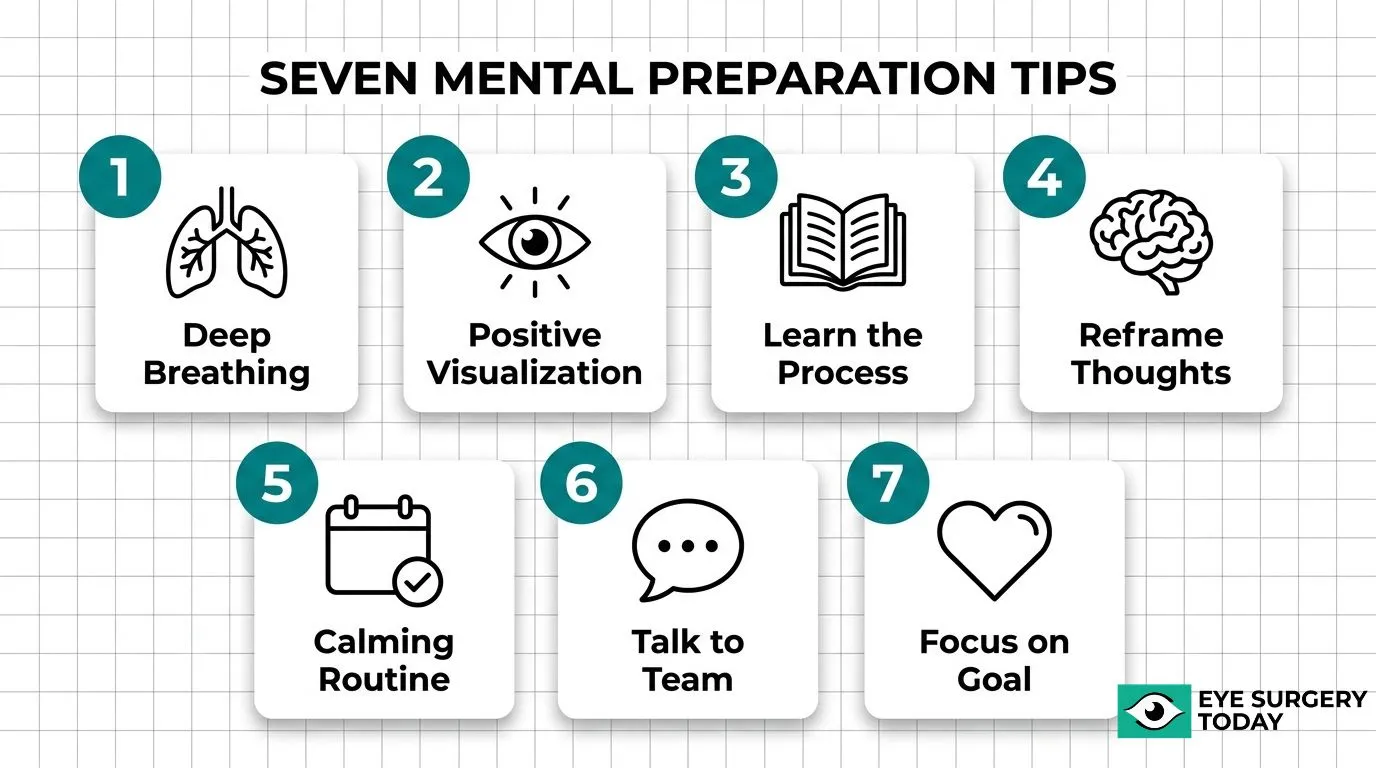
The 7 mental tips to stay calm before cataract surgery are: deep breathing, positive visualization, patient education, cognitive restructuring, a calming pre-surgery routine, open communication with your surgical team, and focusing on your motivating reason for surgery. Most surgeons do not recommend self-administering sedatives beforehand, as doing so may affect consciousness, mental clarity, and reaction time.
1. Practice Deep Breathing and Controlled Relaxation
Deep breathing is one of the most accessible tools for managing pre-surgery anxiety. The 4-7-8 technique, in particular, may help reduce anxiety levels in clinical settings. According to a 2023 study published in Obesity Surgery (Aktaş & İlgin), the 4-7-8 breathing method was beneficial in reducing anxiety in patients, and deep breathing exercises were found to be effective in improving quality of life. To practice: inhale for 4 counts, hold for 7, then exhale slowly for 8. Repeating this cycle several times before surgery can shift your nervous system into a calmer state.
2. Use Positive Visualization of Successful Outcomes
Positive visualization is a mental technique where you picture your surgery going smoothly and your vision improving afterward. Research published in the Journal of Anesthesia, Analgesia and Critical Care (Lanini et al., 2022) found that psychological interventions may contribute to improved surgical outcomes through a positive influence on patients’ metabolic surgical stress response. Patients who combined information, relaxation, and positive imagery were calmer and more cooperative during cataract procedures. Spending a few minutes each day mentally rehearsing a successful outcome is a practical, evidence-supported strategy.
3. Educate Yourself About What Happens During the Procedure
Patient education reduces anxiety by replacing uncertainty with accurate expectations. Research from Patient Education and Counseling (Kekecs et al., 2014) found that providing information about the procedure, the surgical experience, and potential risks decreased anxiety both immediately after surgery and one month later. Understanding that cataract surgery typically involves local anesthesia, a small incision, and removal of the clouded lens removes much of the fear-of-the-unknown element that drives preoperative stress. Surgeon-reviewed educational resources can make this preparation structured and reliable.
4. Reframe Negative Thoughts with Cognitive Restructuring
Cognitive restructuring is a technique for identifying and replacing fear-based thoughts with more accurate, balanced ones. Instead of thinking “something will go wrong,” you redirect toward evidence-based reasoning: the procedure is routine, widely performed, and highly refined. A 2025 study (Budiman et al.) published in ejournalajipati.or.id found that Cognitive Behavioral Therapy in a group format was proven to be an effective intervention for reducing preoperative anxiety, primarily through cognitive restructuring. Even informal versions of this technique, such as writing down your fear and countering it with a fact, can interrupt anxiety cycles before surgery.
5. Establish a Calming Pre-Surgery Routine the Night Before
A consistent, calming routine the night before surgery can lower baseline anxiety going into the procedure. Activities such as light stretching, avoiding stimulating media, preparing your post-surgery items in advance, and going to bed at a regular time all support a lower-stress morning. Research published in ScienceDirect (Guan et al., 2026) found that a structured, simulated surgical scenario intervention significantly reduced preoperative anxiety in older adult patients. Routine creates predictability, and predictability reduces the feeling of being out of control.
6. Communicate Your Fears Openly with Your Surgical Team
Communicating your fears openly with your surgical team is one of the most effective ways to reduce preoperative anxiety. Surgeons and nurses are accustomed to anxious patients and can explain exactly what to expect, adjust their approach, and address specific concerns such as movement, discomfort, or visual sensations during the procedure. Discussing your worries before the day of surgery also allows the team to explore whether any supplemental anxiety support is appropriate for your case. Silence tends to amplify fear; honest conversation reduces it.
7. Focus on Your Motivating Reason for Choosing Surgery
Focusing on your motivating reason for choosing surgery grounds your mindset in purpose rather than fear. Most patients pursue cataract surgery because their vision is affecting daily life, whether that is driving, reading, recognizing faces, or regaining independence. Keeping that specific goal visible, such as writing it down or telling a loved one, provides an anchor when anxiety rises. Research from the Journal of Anesthesia, Analgesia and Critical Care (Lanini et al., 2022) indicates that psychological interventions may improve surgical outcomes through their positive influence on the metabolic stress response, suggesting that purposeful mindset is more than motivational: it may be physiologically beneficial.
How Does Understanding the Cataract Surgery Process Help Reduce Fear?
Understanding the cataract surgery process helps reduce fear by replacing uncertainty with accurate expectations. The sections below cover what happens in the minutes before surgery, how long the procedure takes, and what sedation feels like.
What Happens During the Minutes Before the Procedure Begins?
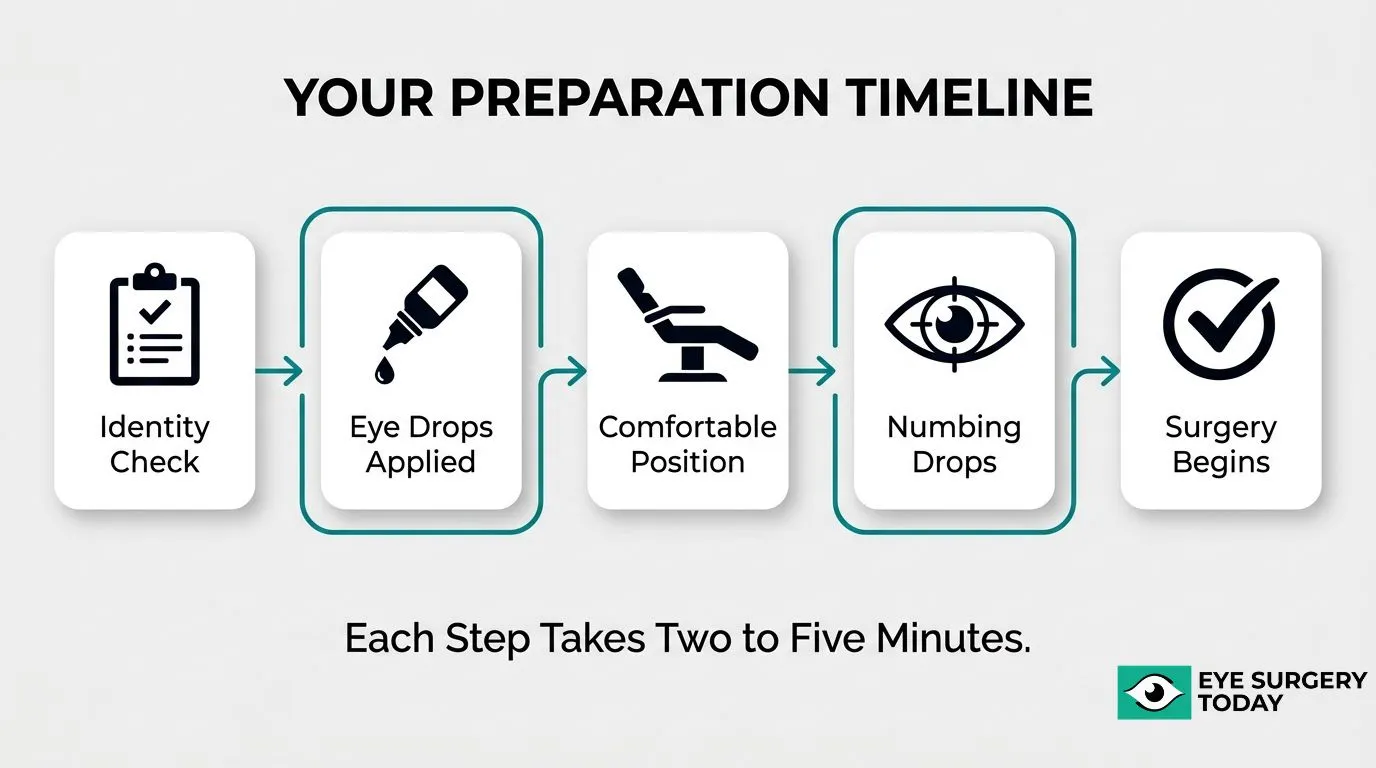
The minutes before cataract surgery begin with a structured preparation sequence designed to keep you comfortable and informed. Staff will confirm your identity, review your medical history, and administer eye drops to dilate your pupil. You will be positioned on a reclining chair or surgical bed, and a sterile drape will be placed over your face with an opening for the eye being treated. Topical anesthetic drops numb the eye so you will not feel pain. The surgical team will explain each step as it happens, which keeps most patients calm and cooperative throughout.
How Long Does Cataract Surgery Actually Take?
Cataract surgery typically takes between 10 and 20 minutes per eye in most routine cases. Advances in technique have made the process considerably faster and less demanding than many patients expect. According to a 2023 report by Dr. Inder Paul Singh, MD, in the American Academy of Ophthalmology, innovations in phacoemulsification and intraocular lens (IOL) technology have resulted in safer, less invasive procedures that no longer require a hospital setting in many cases. The entire visit, including preparation and brief recovery, generally lasts one to two hours.
What Does Sedation Feel Like During Cataract Surgery?
Sedation during cataract surgery feels mild for most patients, ranging from a calm, relaxed state to light drowsiness depending on the method used. Many patients fear moving their eye or head, coughing, or being unable to cooperate, but sedation is specifically calibrated to prevent this. Oral diazepam (Valium) is an option for routine cases, often without the need for IV sedation. According to a 2023 American Academy of Ophthalmology report, Dr. Kendall E. Donaldson, MD, MS, raised an important question about whether patients are being oversedated unnecessarily, reflecting a broader clinical shift toward lighter, more targeted sedation protocols. Most patients report remembering little discomfort from the experience itself.
What Breathing and Relaxation Techniques Work Best Before Eye Surgery?
The breathing and relaxation techniques that work best before eye surgery include diaphragmatic breathing, progressive muscle relaxation, and the 4-7-8 breathing method. Each targets the physiological stress response in a different way, giving patients practical tools to use on surgery day.
How Does Diaphragmatic Breathing Lower Pre-Operative Anxiety?
Diaphragmatic breathing lowers pre-operative anxiety by activating the parasympathetic nervous system, which counteracts the stress-driven physiological responses that surgical anticipation can trigger. Pre-operative anxiety is associated with physical symptoms such as tachycardia, hypertension, hyperventilation, and muscle tension, according to a 2021 NIH review (Obuchowska et al.). Slow, deep breaths drawn from the diaphragm rather than the chest reverse this pattern by slowing the heart rate and reducing muscle tension. Practicing this technique in the waiting area before cataract surgery requires no equipment and can be started immediately, making it one of the most accessible anxiety management tools available to patients.
Can Progressive Muscle Relaxation Help on Surgery Day?
Progressive muscle relaxation can help on surgery day by systematically releasing physical tension stored in major muscle groups, which is a direct manifestation of surgical anxiety. The technique involves sequentially tensing and then releasing muscle groups throughout the body, from the feet upward, producing a measurable reduction in physical tension. Because pre-operative anxiety commonly presents as muscle tension and hyperventilation, addressing the muscular component directly complements other breathing strategies. For patients arriving at a surgical center already tense, spending five to ten minutes on progressive muscle relaxation in a quiet waiting area can meaningfully reduce the physical intensity of pre-operative stress.
How Does the 4-7-8 Breathing Method Calm Surgical Nerves?
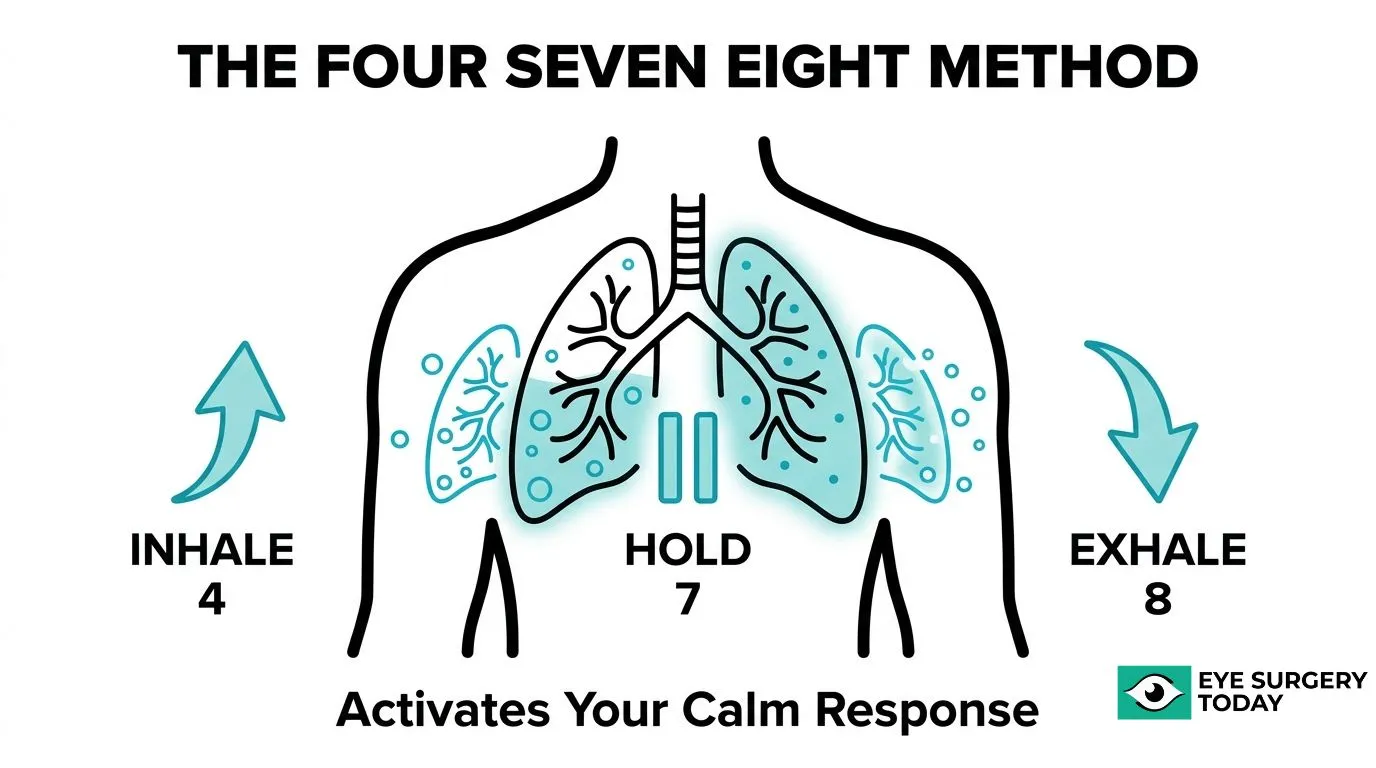
The 4-7-8 breathing method calms surgical nerves by using a structured breath-hold pattern: inhale for four counts, hold for seven, and exhale slowly for eight. A 2023 clinical study published in Obesity Surgery (Aktaş and Ilgin) found the 4-7-8 technique beneficial in reducing patient anxiety levels in clinical practice and effective in improving quality of life. The extended exhale phase is key; it lengthens the outbreath relative to the inbreath, which is consistently associated with parasympathetic activation. Patients can practice this method at home in the days before surgery to build familiarity, so the technique feels automatic when nerves are highest on the day of the procedure.
When Should You Talk to Your Doctor About Cataract Surgery Anxiety?
You should talk to your doctor about cataract surgery anxiety when self-management strategies are not enough to keep fear under control. The following sections cover what your surgeon can prescribe for severe anxiety and how to approach sedation conversations before your procedure.
What Can Your Surgeon Prescribe to Help With Severe Anxiety?
What your surgeon can prescribe to help with severe anxiety depends on your medical history and the level of sedation your procedure requires. Most surgeons do not recommend taking sedatives independently before surgery, as doing so may affect consciousness, mental clarity, and reaction time. If anxiety is significant, your care team can evaluate prescription options and administer medication in a controlled clinical setting where your response can be monitored safely. Raising this concern early, ideally at your preoperative appointment, gives your surgical team time to plan the most appropriate support.
How Can You Discuss Sedation Options Before Your Procedure?
Sedation options before your procedure are best discussed during your preoperative consultation, when your surgeon can match the sedation level to your clinical needs. According to a 2014 review published in CRS Today, common medications used for sedation in ophthalmic procedures fall into three categories: benzodiazepines such as diazepam and midazolam, opioids, and propofol. Not every patient requires the same approach, so being honest about your anxiety level helps your team select the most targeted and appropriate option.
What Should You Avoid Doing the Night Before Cataract Surgery?
The things you should avoid doing the night before cataract surgery include consuming alcohol, taking unapproved medications, eating or drinking after your surgeon’s cutoff time, and engaging in activities that disrupt sleep or elevate stress.
- Drinking alcohol: Alcohol can interfere with sedation, increase bleeding risk, and impair your cooperation during the procedure.
- Taking self-prescribed sedatives: According to a 2021 review published by Dove Medical Press (Obuchowska et al.), most surgeons do not recommend taking sedatives prior to cataract surgery, as they may affect consciousness, mental clarity, and reaction time.
- Eating or drinking past the instructed cutoff: Your surgical team will provide specific fasting instructions; ignoring them may delay or cancel your procedure.
- Staying up late or using screens excessively: Poor sleep heightens anxiety and physical stress responses the morning of surgery.
- Ruminating on worst-case outcomes: Dwelling on fear-based thoughts the night before can compound pre-operative anxiety, which research has linked to increased discomfort during surgery.
- Skipping your surgeon’s pre-op instructions: Failing to follow preparation guidelines, such as applying prescribed eye drops, puts your safety at risk.
Following your surgeon’s pre-operative checklist is the single most effective action you can take the night before cataract surgery.
How Does Mindset Affect Cataract Surgery Recovery Outcomes?
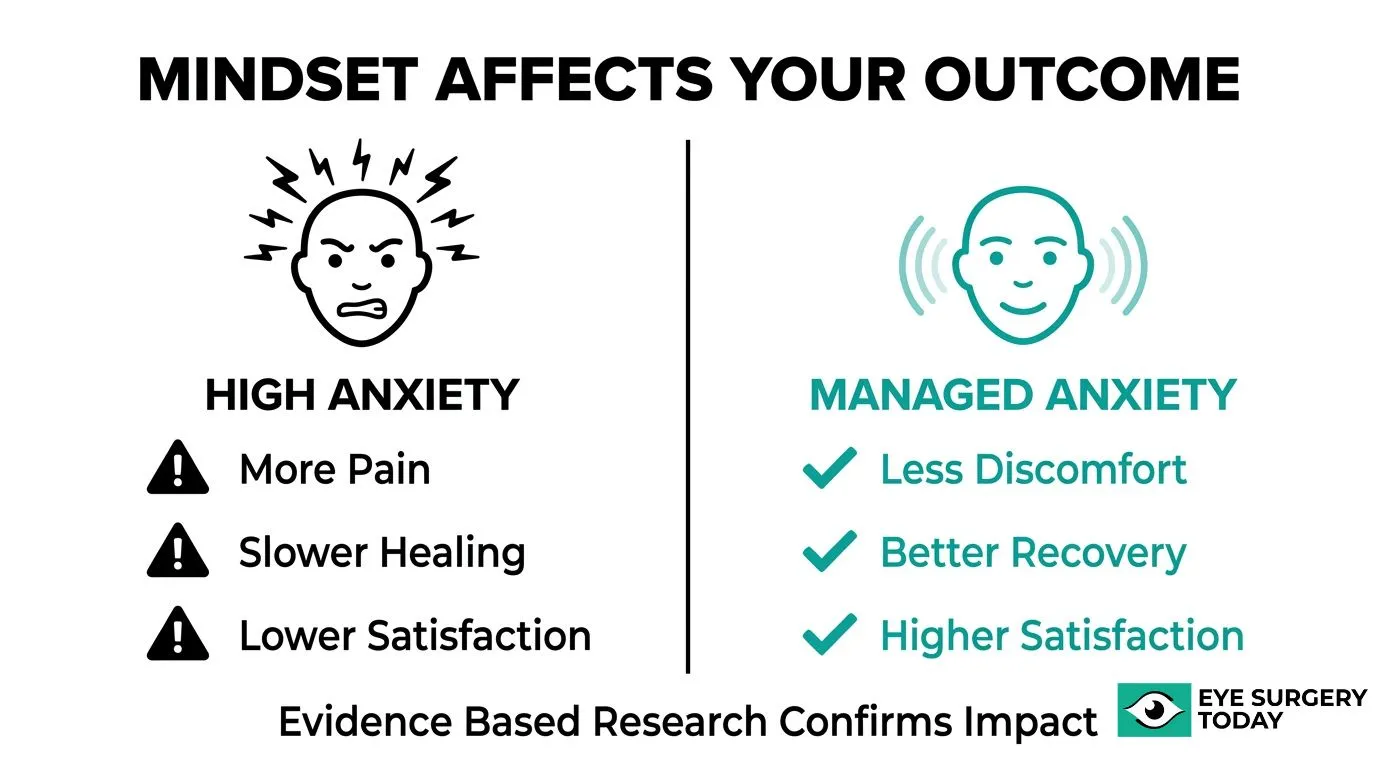
Mindset affects cataract surgery recovery outcomes in measurable ways, influencing pain perception, healing, and overall satisfaction. The research below covers how anxiety raises surgical risk and how psychological interventions may improve post-operative results.
Does Anxiety Affect Cataract Surgery Outcomes?
Yes, anxiety does affect cataract surgery outcomes, and the evidence is clinically significant. According to a 2022 review published in BMJ Open (Bedaso et al.), high levels of preoperative anxiety are associated with adverse surgical outcomes, including severe post-operative pain, increased morbidity, and poorer sleep quality. Notably, preoperative anxiety level may be the only significant predictor of intraoperative pain during cataract surgery, according to research published by Dove Medical Press (Obuchowska et al., 2021). Patients with higher anxiety may also experience delayed healing and reduced satisfaction with their outcomes.
From a clinical standpoint, anxiety is not simply an emotional inconvenience before surgery. It directly shapes the physiological environment in which healing occurs, making pre-operative mental preparation a genuine part of surgical readiness.
Can a Positive Mindset Improve Post-Operative Results?
A positive mindset can improve post-operative results by moderating the body’s stress response during and after surgery. A 2022 study published in the Journal of Anesthesia, Analgesia and Critical Care (Lanini et al.) found that psychological interventions may contribute to improved surgical outcomes through a positive influence on patients’ metabolic surgical stress response. Calmer patients tend to cooperate better during the procedure and report greater comfort throughout recovery.
Prioritizing psychological preparation alongside physical readiness is, in practice, one of the most underutilized strategies available to cataract surgery patients before their procedure.
How Can Surgeon-Reviewed Patient Education Help You Feel Prepared for Cataract Surgery?
Surgeon-reviewed patient education helps you feel prepared for cataract surgery by replacing uncertainty with clear, clinically grounded information about the procedure, risks, and recovery. The H3s below cover how Eye Surgery Today’s expert resources set expectations and the key takeaways for staying calm.
Can Eye Surgery Today’s Expert Resources Help You Understand What to Expect?
Yes, Eye Surgery Today’s expert resources can help you understand what to expect before, during, and after cataract surgery. The platform provides surgeon-reviewed educational articles, guides, and videos designed to translate complex surgical information into clear, accessible language for patients.
According to a study published in Patient Education and Counseling (Kekecs et al., 2014), providing information on the procedure, the experience of undergoing surgery, and potential risks decreased anxiety immediately after the operation and one month after the procedure. Patients who received structured information combined with relaxation and positive imagery were calmer and more cooperative during surgery.
For patients who feel uncertain, accessing reliable educational content before their appointment can meaningfully reduce fear rooted in the unknown.
What Are the Key Takeaways About Staying Calm Before Cataract Surgery?
The key takeaways about staying calm before cataract surgery center on preparation, mindset, and communication. Yes, it is completely normal to feel nervous before cataract surgery; research consistently shows a significant proportion of patients experience pre-operative anxiety. Calming your nerves before eye surgery involves several practical strategies, such as controlled breathing, positive visualization, and open conversations with your surgical team.
The most actionable lessons from this article include:
- Educate yourself early: Surgeon-reviewed resources reduce fear by replacing unknowns with facts.
- Use breathing techniques: Structured methods like diaphragmatic breathing may help lower anxiety on surgery day.
- Reframe negative thoughts: Cognitive restructuring redirects worry toward realistic, positive expectations.
- Communicate openly: Sharing concerns with your surgical team allows them to tailor your comfort and sedation plan.
- Focus on your motivation: Keeping your reason for choosing surgery in view supports emotional resilience throughout the process.
Eye Surgery Today’s surgeon-reviewed resources support each of these steps, giving patients the clarity and confidence they need to move forward.