Cataract surgery with iStent, Hydrus, or canaloplasty is a combined procedure that removes the clouded natural lens while simultaneously addressing glaucoma through a minimally invasive glaucoma surgery (MIGS) device or technique. Each option targets the eye’s natural drainage system to lower intraocular pressure (IOP) and may reduce dependence on daily glaucoma drops.
This guide covers how each MIGS approach works, how the three options compare in clinical outcomes, who may be a strong candidate, what to expect throughout recovery, and how insurance typically applies.
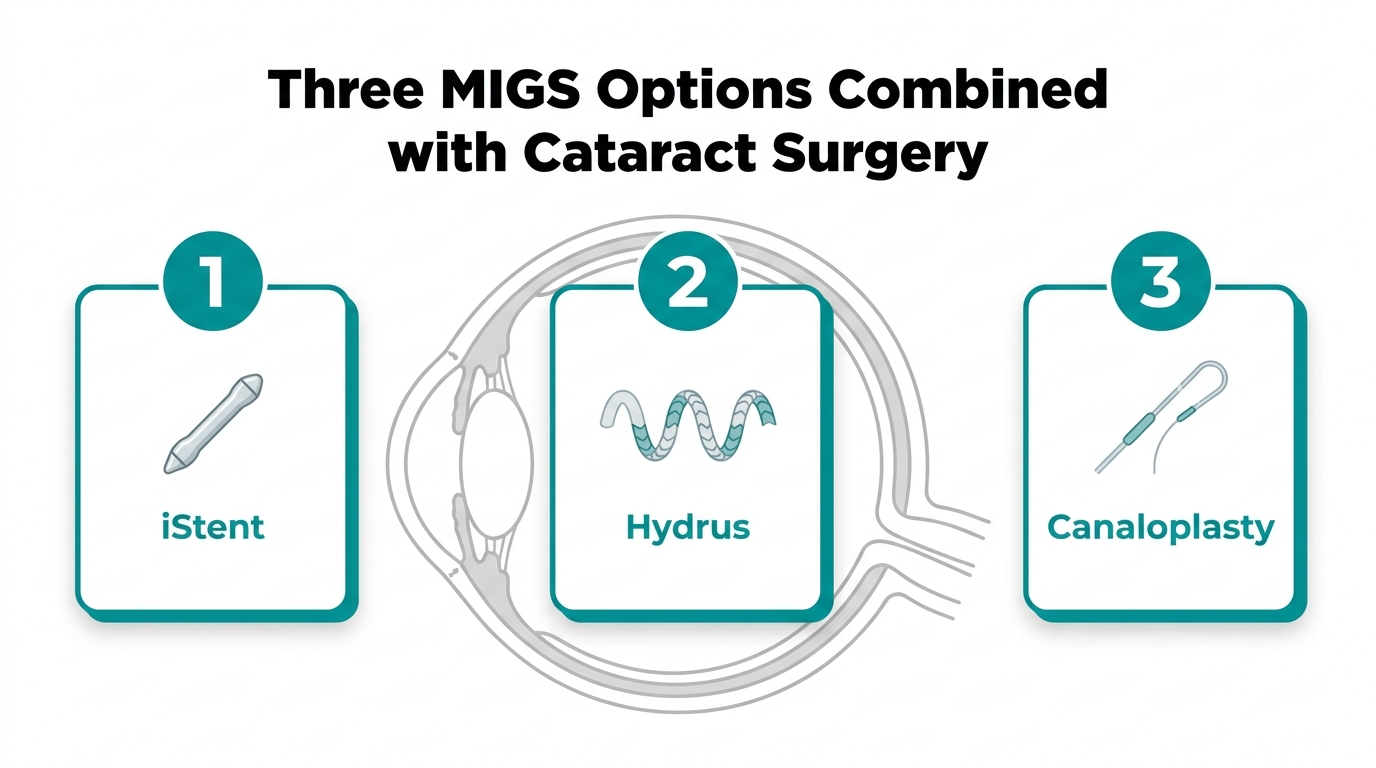
The iStent inject W is a titanium stent that bypasses the trabecular meshwork into Schlemm’s canal, while the Hydrus Microstent is a nitinol scaffold that dilates approximately 90 degrees of that canal. Ab interno canaloplasty (ABiC) uses a microcatheter to viscodilate the full 360 degrees of Schlemm’s canal without leaving a permanent implant. Each mechanism produces different IOP and medication reduction profiles.
Clinical data suggest the Hydrus Microstent may offer stronger IOP reduction in some comparisons and higher medication-free rates than cataract surgery alone, though some evidence indicates iStent may perform slightly better in specific patient populations. Canaloplasty has shown sustained IOP reductions maintained over 5 years, with the added distinction of leaving no device behind.
Candidacy for combined surgery generally applies to adults with mild to moderate open-angle glaucoma who are already planning cataract removal. Coverage varies by payer, and pre-authorization is an important step before scheduling. Recovery closely mirrors standard cataract surgery, with most patients noticing visual improvement within the first several days.
Why Would a Surgeon Combine Glaucoma Treatment with Cataract Surgery?
A surgeon combines glaucoma treatment with cataract surgery to reduce surgical burden, lower eye pressure, and decrease a patient’s dependence on daily glaucoma drops, all within a single procedure. The sections below cover the clinical rationale and the patient profile most likely to benefit.
What Is the Clinical Rationale for Combining These Procedures?
The clinical rationale for combining glaucoma treatment with cataract surgery centers on efficiency and the natural IOP-lowering effect of cataract removal itself. Phacoemulsification, the standard technique for removing a cataract, independently lowers intraocular pressure to some degree. Adding a MIGS device during the same incision amplifies that effect without a separate operation or recovery period. According to CRSToday, combining both procedures in one session reduces surgical burden, improves quality of life by reducing drop dependence, and leverages the IOP-lowering effect of phacoemulsification. For patients already scheduled for cataract surgery, this represents a meaningful opportunity to address two conditions simultaneously.
Which Patients Are Typically Considered for Combined Surgery?
Combined cataract and glaucoma surgery is typically considered for adult patients with mild to moderate primary open-angle glaucoma (POAG) who also have a visually significant cataract requiring removal. These patients tend to be on one or more daily glaucoma eye drops and may benefit from reduced medication burden after surgery. Patients with advanced glaucoma, significant angle abnormalities, or prior filtration surgery may require a different surgical approach and are generally not ideal candidates for MIGS in this context.
What Is MIGS and How Does It Relate to Cataract Surgery?
MIGS is a category of glaucoma procedures defined by an ab interno surgical approach, minimal trauma to ocular tissue, moderate efficacy, an excellent safety profile, and rapid recovery, according to the American Academy of Ophthalmology. When a patient needs cataract surgery and also has glaucoma, MIGS procedures can be performed during the same operative session, addressing both conditions simultaneously.
How Does the iStent Work During Cataract Surgery?
The iStent inject W is a heparin-coated, non-ferromagnetic titanium stent that restores natural aqueous outflow by creating bypass pathways through the trabecular meshwork into Schlemm’s canal. The following sections cover what happens to eye pressure after implantation, how many glaucoma medications iStent may help reduce, and what risks patients should understand.
What Happens to Eye Pressure After iStent Implantation?
Eye pressure after iStent implantation may be reduced meaningfully when combined with cataract surgery. According to a retrospective comparative chart review published in Graefe’s Archive for Clinical and Experimental Ophthalmology, combined cataract surgery with iStent inject W implantation led to a median IOP reduction of 4 mmHg at 3, 6, and 12 months, which was statistically significantly greater than cataract surgery alone. This degree of reduction can be clinically relevant for patients with mild to moderate open-angle glaucoma whose IOP is only partially controlled on medications.
How Many Glaucoma Medications May iStent Help Reduce?
The number of glaucoma medications iStent may help reduce varies, but real-world data suggests a meaningful drop in medication burden over time. In a 2-year post-market surveillance study in Japan, iStent inject W combined with phacoemulsification resulted in an estimated reduction of 1.9 medications at 24 months, published in Clinical Ophthalmology. This aligns with the broader “early recognition, early intervention” paradigm for MIGS, which holds that earlier surgical management may reduce both IOP and long-term topical medication dependence. It is worth noting that a real-world study found the Hydrus Microstent demonstrated superior medication reduction compared to iStent inject W at 12 months.
What Are the Possible Considerations of iStent During Cataract Surgery?
The possible risks of iStent during cataract surgery are generally consistent with the broader MIGS category, which is characterized by minimal ocular tissue trauma, an excellent safety profile, and rapid recovery. Potential concerns include stent malpositioning, transient IOP spikes, intraoperative bleeding within the trabecular meshwork, and, in rare cases, loss of best-corrected visual acuity. Because the procedure uses an ab interno approach, it avoids the conjunctival disruption associated with traditional glaucoma surgeries, which generally contributes to its favorable recovery profile.
How Does the Hydrus Microstent Work During Cataract Surgery?
The Hydrus Microstent works by acting as a permanent intracanalicular scaffold inside the eye’s natural drainage system. The H3 sections below cover how it affects eye pressure, medication use, and potential risks.
What Happens to Eye Pressure After Hydrus Implantation?
Eye pressure after Hydrus implantation typically decreases, as the device directly addresses the primary site of aqueous outflow resistance. The Hydrus Microstent is an 8mm flexible nitinol scaffold that bypasses the trabecular meshwork and dilates approximately 90 degrees of Schlemm’s canal, maintaining long-term patency at that drainage channel. According to the HORIZON trial, published in Ophthalmology, 66% of eyes were medication-free at 5 years when Hydrus was combined with cataract surgery, compared to 46% with cataract surgery alone. For patients with mild to moderate open-angle glaucoma, lowering IOP may help protect remaining vision and reduce the risk of further glaucomatous damage.
How Many Glaucoma Medications May Hydrus Help Reduce?
The Hydrus Microstent may help reduce glaucoma medications burden, with HORIZON trial data showing that 66% of eyes were medication-free at 5 years when Hydrus was combined with cataract surgery. The 5-year HORIZON trial data showed that the majority of Hydrus-plus-cataract patients maintained medication independence compared to those receiving cataract surgery alone. Reducing topical drops may help with adherence and quality of life, which is often an underappreciated benefit of early MIGS intervention.
What Are the Possible Risks of Hydrus During Cataract Surgery?
The possible risks of Hydrus during cataract surgery include device malposition, stent obstruction, and transient IOP elevation in the early postoperative period. The Hydrus received FDA approval in August 2018, with its labeling referencing 5-year pivotal HORIZON study safety data, supporting its favorable risk profile. Additional risks may include anterior chamber inflammation and peripheral anterior synechiae. Because Hydrus is a permanent implant, patients should discuss individual candidacy and risk factors with their surgeon before proceeding.
How Does Canaloplasty Work During Cataract Surgery?
Canaloplasty works by using a microcatheter to viscodilate the entire 360 degrees of Schlemm’s canal, restoring natural aqueous outflow without leaving a permanent implant. The sections below cover its pressure outcomes, medication reduction potential, and associated risks.
What Happens to Eye Pressure After Canaloplasty?
Eye pressure after canaloplasty may be reduced significantly over the long term. According to a report by Ophthalmology Advisor, intraocular pressure in the ab interno canaloplasty (ABiC) group lessened by 45% to 13.2 ± 1.1 mmHg at 3 years, with results maintained at 5 years at 13.4 ± 1.5 mmHg. This level of sustained reduction may be clinically meaningful, particularly for patients with mild to moderate open-angle glaucoma who prefer an approach without a permanent implant.
How Many Glaucoma Medications May Canaloplasty Help Reduce?
The number of glaucoma medications canaloplasty may help reduce varies by patient, but long-term data suggest a meaningful decrease in medication burden. The same Ophthalmology Advisor report tracking ABiC outcomes found that pressure targets were maintained for 5 years. For patients managing multiple daily drops, this reduction can meaningfully improve quality of life and treatment adherence.
What Are the Possible Risks of Canaloplasty During Cataract Surgery?
The possible risks of canaloplasty during cataract surgery are generally consistent with the MIGS safety profile, which includes minimal trauma to ocular tissue. Potential concerns include transient IOP spikes, incomplete canal dilation, and minor bleeding within the canal. Because the procedure leaves no permanent implant, risks associated with device migration or long-term implant-related complications are avoided. Overall, the absence of a permanent device may be an important consideration available when combined with phacoemulsification.
How Do iStent, Hydrus, and Canaloplasty Compare to Each Other?
All three procedures can lower eye pressure and reduce glaucoma medication dependence, but they differ in mechanism, magnitude of effect, and risk profile. The sections below compare IOP reduction, medication burden, and safety across iStent, Hydrus, and canaloplasty.
How Does Eye Pressure Reduction Compare Across All Three?
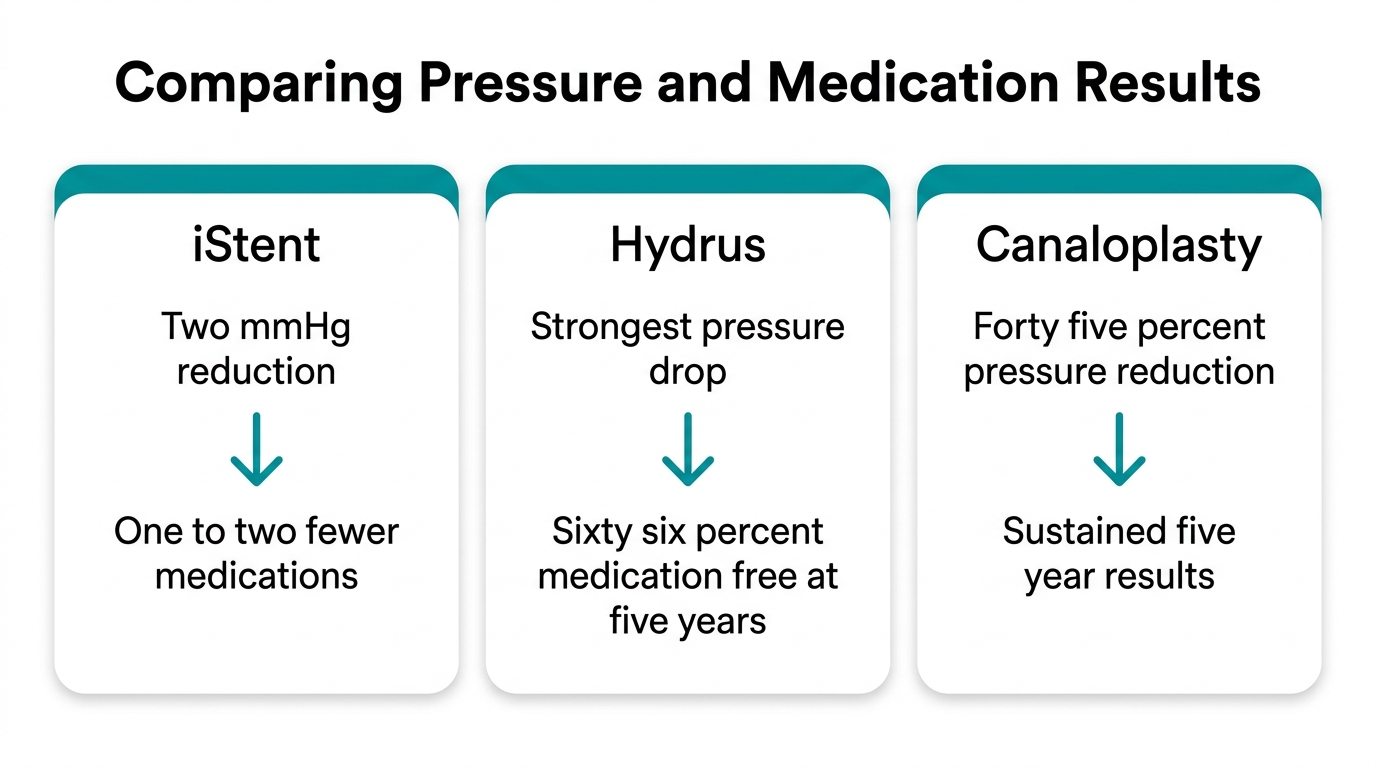
Eye pressure reduction varies meaningfully across iStent, Hydrus, and canaloplasty. A 2-year post-market surveillance study published in Clinical Ophthalmology found that iStent inject W combined with phacoemulsification reduced mean IOP by approximately 2.0 mmHg at 24 months. The Hydrus Microstent has shown stronger IOP-lowering in several comparisons; a real-world study published in Diagnostics demonstrated superior IOP reduction for Hydrus over iStent inject W at 12 months. Canaloplasty has also shown sustained pressure reduction, with one long-term report indicating a 45% IOP reduction to a mean of 13.2 mmHg at 3 years, maintained at 5 years.
How Does Medication Reduction Compare Across All Three?
Medication reduction across iStent, Hydrus, and canaloplasty follows a broadly similar pattern, though the magnitude differs. The iStent inject W reduced glaucoma medications by an estimated 1.9 drops at 24 months in a Japanese post-market study published in Clinical Ophthalmology. The Hydrus Microstent demonstrated the strongest medication-free outcomes in long-term data: the HORIZON trial, published in Ophthalmology, found 66% of Hydrus-treated eyes were medication-free at 5 years, compared to 46% with cataract surgery alone. Comparable long-term medication data for canaloplasty remain more limited in head-to-head trials.
How Do the Risk Profiles Differ Among the Three Procedures?
The risk profiles of iStent, Hydrus, and canaloplasty share a broadly favorable safety profile consistent with MIGS as a category, though each has procedure-specific considerations. The iStent and Hydrus both leave a permanent implant inside Schlemm’s canal, carrying a small risk of device malposition or stent occlusion over time. Canaloplasty uses a microcatheter to viscodilate the canal without leaving a permanent implant, which eliminates implant-related risks but requires successful catheterization of the full 360 degrees of the canal. A study presented at AGS 2025 also noted that iStent may perform slightly better in pseudophakic eyes and SLT-naive patients, suggesting that individual anatomy and surgical history can influence outcomes across all three options.
Who Is a Good Candidate for Combined Cataract and MIGS Surgery?
Good candidates for combined cataract and MIGS surgery are typically adults with mild to moderate open-angle glaucoma who are already planning cataract removal. The H3s below cover candidacy considerations specific to iStent, Hydrus, and canaloplasty.
Who May Be a Good Candidate for iStent with Cataract Surgery?
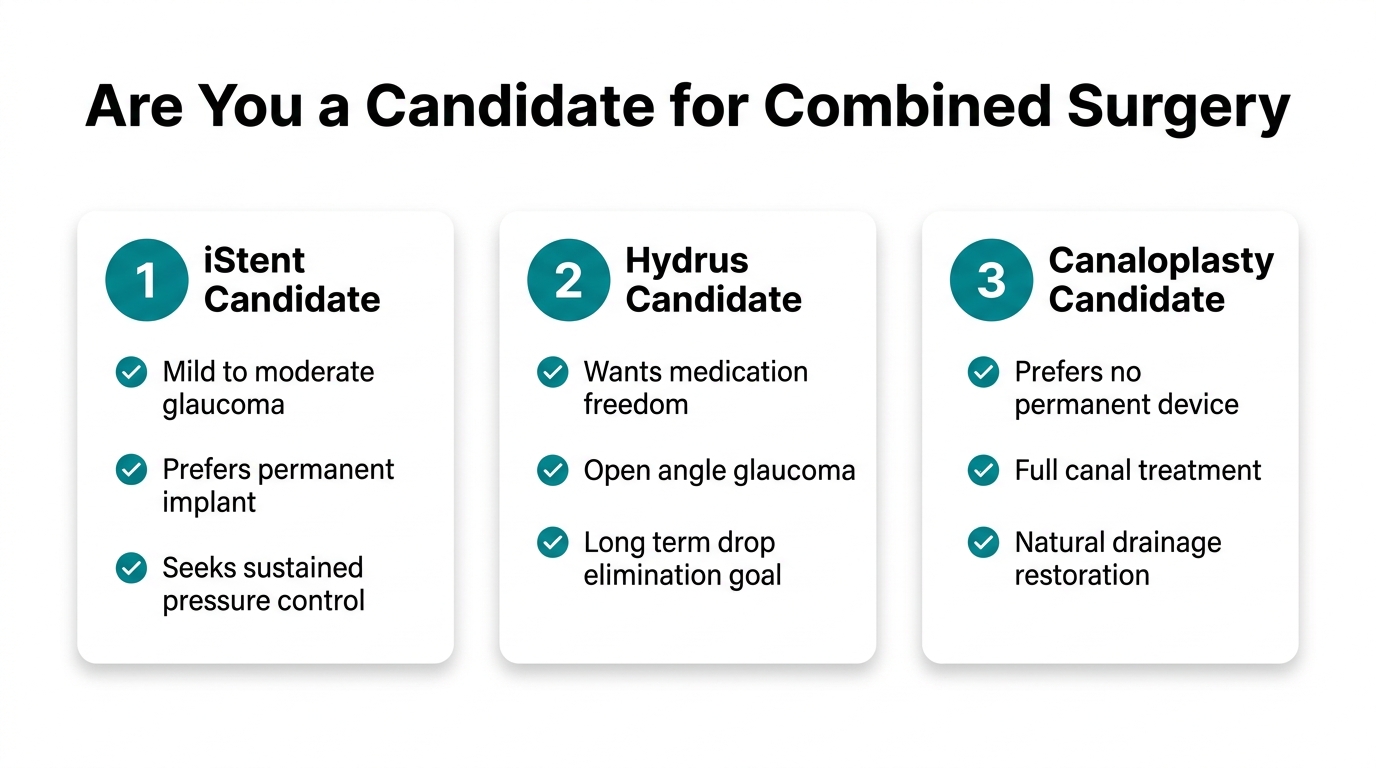
A good candidate for iStent with cataract surgery may be a patient with mild to moderate open-angle glaucoma seeking sustained IOP reduction alongside cataract removal. A retrospective comparative chart review published in Graefe’s Archive for Clinical and Experimental Ophthalmology found that combined cataract surgery with iStent inject W implantation produced a median IOP reduction of 4 mmHg at 3, 6, and 12 months, a result statistically significantly larger than cataract surgery alone. Patients who prefer a permanent, trabecular-based implant and want measurable pressure control over time may be particularly well-suited.
Who May Be a Good Candidate for Hydrus with Cataract Surgery?
A good candidate for Hydrus with cataract surgery may be a patient with open-angle glaucoma who prioritizes long-term freedom from glaucoma eye drops. According to the HORIZON trial, published in Ophthalmology, 66% of eyes treated with the Hydrus Microstent combined with cataract surgery were medication-free at 5 years, compared to 46% in the cataract-surgery-alone group. The Hydrus received FDA approval in August 2018, supported by this pivotal 5-year dataset. Patients motivated to reduce or eliminate daily drop regimens may find this device especially compelling.
Who May Be a Good Candidate for Canaloplasty with Cataract Surgery?
A good candidate for canaloplasty with cataract surgery may be a patient who prefers a procedure that leaves no permanent implant in the eye. Ab interno canaloplasty (ABiC) uses a microcatheter to viscodilate the entire 360 degrees of Schlemm’s canal, restoring the eye’s natural drainage pathway without a stent remaining in place. This approach may suit patients with concerns about long-term implant presence or those whose anatomy makes trabecular stenting less predictable. Discussing individual anatomy and glaucoma severity with a surgeon is essential before choosing any MIGS option.
What Should You Expect Before, During, and After the Procedure?
Before, during, and after combined cataract and MIGS surgery, patients can expect a streamlined experience closely resembling standard cataract surgery, with added steps for the glaucoma component. The sections below cover pre-operative preparation, the intraoperative process, and post-operative recovery.
What Happens Before Combined Cataract and MIGS Surgery?
Before combined cataract and MIGS surgery, your ophthalmologist will conduct a thorough pre-operative evaluation that includes measuring intraocular pressure, assessing glaucoma severity, and confirming your candidacy for a specific MIGS device. Imaging of the anterior segment and a review of your current glaucoma medications are typically part of this workup. You may be advised to continue, pause, or adjust your eye drops depending on surgical timing. Fasting instructions and arrangements for transportation home are standard requirements, consistent with any outpatient eye procedure.
What Happens During Combined Cataract and MIGS Surgery?
During combined cataract and MIGS surgery, the surgeon performs phacoemulsification first to remove the cloudy lens and implant an intraocular lens, then proceeds with the MIGS component through the same small corneal incision. For iStent or Hydrus implantation, a gonioscopic lens is used to visualize the trabecular meshwork, and the device is precisely placed into Schlemm’s canal. For ab interno canaloplasty, a microcatheter viscodilates the full 360 degrees of the canal. The entire combined procedure typically takes only modestly longer than cataract surgery alone and is performed under local anesthesia with sedation.
What Happens After Combined Cataract and MIGS Surgery?
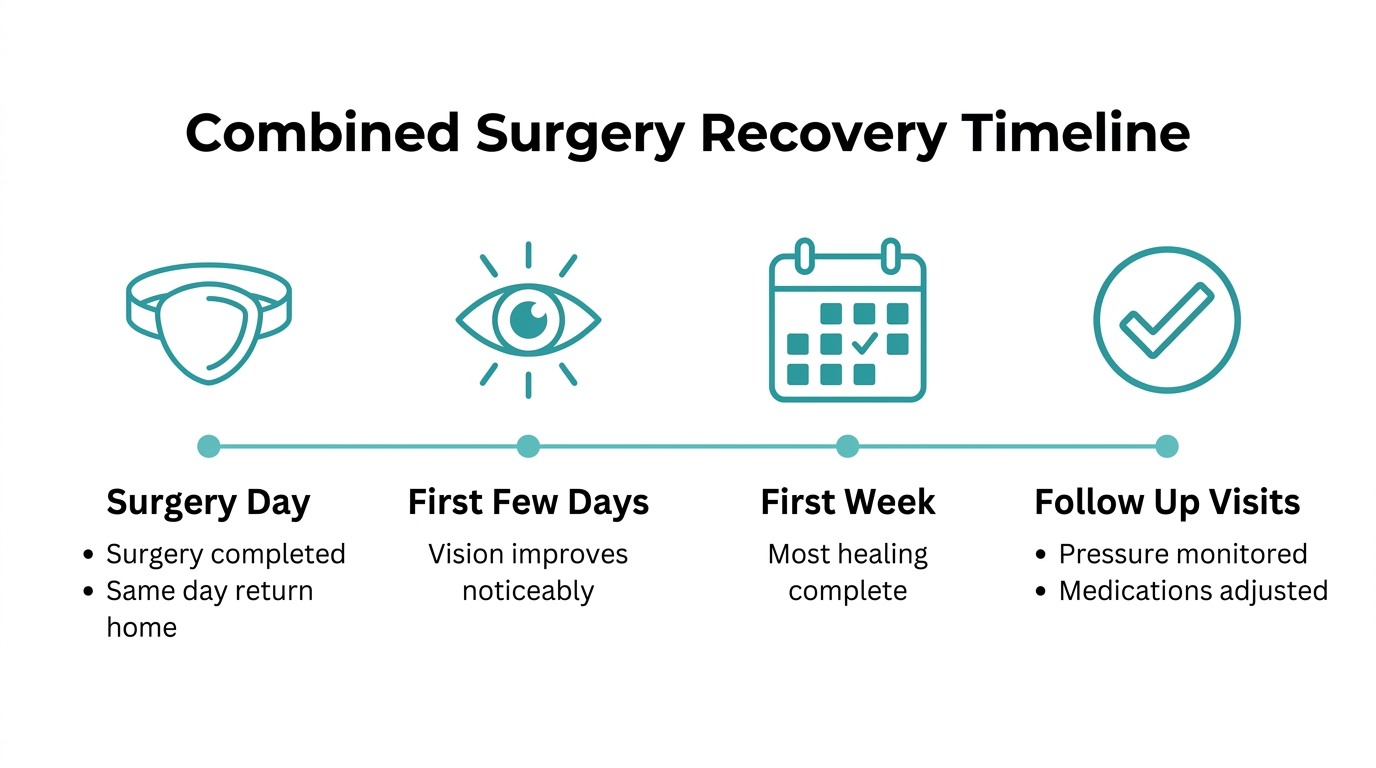
After combined cataract and MIGS surgery, recovery closely mirrors that of cataract surgery alone. According to a surgical recovery resource published by I Can See Clearly, most patients notice significant improvement in vision within the first several days, and the recovery trajectory for combined cataract-MIGS surgery is very similar to cataract surgery alone. Post-operative care typically includes antibiotic and anti-inflammatory eye drops, a protective eye shield overnight, and follow-up visits to monitor both vision and intraocular pressure. Your surgeon will reassess your glaucoma medication regimen at these visits, as IOP reductions from the MIGS procedure may allow for a reduction in drops over time.
How Long Does Recovery Take After Combined Cataract and MIGS Surgery?
Recovery after combined cataract and MIGS surgery is generally rapid, owing to the minimally invasive nature of MIGS procedures. According to the American Academy of Ophthalmology, MIGS is characterized by minimal trauma to ocular tissue, an excellent safety profile, and rapid recovery. Most patients experience a timeline similar to cataract surgery alone, with vision improving noticeably within the first several days.
Does Insurance Typically Cover MIGS Combined with Cataract Surgery?
Insurance coverage for MIGS combined with cataract surgery varies by payer and procedure type. The sections below explain how Medicare and commercial insurers typically handle billing for iStent, Hydrus, and canaloplasty.
How Does Medicare Cover MIGS Procedures?
Medicare coverage for MIGS procedures depends on the specific CPT code billed and the device used. According to CMS, Medicare may cover only 1 unit per eye, per date of service for CPT codes 66991 and 66989, which apply to the insertion of glaucoma drainage devices. This means bilateral implantation of multiple stents in a single session may not receive additional reimbursement under Medicare.
The AMA also added a temporary Category III code, 0671T, for insertion of anterior segment aqueous drainage devices into the trabecular meshwork. This code represents Hydrus, iStent, iStent inject, and iStent infinite. Coverage under Category III codes is generally not guaranteed and varies by payer, making pre-authorization an important step before surgery.
Does Commercial Insurance Cover MIGS with Cataract Surgery?
Commercial insurance coverage for MIGS combined with cataract surgery is not uniform across payers. Many commercial insurers follow coverage policies tied to FDA approval status and published clinical evidence for each device. Coverage decisions can also depend on the patient’s documented glaucoma severity, prior medication history, and whether the procedure meets the insurer’s medical necessity criteria.
Patients considering combined surgery should request a benefits verification and prior authorization from their insurer before scheduling. Understanding the specific billing codes used by the surgical team can help clarify what portion of the procedure may be covered and what cost-sharing the patient should anticipate.
How Can You Decide Which MIGS Option Is Right for You?
Deciding which MIGS option is right for you depends on your glaucoma severity, medication burden, eye anatomy, and whether a permanent implant is acceptable. The H3s below outline how Eye Surgery Today can guide that decision and summarize the key clinical takeaways.
Can Eye Surgery Today Help You Understand Your MIGS Options?
Yes, Eye Surgery Today can help you understand your MIGS options by translating complex comparative clinical data into clear, surgeon-reviewed guidance. Choosing between iStent, Hydrus, and canaloplasty involves weighing IOP targets, implant preferences, and individual eye characteristics. The AMA has even assigned a dedicated Category III code (0671T) covering trabecular meshwork drainage devices including Hydrus, iStent, iStent inject, and iStent infinite, reflecting how clinically distinct these options have become. Eye Surgery Today bridges that complexity, equipping you with the knowledge to have a more informed conversation with your surgical team.
What Are the Key Takeaways About Cataract Surgery with iStent, Hydrus, or Canaloplasty?
The key takeaways are that each device offers a meaningfully different efficacy and anatomical profile, and the right choice depends on your specific clinical situation. According to a systematic review and meta-analysis published in BMJ Open, the Hydrus Microstent showed a higher probability of being the best treatment for IOP reduction compared to both the 1-iStent and 2-iStent groups (0.60 vs. 0.11, respectively). In a direct comparison, Hydrus lowered IOP 3.1 mmHg more than iStent alone. However, a study presented at AGS 2025 suggested iStent may be slightly more efficacious in pseudophakic eyes and in SLT-naive eyes, indicating that patient history matters. Canaloplasty remains valuable for those who prefer no permanent implant. No single device is universally superior; the best MIGS option is the one matched to your glaucoma stage, prior treatments, and anatomical suitability.